
Why Auto Insurance Commercial Use Matters for Your Business
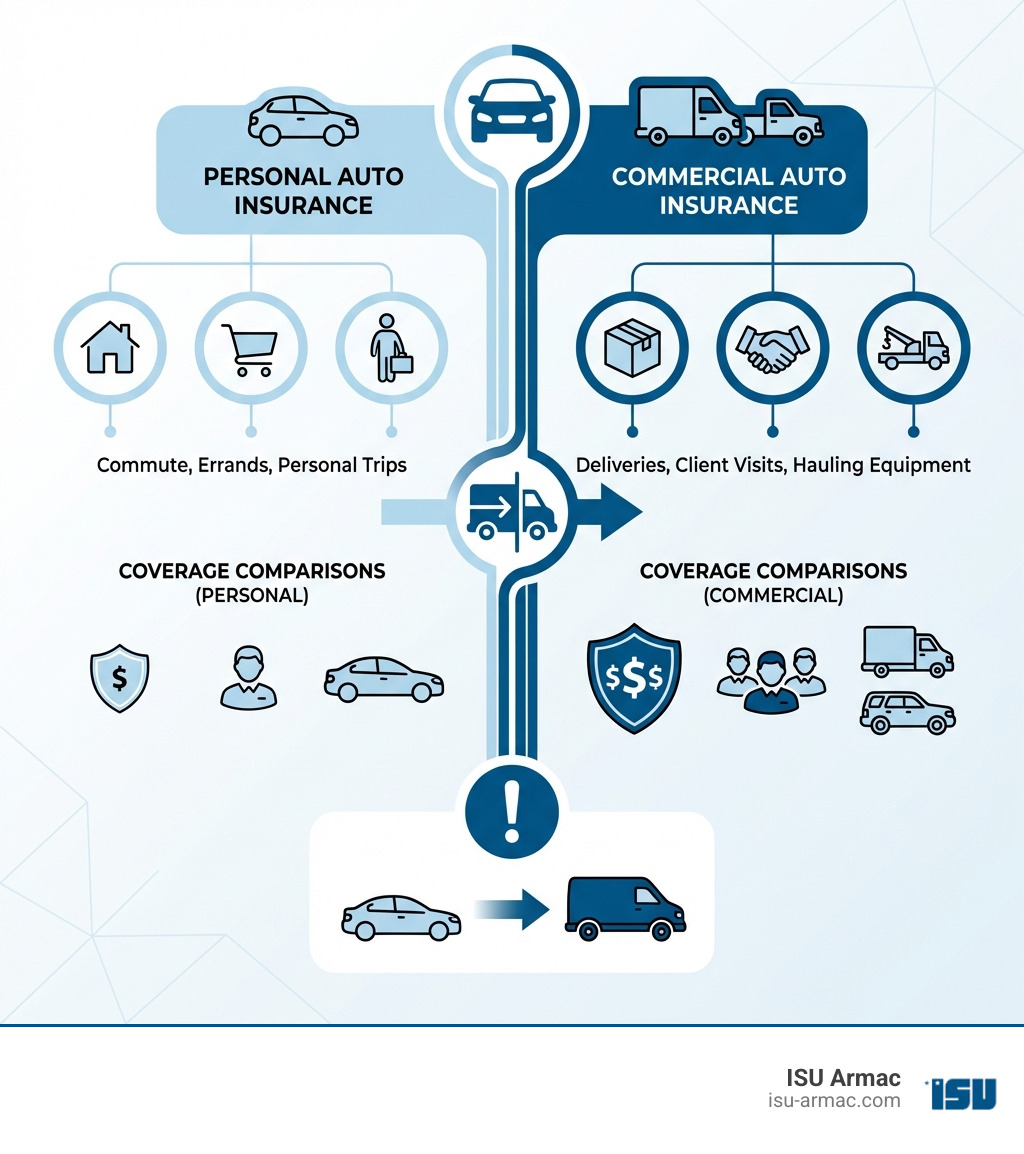
Auto insurance commercial use refers to coverage for vehicles used for business operations—like making deliveries, visiting clients, or hauling materials. If you use a vehicle for work, here’s what you need to know.
Quick Answer: Do You Need Commercial Auto Insurance?
- Personal auto policies don’t cover business use: Most personal policies exclude accidents that occur while using your vehicle for work.
- You need commercial coverage if you:
- Own a business vehicle (registered to your company).
- Transport goods or people for a fee.
- Haul work-related equipment or tools.
- Have employees who drive for your business.
- Use your personal vehicle regularly for business purposes.
- Commercial policies are more expensive: While costs vary, industry averages often exceed $1,500 per year.
- But they offer higher limits: Commercial policies provide broader coverage for business-related risks and multiple drivers.
The difference between personal and commercial coverage isn’t just about price—it’s about protection. Using a personal policy for business activities can lead to denied claims, leaving you personally responsible for damages and legal fees. In almost every state, commercial auto insurance is legally required if you drive for business.
As Ryan McEachron, CEO of ISU Insurance Services ARMAC Agency in Victorville, I’ve helped countless local business owners protect their operations with the right auto insurance commercial use coverage. Whether you’re a contractor hauling equipment across San Bernardino County or a small shop making local deliveries, understanding your coverage options is essential to keeping your business moving safely.
Relevant articles related to auto insurance commercial use:
- personal auto insurance
- does auto insurance follow the car or the person
- personal auto insurance for uber drivers
Understanding the Fundamentals: Commercial vs. Personal Auto Insurance
When we talk about auto insurance commercial use, we are diving into a world distinctly different from personal car insurance. It is a common misconception that a personal policy covers you no matter how you use your vehicle, a belief that can lead to significant financial hardship for businesses in Southern California, from Apple Valley to Oak Hills.

Commercial auto insurance is designed to cover losses if you or an employee are in an accident while driving for work. This includes delivering goods, meeting clients, or transporting equipment. Unlike personal policies, commercial policies anticipate higher mileage and greater potential for liability claims, so they come with higher liability limits and specialized protections.
Most personal auto policies explicitly exclude business use. If you are in an accident while making a work-related delivery with only a personal policy, your claim could be denied, leaving you personally responsible for all costs. For a deeper, third-party overview of how these policies generally work nationwide, the Insurance Information Institute offers a helpful primer. For a focused look at how this applies to your situation, we recommend reading our guide: Do I need both commercial and personal auto insurance?.
Commercial auto insurance is more expensive than personal coverage because it covers higher risks. For more detailed information, check out this external resource from the Insurance Information Institute.
When is a Commercial Policy Required?
If your vehicle is primarily used for business, you likely need a commercial policy. Here are key scenarios where auto insurance commercial use coverage is essential for businesses in places like Victorville and Hesperia:
- Business-owned vehicles: If a vehicle is titled in your business’s name, a commercial policy is required.
- Transporting goods or people for a fee: This includes delivery, catering, or ride-sharing services.
- Hauling work-related equipment: Contractors, landscapers, and other tradespeople who transport tools or materials need commercial coverage.
- Employee drivers: If employees drive company vehicles, or even their own cars for work, your business needs commercial auto insurance to cover liability.
- Contractual requirements: Many clients require you to carry specific commercial auto liability limits as part of your contract.
If you are wondering, “Does my personal auto insurance cover business use?”, the answer is usually no. We have a comprehensive article addressing just that: Does my personal auto insurance cover business use?.
Key Differences from Your Personal Policy
Understanding the core distinctions between personal and commercial auto policies is key to ensuring your business is protected.
- Coverage limits: Commercial policies offer significantly higher liability limits (for example, $1 million or more) because business-related accidents can result in more severe damages and higher legal costs.
- Covered individuals: Personal policies cover the named insured and family members. Commercial policies cover the business owner, listed employees, and other authorized drivers.
- Covered vehicles: Commercial policies cover a wide array of vehicles, including work vans, box trucks, dump trucks, and food trucks, which are not covered by many personal policies.
- Cost comparison: The higher cost of commercial auto insurance is justified by the increased risk exposure and higher coverage limits it provides.
- Policy exclusions: Personal policies exclude business use, while commercial policies have their own exclusions, such as intentional damage or unattached personal belongings.
For a comprehensive comparison, explore our detailed guide: Navigating Business Auto Insurance: A Comprehensive Comparison Guide.
What’s Covered? A Deep Dive into Your Commercial Policy
A robust commercial auto insurance policy is a financial safeguard for your business, protecting you from the costs of vehicle repair, replacement, or rental after a covered incident. Let’s look at the essential components of auto insurance commercial use coverage:
- Liability coverage: The cornerstone of your policy, this covers bodily injury and property damage to others if you or an employee cause an accident while driving for business.
- Collision coverage: This pays for damages to your business vehicle if it hits another vehicle or object, or if it overturns, protecting your investment in your work vehicles.
- Comprehensive coverage: This protects your business vehicle from non-collision events, such as theft, vandalism, fire, or natural disasters.
- Uninsured/underinsured motorist (UM/UIM): This protects you if you’re in an accident with a driver who has no insurance or not enough to cover the damages. It can also cover hit-and-run incidents.
- Medical payments (MedPay) or Personal Injury Protection (PIP): These cover medical expenses for you, your employees, and passengers, regardless of who is at fault.
- Contractual liability requirements: Commercial policies are structured to meet the high liability limits often required by client contracts, offering combined single limits (CSL) for both bodily injury and property damage.
Understanding these coverages is the first step to protecting your business. For a more detailed explanation, refer to our article: What does commercial auto insurance cover?. To grasp the mechanics, our guide on How does commercial auto insurance work? is an excellent resource.
Vehicles, Drivers, and Property Protection
Your auto insurance commercial use policy is customized to cover the specific vehicles and drivers essential to your operations.
Here’s a list of vehicles typically covered under a commercial auto policy:
- Cars, SUVs, and vans
- Box trucks and food trucks
- Utility trailers and cargo trailers
- Specialized vehicles like service utility trucks
Commercial policies are designed to cover your employee drivers when they operate a covered vehicle for business. It’s crucial that all regular drivers are named on your policy. While some policies offer “permissive use” for occasional, unlisted drivers, it’s always best to be transparent with your insurer. In the event a commercial vehicle is stolen or damaged, your comprehensive and collision coverages apply. Filing a claim involves contacting your insurer promptly to start the process.
For businesses utilizing a range of vehicles, our dedicated page provides more insights: Auto Insurance for Commercial Vehicles. And if you’re wondering about your trailers, we’ve got you covered: Are trailers covered under commercial auto insurance?.
Are My Tools and Equipment Covered?
This is a critical question for many businesses in trades or construction. When it comes to auto insurance commercial use, there’s an important distinction:
- Tools and materials exclusion: A standard commercial auto policy covers the vehicle itself but generally excludes the tools, equipment, or materials you transport inside it.
- Inland marine insurance: To protect your gear while in transit or at a job site, you’ll need a separate policy known as inland marine insurance (or tools and equipment insurance).
- Permanently attached equipment: Equipment permanently attached to your vehicle, like a ladder rack or snow plow, is typically covered under your commercial auto policy’s physical damage section.
This is a significant coverage gap for many businesses. We often recommend bundling your commercial auto insurance with other policies, such as Commercial General Liability Insurance California.
Decoding the Price Tag: Factors Affecting Your Auto Insurance Commercial Use Premiums
The cost of auto insurance commercial use varies significantly and is almost always higher than personal car insurance due to increased risks. Understanding what influences your premiums can help you make informed decisions.

While costs vary widely, many small businesses can expect to pay over $1,500 annually for commercial auto insurance. Industry surveys and national data sources such as the National Association of Insurance Commissioners indicate that commercial auto rates have generally trended upward in recent years due to rising repair costs and claim severity. Your actual cost will depend on a multitude of factors:
- Industry risk: Some industries inherently carry more risk. For instance, a contractor or delivery service will likely have higher premiums than an accountant who only drives to occasional client meetings.
- Vehicle type and weight: A heavy-duty truck or a specialized box truck will cost more to insure than a standard sedan used for business.
- Driving distance and usage: How often and how far your vehicles are driven for business directly impacts the risk profile. More mileage generally means higher premiums.
- Employee driving records: The driving history of all employees who operate your vehicles is a major factor. A history of accidents or violations can significantly increase your rates.
- Claims history: Your business’s past insurance claims directly affect future premiums. Frequent or costly claims signal higher risk to insurers.
- Coverage limits and deductibles: Higher liability limits increase your premium, while a higher deductible can lower it.
For a deeper dive into the financial aspects, our article How much does commercial auto insurance cost? provides valuable insights.
How Your Business Operations Impact the Cost of Auto Insurance Commercial Use
The nature of your business is central to determining the cost of your auto insurance commercial use policy.
- Type of business: Different industries present different risk levels. A landscaping business with heavy machinery will have different costs than a consultant using their car for client visits.
- Number of vehicles: The more vehicles in your fleet, the higher your overall premium. Businesses with multiple vehicles may qualify for fleet insurance.
- Business location: Where your business operates can influence rates. Urban areas like Victorville, with higher traffic density, may see higher premiums than less populated areas like Oak Hills. To understand local nuances, you might find our page on California Business Insurance Rates insightful.
- How vehicles are used: A vehicle used to transport hazardous materials will have a higher premium than one used for office supply runs.
Understanding these factors is crucial for managing your insurance budget. You can find more information in our article: Cost of Commercial Auto Insurance.
Driver and Policy Factors That Influence Your Rate
Beyond the vehicle and business type, the individuals behind the wheel and your policy specifics are major determinants of your auto insurance commercial use premiums.
- Driver experience: More experienced drivers with clean records typically result in lower premiums.
- Driving records (MVR): The Motor Vehicle Record (MVR) for every driver is thoroughly checked. Accidents, traffic violations, and DUIs can substantially increase your rates.
- Claims history: A history of at-fault accidents will be viewed as a higher risk by insurers.
- Policy limits: Higher liability limits provide more protection but also increase the premium.
- Deductible choice: A higher deductible can lower your premium, but ensure it is an amount your business can comfortably afford in the event of a claim.
For businesses with drivers who have less-than-perfect records, our guide on Best High Risk Auto Insurance offers some strategies.
Navigating the Gray Area: Personal Use of Commercial Vehicles
One of the most frequent questions about auto insurance commercial use is about using a commercial vehicle for personal errands. You’ve finished a job in Apple Valley and need to pick up groceries on the way home. Are you covered? The answer is: it depends.
Here’s a table comparing common examples to illustrate the distinction:
| Business Use Examples | Personal Use Examples |
|---|---|
| – Driving to a client meeting | – Commuting to and from work (without business stops) |
| – Making deliveries | – Picking up groceries |
| – Transporting tools or equipment to a job site | – Taking the kids to school |
| – Driving between different work locations | – Going on vacation or personal road trips |
| – Visiting suppliers or picking up inventory | – Running personal errands (bank, post office, etc.) |
Many commercial policies allow for some incidental personal use, like stopping for lunch during a work trip. However, regular personal use, like using the company van for family vacations, usually falls outside standard commercial coverage. The key is transparency with your insurance provider. Some policies can be structured to allow for personal use, which is a benefit for small business owners. To learn more, explore our article: Does commercial auto insurance cover personal use?.
Understanding Coverage for Auto Insurance Commercial Use Outside of Work
The specifics of whether your auto insurance commercial use policy extends to personal activities hinges on the policy language.
- Policy language: Always review your policy documents. Some explicitly define “incidental personal use” and what is prohibited. Ask your agent for clarification if you’re unsure.
- Permissive use: This clause might offer coverage for an unlisted driver, like a spouse, who has your permission to drive the vehicle. However, this is usually for occasional, not regular, use.
- Owner vs. employee use: Business owners often have more flexibility than employees when it comes to personal use of commercial vehicles.
- Family member driving rules: If a family member needs to drive a commercial vehicle, they generally need to be an authorized driver listed on the policy.
To dig deeper into the nuances, our comprehensive guide, Commercial Vehicle Private Use Complete Guide, offers invaluable information.
The Risks of Uncovered Personal Use
Ignoring the distinction between business and personal use can lead to severe consequences. The risks of using a commercial vehicle for personal errands without proper coverage are significant:
- Claim denial: Your insurer can deny the claim if an accident occurs during unapproved personal use, leaving you to pay all costs out of pocket.
- Personal liability: Without insurance, you could be personally liable for hundreds of thousands of dollars in property damage and injury claims.
- Lawsuits against the business: An accident involving an uninsured vehicle can lead to lawsuits that jeopardize your business assets.
- Policy cancellation: Misrepresenting vehicle use could lead to your policy being canceled, making it difficult and expensive to secure new coverage.
- Financial consequences: You could face fines and license suspension for not meeting state minimum liability requirements if your policy is deemed invalid.
In short, a quick personal errand can turn into a financial disaster if your coverage isn’t in order. It’s not worth the risk.
Frequently Asked Questions about Commercial Auto Insurance
We understand that auto insurance commercial use can be complex, so we’ve compiled answers to some frequently asked questions to help clarify common concerns.
Can I buy commercial auto insurance as a standalone policy?
Yes, commercial auto insurance can be purchased as a standalone policy. However, we often recommend bundling it with other business policies, such as a Business Owner’s Policy (BOP) or general liability insurance. Bundling can offer several benefits:
- Cost savings: Many insurers offer discounts when you bundle multiple policies.
- Comprehensive protection: A standalone auto policy covers your vehicles, but a BOP or general liability policy protects against other risks like slips and falls or product liability.
- Streamlined management: Having multiple policies with one provider simplifies administration and claims.
At ISU Armac, we specialize in finding the right blend of coverages for your business. We recommend working with an ISU Armac independent agent to review the coverage needs of your business and help you find the right insurance product.
Are my commercial auto insurance premiums tax-deductible?
Yes, commercial auto insurance premiums are generally considered a legitimate business expense and are tax-deductible. This means you can typically subtract the cost from your taxable income, reducing your overall tax burden.
- Business expense: The IRS views necessary business insurance as an ordinary and necessary expense.
- Consult a professional: While generally deductible, it’s always best to consult with a qualified tax professional. They can provide specific guidance based on your business structure and current IRS guidelines.
For more information, our Write Off Commercial Auto Insurance Guide offers further details.
What happens if my commercial vehicle is stolen or damaged?
A comprehensive auto insurance commercial use policy is designed to protect your business in these scenarios.
- Comprehensive coverage: If your vehicle is stolen, vandalized, or damaged by non-collision events like fire or hail, this coverage pays for repairs or replacement up to its actual cash value (ACV).
- Collision coverage: If your vehicle is damaged in an accident with another vehicle or object, this coverage pays for the necessary repairs or replacement.
- Filing a claim: Contact your insurer as soon as possible to report the incident. A claims representative will guide you through the process.
- Actual Cash Value (ACV): In a total loss, your insurer typically pays the vehicle’s ACV, which is its replacement value minus depreciation for factors like age and mileage.
For businesses with larger vehicles, specific physical damage insurance is crucial. Learn more here: Physical Damage Insurance for Semi Truck Cost.
Conclusion: Securing the Right Coverage for Your Business
In the dynamic business landscape of Southern California, from the busy streets of Victorville to the growing communities of Apple Valley and Hesperia, ensuring your business vehicles are properly insured isn’t just about compliance; it’s about safeguarding your livelihood. We’ve explored the critical distinctions between personal and commercial auto insurance, highlighted the necessity of dedicated auto insurance commercial use policies, and digd into the various coverages that protect your assets, employees, and reputation.
Personal auto policies are simply not designed to cover business risks, and relying on them can lead to devastating financial consequences. Commercial auto insurance provides the higher liability limits, specialized protections, and broader coverage for vehicles and drivers that your business needs to operate safely and legally. From protecting your vehicles against theft and damage to covering liability in an accident, the right policy is an investment in your business’s future.
At ISU Armac, we pride ourselves on our expertise and our commitment to the local business community. We understand that every business is unique, and that’s why we don’t believe in one-size-fits-all solutions. Our strength lies in our ability to shop multiple carriers, leveraging our relationships to find you the best coverage at the most competitive rates. We’re here to help you steer the complexities of commercial auto insurance, ensuring you get custom coverage that truly meets your specific needs.
Don’t leave your business vulnerable on the road. Take the proactive step to protect your operations today.