
Understanding Business Insurance Costs in the Golden State
California business insurance rates vary significantly based on your industry, business size, and location, but small businesses typically pay between $42-$175 per month depending on the type of coverage. Here’s what you need to know about the average costs:
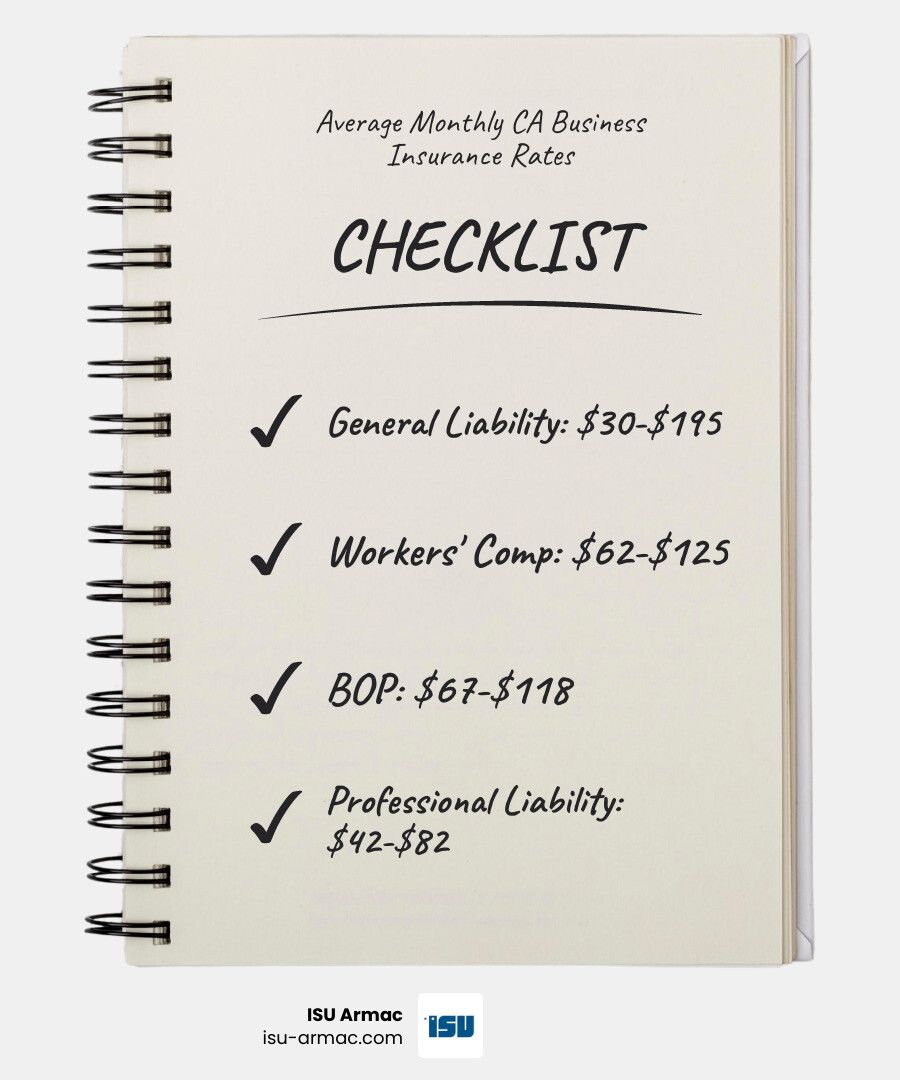
Average Monthly California Business Insurance Rates:
- General Liability: $30-$195 (sole proprietors vs. LLCs)
- Workers’ Compensation: $62-$125
- Business Owner’s Policy (BOP): $67-$118
- Professional Liability: $42-$82
- Commercial Auto: $574
California’s diverse economy – from tech startups in Silicon Valley to construction companies in the Central Valley – creates a wide range of insurance needs and costs. Whether you’re a sole proprietor running a consulting business or an LLC with 20 employees, understanding these rates helps you budget effectively and find the right coverage.
The state requires specific insurance types like workers’ compensation for businesses with employees, but many other coverages, while not legally mandated, are essential for protecting your business from lawsuits and unexpected losses.
I’m Ryan McEachron, CEO of ISU Insurance Services ARMAC Agency in Victorville, where I’ve helped High Desert businesses steer California business insurance rates for over two decades. My experience on the Victorville City Council and with local business organizations gives me unique insight into the insurance challenges facing California entrepreneurs.
Simple California business insurance rates glossary:
- what is small business insurance
- insurance needed for small business
- how to get small business insurance
What Are the Average California Business Insurance Rates?
When we talk about California business insurance rates, it’s important to understand that there isn’t a single, fixed price. Costs are highly individualized, reflecting the unique risks and operations of each business. However, we can provide average and median figures to give you a clearer picture of what to expect.
Understanding Average vs. Median Costs
You might hear both “average” and “median” costs, and it’s helpful to know the difference. The average cost is simply the sum of all prices divided by the number of prices. The median cost, on the other hand, is the middle value in a sorted list of prices. Why does this matter? Averages can be skewed by extremely high or low outliers. For example, if a few very large or high-risk businesses pay significantly more, the average might look higher than what most small businesses typically pay. The median often provides a more accurate picture of what a “typical” business might pay for their premium.
For instance, according to recent industry data, the median monthly cost of a business insurance policy can range from $42 for professional liability to $80 for workers’ compensation, while the average costs for these same policies could be higher due to the influence of larger or riskier accounts.
Average Costs by Policy Type
Let’s break down the typical monthly and annual costs for different types of business insurance in California, drawing from our extensive research:
- General Liability Insurance: This is a foundational policy for almost any business. It protects against claims of bodily injury, property damage, and advertising injury. For small businesses, the average cost can be around $42 per month, or about $500 annually. However, this can vary significantly. For example, sole proprietors in California might pay an average of $30 per month, while LLCs could see rates closer to $195 per month, reflecting different risk exposures and legal structures. Some sources indicate that nearly half of customers pay less than $45 per month for general liability.
- Workers’ Compensation: If you have employees in California, this is legally required. It covers medical expenses and lost wages for employees injured on the job. Most of our customers with less than $300,000 in payroll pay an average of $81 a month. For businesses with 20 employees, the average monthly cost is around $175. Overall, the average cost for workers’ compensation in California can range from $62 to $125 per month.
- Business Owner’s Policy (BOP): This is a popular option that bundles general liability, commercial property, and business interruption insurance into one convenient policy, often at a reduced rate. According to some industry reports, small business insurance customers paid an average of $141 per month, or $1,687 per year, for BOP coverage. Other data suggests median costs around $67 per month and averages around $118 per month.
- Professional Liability (E&O): Also known as Errors and Omissions (E&O) insurance, this protects businesses that provide professional services or advice against claims of negligence, mistakes, or inadequate work. The average cost for a standalone policy is around $62 per month and $744 per year. For certain industries in California, the average is around $82 per month. Median costs can be as low as $42 per month.
- Commercial Auto: If your business uses vehicles, whether owned or leased, for operations, you’ll need this. It covers accidents involving company vehicles. On average, our customers paid about $574 a month for commercial auto insurance coverage. This higher cost reflects the significant risks associated with vehicle use.
- Commercial Property: This protects your business’s physical location and its contents (equipment, inventory) from perils like fire, theft, or vandalism. Industry data shows that some customers pay about $1,605 a year, or $134 a month, on average.
- Cyber Insurance: As businesses become more digital, protecting against data breaches and cyberattacks is crucial. The average cost for cyber insurance can be around $1,827 annually.
Here’s a quick comparison of average monthly costs for different business structures in California:
| Policy Type | Sole Proprietor (Average Monthly) | LLC (Average Monthly) |
|---|---|---|
| General Liability | $30 | $195 |
| Workers’ Compensation | (N/A unless voluntarily covered) | $62 – $175 |
| Professional Liability | $42 – $82 | $42 – $82 |
Our goal is to help you find the most comprehensive coverage at the most affordable rates, whether you’re a sole proprietor or a growing LLC in Southern California.
Key Factors That Influence Your Insurance Premiums
Think of insurance premiums like a recipe – there are specific ingredients that go into creating your final rate. Insurance companies don’t just throw darts at a board to determine what you’ll pay. Instead, they use a careful risk assessment and underwriting process to evaluate your business and calculate premiums that reflect your unique situation.
Understanding these factors helps you see why California business insurance rates can vary so dramatically between businesses, even those in the same industry. More importantly, knowing what influences your rates gives you the power to potentially lower them.

Industry, Business Size, and Location
These three elements form the foundation of how insurers view your business risk. Let’s break down why each one matters so much.
Your industry is probably the biggest factor in determining your rates. A construction company faces very different risks than a graphic designer working from home. High-risk industries like construction, restaurants, and manufacturing deal with heavy equipment, hot surfaces, and lots of potential for accidents. These businesses naturally pay more for coverage.
On the flip side, low-risk industries like consulting, accounting, or freelance writing have fewer physical hazards. A consultant’s biggest risk might be spilling coffee on their laptop, while a roofer faces serious injury risks every day.
Business size affects your premiums in several ways. The number of employees on your payroll directly impacts workers’ compensation costs – more employees means more potential for workplace injuries. Your annual revenue and payroll size also matter because they indicate the scale of your operations and potential exposure to claims.
A solo consultant will pay much less than a company with 20 employees, even in the same industry. It’s simple math – more people means more opportunities for something to go wrong.
Location within California can make a surprising difference in your rates. Urban vs. rural locations each have their own risk profiles. A business in downtown Los Angeles faces different challenges than one in a small Central Valley town. Local crime rates, foot traffic, and even proximity to fire stations can influence your premiums.
Here in the High Desert, we see how location affects rates firsthand. A business in Victorville might pay different rates than one in Apple Valley, even though they’re just miles apart.
Policy Limits, Deductibles, and Claims History
These factors give you more control over your insurance costs, which is good news for budget-conscious business owners.
Policy limits are like the ceiling on how much your insurance will pay out. You’ll see per-occurrence limits (the max for each individual claim) and aggregate limits (the total max for your entire policy period). Higher limits provide better protection but cost more. It’s about finding the sweet spot between adequate coverage and affordable premiums.
Your deductible is the amount you pay before insurance kicks in. Choosing a higher deductible can significantly lower your monthly premiums. Just make sure you can comfortably afford that deductible if you need to file a claim.
Claims history is like your business’s report card in the eyes of insurers. A clean record with no previous claims shows you’re a lower risk. For workers’ compensation, this gets formalized through something called an Experience Modification Rate (EMR). A good EMR can lower your rates, while a poor one will increase them.
The best part? You can improve your claims history through smart risk management practices. Safety training, proper equipment maintenance, and creating a culture of safety all help keep claims low and premiums affordable.
What Business Insurance Is Legally Required in California?
Running a business in California means following specific insurance requirements that the state has put in place to protect workers and the public. These aren’t optional coverages you can skip to save money – they’re legal mandates with serious consequences for non-compliance, including hefty fines and potential jail time.
Understanding these requirements is crucial for staying compliant and avoiding costly penalties that could seriously impact your business operations and California business insurance rates.

Workers’ Compensation Insurance
If you have even one employee in California, workers’ compensation insurance isn’t just recommended – it’s the law. California state law requires virtually all employers to carry this coverage, which protects employees who get injured or become ill due to their work.
This insurance covers your employees’ medical bills and lost wages when they can’t work due to a job-related injury or illness. It’s designed to provide quick medical care and financial support without the need for lengthy legal battles to determine fault.
The requirements extend beyond traditional employees in certain situations. Some contractor rules are particularly strict – if you’re in construction trades like roofing, tree service, or HVAC work, you may need workers’ comp coverage even if you don’t have employees. You can either purchase traditional coverage or obtain a Certification of Self-Insurance if you meet specific financial requirements.
California doesn’t mess around with workers’ comp violations. Non-compliance is treated as a misdemeanor, with fines starting at $10,000 and potential jail time for business owners. We’ve seen businesses in the High Desert face serious financial hardship from these penalties, which is why we always ensure our clients understand and meet these requirements.
To help you understand potential costs, California provides a Workers’ Compensation Rate Comparison tool. These are base rates – your actual premium will depend on your specific industry, payroll, and claims history.
Commercial Auto Insurance
When your business owns, leases, or regularly uses vehicles for operations, commercial auto insurance becomes legally required. This coverage protects against financial losses from accidents involving your business vehicles, and California has set specific minimum requirements.
Your commercial auto policy must meet California’s minimum requirements of $15,000 for bodily injury per person, $30,000 for bodily injury per accident, and $5,000 for property damage per accident. While these are minimums, most businesses benefit from higher limits given today’s medical costs and lawsuit settlements.
Don’t assume your personal auto insurance covers business use – it typically doesn’t. If you’re using your personal vehicle for business activities and get into an accident, you could find yourself completely unprotected. This is where hired and non-owned auto coverage becomes valuable.
For businesses where employees use their personal cars for work – think delivery drivers, sales representatives, or service technicians – hired and non-owned auto coverage protects your business from liability when accidents occur. This coverage can often be added to your general liability policy or Business Owner’s Policy, making it an affordable way to close a potentially expensive coverage gap.
We help businesses throughout Southern California understand these requirements and find coverage that meets both legal mandates and practical protection needs without inflating their California business insurance rates unnecessarily.
How to Save Money on Your California Business Insurance
Nobody wants to pay more than they have to, especially for something as essential as insurance. While California business insurance rates can seem daunting, there are smart strategies to reduce your premiums without compromising on vital protection. We specialize in helping businesses in Oak Hills, Hesperia, and throughout Southern California find these savings.

Bundling Policies and Managing Risk
One of the most effective ways to save is to combine your coverages:
- Bundling Policies: Many insurers offer discounts when you purchase multiple policies from them. The most common bundle is a Business Owner’s Policy (BOP), which combines general liability, commercial property, and often business interruption insurance. This not only simplifies your insurance management but can also lead to significant savings, sometimes up to 25% or more. Paying your premium upfront for the entire year can also lead to discounts.
- Risk Management: A proactive approach to safety can directly lower your premiums. Insurers reward businesses that demonstrate a commitment to minimizing risks.
- Safety Programs: Implement comprehensive safety protocols and regular training for your employees. This reduces the likelihood of workplace accidents, which directly impacts your workers’ compensation and general liability costs.
- Workplace Safety: Maintain a clean, organized, and secure environment. For example, installing smoke detectors and burglar alarms can lower commercial property insurance rates. For general liability, keeping public areas safe can prevent slip-and-fall incidents.
- Reducing Hazards: Identify and mitigate specific hazards in your industry. For a restaurant, this might mean strict food handling procedures; for a construction company, rigorous equipment maintenance. A strong risk management plan can help you maintain a clean claims history, which is key to lower rates.
Comparing Quotes and Adjusting Coverage
The insurance market is competitive, and shopping around is crucial:
- Shopping Around: Don’t settle for the first quote you receive. Different insurers have different underwriting guidelines and target markets, which means their rates for the exact same coverage can vary significantly. We, as independent agents, have the unique ability to shop multiple carriers for you, ensuring you get the best coverage at the lowest rates. This is a core part of our service in Victorville and beyond.
- Adjusting Deductibles: As we discussed, choosing a higher deductible means you pay more out-of-pocket if a claim occurs, but your premium will be lower. Consider your business’s financial capacity to absorb a higher deductible in exchange for lower monthly costs.
- Reviewing Policy Limits: Re-evaluate your coverage limits periodically. As your business grows or changes, your needs might too. Ensure you’re not over-insured (paying for more coverage than you realistically need) or under-insured (leaving yourself vulnerable).
- Questions to Ask an Insurance Provider Before Buying:
- What factors specifically affect my California business insurance rates?
- Are there any discounts available for bundling policies or for implementing safety measures?
- What are the per-occurrence and aggregate limits for my general liability policy?
- What is the average deductible for businesses in my industry?
- How will my claims history impact my future premiums?
- Can you provide a detailed breakdown of what each policy covers and excludes?
- What is your process for handling claims?
- Do you offer “pay-as-you-go” options for workers’ compensation?
- How often should I review my policy to ensure it still meets my needs?
- Are there any California-specific regulations or requirements I should be aware of that might affect my coverage?
Frequently Asked Questions about California Business Insurance Rates
We get these questions all the time from business owners across the High Desert and Southern California. After helping hundreds of businesses steer their insurance needs, I’ve found these answers help clarify the most common concerns about California business insurance rates.
How does the number of employees affect my California business insurance rates?
Your employee count is like a multiplier for your insurance costs, especially when it comes to workers’ compensation and general liability coverage.
Workers’ compensation costs scale directly with your workforce. The system works on a per-$100-of-payroll basis, using classification codes that match the type of work your employees perform. A roofing company with five employees will pay significantly more than a consulting firm with the same number of people because of the different risk levels involved.
Here’s what really happens: as your team grows from just you to 20 employees, your workers’ comp premium can jump from zero (sole proprietors aren’t required to carry it) to several hundred dollars monthly. The exact amount depends on your industry’s risk classification and your total payroll.
General liability risk increases too, though not as dramatically. More employees mean more interactions with customers, more people working at client locations, and simply more opportunities for accidents to happen. An employee might accidentally damage a client’s property or someone could get injured at your business location. Insurance companies factor this increased exposure into your premium calculations.
The good news? Many insurers offer better rates per employee as you grow, recognizing that larger, established businesses often have better safety protocols and risk management practices.
What is the difference between general liability and professional liability?
Think of these two coverages as protecting different sides of your business coin. General liability covers the physical world, while professional liability protects your expertise and advice.
General liability insurance handles the tangible risks of running a business. If a customer slips on your wet floor and breaks their wrist, that’s general liability. When your delivery driver accidentally backs into a client’s fence, general liability steps in. It also covers advertising injury claims like someone saying your marketing materials copied their ideas or contained false statements.
This coverage is about bodily injury and property damage that happens because of your business operations. Nearly every business needs it because accidents happen, regardless of how careful you are.
Professional liability insurance, also called Errors and Omissions (E&O), protects businesses that provide professional services or advice. It covers claims of negligence, errors, or inadequate work in your professional duties.
For example, if you’re an accountant and make a calculation error that costs your client money in penalties, that’s professional liability territory. A marketing consultant whose campaign strategy fails to deliver promised results might face a professional liability claim. Software developers, architects, consultants, and similar service providers typically need this coverage.
The key difference: general liability covers accidents and physical incidents, while professional liability covers mistakes and failures in your professional judgment or services.
Where can I find official resources to compare insurance providers in California?
Smart shopping starts with reliable information, and California provides several official resources to help you make informed decisions about your business insurance.
The California Department of Insurance is your primary source for official information. They maintain an online sample rates comparison tool that, while focused mainly on personal insurance, gives you insight into how rates are structured and regulated in our state. They also provide detailed information about legally required coverages and operate consumer hotlines when you have questions about your rights or coverage requirements.
Before choosing any insurance company, check their financial stability ratings through independent rating agencies like AM Best. These ratings tell you whether an insurer has the financial strength to pay claims, especially during challenging economic times. You want an insurer that’ll be there when you need them most.
The California Department of Insurance also provides consumer complaint ratios, showing how often customers file complaints against different insurance companies. This data helps you understand which insurers provide better customer service and claims handling.
For workers’ compensation specifically, California offers a rate comparison tool that shows manual base rates by classification code, though your actual rates will vary based on your specific business factors and claims history.
As independent agents, we use these official resources alongside our industry relationships to help you steer the options and find the coverage that makes sense for your business and budget.
Find the Right Coverage at the Best Rate
You’ve made it through the maze of California business insurance rates, and now you’re armed with the knowledge to make smart decisions for your business. Whether you’re running a small consulting firm in Apple Valley or managing a growing construction company in Victorville, understanding these rates isn’t just about compliance—it’s about protecting everything you’ve worked to build.
Here’s what we’ve learned together: every business has its own insurance fingerprint. Your industry risk level, the number of employees on your payroll, your location within California, and even your claims history all work together to create your unique premium calculation. A restaurant owner in Los Angeles will have different needs and costs than a graphic designer working from home in the High Desert.
The good news? You’re not stuck with whatever rate gets thrown your way. California business insurance rates can be managed through smart choices like bundling policies into a Business Owner’s Policy, maintaining excellent safety programs, and yes—shopping around for the best deal.
This is where our role as independent agents becomes your advantage. We’re not tied to just one insurance company trying to sell you their products. Instead, we have relationships with multiple carriers, which means we can compare options side by side and find coverage that fits both your protection needs and your budget. It’s like having a personal shopper, but for insurance.
Don’t let the complexity of insurance requirements overwhelm you or delay your decision. Every day your business operates without proper coverage is a day you’re taking unnecessary risks. The cost of the right insurance policy is always less than the potential cost of being uninsured when something goes wrong.
Ready to stop worrying about insurance and start focusing on growing your business? Get a comprehensive business insurance quote from ISU Armac today. We’ll handle the complicated stuff so you can get back to doing what you do best—running your business.