
Understanding the Complexities of Commercial Vehicle Private Use
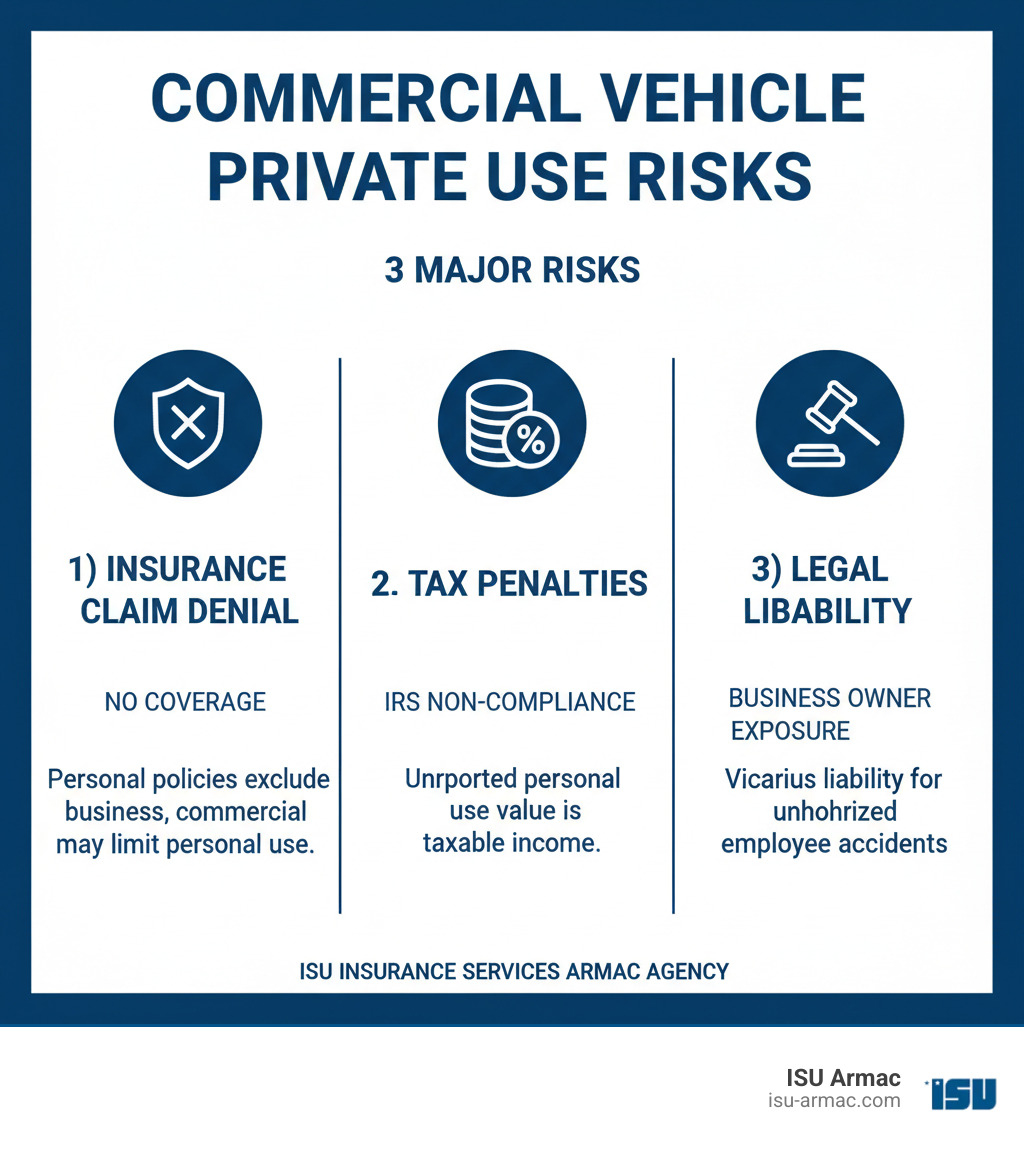
Commercial vehicle private use creates a tricky situation. Using a work truck for a family dinner or weekend errand seems convenient, but it opens up a maze of insurance gaps, tax implications, and legal risks.
Here’s what you need to know:
- Insurance Gaps: Personal auto policies typically won’t cover accidents in a company vehicle. You need a commercial policy that explicitly permits personal use.
- Taxable Income: The IRS treats personal use of a company vehicle as a taxable benefit to the employee.
- Legal Compliance: Vehicles over 10,001 pounds must often comply with DOT/FMCSA regulations, even for personal trips.
- Company Policies: Businesses need clear, written rules about who can drive company vehicles and for what purposes.
Many business owners assume ownership grants them unlimited use, but insurance companies and tax authorities disagree. Without proper planning, you could face denied claims, unexpected tax bills, or personal liability. The good news is that the right insurance and clear policies allow for safe use of your commercial vehicle for both business and personal needs.
I’m Ryan McEachron, CEO of ISU Insurance Services ARMAC Agency in Victorville. With over 25 years of experience, I’ve helped countless business owners steer commercial vehicle insurance. This guide will walk you through what you need to know to stay protected and compliant.
Defining the Line: What Counts as Commercial vs. Personal Use?

The line between commercial and personal vehicle use is more nuanced than it seems. A commercial vehicle is one used primarily for work, like transporting goods or equipment. This includes obvious vehicles like delivery vans, but even a standard pickup can be classified as commercial if its main purpose is business. Vehicle weight (over 10,001 pounds) or registration in a business’s name also typically designates it as commercial.
Personal use is any driving not directly related to business operations. This includes your daily commute, weekend trips to the hardware store, or stopping for groceries on the way home. Even minor personal errands during the workday, which the IRS calls “de minimis use,” can have tax and insurance implications. While there’s no hard limit on personal use, every personal mile reduces your potential tax deductions and may create taxable income for employees. For more details, see our Navigating Business Auto Insurance: A Comprehensive Comparison Guide.
What is Considered Personal Use?
The rule is simple: any driving that doesn’t further your employer’s business is personal.
- Commuting Miles: Driving from home to your regular workplace and back is personal use. The IRS views getting to work as a personal expense.
- Personal Errands: Side trips to pick up a child from school, grab lunch, or run to the dry cleaner are all personal use.
- Use by Family Members: If a spouse or child borrows the company vehicle, it’s personal use and creates significant liability exposure unless they are explicitly covered.
- Vacation Travel: Taking the work truck on a family camping trip is clearly personal use. The burden of proof is on the employee to document that travel was for business.
What is Considered Business Use?
Business use includes all driving directly connected to company operations, which helps maximize tax deductions.
- Travel Between Job Sites: Driving from one client’s location to another is a classic example of business use.
- Transporting Goods or Equipment: Hauling materials, delivering products, or moving tools for your business is commercial use.
- Client and Vendor Meetings: Driving to sales calls, networking events, or partner appointments qualifies as business use.
- Travel from a Home Office: If your home office is your principal place of business per IRS Publication 587, driving to client sites or temporary work locations may be considered business mileage.
The distinction is critical because only business use is tax-deductible. Meticulous record-keeping is essential.
The Insurance Puzzle: Covering Your Vehicle for Both Work and Play
Here’s where many business owners find they’re unprotected. You might assume your Commercial Auto Insurance covers a personal trip in the work truck, but that’s not always true. Most personal auto policies specifically exclude vehicles “furnished or available for your regular use,” meaning your personal policy won’t cover the company truck in your driveway.
This is why commercial vehicle private use requires a properly structured commercial policy. The policy must define permissive use (who can drive) and named insureds to avoid a massive coverage gap. The answer to “Does Commercial Auto Insurance Cover Personal Use?” depends entirely on your policy’s specific wording and endorsements. Commercial policies also offer much higher liability limits, which are crucial for protecting business assets.
Commercial vs. Personal Auto Insurance: Key Differences
Understanding these distinctions explains why you need the right coverage for commercial vehicle private use.
| Feature | Personal Auto Insurance | Commercial Auto Insurance |
|---|---|---|
| Covered Drivers | Policyholder and immediate family. | Can cover employees, named drivers, and permissive users. |
| Liability Limits | Lower, for individual risk. | Higher, for greater business exposure. |
| Vehicle Types | Standard cars, SUVs, personal trucks. | Vans, trucks, fleets, specialized vehicles. |
| Cost | Generally lower premiums. | Generally higher premiums. |
| Primary Use | Commuting, errands, leisure. | Business operations, transporting goods/people. |
Commercial insurance is built for business risks, offering broader driver coverage and higher liability limits to protect your business and personal assets from lawsuits. If you’re unsure of your needs, our guide on “Do I need both commercial and personal auto insurance?” can help.
Special Endorsements for Commercial Vehicle Private Use
Even a great commercial policy may need endorsements to cover commercial vehicle private use.
- Drive Other Car (DOC) Coverage: This endorsement (CA 99 10) extends liability protection to owners or executives who drive company cars for personal use and don’t have a personal auto policy. It’s essential for anyone relying solely on a company vehicle.
- Hired and Non-Owned Auto Insurance: This protects your business when employees use their personal vehicles for work errands or when you rent vehicles.
Family members driving company vehicles is extremely risky, as they are typically not covered. The safest approach is to prohibit this use entirely. If it’s unavoidable, you must speak with your agent to add them as named insureds. These details are critical; a simple endorsement can prevent a six-figure claim. To learn more, review our guide on What does commercial auto insurance cover?
The Tax Man Cometh: IRS Rules for Commercial Vehicle Private Use
Once you’ve handled the insurance, the IRS has its own rules. When employees use a company vehicle for personal reasons, the IRS considers it a taxable fringe benefit. The value of this personal use must be calculated and included in the employee’s wages as imputed income.
As an employer, you are responsible for withholding federal income tax, Social Security, and Medicare on this value and reporting it on the employee’s Form W-2. Failure to do so can lead to penalties for both the business and the employee. The IRS provides information on company provided automobiles to help employers comply.
How the IRS Values Personal Use for Taxable Income
The IRS provides several methods for valuing commercial vehicle private use.
- Annual Lease Value (ALV) Rule: This popular method uses an IRS table to find a vehicle’s annual lease value based on its Fair Market Value. You then multiply this value by the percentage of personal miles driven.
- Cents-per-Mile Rule: This simple method involves multiplying the total personal miles driven by the IRS standard mileage rate for that year. This can be used for vehicles under a certain value (currently $50,000) that are regularly used for business.
- Commuting Valuation Rule: If you have a written policy prohibiting all personal use except for commuting, you can value each one-way commute at just $1.50. This is the simplest but most restrictive method.
Record-Keeping for Tax Compliance
Solid record-keeping is the foundation of tax compliance for commercial vehicle private use. Without it, the IRS may assume all use is personal, leading to a larger tax bill.
You must maintain a log for every trip, including the date, odometer readings, total miles, and business purpose. While manual logs are acceptable, automated GPS tracking provides precise, tamper-proof records that streamline the process.
The burden of proof is on you to show that vehicle use was for business. Poor records can result in disallowed tax deductions, increased taxable income for employees, and IRS penalties. Establishing good habits from day one protects your business and your employees.
Staying Compliant: Legal, Regulatory, and Business Risks
Allowing commercial vehicle private use without proper oversight creates serious legal and business risks beyond insurance and taxes. If an employee has an accident during personal use, your business could be held responsible through vicarious liability, putting your business assets on the line.
There’s also the risk of reputational harm. A driver in a company-branded vehicle represents your business, and reckless behavior can damage your public image. Unmonitored personal use also leads to increased wear and tear, higher fuel costs, and a shorter vehicle lifespan.
Furthermore, if your vehicles have a Gross Vehicle Weight Rating (GVWR) of 10,001 pounds or more, they are subject to DOT and FMCSA regulations, even during personal use. While there are narrow exemptions for occasional personal transport, understanding these rules is key to compliance. The United States Department of Transportation offers comprehensive guidance.

Best Practices for Managing Commercial Vehicle Private Use
You can manage these risks with clear, written policies. A vehicle use policy is your rulebook for commercial vehicle private use, protecting both the company and its employees.
- Create a written policy defining authorized drivers.
- Clearly state permitted and prohibited uses (e.g., commuting allowed, weekend trips forbidden).
- Establish clear accident reporting procedures.
- Be transparent about GPS monitoring if used.
- Conduct regular driver record checks.
- Work with your insurance agent to ensure your policy covers all intended uses and consult an accountant on tax implications.
Can a Commercial Vehicle Be Converted for Personal Use?
Yes, you can convert a commercial vehicle for personal use, but it requires several steps. The process involves re-titling the vehicle with your local DMV to change its registration from commercial to private.
Crucially, you must inform your insurance carrier of the change and switch from a commercial policy to a Personal Auto Insurance policy. Be upfront about the vehicle’s history, as it may affect your rates. This change will also impact your taxes and fees, and some states may require a new inspection. While possible, weigh the costs, as commercial vehicles are often more expensive to maintain and insure than standard personal cars.
Frequently Asked Questions about Vehicle Use
Business owners and employees often have questions about the rules for commercial vehicle private use. The answers aren’t always intuitive, but getting them right is critical. Here are some of the most common questions we hear at ISU Armac.
Does my personal auto insurance cover me if I drive my work truck home?
Typically, no. Most personal auto policies exclude coverage for vehicles “furnished or available for your regular use.” Your insurer sees the company truck in your driveway as a business asset, not your personal car. Commuting in a work vehicle falls into a gray area. If you have an accident, your personal policy will likely deny the claim, and the business policy might too if you were off the clock. This could leave you personally liable for all damages. It is essential to have a commercial policy properly endorsed for this type of use.
Can my spouse or child drive the company van for an errand?
This is extremely risky unless you have taken specific steps to ensure they are covered. Most business auto policies do not automatically cover non-employee family members. An insurer underwrites your policy based on the risk of your employees driving, not your family. If your spouse causes an accident in the company van, your business and personal assets could be at risk. The safest policy is to prohibit family members from driving company vehicles. If it is absolutely necessary, they must be explicitly added as named insureds on your commercial policy.
What are the DOT rules for personal use of a large truck?
The Federal Motor Carrier Safety Administration (FMCSA) provides a narrow exemption for the “occasional transportation of personal property by individuals not for compensation.” This means if you use a large commercial truck to move your own furniture, for example, you may be exempt from Hours of Service (HOS) and Electronic Logging Device (ELD) rules for that specific trip.
However, this exemption is limited. Commercial Driver’s License (CDL) requirements still apply based on the vehicle’s weight (typically 26,001 pounds or more), regardless of use. The term “occasional” is also key; it does not cover regular personal use. State rules can also vary, so always verify requirements with your state’s motor vehicle department.
Conclusion
Navigating a commercial vehicle private use arrangement doesn’t have to be a headache. With proper planning and professional guidance, you can safely use a work vehicle for both business and personal needs.
To recap:
- Insurance is your foundation. A personal policy is not enough; you need a commercial auto policy with the right endorsements for personal use.
- Clear written policies protect everyone. Define who can drive, when, and for what purpose to limit liability.
- Tax compliance is mandatory. The IRS views personal use as a taxable benefit, and accurate record-keeping is essential.
- Legal and regulatory risks are significant. Understand DOT rules and vicarious liability to protect your business.
At ISU Armac, we help businesses in Victorville, Apple Valley, Hesperia, and throughout Southern California manage these challenges. We don’t just sell policies; we build relationships and find customized solutions by shopping multiple carriers. This ensures you get coverage that fits your unique situation.
The peace of mind from knowing you’re properly protected is priceless.
Ready to eliminate the uncertainty? Get a comprehensive Commercial Auto Insurance Quote Online today. We’ll review your needs and find the coverage that protects you completely for both business and personal use.