
Why Proper Insurance is Critical for Uber Drivers
Do I need commercial auto insurance for Uber? The short answer is yes, but the type you need depends on your driving frequency and state laws. Here’s what you need to know:
Quick Answer:
- Personal auto insurance is NOT enough as it excludes commercial use.
- Uber provides limited coverage with significant gaps and a high $2,500 deductible.
- Most drivers need a rideshare endorsement ($15-30/month) for their personal policy.
- Full-time drivers may need a full commercial auto policy for complete protection.
Driving for Uber is a popular way to earn income, but your personal auto insurance won’t cover you. Personal policies exclude coverage when your vehicle is used for business, which includes ridesharing.
While Uber provides some insurance, it has significant gaps. During “Period 1” (app on, waiting for a ride), Uber’s coverage is minimal. Even with a passenger, you face a $2,500 deductible on claims for your own vehicle.
Without proper coverage, you risk denied claims, personal liability for damages, and policy cancellation.
I’m Ryan McEachron, CEO of ISU Insurance Services ARMAC Agency in Victorville. With over two decades of experience, I’ve helped countless drivers steer complex insurance needs, including answering do I need commercial auto insurance for Uber.
Easy do i need commercial auto insurance for uber word list:
- when do i need commercial auto insurance
- what does commercial auto insurance cover
- do i need both commercial and personal auto insurance
Personal vs. Commercial Auto Insurance: What’s the Difference?

Understanding the difference between personal and commercial auto insurance is crucial when asking “do I need commercial auto insurance for Uber?”
Personal auto insurance covers everyday driving like commuting and errands. It’s not designed for making money with your vehicle and includes a business use exclusion. This clause means your coverage is void if you’re using your car to earn money, such as driving for Uber.
Commercial Auto Insurance, however, is designed for business use. It offers higher liability limits and broader protection to cover the increased risks of commercial activities. When you drive for Uber, your car is a commercial vehicle, which is why understand Does my personal auto insurance cover business use?.
Why Your Personal Policy Isn’t Enough
The business use exclusion in your personal policy can lead to a financial disaster. Insurers include this because commercial driving increases risk, and personal policies aren’t priced to cover it.
- Risk of Claim Denial: If you have an accident while driving for Uber, your personal insurer will likely deny the claim upon finding the commercial use. You would then be responsible for all costs.
- Policy Cancellation: Insurers often cancel policies entirely if they find undisclosed rideshare driving. This can make it difficult and more expensive to get coverage in the future.
- Personal Financial Liability: Without valid insurance, you are personally responsible for all damages, including medical bills, property damage, and legal fees. A single serious accident could jeopardize your savings, assets, and financial future.
Proper insurance is essential for protecting yourself. Fortunately, affordable solutions are available.
Understanding Uber’s Provided Insurance Coverage

Uber provides insurance for its drivers, but the coverage is contingent and varies across three distinct driving periods. Understanding these periods is crucial when asking do I need commercial auto insurance for Uber, as there are significant gaps and high deductibles. Uber’s official policy details can be found on their Insurance to help protect you page.
Period 0 & 1: Offline or Waiting for a Request
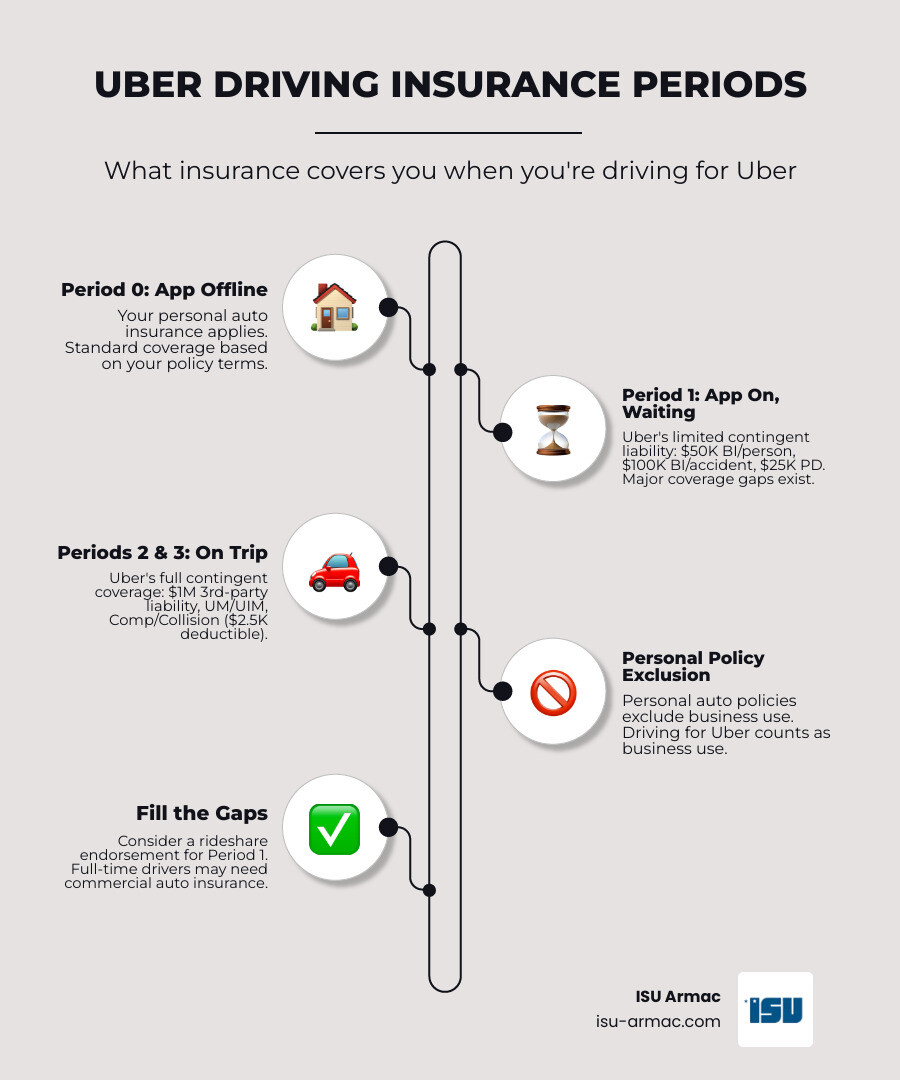
- Period 0 (App Off): Your personal auto insurance is your primary and only coverage. It functions as normal for personal driving.
- Period 1 (App On, Waiting for Request): This is the biggest insurance gap. Your personal policy no longer applies, and Uber provides only limited liability coverage: $50,000 per person for bodily injury, $100,000 total per accident for bodily injury, and $25,000 for property damage. Crucially, this does not cover damage to your own car or your own injuries.
This “Period 1 gap” is a major reason why drivers need supplemental insurance.
Period 2 & 3: En Route or On a Trip
Once you accept a ride (Period 2, en route to passenger) or have a passenger in the car (Period 3), Uber’s coverage increases significantly:
- $1 million in third-party liability coverage: This covers damage and injuries you cause to others.
- Uninsured/underinsured motorist coverage: Protects you if the at-fault driver has insufficient insurance.
- Contingent comprehensive and collision coverage: This covers damage to your own vehicle, but with two major caveats. First, you must already have this coverage on your personal policy. Second, you are responsible for a $2,500 deductible. This means you pay the first $2,500 for repairs out of pocket.
While the $1 million liability limit is substantial, the Period 1 gap and the high deductible in Periods 2 & 3 can leave you financially exposed.
So, Do I Need Commercial Auto Insurance for Uber?
The answer to “Do I need commercial auto insurance for Uber?” is yes, but the type of coverage depends on your needs. The goal is to fill the gaps left by your personal policy and Uber’s insurance to protect your assets. You can learn more about What does commercial auto insurance cover? to understand your options.
Why a Rideshare Endorsement is Often the Best First Step
For most part-time drivers, a rideshare endorsement is the ideal solution. This add-on to your personal policy is designed to fill coverage gaps, especially the critical Period 1 gap when you are online but waiting for a request.
- Protection: It extends your personal policy’s protection into the periods where Uber’s coverage is insufficient or non-existent.
- Affordability: A rideshare endorsement typically costs only $15 to $30 more per month, a small price for significant financial protection.
- Simplicity: It can usually be added to your current policy with a simple phone call.
When Do I Need Commercial Auto Insurance for Uber Instead of an Endorsement?
A full commercial auto policy may be necessary if your driving is more than a side hustle. Consider a commercial policy if you:
- Drive full-time for Uber: Your increased time on the road means higher risk, warranting more comprehensive protection.
- Live in a state with strict laws: Some states have requirements that an endorsement cannot meet.
- Use your vehicle primarily for business: If your car is more of a work tool than a personal vehicle, a commercial policy is more appropriate.
- Operate multiple vehicles or a fleet for ridesharing.
- Drive for premium services like Uber Black, which require drivers to carry their own commercial insurance.
Our Navigating Business Auto Insurance: A Comprehensive Comparison Guide can help you make the right choice for your situation.
The Risks and Costs of Driving Underinsured
Driving underinsured is a significant financial gamble. When asking “do I need commercial auto insurance for Uber,” you’re really asking how to protect yourself from financial ruin. The consequences of being improperly insured include:
- Claim Denial: Your personal insurer will deny claims for accidents that occur during commercial activity.
- High Out-of-Pocket Costs: Even when Uber’s policy applies, you face a $2,500 deductible for damage to your own car. Without coverage, you’re responsible for all repair costs.
- Legal Liability: In a serious accident, you could be held personally liable for medical bills, property damage, and legal fees, putting your personal assets like your home and savings at risk.
A rideshare endorsement is affordable at $15-$30/month, while a full commercial policy may cost $100-$300/month. This is a small investment compared to the potential cost of an accident. Learn more about the Cost of Commercial Auto Insurance.
Factors That Influence Your Insurance Cost
Several factors determine your premium:
- Driving Record: A clean record lowers your rates.
- Vehicle Type and Age: Newer, more expensive cars cost more to insure.
- Location: Urban areas like those in Southern California (Victorville, Apple Valley, Hesperia) have higher rates due to more traffic and risk.
- Coverage Limits & Deductible: Higher limits increase premiums, while a higher deductible lowers them.
- Annual Mileage: More driving means more risk and higher costs.
- Credit Score: In many states, a better credit score can lead to lower premiums.
State Requirements and Their Impact
Rideshare insurance laws vary significantly by state, which directly impacts costs. Understanding your state’s rules is essential. For example, some states mandate very high liability limits for Transportation Network Companies (TNCs) like Uber, making insurance a larger portion of every fare.
| State/Region | TNC Liability Requirement | Personal Vehicle Requirement | Ratio (TNC vs. Personal) | Impact on Fares |
|---|---|---|---|---|
| California | $1,000,000 | $30,000 per person | ~33x higher | ~1/3 of fare |
| Nevada | $1,500,000 | $50,000 per incident | 30x higher | Significant |
| New Jersey | $1,500,000 | $50,000 per incident | 30x higher | ~1/3 of fare |
| New York | $1,250,000 (UM/UIM) | $50,000 per person (UM/UIM) | 25x higher | 28% of fare |
These strict regulations have driven up insurance costs for rideshare services. If you’re driving in a state with unique rules, like Florida, specific guidance is needed. See our guide on Commercial Auto Insurance Florida. An experienced agent can help you steer these local requirements.
What to Do After an Accident in Your Uber

Accidents can happen even to the most careful drivers. Knowing what to do after a collision is key to a smooth claim process, especially when you’ve been asking do I need commercial auto insurance for Uber. Follow these steps immediately after an accident:
- Ensure Safety: Check on yourself, your passengers, and others involved. Call 911 if there are injuries or significant damage.
- Move to a Safe Location: If possible, move your vehicle out of traffic and turn on your hazard lights.
- Exchange Information: Get the other driver’s name, phone number, insurance details, and license plate number. Provide your own insurance information, but do not admit fault.
- Document Everything: Use your phone to take photos of the damage to all vehicles, the accident scene, license plates, and insurance cards. Detailed documentation strengthens your claim.
- Report in the Uber App: As soon as it is safe, use the Safety Toolkit in the driver app to report the crash. You can also report a crash to Uber on their website. This is a critical step to initiate their insurance process.
- Contact Your Insurer: Notify your own insurance provider (whether you have a rideshare endorsement or a commercial policy). Be honest about your driving activity at the time of the accident.
- Seek Medical Attention: See a doctor if you feel any pain or discomfort, even if it appears hours or days later. Adrenaline can mask injuries, and medical records are important for any potential injury claim.
Finding the Right Insurance for Your Uber Business
Now that you know the answer to do I need commercial auto insurance for Uber, the next step is finding the right policy. Focus on comprehensive protection, not just the lowest price, as cheap policies can have costly gaps.
Steps to Get the Best Coverage
- Ask your current insurer about a rideshare endorsement. This is the easiest first step and may be your most affordable option.
- Gather quotes from multiple providers. Rates vary significantly, so compare at least three to five quotes. Our guide on Who has the cheapest commercial auto insurance? can help you start.
- Review coverage details. Pay close attention to limits, deductibles, and exclusions. Ensure the policy covers the Period 1 gap and consider how it works with Uber’s $2,500 deductible.
- Consult with an independent insurance agent. An independent agent works for you, not a single company. At ISU Armac, we shop multiple carriers to find the best policy for your needs.
With expertise in the Victorville, Apple Valley, and Hesperia markets, we understand the risks in Southern California. We can find the right Business Auto Insurance to protect your business at a competitive rate. Take the time to compare options and choose coverage that provides true peace of mind.
Conclusion
To answer the question do I need commercial auto insurance for Uber?—yes, you absolutely need coverage beyond your personal policy.
Your personal auto insurance excludes commercial driving, and Uber’s provided insurance has critical gaps, like in Period 1, and a high $2,500 deductible. Don’t gamble with your financial future.
- For part-time drivers, a rideshare endorsement is an affordable and effective solution, typically costing $15-30 per month.
- For full-time drivers, a full commercial auto insurance policy provides the comprehensive protection needed to secure your primary income stream.
The small monthly cost of proper insurance is a wise investment compared to the devastating financial impact of an uncovered accident.
As an independent agency, ISU Armac shops multiple top-rated carriers to find the ideal policy for your needs. We understand the challenges for drivers in Victorville and Southern California. Get a comprehensive Business Auto Insurance quote today and drive with the confidence that you are fully protected.