
Why Florida Business Owners Need Commercial Auto Insurance
The “Why” and “Who”: Understanding Florida’s Commercial Auto Needs
The Critical Difference: Commercial vs. Personal Auto Policies
Picture this: You’re a contractor in Tampa, and you’ve just finished a job. On your way home, you stop to pick up materials for tomorrow’s project. A distracted driver rear-ends your truck, and suddenly you’re dealing with injuries and property damage. Here’s the shocking part – your personal auto insurance might deny your claim entirely.
Personal auto policies have a dirty little secret – they typically exclude coverage when you’re using your vehicle for business purposes. This means activities like delivering goods to clients, transporting employees, or even carrying business tools could leave you completely unprotected.
The gap between personal and commercial coverage is like the difference between a life jacket and a full rescue boat. Personal policies might offer $25,000 to $50,000 in liability coverage, while commercial auto insurance florida policies typically start at $1 million. That’s not just legal compliance – it’s real protection for your business assets.
Commercial policies also handle situations that personal insurance won’t touch. If you’re a landscaper and accidentally damage a client’s prized garden while backing up your work truck, your personal policy would likely leave you holding the bill. Commercial coverage steps in to protect both your vehicle and your business reputation.
More info about business use and when you need commercial auto can help you understand these critical gaps before they become expensive surprises.
Who is Required to Have Commercial Auto Insurance in Florida?
Florida doesn’t mess around when it comes to commercial auto requirements. The state makes it crystal clear: if you’re using vehicles for business purposes, you need commercial coverage. But the rules go deeper than just company-owned trucks.
Business-owned, leased, or rented vehicles are the obvious candidates. If your company name is on the title or lease agreement, you absolutely need commercial coverage. But here’s where it gets interesting – employees using personal cars for work also trigger commercial insurance requirements for your business.
This is where Hired and Non-Owned Auto (HNOA) coverage becomes your safety net. Let’s say your office manager drives her personal car to the bank for a business deposit and gets into an accident. Her personal insurance covers her vehicle damage, but if the other driver decides to sue your business for additional damages, HNOA coverage protects your company.
Think of HNOA as insurance for your insurance gaps. It’s especially crucial for businesses where employees regularly run errands, meet clients, or travel between job sites in their personal vehicles. Without it, a simple coffee run for the office could turn into a major liability issue.
Common Florida Businesses and Vehicles Requiring Coverage
Florida’s sunshine economy creates unique insurance needs across dozens of industries. From contractors hauling tools across Orlando to food trucks serving beachgoers in Miami, the variety is endless.
Service professionals make up a huge chunk of Florida’s commercial auto needs. Landscapers need coverage for their trucks and trailers, while real estate agents require protection when driving clients to property showings. Delivery services have exploded across the state, especially in major metro areas where quick service is everything.
The food and hospitality industry has its own special requirements. Food trucks need comprehensive coverage that protects both their mobile restaurant and their route to events. Caterers often use personal vehicles to transport expensive equipment and food to venues across town.
Vehicle types are just as diverse as the businesses using them. Pickup trucks dominate the contractor market, while commercial vans serve everyone from plumbers to mobile pet groomers. Box trucks handle deliveries, and yes, even sedans need commercial coverage when they’re used for business purposes.
The key isn’t what you drive – it’s how you use it. A basic sedan driven by a consultant visiting clients needs the same commercial protection as a contractor’s work truck. The risks might be different, but the need for proper coverage is identical.
For more detailed information about business vehicle insurance, our comprehensive guide covers specific requirements for different industries and vehicle types.
Florida’s Legal Requirements and Coverage Deep Dive

Florida’s Minimum Commercial Auto Insurance Coverage
When it comes to commercial auto insurance florida requirements, the state keeps things relatively straightforward – but don’t let that fool you into thinking minimum coverage is enough to protect your business.
Florida requires the same basic coverage for commercial vehicles as personal ones, but the stakes are much higher when you’re operating a business. The state mandates $10,000 in Personal Injury Protection (PIP) and $10,000 in Property Damage Liability (PDL). While Bodily Injury Liability isn’t technically required by state law, most lenders and leasing companies will demand it before they’ll finance your business vehicle.
Here’s how these coverages work in the real world. Personal Injury Protection is Florida’s famous “no-fault” coverage that kicks in regardless of who caused the accident. It pays 80% of your medical bills and 60% of lost wages up to your policy limit. The catch? You must seek treatment within 14 days of the accident, or the coverage becomes much more limited.
Property Damage Liability covers the other guy’s stuff when you’re at fault. Think damaged vehicles, knocked-over mailboxes, or that unfortunate incident where your delivery truck backs into someone’s garage door. The $10,000 minimum might seem reasonable until you realize that’s barely enough to cover a fender-bender with today’s vehicle prices.
The reality is that these minimums were set decades ago and haven’t kept pace with inflation or today’s repair costs. Smart business owners recognize that operating with just the state minimums is like wearing a raincoat in a hurricane – it’s technically protection, but it won’t help much when the storm hits.
For the most current official requirements, you can check the Florida insurance requirements directly from the state’s website.
Beyond the Minimums: What a Full Policy Covers
While Florida’s minimums might keep you legal, they won’t keep you in business after a serious accident. A comprehensive commercial auto policy includes several additional coverages that transform your basic protection into genuine business security.
Collision coverage is your safety net when physics wins and your vehicle loses. Whether you slide into a guardrail during one of Florida’s notorious afternoon thunderstorms or get rear-ended at a red light, collision coverage handles your vehicle repairs regardless of who’s at fault. This coverage becomes especially valuable when you’re driving a $50,000 work truck instead of a $5,000 beater.
Comprehensive coverage protects against what insurance folks call “acts of God and acts of idiots.” In Florida, this means hurricane damage, falling tree limbs, theft, vandalism, and flood damage. Given that Florida leads the nation in both severe weather and vehicle theft, comprehensive coverage isn’t just smart – it’s essential for business survival.
Uninsured and Underinsured Motorist coverage addresses an uncomfortable truth: not everyone follows the law. When that uninsured driver runs a red light and totals your work van, UM/UIM coverage steps in to protect you. In Florida, you can choose between “stacked” and “non-stacked” coverage – stacked coverage combines limits from multiple vehicles, giving you higher protection levels.
Medical Payments coverage works alongside your PIP benefits to cover medical expenses for you and your passengers. Unlike PIP, which has specific treatment timing requirements, medical payments coverage is more straightforward and can help fill gaps in your health insurance.
For detailed explanations of what commercial auto covers and specialized protection like big rig insurance, our comprehensive guides break down each coverage type.
What’s NOT Covered? Tools, Equipment, and Cargo
Here’s where many Florida business owners get an expensive education: your commercial auto insurance florida policy covers your vehicle, but it doesn’t automatically cover everything inside it. This gap in coverage has bankrupted more than one small business owner who assumed their policy covered everything.
Your $10,000 worth of contractor tools in the back of your truck? Not covered if they’re stolen. That expensive equipment you’re transporting to a job site? Not covered if it’s damaged in an accident. The client’s property you’re delivering? Definitely not covered under your commercial auto policy.
Tools and equipment represent one of the biggest coverage gaps. Your commercial auto policy will pay to repair your vehicle after a break-in, but it won’t replace the thousands of dollars worth of tools that were stolen. The same applies to laptops, tablets, and other business equipment you carry in your vehicle.
Client property and cargo present another significant exposure. If you’re transporting goods for clients and they’re damaged or stolen, your commercial auto policy typically won’t cover the loss. This can be particularly devastating for moving companies, delivery services, or any business that regularly transports valuable client property.
Business interruption costs can be just as damaging as direct property losses. While your commercial auto policy might pay for a rental vehicle, it won’t cover the income you lose while your specialized work truck is being repaired.
The good news is that these coverage gaps have solutions. Inland Marine insurance covers your tools and equipment whether they’re in your vehicle, at a job site, or in your shop. A Business Owner’s Policy (BOP) often includes some coverage for business personal property and can be an affordable way to fill multiple coverage gaps at once.
For businesses that regularly transport client property, cargo coverage provides specific protection for goods in transit. And for comprehensive liability protection, a commercial umbrella policy extends your coverage limits far beyond your base auto policy.
Understanding these exclusions before you need coverage is crucial. We’ve helped too many business owners who finded these gaps only after suffering a loss. For specific questions about trailer coverage, our detailed guide explains what’s automatically covered and what requires additional protection.
The Bottom Line: Cost of Commercial Auto Insurance Florida

Average Commercial Auto Insurance Costs in Florida
Here’s the number every Florida business owner wants to know: what will commercial auto insurance florida actually cost your business? While every situation is unique, we can give you realistic expectations based on current market data and our years of experience helping Florida businesses.
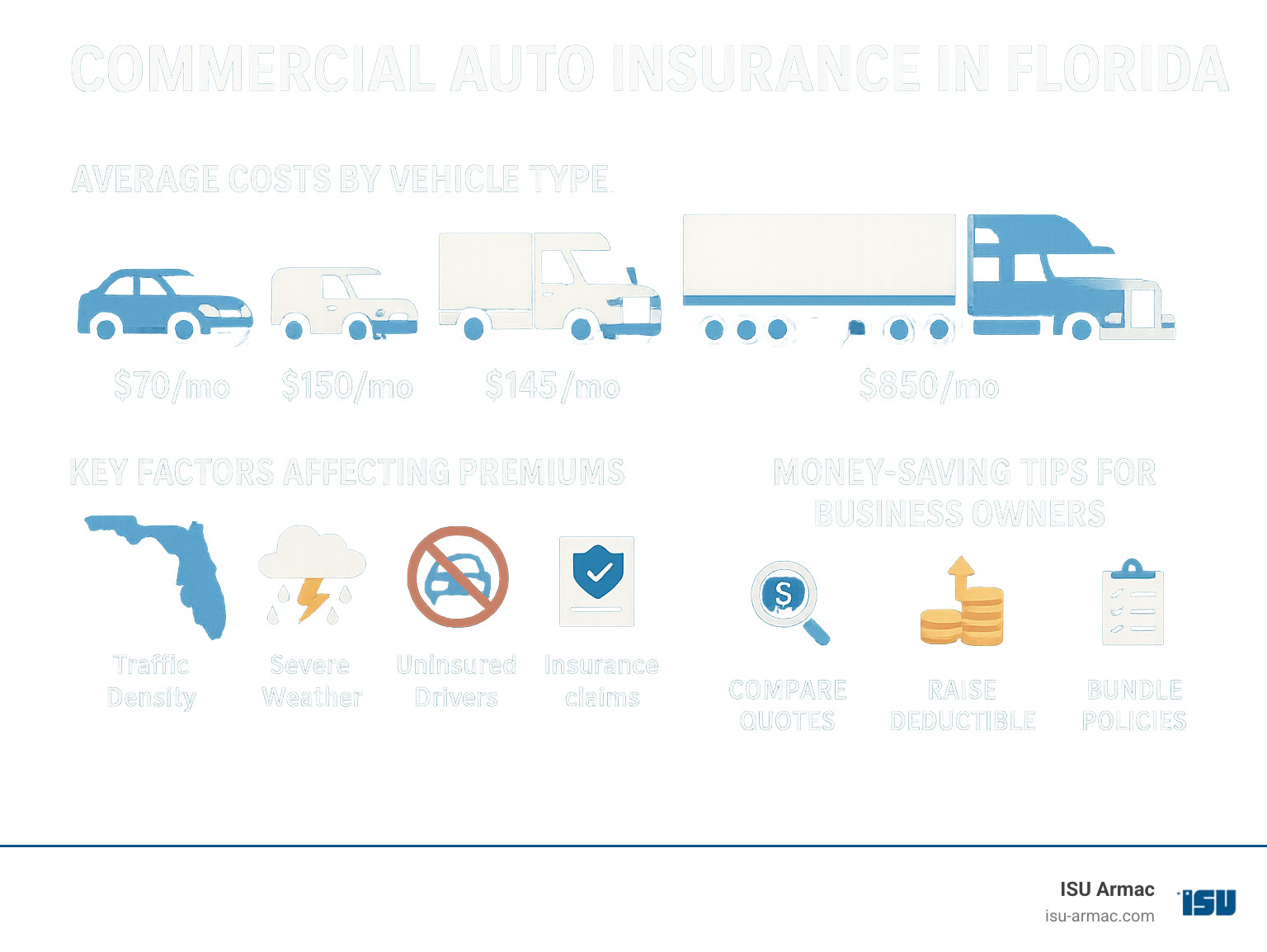
The average monthly cost for commercial auto insurance in Florida is $266, but that’s just the starting point. What matters more is understanding where your business likely falls within the range. Here’s what we typically see: 37% of small businesses pay less than $100 monthly, which often surprises business owners who expect much higher costs.
For specific vehicle types, the ranges vary significantly. Commercial cars typically run $750 to $1,200 annually (about $63 to $100 monthly), making them the most affordable option for service-based businesses. Semi-trucks fall in the $1,500 to $2,000 annual range ($125 to $167 monthly), while heavy trucks can cost $8,000 to $12,500 annually ($667 to $1,042 monthly).
Florida’s costs reflect some unique challenges we face here. Our high traffic density in cities like Miami and Orlando increases accident risks. The state’s severe weather patterns – from hurricanes to daily thunderstorms – drive up comprehensive claims. We also deal with higher uninsured motorist rates and a litigation environment that can inflate claim costs.
But here’s what I’ve learned after years in this business: most Florida entrepreneurs overestimate their insurance costs, sometimes by 50% or more. The reality is often much more manageable than expected.
For the most current pricing information, our detailed breakdown of the cost of commercial auto insurance provides additional insights into market trends.
Key Factors That Influence Your Premium
Understanding what drives your premium helps you make smarter decisions and potentially save money. Insurance companies look at your business like a puzzle, evaluating each piece to determine your risk level.
Your vehicles play a huge role in determining costs. A shiny new box truck costs more to insure than a well-maintained older pickup truck. The type and value of your vehicles matter, but so do safety features. Vehicles with backup cameras, anti-lock brakes, and other advanced safety systems often qualify for discounts that can add up quickly.
Where you operate significantly impacts your rates. Running a landscaping business in downtown Miami costs more than the same business in rural Ocala. Your garaging location – where vehicles are parked overnight – affects rates because theft and vandalism risks vary dramatically across Florida.
Your industry carries its own risk profile. Construction companies and delivery services typically pay more than consulting firms or real estate agencies. Insurance companies have decades of claims data showing which businesses face higher risks, and they price accordingly.
Driver-related factors often have the biggest impact on your premium. Clean driving records result in lower costs, while accidents and violations can increase rates for years. The age and experience of your drivers matter too – younger or inexperienced drivers increase premiums significantly.
Your coverage choices directly affect costs. Higher liability limits provide better protection but cost more. Deductibles offer a direct trade-off – higher deductibles reduce premiums but increase your out-of-pocket costs when you file a claim.
Claims history follows your business like a shadow. Previous claims, even small ones, can impact your rates for three to five years. This is why many businesses choose to handle minor incidents out of pocket rather than file claims.
The annual mileage your vehicles travel and the radius of your operations also factor into pricing. Local delivery services typically pay less than businesses that travel statewide or nationally.
For businesses focused on finding the best rates, our guide on affordable commercial auto insurance offers strategies for minimizing costs while maintaining proper protection.
How to Potentially Lower Your Insurance Costs
Smart business owners know that commercial auto insurance florida is a necessary expense, but you don’t have to pay more than necessary. After helping hundreds of Florida businesses, I’ve seen which strategies actually work to reduce premiums.
Driver safety programs offer some of the biggest potential savings. Implementing formal driver training, conducting regular driving record checks, and maintaining a written vehicle use policy demonstrate to insurance companies that you’re serious about risk management. Some insurers offer substantial discounts for businesses that install telematics devices to monitor driving behavior.
Bundling your policies often provides significant savings. When you combine commercial auto with general liability, property insurance, or workers’ compensation, most insurers offer meaningful discounts. We’ve seen businesses save 10% to 25% by bundling policies with the same carrier.
Increasing your deductibles can substantially reduce premiums, but make sure you can comfortably afford the higher out-of-pocket expense. Moving from a $500 to $1,000 deductible might save you $200 to $400 annually – a smart trade-off for many businesses.
Paying annually instead of monthly often results in discounts and eliminates processing fees. While it requires more cash upfront, the savings typically justify the approach for established businesses.
Vehicle safety features can reduce premiums more than many business owners realize. Anti-theft devices, GPS tracking systems, and backup cameras show insurers you’re taking steps to prevent claims. Some newer safety technologies like automatic emergency braking can qualify for additional discounts.
Regular policy reviews ensure you’re not paying for coverage you don’t need or missing opportunities for savings. Business needs change, and your insurance should evolve accordingly. We recommend annual reviews to optimize both coverage and cost.
Maintaining good business credit affects your insurance rates in Florida. Insurance companies use credit information as one factor in determining rates, so managing your business credit responsibly can help keep premiums lower.
At ISU Armac, we shop multiple carriers to find the best combination of coverage and price for each client. Our independent agency status means we’re not tied to any single insurance company, giving us the flexibility to find the most competitive rates for your specific situation.
The key is balancing cost savings with adequate protection. I’ve seen too many businesses save money on premiums only to find they’re underinsured when they actually need to file a claim. The goal is finding the sweet spot where you’re properly protected without overpaying.
Securing Your Policy: How to Get the Best Quote and Coverage

Information You’ll Need for an Accurate Quote
Getting a solid quote for commercial auto insurance florida isn’t rocket science, but it does require some homework. Think of it like applying for a loan – the more accurate information you provide upfront, the better your quote will reflect your actual premium.
Your business information forms the foundation of your quote. Insurance companies want to know your legal business name, any DBA you operate under, and your business address. They’ll also need your Federal Tax ID number, a detailed description of what your business actually does, how long you’ve been in business, and your annual revenue. Don’t forget to mention how many employees you have – this affects your overall risk profile.
Vehicle details are where things get specific. You’ll need the VIN for every vehicle you want to insure, along with the year, make, model, and type of each vehicle. Insurance companies also want to know the purchase price or current value, what you primarily use each vehicle for, and how many miles you drive annually. Where you park your vehicles overnight matters too – a secure garage gets better rates than street parking.
Driver information is crucial because your team’s driving records directly impact your rates. Gather full names, dates of birth, driver’s license numbers, and states of issue for everyone who’ll drive your vehicles. You’ll need driving records for the past five years, details about commercial vehicle experience, and any special training or certifications your drivers have.
Don’t forget about coverage preferences. Think about what liability limits make sense for your business, what deductibles you’re comfortable with, and whether you need comprehensive, collision, or rental reimbursement coverage. If you’re replacing existing coverage, have that information handy too.
For businesses with larger vehicles, you might need a DOT number if your vehicles exceed 10,000 pounds. Insurance companies also want to know if you operate across state lines, transport hazardous materials, or have specialized equipment on your vehicles.
Finally, gather your claims history for the past five years. If you have current insurance, request loss runs from your carrier. Any lapses in coverage will come up, so be prepared to explain them.
Why Comparing Quotes is Your Smartest Move
Here’s something that might surprise you: commercial auto insurance florida rates can vary by hundreds of dollars per month between companies for identical coverage. It’s not unusual to see a 30-40% difference in premiums for the same business and vehicles.
This happens because every insurance company evaluates risk differently. Some insurers love working with contractors and offer them great rates, while others prefer transportation companies. Some are aggressive with pricing for newer businesses, while others want to see a long track record before offering their best rates.
But it’s not just about price – coverage differences matter too. One company might include rental reimbursement as standard, while another charges extra for it. Policy language varies between insurers, which can affect how claims are handled and what situations are covered.
This is where working with an independent agent like ISU Armac becomes invaluable. We can compare multiple insurance companies simultaneously, saving you hours of phone calls and paperwork. More importantly, we understand which companies offer the best combination of coverage, price, and service for your specific type of business.
Our approach goes beyond finding the cheapest policy. We look at the financial strength of the insurance company, their reputation for handling claims fairly, whether the coverage actually fits your risks, and their track record for rate stability. There’s no point in saving money on a policy that won’t be there when you need it most.
The comparison process starts with understanding your business and risk exposures. We then survey the market to get quotes from multiple carriers, analyze not just prices but coverage features, and present you with options along with our professional recommendations. But our service doesn’t end there – we monitor your coverage and shop rates at renewal to make sure you’re always getting the best value.
For a quick start, you can get a commercial auto insurance quote online through our website, or contact us directly for personalized service.
Protecting Your Florida Business on the Road
Commercial auto insurance florida represents more than just checking a legal box – it’s your financial safety net in a state where business vehicles face unique challenges every day. From Miami’s heavy traffic to Orlando’s tourist congestion, from hurricane season to the everyday reality of sharing roads with uninsured drivers, Florida businesses need solid protection.
The key takeaways are straightforward but important. Florida law requires commercial auto insurance whenever you use vehicles for business purposes. Your personal auto policy excludes business activities, creating dangerous gaps in coverage. While state minimum requirements provide basic protection, most businesses need comprehensive coverage to truly protect their assets and operations.
Costs vary significantly based on your business type, vehicles, and risk factors. A contractor hauling equipment faces different risks than a consultant driving to client meetings, and insurance companies price accordingly. Shopping multiple carriers through an independent agent ensures you get the best value for your specific situation.
At ISU Armac, we bring decades of experience in commercial insurance, combined with our independent agency status, to provide Florida businesses with comprehensive protection at competitive rates. We understand the unique challenges Florida businesses face – from severe weather to high traffic density – and we structure policies accordingly.
Our multiple carrier access means we shop numerous insurance companies to find your best options. Our local understanding of Florida’s business environment and insurance market helps us identify coverage gaps before they become problems. We provide personalized service because every business is unique, and we customize coverage accordingly. Most importantly, we offer ongoing support – we’re here for the long haul, not just the initial sale.
Don’t wait until you’re facing a claim to find coverage gaps. Florida’s roads are unpredictable, weather can change quickly, and accidents happen to even the most careful drivers. Protecting your business with proper commercial auto insurance is one of the smartest investments you can make.
Whether you’re hauling equipment across the state, serving customers from a food truck in downtown Miami, or driving to client meetings throughout Florida, we can help you find the right coverage at the right price.
Ready to protect your Florida business? Get a comprehensive business auto insurance quote today and find why thousands of businesses trust ISU Armac for their commercial insurance needs. The road ahead is full of opportunities for your business – make sure you’re properly protected for the journey.