
Understanding Personal Auto Insurance: Your Essential Financial Safety Net
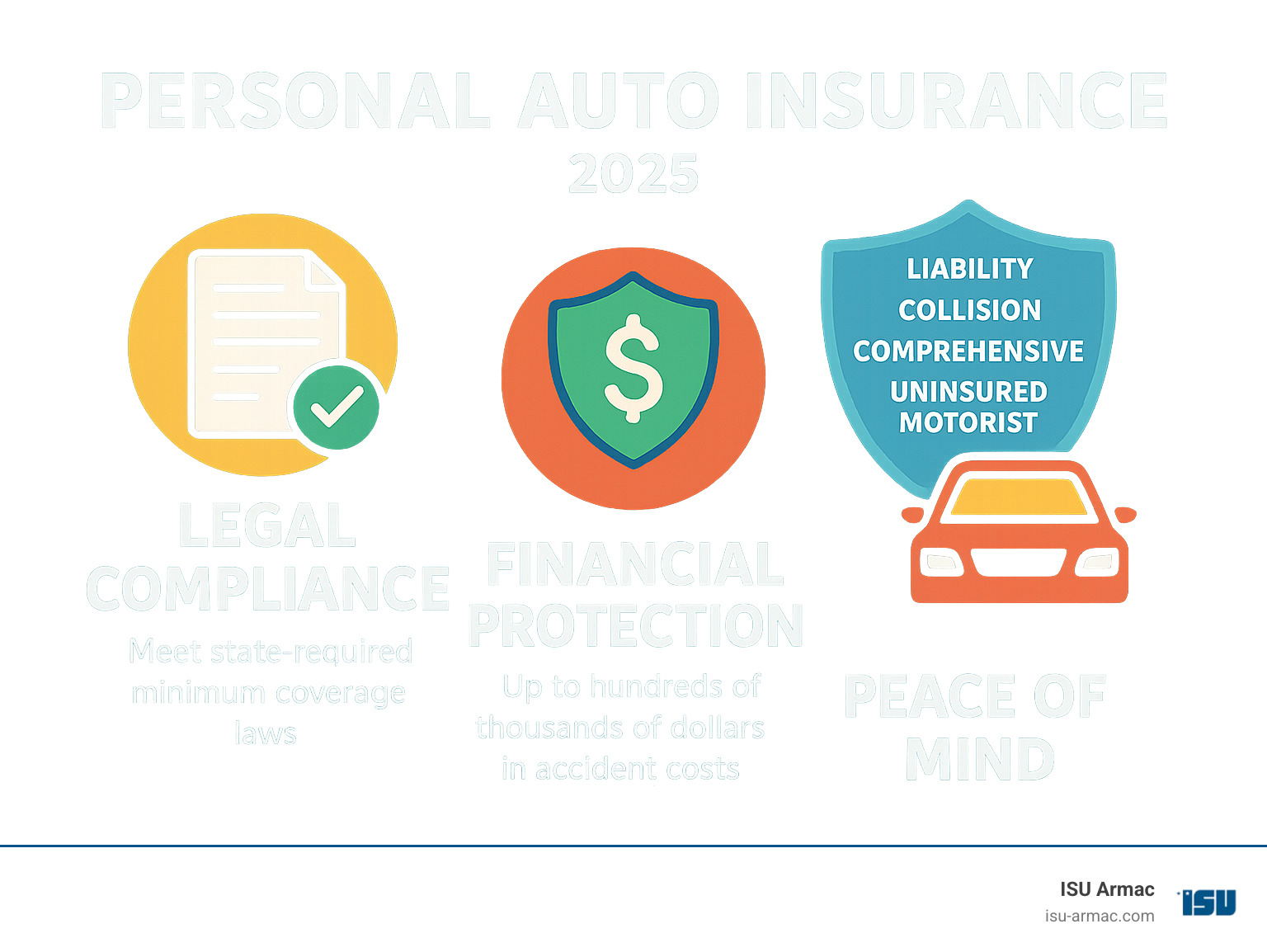
Personal auto insurance is a legal contract between you and an insurance company that provides financial protection against accidents, theft, and other vehicle-related incidents. This coverage is mandatory in most states and serves three critical purposes:
1. Legal Compliance – Meet state-required minimum coverage laws
2. Financial Protection – Shield your assets from costly accident claims
3. Peace of Mind – Drive confidently knowing you’re protected
Personal auto insurance policies typically include both mandatory coverages (like liability insurance) and optional coverages (like comprehensive and collision). In California, drivers must carry minimum liability limits of $15,000 per person and $30,000 per accident for bodily injury, plus $5,000 for property damage.
The policy works as a contract where you pay premiums in exchange for coverage when accidents happen. Your insurance company agrees to pay for covered damages up to your policy limits, while you’re responsible for deductibles and any costs above those limits.
Whether you’re commuting to work in Victorville, taking weekend trips to the mountains, or running errands around town, having adequate personal auto insurance protects both your financial future and your ability to drive legally.
I’m Ryan McEachron, CEO of ISU Insurance Services ARMAC Agency, and I’ve been helping High Desert residents steer personal auto insurance options since 1995. My experience on the Victorville City Council and deep community roots give me unique insight into the coverage needs of local drivers.
Understanding Your Coverage: Mandatory vs. Optional Policies
Think of your personal auto insurance policy as a financial safety net with different layers of protection. Just like building a house, you start with a foundation (mandatory coverage) and then add features that make it more comfortable and secure (optional coverage).

Every state requires certain basic coverages to keep you legal on the road. These mandatory protections ensure that if you cause an accident, there’s money available to help the people you’ve hurt. But smart drivers often add optional coverages that protect their own vehicles and provide extra security.
Your policy structure is like a menu where some items are required and others are your choice. California has specific requirements, but you can customize your coverage based on your needs, budget, and how much risk you’re comfortable taking. Understanding these options helps you make informed decisions about your protection.
For help understanding insurance terminology, the California Department of Insurance provides a helpful guide on Automobile Insurance Terms.
Mandatory Auto Insurance Coverage in California
California doesn’t mess around when it comes to auto insurance requirements. If you want to drive legally in the Golden State, you must carry liability insurance to prove you can pay for damages if you cause an accident.
Liability insurance has two main parts that work together to protect others when you’re at fault. Bodily Injury Liability covers medical bills, lost wages, and pain and suffering for people you injure in an accident. This includes other drivers, their passengers, pedestrians, or cyclists who get hurt because of your mistake.
Property Damage Liability pays for the stuff you damage in an accident. This could be someone’s car, their fence, a storefront, or even a fire hydrant. You’d be surprised how expensive it can be to replace a modern vehicle’s bumper or repair a damaged building.
California requires minimum coverage limits of $15,000 per person for bodily injury, $30,000 total per accident if multiple people are hurt, and $5,000 for property damage. Insurance folks call this “15/30/5” coverage.
Here’s the thing though – these minimums might not be enough for a serious accident. If you cause a crash that results in $50,000 in medical bills, you’d be personally responsible for the extra $35,000 beyond your $15,000 limit. That’s why many drivers choose higher limits to protect their savings and assets.
The consequences of driving without insurance are serious. You could face fines, license suspension, and vehicle impoundment. Even worse, you’d be completely exposed to paying accident costs out of your own pocket. For complete details on California’s requirements, check out California’s minimum liability requirements.
Frequently Required & Optional Auto Insurance Coverages
While liability coverage keeps you legal, additional coverages protect your own interests and provide more complete protection. If you have a car loan or lease, your lender will require some of these “optional” coverages.
Collision coverage fixes your car when you hit something or something hits you, regardless of who’s at fault. Whether you rear-end someone at a red light or slide into a guardrail during a rainstorm, collision coverage handles your vehicle’s repair costs. This coverage is essential if you’re still paying off your car.
Comprehensive coverage protects against everything else that can damage your car. Think theft, vandalism, hail storms, flood, fire, or hitting a deer. In the High Desert, we see comprehensive claims for everything from flash flood damage to vehicles stolen from shopping centers. It also covers glass damage, like when a rock chips your windshield on Highway 395.
Uninsured and Underinsured Motorist Coverage might be the most important optional coverage you can buy. Unfortunately, many California drivers either have no insurance or carry only the minimum limits. If one of these drivers hits you and causes serious injuries, their coverage won’t be enough to pay your medical bills. This coverage steps in to fill that gap.
Medical Payments coverage handles immediate medical expenses for you and your passengers, no matter who caused the accident. It works quickly to pay for emergency room visits, ambulance rides, and initial treatment while other insurance sorts itself out.
Gap insurance is crucial if you financed or leased your vehicle. Cars lose value quickly, and if yours is totaled six months after purchase, you might owe more than it’s worth. Gap coverage pays the difference between your car’s value and your remaining loan balance.
Rental reimbursement pays for a rental car while yours is being repaired after a covered claim. Roadside assistance provides towing, jump-starts, flat tire changes, and emergency fuel delivery when you’re stranded.
If you own a classic or specialty vehicle, you’ll need different coverage designed for these unique cars. Learn more about Classic Auto Insurance options.
Who and What Is Covered by a Personal Auto Insurance Policy?
Your personal auto insurance policy creates a protective bubble around certain people and vehicles. Understanding who’s covered can prevent nasty surprises when you need to file a claim.
You as the policyholder are always covered when driving any vehicle listed on your policy. Family members living in your household are typically covered too, whether they’re driving your car or borrowing someone else’s vehicle with permission.
Permissive drivers – people you give permission to drive your car – are usually covered under your policy. If your neighbor borrows your truck to pick up lumber and has an accident, your insurance would generally provide coverage. However, this doesn’t mean you should lend your car to just anyone.
Your policy primarily covers the vehicles listed on your policy, but coverage often extends to non-owned vehicles you might drive occasionally. This includes rental cars or vehicles you borrow, though your coverage is usually secondary to any insurance the rental company or vehicle owner carries.
One critical limitation involves business use versus personal use. Your personal auto insurance covers normal activities like commuting to work, running errands, or taking family trips. However, if you use your vehicle for business purposes like ride-sharing, food delivery, or sales calls, your personal policy likely won’t cover accidents that happen during these commercial activities.
This business use exclusion catches many people off guard. If you use your personal vehicle for any type of business activity, you need to understand what’s covered and what isn’t. For detailed information about this important distinction, read Does My Personal Auto Insurance Cover Business Use?.
How Your Personal Auto Insurance Premium is Calculated
Ever wonder how insurance companies come up with that number on your personal auto insurance bill? It’s not pulled out of thin air – there’s actually a detailed process behind it that’s part science, part statistics, and entirely focused on assessing risk.

Think of calculating your premium like putting together a puzzle. Insurance companies use a two-step process called underwriting and rating to create your unique picture. During underwriting, they gather information about you, your car, and your driving habits to figure out how likely you are to file a claim. Then, during rating, they assign a price based on that risk level.
Your driving record is probably the biggest piece of this puzzle. A clean record with no accidents or tickets tells insurers you’re a safe bet. On the flip side, that speeding ticket from last year or a fender-bender can bump up your rates significantly. It’s like your driving report card – and insurers definitely check it.
Where you live also plays a huge role in your premium. If you’re parking your car in downtown Los Angeles versus rural Apple Valley, you’re looking at very different risk levels. Urban areas typically mean more traffic, higher theft rates, and more chances for accidents. Here in the High Desert, we often see lower rates than our friends in busier metropolitan areas.
The vehicle you drive is another major factor. That shiny new sports car might be fun, but it’s also expensive to repair and attractive to thieves. Insurance companies know exactly which cars cost more to fix and which ones disappear from parking lots most often. Safety features like anti-lock brakes and airbags can help lower your premium, while high-performance engines might raise it.
Age and experience matter too. Newer drivers typically pay more because statistics show they’re more likely to have accidents. It’s not personal – it’s just math. As you gain more years behind the wheel without incidents, your rates generally improve.
Annual mileage affects your premium because more time on the road equals more opportunities for accidents. If you’re commuting from Victorville to Los Angeles daily, you’ll likely pay more than someone who only drives locally for errands and weekend trips.
Your credit history can also influence your rates in many states, including California. Insurance companies have found that credit scores often correlate with claim frequency, though this factor has become less prominent in recent years.
Finally, the coverage choices you make directly impact your premium. Higher liability limits and additional coverages like comprehensive and collision will increase your cost. However, choosing higher deductibles can help lower your premium since you’re agreeing to pay more out-of-pocket if something happens.
Understanding these factors helps you make smarter decisions about your coverage. Some things you can’t change – like your age or where you live – but others, like maintaining a clean driving record and choosing appropriate deductibles, are entirely in your control. For more detailed information about how auto insurance works, the NAIC guide on auto insurance offers excellent insights into the industry standards and practices.
Smart Strategies for Saving Money on Auto Insurance
Nobody enjoys paying more than necessary for personal auto insurance, but the good news is that smart shoppers have plenty of opportunities to reduce their premiums while maintaining excellent protection. After nearly three decades in the insurance business, I’ve seen countless ways clients can trim their costs without compromising their coverage.

One of the most effective money-saving strategies is bundling policies. When you combine your personal auto insurance with your home, renters, or umbrella insurance through the same carrier, most companies reward you with substantial discounts. I’ve seen clients save up to 10% or more just by bringing their policies together under one roof. It’s not just about the savings either – having all your insurance with one company simplifies your life and gives you a single point of contact when you need help.
If you have multiple vehicles in your household, a multi-car discount can deliver significant savings. Rather than insuring each car separately, putting them all on one policy typically reduces your overall premium while making management much easier.
Your driving record remains the biggest factor in determining your rates. Maintaining a clean driving record free of accidents and traffic violations is like having a golden ticket to lower premiums. Safe drivers can see savings of 30% or more compared to those with violations. Every time you resist the urge to speed or drive aggressively, you’re potentially putting money back in your pocket.
Families with student drivers should definitely ask about good student discounts. Many insurers offer meaningful reductions for young drivers who maintain good grades, recognizing that responsible students often become responsible drivers.
Modern vehicles come packed with safety features, and insurers love rewarding drivers who choose cars equipped with anti-lock brakes, airbags, electronic stability control, and anti-theft devices. These features reduce the likelihood of claims, so carriers pass those savings along to you.
Choosing higher deductibles is a straightforward way to lower your premium. By agreeing to pay more out-of-pocket if you have a claim, you’re taking on more risk, which insurers reward with lower monthly or annual costs. Just make sure you can comfortably afford whatever deductible you choose.
Usage-based insurance programs have become increasingly popular and effective. These programs use smartphone apps or small devices to monitor your driving habits – things like how many miles you drive, your speed, braking patterns, and what times you’re on the road. Safe drivers in these programs often see discounts of up to 25%, and about three out of four participants save money.
The type of vehicle you drive has a major impact on your personal auto insurance costs. Cars that are less expensive to repair, have excellent safety ratings, and aren’t frequently stolen will cost less to insure. Some carriers even offer special discounts for hybrid or electric vehicles, sometimes as much as 10% off your coverage.
Many insurers offer small online purchase discounts for customers who get quotes and buy policies through their websites, making the process both convenient and cost-effective.
Here’s where working with an independent agency like ISU Armac really pays off. Instead of calling around to different insurance companies yourself, we shop multiple carriers for you, comparing rates and coverage options to find the best deal. This saves you time and often uncovers savings you might miss by only getting quotes from one company. Whether you’re searching for a car insurance broker near me or wondering about car insurance with first responder discount, our team has the expertise and carrier relationships to help you find the right coverage at the right price.
The key is combining several of these strategies. A client might bundle their auto and home insurance, maintain a clean driving record, choose a higher deductible, and participate in a usage-based program – and those savings can really add up. Every situation is different, which is why we take the time to understand your specific needs and find the combination of coverages and discounts that works best for your budget.
Frequently Asked Questions about Personal Auto Insurance
We hear a lot of questions about personal auto insurance, and that’s a good thing! It means you’re being proactive about understanding your coverage. Here are some of the most common questions we get, with clear answers to help you feel more confident on the road.
Does auto insurance follow the car or the person?
This is a classic question, and the answer is a bit of both, but primarily the car.
Generally, the personal auto insurance policy on the vehicle you’re driving is considered the primary coverage. This means that if you lend your car to a friend and they get into an accident, your policy is usually the first one that would respond to damages. This is often referred to as “permissive use” coverage, and almost all liability policies cover a licensed driver who drives your car with your permission.
However, your policy also covers you as the insured person. If you’re driving a non-owned vehicle, like a rental car or a friend’s car, your personal policy may provide secondary coverage for liability, and sometimes even physical damage, depending on your specific policy terms. For instance, if you drive a friend’s car and they are not insured, your liability insurance generally covers you.
When it comes to rental cars, your personal policy might extend some coverage. However, it’s often wise to check with your insurer or consider the supplemental insurance offered by the rental company, especially for things like collision damage waivers or personal effects coverage. Credit card benefits can also play a role, often providing secondary collision and theft protection.
If you frequently drive cars you don’t own and don’t have your own vehicle, a non-owner policy might be a good fit. We’ll discuss that next. For a deeper dive into this topic, check out Does Auto Insurance Follow the Car or the Person?.
What should I do if I get into an accident?
Getting into a car accident can be a jarring experience, but knowing what to do beforehand can help you stay calm and protect yourself.
First and foremost, stay calm and assess the situation. Ensure your safety and the safety of any passengers. If possible and safe, move your vehicle to the side of the road. Immediately check for injuries for yourself and anyone else involved. If anyone is injured, call 911 right away for emergency services and police assistance. Even for minor accidents, calling the police is often best, as they can create an official accident report, which is invaluable for insurance claims.
Next, exchange information with the other driver(s). You’ll need their name, contact information, insurance company and policy number, driver’s license number, and the vehicle’s make, model, year, and license plate number. It’s also a good idea to take photos of their driver’s license and insurance card (but do not share your driver’s license number directly, as it can be used for identity theft). Be sure to document the scene thoroughly. Take photos and videos of the accident from various angles, including damage to all vehicles, road conditions, traffic signs, and any relevant surroundings. Note the exact date, time, and location of the accident, and if there are any witnesses, get their contact information.
As soon as you can, notify your insurer. Report the accident to your personal auto insurance company promptly. Most have 24/7 claims hotlines or mobile apps for easy reporting. Provide them with all the details and documentation you collected. Finally, and this is crucial: avoid admitting fault. Even if you think you were at fault, do not admit it at the scene. Let the police and your insurance company determine fault after their investigation. Any statements you make could be used against you later. If you feel any pain or discomfort, even minor, seek medical attention as some injuries may not be immediately apparent. Your liability insurance covers lawsuits, and your company has a duty to provide a lawyer to represent you if you are sued.
Can I get personal auto insurance if I don’t own a car?
Yes, absolutely! If you don’t own a car but frequently drive, such as renting vehicles regularly or borrowing cars from friends or family, you can get a non-owner car insurance policy.
A non-owner policy provides liability coverage specifically for you when you’re driving a car you don’t own. This is crucial because while the car you borrow or rent might have its own insurance, a non-owner policy ensures that you are protected against liability if you cause an accident. It acts as primary coverage for liability in situations where there might otherwise be none, or as secondary coverage if the car’s policy limits are exhausted.
This type of policy is particularly useful if you’re a frequent rental car user, as it can be a more cost-effective way to ensure continuous liability coverage than relying solely on rental company insurance or credit card benefits. It’s also ideal for individuals who frequently borrow cars, providing peace of mind that you’re covered for liability in case of an accident. Additionally, if you’ve recently sold your car but plan to buy another soon, a non-owner policy can help you maintain continuous coverage, preventing a lapse that could lead to higher premiums later.
A non-owner policy typically only covers liability. It generally does not cover physical damage to the car you are driving (like collision or comprehensive coverage). For that, you would need to rely on the car owner’s policy or purchase additional coverage from a rental company. If this sounds like your situation, we can help you explore your options for Personal Auto Insurance No Car.
Conclusion: Finding the Right Auto Insurance Policy for Your Needs
We’ve journeyed through the ins and outs of personal auto insurance together, and hopefully, it feels a little less mysterious now. We’ve explored everything from the must-have liability coverage to optional protections like comprehensive and collision. You’ve also learned how factors like your driving record and even your car’s model can affect your rates, and finded clever ways to save money, like bundling policies or taking advantage of good driver discounts.
The biggest takeaway? While meeting legal requirements is important, having adequate personal auto insurance coverage is truly essential. State minimums are just that – minimums. They often don’t provide enough financial protection if you’re involved in a serious accident. It’s about finding that sweet spot: balancing the cost of your policy with the protection it offers, ensuring you can drive with genuine peace of mind without overpaying.
And that’s where we come in! At ISU Armac, we believe the role of an independent agent is to be your trusted advisor. Think of us as your personal guide in the insurance maze. Unlike agents who work for just one insurance company, we have the unique ability to shop multiple carriers on your behalf. This means we can compare a wide range of policies and rates, helping you find the best coverage that fits your unique needs and budget.
Whether you’re cruising the streets of Victorville, enjoying Apple Valley’s views, or navigating Hesperia and other areas across Southern California, our team is dedicated to providing personalized service and expert advice. We truly understand the local landscape and are committed to protecting what matters most to you. Don’t leave your financial security to chance; let us help you build a robust personal auto insurance policy that fits your life perfectly.
Ready to get behind the wheel of a policy that truly fits you? We’re here to help you steer the options. Explore our custom auto insurance services and let us find the perfect policy for you: Get custom auto insurance services.