
Why Licensed Drivers Need Protection Without Vehicle Ownership
Personal auto insurance no car is possible through non-owner car insurance policies that provide liability coverage for licensed drivers who don’t own a vehicle but occasionally drive borrowed or rented cars.
Quick Answer for Non-Owner Insurance:
- What it is: Liability-only coverage for drivers without owned vehicles
- Who needs it: Frequent car renters, car-sharing users, and those borrowing vehicles regularly
- What it covers: Bodily injury and property damage liability (not the vehicle itself)
- Average cost: $285-$750 annually, typically cheaper than standard auto policies
- How to get it: Contact insurance agents directly (most don’t offer online quotes)
The thought of having car insurance when you don’t own a car might sound strange, but it’s actually a smart financial move for many Victorville residents. Whether you’re renting cars for weekend trips to Los Angeles, borrowing a friend’s vehicle for errands, or using car-sharing services, you still need protection from potential liability.
Non-owner car insurance fills this gap. It provides essential liability coverage without the need to own a vehicle, protecting you from costly lawsuits if you cause an accident while driving someone else’s car.
Many people find they need this coverage after experiencing a gap in their insurance history or realizing that rental car insurance from companies can cost $10-$15 per day. For frequent drivers without ownership, a non-owner policy often proves more economical and comprehensive.
I’m Ryan McEachron, CEO of ISU Insurance Services ARMAC Agency, and I’ve helped countless Victorville residents steer personal auto insurance no car scenarios over my decades in the insurance industry. Understanding these specialized policies can save you significant money while ensuring you’re properly protected on the road.
Relevant articles related to personal auto insurance no car:
What is Non-Owner Car Insurance?
If you’re a licensed driver in Victorville who doesn’t own a car but occasionally rents or borrows one, personal auto insurance no car is your financial lifesaver.
A non-owner car insurance policy (or “named non-owner policy”) is designed for this exact situation. While traditional auto insurance protects a specific vehicle, non-owner insurance follows you, the driver. It’s liability-only coverage that applies when you’re driving someone else’s car.
It’s a personal safety net that covers damages and injuries you cause to others. As the Texas Department of Insurance explains, “A non-owner car insurance policy provides liability coverage” for these scenarios. The coverage includes:
- Bodily Injury liability: Pays for medical expenses and lost wages if you injure someone.
- Property Damage liability: Covers damage to other people’s vehicles or property.
Crucially, non-owner insurance acts as secondary coverage. If you cause an accident in a friend’s car, their policy pays first. Your non-owner policy then covers any costs exceeding their limits, saving you from potentially thousands in out-of-pocket expenses.
At ISU Armac, our expertise in Personal Lines Insurance means we can find the right non-owner policy for your car-free lifestyle.
Key Benefits of a Non-Owner Policy
A non-owner policy delivers significant value:
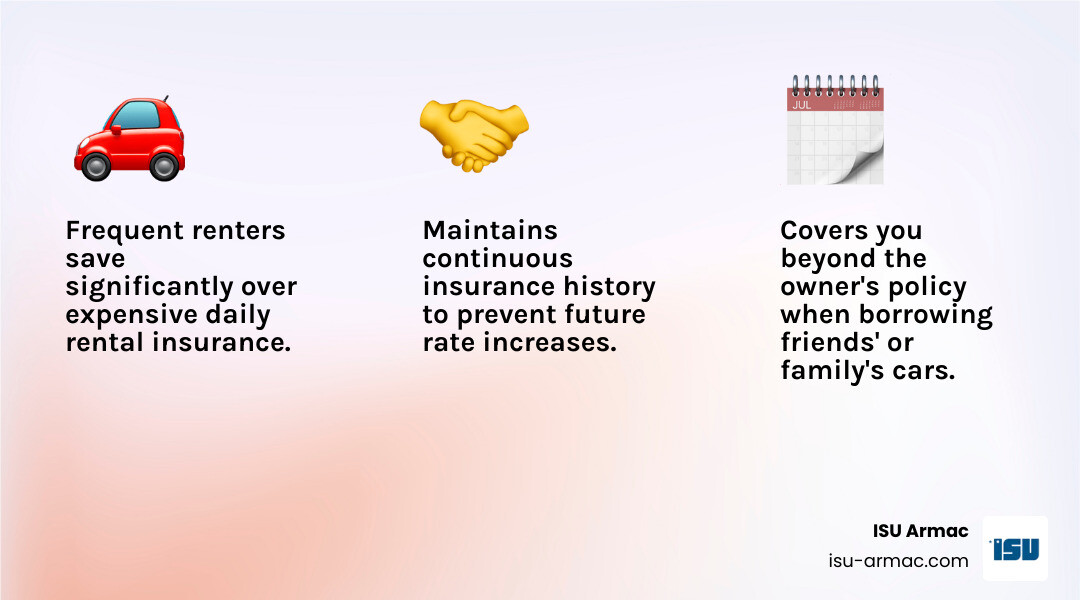
- Maintaining continuous coverage: Insurance companies dislike coverage gaps and may charge higher premiums later. A non-owner policy keeps your insurance record continuous, which can lead to lower rates when you eventually buy a car.
- Fulfilling legal requirements: It can satisfy the need for an SR-22 form after a serious violation (e.g., DUI), which is often required to reinstate a license even if you don’t own a car.
- Cheaper than rental insurance add-ons: Rental companies charge $10-$15 per day for liability coverage. A non-owner policy is often cheaper annually than just a few rental periods’ worth of this coverage.
- Supplementing the owner’s policy: If you cause an accident where damages exceed the car owner’s liability limits, your policy covers the difference, protecting your finances and relationships.
How is a Non-Owner Policy Different from Standard Auto Insurance?
The key difference is that standard auto insurance covers a specific car, while non-owner insurance covers you as a driver in any non-owned vehicle.
- Standard auto policies cover a specific vehicle with collision, comprehensive, and primary liability coverage. The cost reflects the vehicle’s value and your driving history.
- Non-owner policies provide secondary, liability-only coverage. With no collision or comprehensive, they are significantly less expensive.
The cost difference is dramatic. A standard policy can be $1,200-$2,000 annually, whereas a non-owner policy is typically $285-$750 per year. If you own a car, you need standard insurance. If you’re a licensed driver who occasionally borrows or rents, a non-owner policy offers the perfect balance of protection and affordability.
Who Needs This Specialized Coverage?
Personal auto insurance no car isn’t for everyone, but for certain licensed drivers, it’s an essential financial safety net. It acts as a personal liability umbrella that follows you, protecting you from major out-of-pocket expenses if an accident occurs in a vehicle you don’t own.

Key Scenarios for Personal Auto Insurance No Car
Non-owner insurance is ideal for:
- Frequent car renters: It’s often cheaper annually than paying the high daily liability fees from rental companies.
- Car-sharing users: Services like Zipcar or Turo often provide only minimum liability. A non-owner policy acts as a buffer, offering higher limits and better protection.
- Frequent borrowers of friends’ cars: It provides peace of mind by offering coverage beyond the car owner’s policy limits, protecting you both from financial hardship.
- Drivers needing an SR-22 or FR-44: If you need to prove financial responsibility to reinstate your license but don’t own a car, a non-owner policy is the most economical solution.
- Individuals between cars: Maintaining continuous coverage with a non-owner policy prevents you from being seen as a high-risk driver, which can save you money on future policies.
- Employees using company cars for personal use: A non-owner policy can fill coverage gaps left by a commercial auto policy, which may not cover personal errands.
When a Non-Owner Policy Isn’t the Right Fit
This policy isn’t for everyone. You don’t need it if you are a:
- Car owner: You need a standard auto policy for your vehicle.
- Driver with regular household access: If you regularly drive a car owned by someone in your household (like a spouse or parent), you should be listed on their policy.
- Unlicensed individual: You must have a valid driver’s license to be insured.
- Very infrequent driver: If you drive only once or twice a year, the annual premium may not be cost-effective.
An honest assessment of your driving habits is key. For a deeper understanding of how coverage works in these scenarios, read our guide on Does Auto Insurance Follow the Car or the Person?. This will help you decide if personal auto insurance no car is right for you.
Understanding Personal Auto Insurance No Car: Coverage and Costs
When you’re exploring personal auto insurance no car options, you’re essentially looking at how to meet your financial responsibility as a driver without owning a vehicle. Every state requires drivers to be financially responsible for any damage or injuries they cause in an accident—and a non-owner policy is your ticket to fulfilling this requirement.
The beauty of non-owner insurance lies in its simplicity and affordability. Since there’s no specific vehicle to insure, the cost factors are straightforward: your policy limits, driving record, location, age, and how often you plan to drive. While you could choose state minimum coverage, we typically recommend higher limits for better financial protection. Here’s something that might surprise you—there’s usually no deductible on non-owner policies because they don’t cover physical damage to any specific vehicle.

What a Non-Owner Policy Typically Covers
A non-owner policy focuses entirely on liability—protecting others from damages you might cause. Think of it as your personal safety net when you’re behind the wheel of someone else’s car.
Bodily Injury Liability (BI) forms the foundation of your coverage. If you cause an accident that injures someone, this pays for their medical expenses, lost wages, and pain and suffering. It’s the coverage that protects you from potentially devastating lawsuits.
Property Damage Liability (PD) handles the other side of the equation—damage to someone else’s car, fence, building, or other property. Whether you accidentally back into a neighbor’s mailbox or cause a multi-car collision, this coverage steps in to pay for the repairs.
Many policies also offer Uninsured/Underinsured Motorist (UM/UIM) coverage, which we highly recommend. This protects you if you’re injured by a driver who has no insurance or insufficient coverage. It’s your shield against the unfortunate reality that not everyone on the road carries adequate insurance.
Medical Payments (MedPay) or Personal Injury Protection (PIP) can cover your own medical expenses regardless of who caused the accident. While optional, it provides valuable peace of mind, especially if you don’t have robust health insurance.
For those seeking even greater financial security, an Umbrella Insurance policy can provide extra liability coverage above your non-owner policy limits, offering protection against significant claims that could otherwise devastate your financial future.
What a Non-Owner Policy Does Not Cover
Understanding what’s not covered is just as important as knowing what is. You’re insuring yourself as a driver, not any specific vehicle.
Collision damage to the car you’re driving isn’t covered. If you cause an accident, your non-owner policy won’t pay to repair the borrowed or rented car. That responsibility typically falls to the vehicle owner’s collision coverage or comes out of your own pocket.
Comprehensive damage from theft, vandalism, or natural disasters also isn’t your policy’s responsibility. If the car you’re driving gets stolen or damaged by hail, you’ll need to rely on the owner’s comprehensive coverage.
Your personal belongings inside the car aren’t protected either. That laptop, phone, or luggage damaged in an accident? Your non-owner policy won’t cover those losses.
Towing and roadside assistance services aren’t included, nor is rental reimbursement if you need a temporary car while a damaged vehicle is being repaired. Most importantly, this coverage doesn’t apply to any vehicle you own or have regular access to—for those situations, you need a standard auto insurance policy.
The Average Cost of a Non-Owner Policy
Here’s where personal auto insurance no car really shines—it’s remarkably affordable compared to standard auto insurance. Since insurers don’t need to factor in a specific vehicle’s make, model, age, or value, your premiums stay low.
Annual premiums typically range from $285 to $750, depending on your coverage choices and risk factors. For basic liability coverage, you might pay as little as $285 per year. More comprehensive liability coverage with higher limits averages around $546 annually.
However, prices can vary significantly between insurance companies. The same coverage that costs $575 with one insurer might cost $1,328 with another. This wide range makes shopping around essential—and it’s exactly why we work with multiple carriers to find you the best rates.
If you’re considered a high-risk driver and need an SR-22 filing, expect to pay more. Your driving record, age, and location all influence your premium, but even high-risk drivers often find non-owner policies more affordable than you might expect.
The real value becomes clear when you compare it to daily rental car insurance fees. At $10-$15 per day, rental company liability coverage can easily exceed $1,000 annually if you rent frequently. A non-owner policy provides year-round protection at a fraction of that cost.
How to Secure a Non-Owner Insurance Policy
Getting a non-owner insurance policy might feel a little different than getting a quote for a car you own, primarily because many insurers don’t offer online quotes for this specialized coverage. But don’t worry—the process is straightforward when you know how to approach it, and we’re here to guide you through every step.

The Process of Getting a Quote
The best way to get a quote for personal auto insurance no car is typically by contacting an insurance agent directly. While some major companies might not advertise non-owner policies prominently on their websites, most offer them. Think of it like ordering a special dish at a restaurant—it might not be on the menu, but the chef can definitely make it for you.
A phone call or an in-person visit is often necessary to discuss your specific needs. This personal touch actually works in your favor because an experienced agent can explain the nuances of non-owner coverage and help you avoid common pitfalls.
When you contact an agent, be prepared to provide some basic information. You’ll need your valid driver’s license number and history, your address and personal details, and your driving record (including any past accidents, tickets, or violations). The agent will also want to know how often you drive non-owned vehicles and for what purposes—whether it’s frequent rentals, borrowing from friends, or using car-sharing services. If you need an SR-22 or FR-44 filing, make sure to mention this upfront.
It’s highly recommended to compare offers from several insurance companies. Even if you have an existing homeowners or renters policy, your current insurer might offer a multi-policy discount for adding a non-owner auto policy. At ISU Armac, we pride ourselves on being able to shop multiple carriers to find the best coverage at the lowest rates for our clients in Victorville and across Southern California.
How to Get Personal Auto Insurance No Car
Securing the right non-owner policy doesn’t have to be complicated. Here’s how to approach it step by step:
First, assess your driving habits. Think about how often you drive vehicles you don’t own, whether they are rentals, borrowed cars, or car-sharing vehicles. Understanding your typical usage will help determine the right amount of coverage. If you rent a car twice a month for work, that’s very different from borrowing your neighbor’s truck once a year.
Next, gather your personal information. Have your driver’s license, Social Security number, current address, and a history of your driving record (including any accidents or violations) ready. This preparation will make the conversation with your agent much smoother.
Then, contact insurance agencies directly. As mentioned, this is often the most effective way to get quotes. Reach out to reputable agencies like ISU Armac. We specialize in finding the right coverage for diverse needs and can steer the options from various carriers on your behalf. Our experience with non-owner policies means we know which companies offer the best rates and coverage for different situations.
During your consultation, discuss coverage limits carefully. Don’t just settle for the state minimums. Consider your assets and potential risks. We can help you determine appropriate liability limits that offer robust financial protection. If you cause a serious accident, the difference between minimum coverage and adequate coverage could mean the difference between financial security and financial ruin.
Finally, purchase the policy once you’ve compared quotes and found one that meets your needs and budget. This will give you the peace of mind that comes with being properly covered, whether you’re driving a rental car on vacation or borrowing a friend’s vehicle for a weekend errand.
The entire process typically takes just a few days from initial contact to having your policy in hand. And once you have it, you’ll wonder how you ever drove without this essential protection.
Frequently Asked Questions About Non-Owner Insurance
When clients visit us at ISU Armac, they often have questions about personal auto insurance no car. It’s understandable – this type of coverage isn’t as well-known as traditional auto insurance, but it’s incredibly valuable for the right situations. Let me address the most common questions we hear to help you understand whether this coverage makes sense for your lifestyle.
Can I get car insurance if I don’t own a car?
Absolutely! This is exactly what non-owner car insurance was created for. You might think it sounds backwards – getting car insurance without a car – but it makes perfect sense when you consider that you’re the one driving, not the vehicle itself.
A non-owner policy provides liability coverage for licensed drivers who don’t own a vehicle but still find themselves behind the wheel from time to time. Whether you’re borrowing your sister’s car for a weekend trip or renting a vehicle for a business meeting, you need protection if something goes wrong.
The beauty of this coverage is that it follows you as the driver, regardless of which car you’re operating. You’re protected financially if you cause an accident, even though you don’t have a car registered in your name sitting in your driveway.
Does non-owner insurance cover rental cars?
Yes, and this is where many of our clients see the biggest savings! A non-owner policy typically provides liability coverage when you’re driving a rental car, which means it covers damages and injuries you cause to other people and their property.
If you rent cars even a few times a year, you’ve probably noticed how expensive the rental company’s liability coverage can be – often $10 to $15 per day. Over time, these daily fees can easily exceed the cost of an annual non-owner policy. It’s like buying insurance by the slice instead of getting the whole pie at a better price.
However, there’s an important distinction to remember: your non-owner policy won’t cover physical damage to the rental car itself. If you back into a pole and dent the rental car’s bumper, that’s not covered. For collision and comprehensive protection on rental vehicles, you’d need to explore other options like your credit card’s rental benefits or the rental company’s Collision Damage Waiver.
What happens if I cause an accident in a borrowed car?
This is where the “secondary coverage” aspect of non-owner insurance really shines. When you’re driving someone else’s car, their insurance policy is considered the primary coverage – it responds first to handle damages and injuries up to its policy limits.
But here’s where things get interesting: what if the damages exceed their coverage limits? Let’s say your friend has a basic policy with $25,000 in bodily injury coverage, but the accident you caused results in $40,000 in medical bills. Without a non-owner policy, you’d be personally responsible for that extra $15,000.
With personal auto insurance no car coverage, your policy would step in as secondary coverage to handle those remaining costs, protecting you from potentially devastating out-of-pocket expenses. It’s like having a financial safety net that catches you when the primary coverage isn’t enough.
This dual layer of protection is one of the key reasons we recommend non-owner policies for people who frequently borrow vehicles. It’s not just about meeting legal requirements – it’s about protecting your financial future from the unexpected.
Get the Right Coverage for Your Car-Free Lifestyle
Living without a car doesn’t mean living without insurance needs. Whether you’re embracing public transportation, cycling through Victorville’s neighborhoods, or simply choosing a more minimalist lifestyle, personal auto insurance no car remains a crucial financial protection tool when you do find yourself driving.
A non-owner car insurance policy serves as your financial safety net, providing essential liability protection that shields you from potentially devastating costs if you cause an accident while driving someone else’s vehicle. Think of it as your personal insurance that travels with you, regardless of whose car you’re behind the wheel of.
The smart choice for many car-free drivers isn’t to skip insurance altogether—it’s to choose the right type of coverage for their unique situation. Non-owner insurance offers exactly that: targeted protection that makes financial sense without the expense of insuring a vehicle you don’t own.
For frequent car renters, this coverage often pays for itself by eliminating those expensive daily insurance add-ons at rental counters. For those who borrow cars regularly, it provides peace of mind knowing you’re covered beyond the car owner’s policy limits. And for drivers working to reinstate their licenses after a serious violation, it’s often the most economical way to meet SR-22 requirements.
At ISU Armac, we’ve spent years helping Victorville residents steer these specialized insurance needs. Our team understands that your car-free lifestyle doesn’t make you any less of a driver—it just means you need a different approach to coverage. We take pride in our ability to shop multiple carriers on your behalf, ensuring you get the most comprehensive protection at the best possible rates.
Whether you’re in Apple Valley, Hesperia, Oak Hills, or anywhere across Southern California, we’re committed to providing personalized advice that fits your specific driving habits and budget. Our goal is to make insurance simple and accessible, helping you understand your options so you can make confident decisions about your financial protection.
Don’t let the absence of car ownership leave you exposed to financial risk on the road. The right non-owner policy provides the liability protection you need while maintaining the financial flexibility you want from your car-free lifestyle.

Ready to explore your options for personal auto insurance no car? Get a Quote for Your Auto Insurance Needs with ISU Armac today. We’re here to help you find the perfect coverage that matches your car-free lifestyle while keeping you protected on the road.