
Why Understanding Business Vehicle Tax Deductions Matters
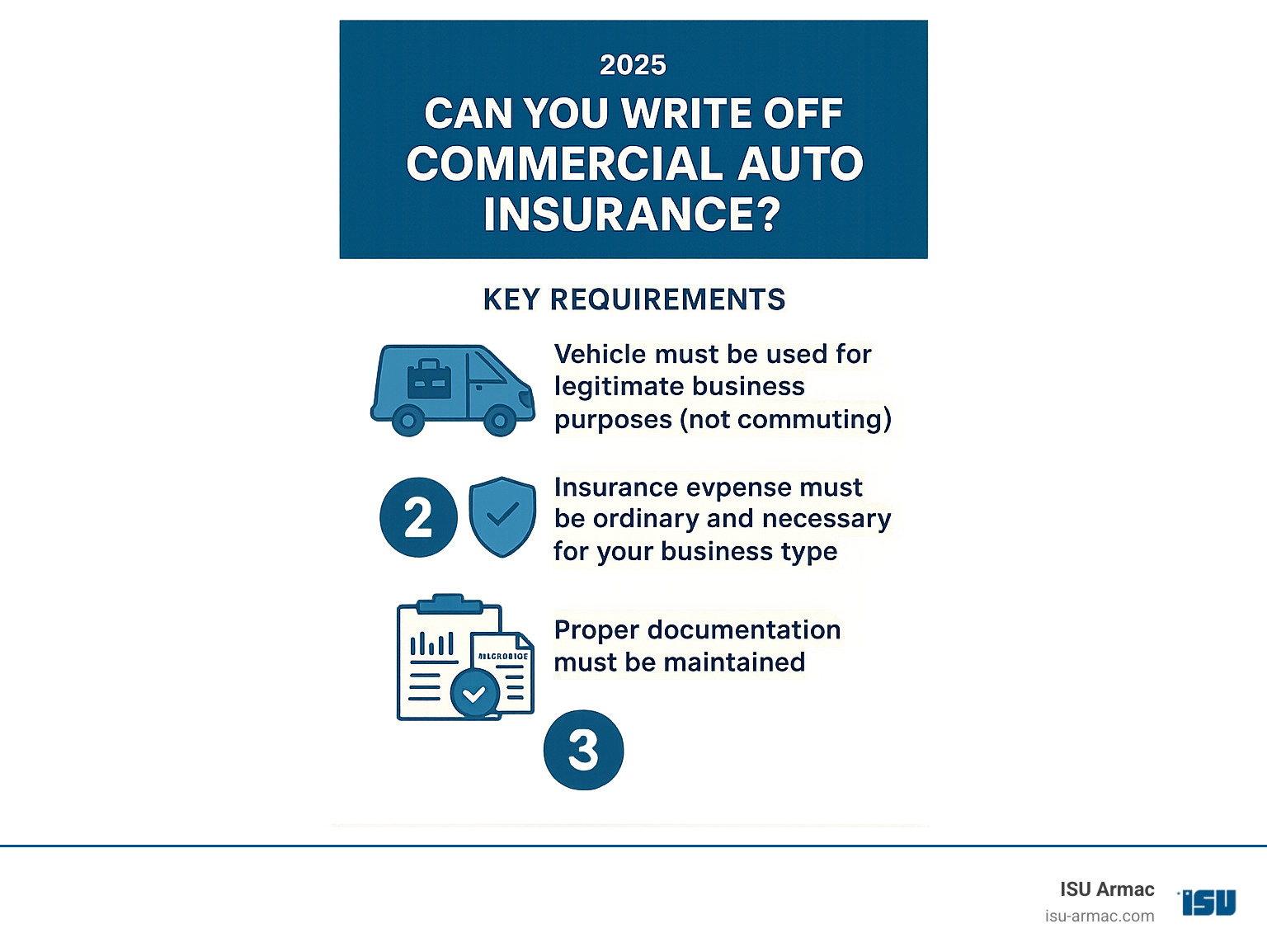
Can you write off commercial auto insurance? Yes, in most cases you can deduct commercial auto insurance premiums as a business expense if you use your vehicle for business purposes and meet IRS requirements for “ordinary and necessary” business costs.
Quick Answer for Business Owners:
- Self-employed individuals can deduct commercial auto insurance premiums.
- Business owners (sole proprietors, partnerships, LLCs, corporations) qualify for deductions.
- Vehicle must be used for business purposes (not commuting to a regular workplace).
- Choose between two methods: Actual Expense Method (includes insurance) or Standard Mileage Rate.
- Keep detailed records: mileage logs, receipts, and insurance policy documents.
- Report on Schedule C (Line 9) for most small businesses.
During tax season, maximizing deductions is key to reducing taxable income. For businesses that rely on transportation, vehicle expenses—including insurance premiums—are one of the largest potential write-offs, but the rules can be complex.
The Tax Cuts and Jobs Act significantly changed vehicle expense deductions, particularly for employees who can no longer deduct unreimbursed vehicle expenses. For business owners and the self-employed, however, commercial auto insurance remains a valuable tax deduction when properly documented.
I’m Ryan McEachron, CEO of ISU Insurance Services ARMAC Agency. With years of experience helping Victorville business owners steer insurance and tax implications, I’ve seen how understanding whether can you write off commercial auto insurance can significantly impact a company’s bottom line and the importance of proper vehicle expense planning.
Handy can you write off commercial auto insurance terms:
- how does commercial auto insurance work
- what does commercial auto insurance cover
- when do i need commercial auto insurance
Who Qualifies and What’s Deductible?

The Internal Revenue Service (IRS) has a simple test for business deductions: they must be ordinary and necessary for your trade or business. This means the expense should be common in your industry and helpful for your business operations. Can you write off commercial auto insurance? Absolutely – if you meet these criteria and use your vehicle for legitimate business purposes.
Who Can Claim Commercial Auto Insurance as a Business Expense?
The beauty of vehicle expense deductions is that they’re available to virtually every type of business structure. Whether you’re just starting out as a self-employed individual or running an established corporation, you can likely deduct your commercial auto insurance premiums.
Sole proprietors have it straightforward – any vehicle expenses directly tied to your business operations are deductible on your tax return. If you’re operating as a partnership with other business owners, the business can deduct insurance premiums for vehicles used in partnership activities. Corporations of all types – including LLCs, S-Corps, and C-Corps – can write off commercial auto insurance as a business expense.
Here’s where it gets interesting for today’s workforce: independent contractors and gig economy workers are considered self-employed by the IRS. This means whether you’re driving for rideshare companies, making deliveries, or visiting clients as a freelancer, you can deduct a portion of your auto insurance based on business use. The key is keeping accurate records of your business miles versus personal driving.
What Specific Types of Commercial Auto Insurance Are Deductible?
When we talk about deductible insurance costs, we’re looking at Commercial Auto Insurance policies designed specifically for business vehicle use. The good news? Pretty much every component of your commercial policy qualifies for deduction.
Liability coverage protects your business when you’re at fault in an accident – it’s typically required by law and fully deductible. Collision coverage handles damage from accidents with other vehicles or objects, while comprehensive coverage protects against theft, vandalism, and weather damage. Uninsured motorist coverage steps in when the other driver lacks adequate insurance.
Don’t overlook hired and non-owned auto insurance – this coverage is crucial if your business rents vehicles or has employees use their personal cars for work. The premiums for this specialized coverage are also deductible business expenses.
How Does the Business Use of a Vehicle Determine Deductibility?
This is where many business owners get tripped up, but the concept is actually pretty simple. The IRS draws a clear line between business use and personal use of your vehicle.
Business use includes driving to meet clients, visiting job sites, picking up supplies, making deliveries, or attending business meetings. These activities directly support your business operations and qualify for deductions.
Personal use covers your daily commute to a regular workplace, running errands, or family trips. Here’s a common misconception: driving from home to your main office is considered commuting, not business use, even if you make work calls during the drive.
The exception? If your home is your principal place of business, then driving from your home office to client locations counts as business travel. For mixed-use vehicles that serve both business and personal needs, you’ll need to track your business mileage carefully to determine what percentage of your total vehicle expenses you can deduct.
If you’re wondering about coverage nuances for vehicles used for both purposes, check out our guide on Does Commercial Auto Insurance Cover Personal Use? to understand how insurance and tax deductions work together.
How Can You Write Off Commercial Auto Insurance? Calculation Methods and Documentation

The IRS provides two distinct methods for deducting vehicle expenses. Understanding both will help you maximize your tax savings while staying compliant.
What is the Difference Between Claiming Insurance and Claiming Mileage?
You must choose between the Actual Expense Method or the Standard Mileage Rate Method for each vehicle. This choice directly impacts whether can you write off commercial auto insurance as a separate line item.
The Actual Expense Method involves tracking all vehicle-related spending, including commercial auto insurance premiums, gas, oil, repairs, tires, depreciation, and registration fees. You then calculate the business-use percentage of your total miles and apply that percentage to your total expenses. For example, if your vehicle use is 60% business and your annual insurance premium is $2,400, you could deduct $1,440 ($2,400 x 60%).
The Standard Mileage Rate Method simplifies record-keeping. You multiply your business miles by the IRS standard rate (65.5 cents per mile for 2023). However, this rate already includes an allowance for insurance, so you cannot deduct your commercial auto insurance premiums separately if you choose this method.
If you have high insurance premiums, significant repair costs, or a newer vehicle with substantial depreciation, the actual expense method may yield a larger deduction. If you prefer simpler record-keeping and drive many business miles, the standard mileage rate might be better.
Here’s a helpful comparison to guide your decision:
| Feature | Actual Expense Method | Standard Mileage Rate Method |
|---|---|---|
| Insurance Deduction | Yes, separately deductible based on business use | No, insurance cost included in per-mile rate |
| Record Keeping | Detailed expense tracking plus mileage logs | Mileage logs only |
| Best For | High vehicle expenses, newer vehicles, complex situations | High business mileage, simplified bookkeeping |
| Complexity | More paperwork but potentially higher deductions | Less paperwork but limited flexibility |
The best practice is to calculate your potential deduction both ways before filing. You can find current rates on the IRS standard mileage rates page.
What Documentation Proves You Can You Write Off Commercial Auto Insurance?
Excellent record-keeping is your best defense against an IRS audit. Without proper documentation, legitimate business expenses can be disallowed.
- Mileage Log: This is the foundation of your claim. For every business trip, record the date, destination, business purpose, and total miles driven or odometer readings. The IRS requires contemporaneous records, so track trips as they happen. Smartphone apps can simplify this process.
- Receipts: When using the actual expense method, keep every receipt for insurance premiums, fuel, repairs, tires, and registration. Tolls and parking fees are separately deductible under both methods, so save those receipts as well.
- Insurance Policy Documents: Keep copies of your policy declarations page and payment confirmations to verify your coverage and costs.
- Bank and Credit Card Statements: These provide additional verification for your expenses and create a paper trail to support your claims.
The IRS generally recommends keeping tax records for three years, but many tax professionals suggest holding onto vehicle-related documentation for six years.
How Do Leasing Costs Affect the Deductibility of Insurance?
If you lease a business vehicle, both your lease payments and commercial auto insurance premiums can be deductible. The process is similar to owned vehicles.
Lease payments are treated as operating expenses. You apply your business-use percentage to your annual lease costs to determine the deductible amount.
Commercial auto insurance for leased vehicles follows the same rules. Using the actual expense method, you can deduct the business-use percentage of your premiums. The fact that the vehicle is leased doesn’t change how insurance is treated.
If you choose to deduct actual expenses for a leased vehicle, you must use that method for the entire lease term; you cannot switch to the standard mileage rate.
Understanding all vehicle costs helps you decide if leasing or buying is better for your business. Our guide on the Cost Of Commercial Auto Insurance can help you factor these expenses into your analysis.
Reporting Deductions and Avoiding Common Mistakes

Properly claiming your vehicle deductions on your tax return is crucial. Getting it right saves money, while errors can trigger an audit or lead to lost deductions.
Where on Tax Forms Should Commercial Auto Insurance Expenses Be Reported?
Knowing where to report vehicle expenses simplifies the process. Your business structure determines the correct form.
- Sole Proprietors/Single-Member LLCs: Use Schedule C (Form 1040). Report vehicle expenses on Part II, Line 9, “Car and truck expenses.” This is where you report totals from either the Actual Expense or Standard Mileage Rate method.
- Corporations: S-Corporations (Form 1120S) and C-Corporations (Form 1120) report commercial auto insurance as a regular business expense on their corporate returns.
- Partnerships/Multi-Member LLCs: Use Form 1065 to report vehicle expenses. The tax benefits then flow through to each partner’s individual return via Schedule K-1.
Using a qualified tax professional or reliable tax software is valuable for ensuring deductions are reported correctly.
What are the rules if you can you write off commercial auto insurance for a mixed-use vehicle?
Many business owners use one vehicle for both business and personal trips. The IRS allows this, but you can only deduct the portion of expenses related to business use.
The calculation is (Business Miles / Total Miles) x Total Expenses. For example, if you drive 25,000 total miles with 18,000 being for business, your business-use percentage is 72%. If your annual insurance premium is $2,400, you can deduct $1,728 ($2,400 x 0.72).
Accurate mileage logs are absolutely critical for mixed-use vehicles. The IRS requires detailed, contemporaneous records showing dates, destinations, business purposes, and mileage. Without them, your deduction could be disallowed. This situation also raises insurance questions, as explored in our guide, Do I Need Both Commercial and Personal Auto Insurance?.
What Are Common Mistakes to Avoid When Claiming This Deduction?
Even experienced business owners can make costly errors when claiming vehicle deductions.
- Mixing personal and business expenses: Only costs related to business use are deductible. Keep personal and business expenses completely separate in your records.
- Poor record-keeping: The IRS requires proof. Missing receipts or incomplete mileage logs can invalidate your deductions.
- Deducting commuting miles: The daily drive from home to your primary workplace is considered personal commuting and is not deductible. An exception exists if your home is your principal place of business.
- Choosing the wrong deduction method: Automatically picking the standard mileage rate for simplicity might cost you money. Always calculate your deduction both ways to see which is more beneficial.
- Overlooking state-specific rules: State tax laws for vehicle deductions may differ from federal rules.
- Forgetting TCJA changes: The Tax Cuts and Jobs Act eliminated unreimbursed vehicle expense deductions for most employees through 2025. This deduction is now primarily for business owners and the self-employed.
Frequently Asked Questions about Writing Off Vehicle Insurance
Business owners often find themselves scratching their heads when it comes to vehicle expense deductions. After years of helping Victorville entrepreneurs steer these waters, I’ve noticed the same questions pop up again and again. Let’s clear up some of the most common confusion around can you write off commercial auto insurance and related vehicle expenses.
Can employees write off their car insurance if they use their car for work?
The short answer is no – most employees cannot deduct their car insurance, even if they use their personal vehicle for work tasks that their employer doesn’t reimburse.
This changed dramatically with the Tax Cuts and Jobs Act (TCJA) that took effect in 2018. Before then, employees could deduct unreimbursed business expenses as itemized deductions. The TCJA suspended this deduction through 2025, leaving most employees unable to write off vehicle expenses.
However, a few specific exceptions exist. Armed Forces reservists who travel more than 100 miles from home for their duties, qualified performing artists, and fee-basis state or local government officials can still claim these deductions under strict criteria.
For most W-2 employees, this deduction is unavailable until the rules potentially change after 2025. This is why structuring work as a business entity can offer significant tax advantages.
Are there any limits on how much commercial auto insurance I can deduct?
While the IRS doesn’t set a specific dollar cap on commercial auto insurance premiums, your deduction is limited by two key factors. First, the expense must be “ordinary and necessary” for your type of business, meaning the premium is reasonable for your industry and vehicle.
The biggest limitation is the business-use percentage rule. You can only deduct the portion of your premium that corresponds to your vehicle’s business use. If you drive 15,000 business miles out of 20,000 total miles, you can deduct 75% of your premium.
For high-value vehicles, there’s another consideration. The IRS imposes annual limits on depreciation for luxury vehicles, which can affect your total deduction under the Actual Expense Method. While this doesn’t directly cap your insurance deduction, it’s part of the overall vehicle expense strategy.
The key is maintaining accurate records that clearly demonstrate your business use percentage. Without proper documentation, even a reasonable premium could be challenged.
Can I deduct my car insurance deductible payment on my taxes?
Yes, and this often surprises business owners. If you use the Actual Expense Method, the deductible you pay for a business-related insurance claim can be included as a business expense for that tax year.
When your business vehicle is damaged, the insurance deductible is a direct, out-of-pocket cost of maintaining your business operations.
Just like any other actual expense, you must apply your business-use percentage to determine the deductible portion. If your vehicle is used 80% for business, then 80% of that deductible payment becomes a business expense.
This only works if you’ve chosen the Actual Expense Method. If you’re using the Standard Mileage Rate, the deductible payment is considered part of the costs already built into the per-mile rate and cannot be deducted separately.
Keep detailed records of the payment and documentation showing the business-related nature of the claim to create a clear paper trail.
Secure Your Business and Your Bottom Line
Understanding can you write off commercial auto insurance is about making smart decisions that protect your operations and financial future. You’re now equipped with the knowledge to maximize this valuable deduction.
Business vehicle tax planning comes down to a few fundamental truths. Business use must be legitimate and well-documented to stand up to IRS scrutiny. Whether you’re a contractor, real estate agent, or delivery driver, your vehicle expenses represent real costs of doing business.
Choosing between the Actual Expense Method and Standard Mileage Rate can significantly impact your tax savings. With actual expenses, you can deduct your commercial auto insurance premiums based on business use. With the standard mileage rate, those costs are already baked into the per-mile calculation.
Meticulous record-keeping cannot be overstated. Mileage logs, policy documents, and receipts are your proof for the IRS that your deductions are legitimate. A simple mileage tracking app and a dedicated folder for receipts can save you headaches and potentially thousands in tax savings.
At ISU Armac, we’ve seen how the right commercial auto insurance policy does double duty. It protects your business from the financial devastation of an accident or liability claim, and it provides deductible premiums that help reduce your taxable income.
Our approach goes beyond just comparing prices. We shop multiple carriers to find policies that offer comprehensive protection at competitive rates, ensuring your insurance investment works as hard as you do. Whether you’re operating in Victorville, Apple Valley, Hesperia, or throughout the High Desert region, we understand the unique challenges local businesses face.
Tax compliance and proper coverage go hand in hand. While we can’t provide specific tax advice—that’s a job for a qualified tax professional—we can help you secure the commercial auto insurance that makes these deductions possible.
Ready to take the next step? Our Navigating Business Auto Insurance: A Comprehensive Comparison Guide will help you understand your coverage options and choose the right policy for your business needs.
Your business vehicle is an investment in your success. Ensure it’s properly protected and tax-optimized with the right commercial auto insurance coverage.