
Why Small Business Health Insurance Rates Matter More Than Ever
Decisions about group health insurance rates for small business can make or break your budget and your ability to attract top talent. As a Victorville business owner, you face a critical challenge: finding affordable health benefits that keep your team happy without hurting your bottom line.
Quick Answer: Average Group Health Insurance Costs for Small Businesses (2023)
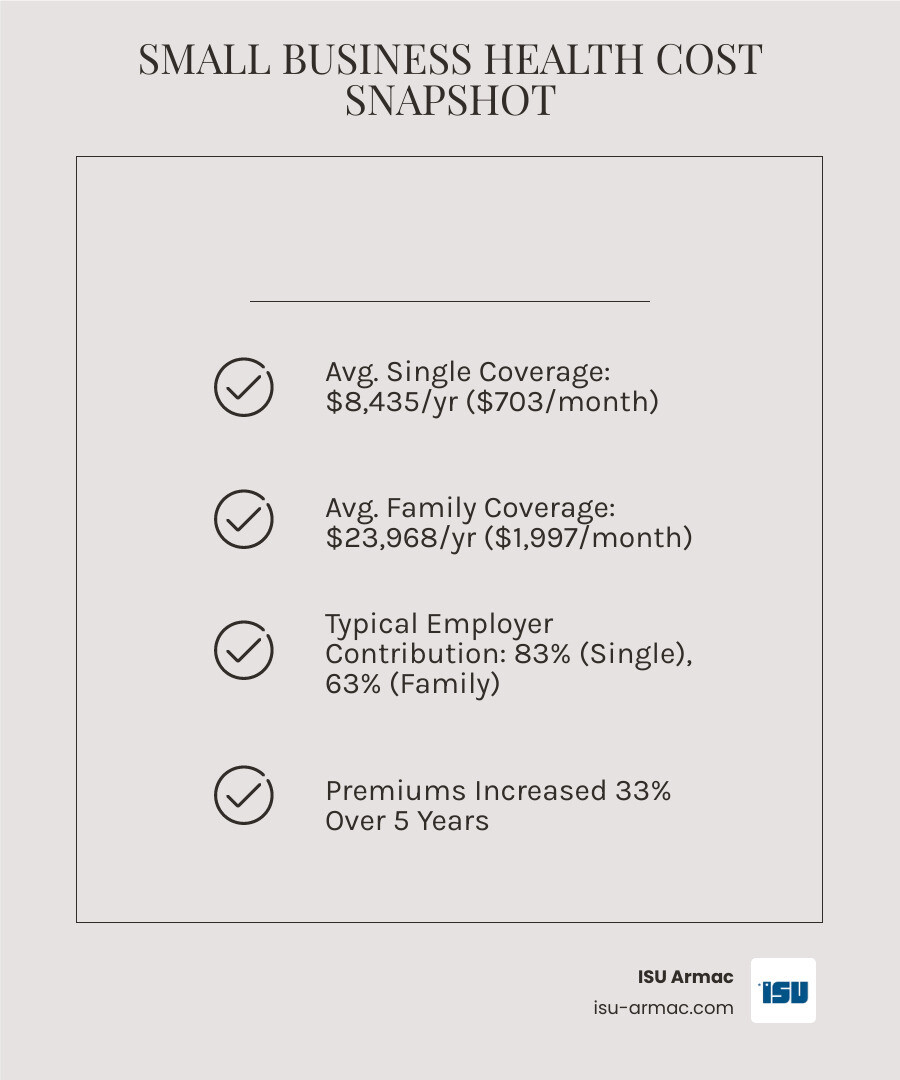
- Single Coverage: $8,435 annually ($703/month per employee)
- Family Coverage: $23,968 annually ($1,997/month per employee)
- Typical Employer Contribution: 83% for single plans, 63% for family plans
- Small Business Range: Most pay between $6,485-$13,737 per employee annually
The numbers tell a stark story. Premiums for small businesses have grown 33% over five years, with many spending nearly 12% of their payroll on health costs, compared to just 7% for larger companies.
However, your rates aren’t set in stone. Factors like industry, location, employee demographics, and plan design can dramatically impact your costs. Understanding these variables and working with the right insurance partner can save you thousands while providing the coverage your employees need.
I’m Ryan McEachron, CEO of ISU Insurance Services ARMAC Agency. For over two decades, I’ve helped local businesses steer group health insurance rates for small business challenges. My experience on the Victorville City Council and with High Desert businesses has shown me how smart insurance decisions fuel growth and employee satisfaction.
Similar topics to group health insurance rates for small business:
- medical insurance options for small business
- association health plans for small business
- can a small business pay for individual health insurance
What is the Average Cost of Small Business Health Insurance?
Let’s cut to the chase – group health insurance rates for small business aren’t getting cheaper. According to the latest Kaiser Family Foundation 2023 Survey, small businesses saw a 7% premium increase in one year.
Average annual premiums for small firms are now $8,435 for single coverage and $23,968 for family coverage. This upward trend shows no signs of slowing down.

However, employers don’t shoulder this burden alone. Employer contributions typically cover the majority of these costs. For single coverage, employers pick up an average of 83% of the premium ($6,485). For family coverage, employers still cover a substantial 63% of the premium ($13,737).
Broken down into monthly premium estimates, you’re looking at about $703 per month for single coverage and $1,997 per month for family coverage per employee. This is the total premium before the employee’s portion is paid.
Small businesses now spend nearly 12% of their payroll on health coverage, compared to 7% for larger companies. Understanding these costs upfront helps you plan better and make smarter decisions about plan design and contributions.
How Group Health Insurance Plans Differ in Cost from Individual Plans
Group plans offer a significant risk pool advantage. Instead of pricing based on each person’s health history, insurers spread the risk across your entire team. This typically results in lower, more stable premiums.
This group rate benefit means your premiums are based on the group’s overall demographics, not individual health conditions. Another key advantage is the ability to shop for coverage year-round, offering flexibility that individual market enrollment windows don’t. This is crucial for growing businesses adding new team members.
The cost difference can be substantial compared to individual plans, where premiums are tied to personal circumstances. Group coverage levels the playing field. To learn more about how individual plans work, visit Individual Medical.
Understanding Employee Out-of-Pocket Costs
The monthly premium is just the start. When your team needs medical care, they face additional out-of-pocket costs that impact their finances. These include:
- Deductibles: The amount an employee pays before insurance begins to pay, often ranging from $1,000 to over $5,000.
- Copayments: Fixed amounts for services, like $30 for a doctor visit.
- Coinsurance: The percentage of costs an employee pays after meeting their deductible (e.g., 20% in an 80/20 split).
- Out-of-Pocket Maximum: The annual cap on an employee’s medical expenses, providing a crucial safety net.
Prescription drug costs also vary significantly between plans based on the formulary and tier structure. The metal tier system (Bronze, Silver, Gold, Platinum) helps balance these costs. Bronze plans have lower premiums but higher out-of-pocket expenses, while Platinum plans have the highest premiums and lowest out-of-pocket costs.
Understanding these costs helps you choose a plan that keeps your team healthy and financially stable. When employees can afford care, they stay healthier and more productive. Learn more about optimizing these benefits at Employee Health Coverage.
Key Factors That Drive Your Group Health Insurance Rates for Small Business
Think of group health insurance rates for small business like a recipe; small variations in your business profile can significantly impact what you pay. Insurance companies evaluate specific risk factors to predict your group’s potential healthcare costs.
Understanding these factors puts you in the driver’s seat. Your employee demographics, location, industry, business size, and the type of plan you choose all play a role in determining your final rates.

Once you know what drives these costs, you can make smarter decisions about everything from hiring to plan design. For a comprehensive look at how we tailor solutions based on these factors, visit Health Insurance for Small Business.
How Employee Demographics and Location Impact Premiums
Your team’s makeup and your business location significantly impact your premiums.
- Age: Healthcare costs generally increase with age, so an older workforce often leads to higher premiums. Insurers use “age bands” to calculate rates based on employee age.
- Tobacco use: Smokers typically face higher individual rates due to increased health risks. Many plans offer wellness programs to help employees quit, which can lower future costs.
- Location: Healthcare costs vary dramatically by region. Factors like local provider networks and facility costs mean that a Health Insurance Victorville CA quote will differ from one in Los Angeles or San Diego. Your business’s zip code is a key pricing factor.
- Industry: While the ACA limits its impact on small group pricing, your industry can still cause slight rate variations due to occupational factors.
The Role of Employer Contributions and Business Size
Your contribution strategy and business size are key financial levers. Most insurers require you to contribute at least 50% of the employee-only premium, a benchmark that also helps you qualify for federal tax credits.
Going beyond the minimum is a powerful recruitment and retention tool, as 87% of employees consider health benefits extremely important. It’s an investment in your team.
Business size also affects your rates. Larger groups can spread risk more effectively, often resulting in more favorable pricing. A major health event has less impact on a group of 50 than a group of five. This is why smaller businesses often spend a higher percentage of their payroll on health insurance than larger companies—they have less negotiating power and a smaller risk pool.
While businesses with fewer than 50 employees aren’t required by the ACA to offer insurance, doing so provides a significant competitive advantage. The Benefits of Offering Health Insurance to Employees often outweigh the costs through reduced turnover and improved productivity.
Navigating Your Options: Plan Types and Cost-Saving Strategies
When evaluating group health insurance rates for small business, the cheapest premium isn’t always the best deal. The key is finding the sweet spot where employees get meaningful coverage without breaking your budget. This means understanding different plan structures, leveraging tax benefits, and knowing when to call in an expert.

A smart benefits strategy helps you compete for talent while maintaining financial flexibility. Every business has unique needs, which is why we offer comprehensive guidance at Small Business Health Insurance Options.
How Plan Types Affect Group Health Insurance Rates for Small Business
Your choice of plan type directly impacts monthly premiums and your employees’ healthcare experience. Here are the most common options:
- HMO (Health Maintenance Organization): Offers lower premiums but requires members to use a specific network, choose a primary care physician (PCP), and get referrals for specialists.
- PPO (Preferred Provider Organization): Provides more flexibility with larger networks and no referral requirements for specialists. This freedom comes with higher premiums.
- High-Deductible Health Plans (HDHPs): Feature lower premiums in exchange for higher deductibles. They are often paired with a tax-advantaged Health Savings Account (HSA).
| Plan Type | Network Size & Flexibility | Typical Cost (Premium) | Key Features |
|---|---|---|---|
| HMO (Health Maintenance Organization) | Smaller, more restricted network; requires PCP and referrals for specialists. | Generally Lower | Emphasis on coordinated care, often lower out-of-pocket costs within network. |
| PPO (Preferred Provider Organization) | Larger network, more flexibility; no referrals needed for specialists. | Generally Higher | Can go out-of-network (but at higher cost); greater choice of doctors. |
| HDHP (High-Deductible Health Plan) | Can be HMO or PPO; features higher deductibles. | Generally Lower | Often paired with an HSA (Health Savings Account) for tax-advantaged savings. |
| POS (Point of Service) | Hybrid of HMO and PPO; requires PCP and referrals for in-network, but allows out-of-network at higher cost. | Moderate | Balances cost savings with some flexibility. |
| EPO (Exclusive Provider Organization) | Similar to PPO but no out-of-network coverage (except emergencies); no referrals needed. | Moderate | More network choice than HMO, but strict about in-network only. |
The metal tiers (Bronze, Silver, Gold, Platinum) also affect costs. Bronze plans have the lowest premiums and highest out-of-pocket costs, while Platinum plans have the highest premiums and lowest out-of-pocket costs. The best choice depends on your workforce. We help you analyze these trade-offs at Medical Insurance Options for Small Business.
Tax Credits and Deductions You Can’t Afford to Miss
Offering health insurance can be a win-win. First, every dollar you spend on employee health insurance premiums is tax deductible as a business expense, reducing your taxable income.
The real game-changer is the Small Business Health Care Tax Credit. This is a direct credit that reduces the tax you owe. If you qualify, you can get up to 50% of your premium costs back (35% for tax-exempt organizations).
To qualify, you need fewer than 25 full-time equivalent employees, average wages of $56,000 or less, and you must pay at least 50% of employees’ premiums through the Small Business Health Options Program (SHOP). The IRS provides detailed guidance on the Small Business Health Care Tax Credit, and you can estimate your savings with the Healthcare.gov tax credit estimator.
The Role of an Insurance Broker and Support Services
Navigating group health insurance rates for small business alone is challenging. Working with an independent broker like ISU Armac simplifies the process and ensures you get the best value. Unlike agents tied to one company, we partner with multiple top-rated carriers to shop the entire market for you. We provide:
- Carrier Shopping & Plan Selection: We find plans that fit your budget and provide expert guidance on deductibles, networks, and coverage.
- Compliance Support: We help you stay compliant with changing ACA, ERISA, and state regulations.
- Renewals & Negotiations: We work with carriers to minimize rate increases and secure the best terms.
- Employee Communication: We assist with enrollment and help your team understand their benefits.
Our local knowledge of the Victorville and High Desert market gives us unique insight into regional cost factors. We simplify a complex process, saving you time and money. Learn more about How to Get Health Insurance for My Small Business.
Frequently Asked Questions about Small Business Health Insurance Rates
When it comes to group health insurance rates for small business, we hear the same thoughtful questions from business owners week after week. Let me address the most common ones.
Are small businesses required to provide health insurance?
Under the Affordable Care Act (ACA), businesses with fewer than 50 full-time equivalent employees are not required to offer health insurance and face no penalties for not doing so.
However, not being required doesn’t mean it’s not essential. With 87% of employees calling health insurance “extremely important” when considering a job, offering benefits is a critical tool for attracting and retaining top talent.
Offering coverage improves employee loyalty, reduces financial stress, and shows you care about your team’s wellbeing. While most states follow federal guidelines, we always check local rules to ensure compliance. For a deeper dive, visit Are Small Businesses Required to Provide Health Insurance?.
How can I get a quote for my small business?
Getting an accurate quote is straightforward. We need some key information:
- Your business zip code to determine your geographic rating area.
- The number of eligible employees (most carriers require at least two).
- Basic demographics like employee ages and tobacco use status.
- Your desired coverage level and employer contribution strategy.
With this information, we shop multiple carriers and present you with clear, jargon-free comparisons. The Small Business Health Options Program (SHOP) Marketplace is another avenue to explore. Learn more about how to Shop Small Business Health Options Program for your specific needs.
What are the administrative costs of managing a group plan?
Beyond premiums, managing a group plan involves significant administrative costs, primarily in time and compliance.
- Time Commitment: Expect to spend significant time on benefits administration, especially during the annual renewal season. This can add up to over two full work weeks per year.
- Regulatory Compliance: Staying compliant with complex ACA and ERISA mandates is crucial to avoid steep penalties. This includes tracking hours, providing notices, and filing reports.
- Annual Renewals & Employee Support: The renewal process involves analyzing rate increases and managing re-enrollment. You’ll also need to handle ongoing employee questions about coverage and claims.
A broker handles these tasks for you, managing compliance, renewals, and employee support. It’s like having a benefits department without the overhead. Explore how we simplify Employee Healthcare Plans for businesses just like yours.
Conclusion
Understanding group health insurance rates for small business is the first step to controlling costs. As we’ve covered, factors like employee demographics, location, plan type, and contribution levels all shape your premiums.
While average annual premiums of $8,435 for single and $23,968 for family coverage are significant, you are not powerless. Strategic planning can dramatically lower your costs while delivering valuable coverage.
Leverage the risk pool advantage of group plans, take advantage of tax deductions and credits, and choose the right plan type (HMO, PPO, or HDHP) to balance premiums with out-of-pocket costs. This allows you to create a package that fits your budget and your team’s needs.
Offering health benefits is also a powerful tool for attracting and retaining talent, as most employees consider it an essential benefit. It’s an investment in a stable, productive workforce.
As costs rise, having an expert partner is critical. Our local knowledge in Victorville and the High Desert, combined with our ability to shop multiple carriers, uncovers the best value for your business.
With thoughtful plan selection and expert guidance, you can create a benefits package that strengthens both your team and your bottom line. Ready to find what’s possible for your business? Find the best small business medical insurance for your team and let us show you how the right partnership can make all the difference.