
Why Employee Health Coverage Matters More Than Ever
Employee health coverage is the largest source of health insurance for working Americans, providing medical care, financial protection, and helping businesses attract and retain talent.
Key facts about employee health coverage:
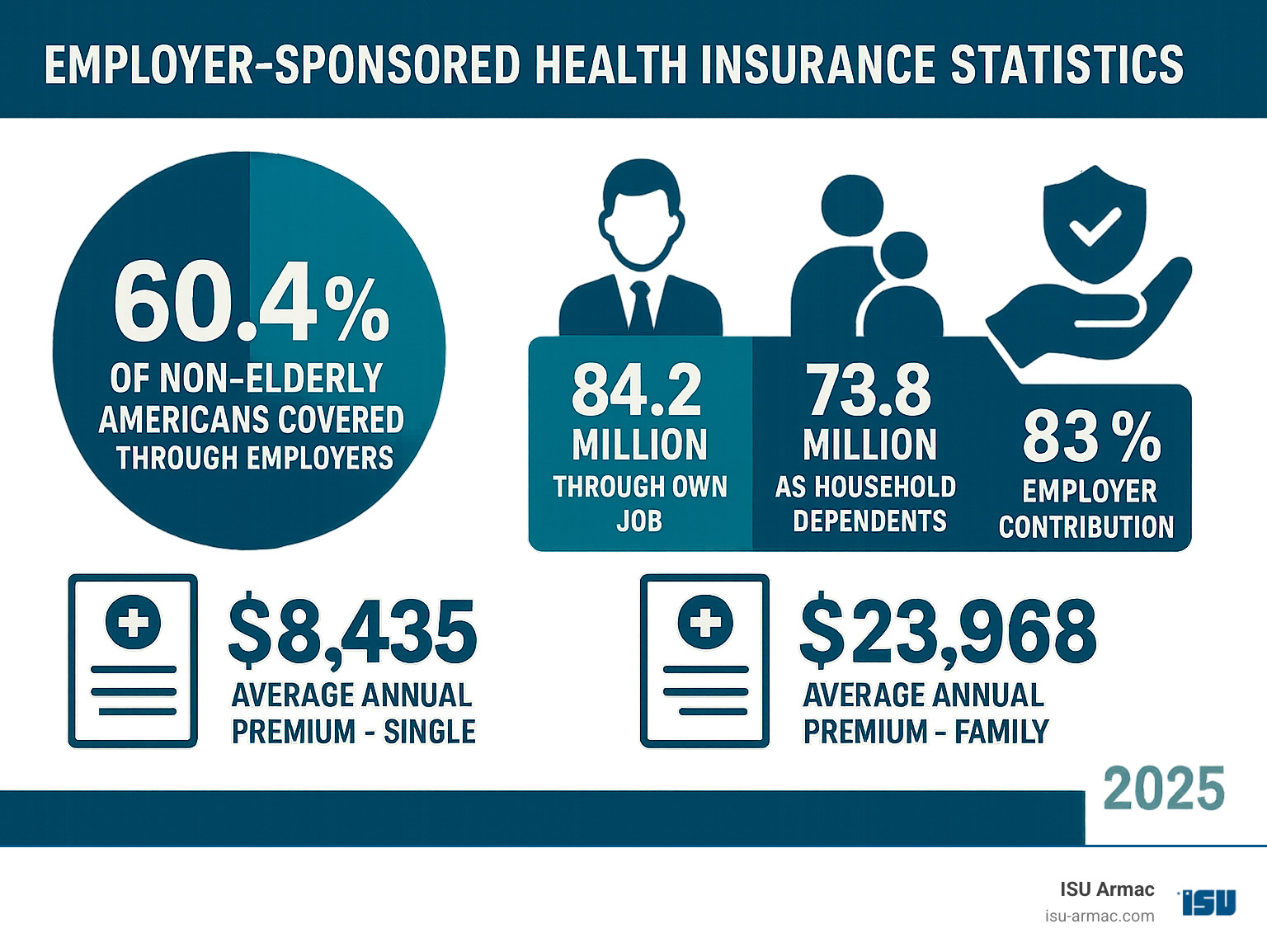
- 164.7 million Americans rely on employer-sponsored health insurance
- Average costs in 2023: $8,435 for single coverage, $23,968 for family coverage
- Employer contribution: Typically covers 83% of single premiums, 71% of family premiums
- Legal requirements: Businesses with 50+ full-time employees must offer coverage under the ACA
- Plan types: PPO, HMO, High-Deductible Health Plans with various network options
For California businesses, understanding employee health coverage is about creating a competitive advantage. Offering comprehensive health benefits improves employee retention and attracts top talent.
The system uses risk pooling, where employers negotiate group rates. This approach offers better coverage at lower costs than individual plans, with significant tax advantages for both employers and employees.
I’m Ryan McEachron, CEO of ISU Armac in Victorville. With over two decades of experience, I’ve helped countless businesses steer employee health coverage to protect their workforce and manage costs. My work with local organizations has shown me how the right coverage strengthens our entire community.
Employee health coverage terms made easy:
- association health plans for small business
- can a small business pay for individual health insurance
- shop small business health options program
Understanding Employer-Sponsored Insurance: The Bedrock of U.S. Health Coverage
Born from WWII-era wage freezes, employer-sponsored health insurance was a creative way to attract workers. Decades later, this innovation is the backbone of American healthcare, with over 164 million people relying on it today.

This system wasn’t designed by policy experts but emerged from business needs, getting a major boost when the War Labor Board made these benefits tax-free. That decision created the foundation for today’s ESI tax exclusion, making these plans financially attractive.
Why ESI is the Dominant Form of Coverage
The success of ESI lies in risk pooling. By covering a group of workers with diverse health levels, employers create a balanced risk pool. This group coverage approach prevents “adverse selection,” where only sick people buy insurance, driving up costs. ESI’s diverse risk pools keep premiums stable and affordable.
The financial benefits are significant. Employers can deduct their contributions to employee health coverage as a business expense, while employees pay their share with pre-tax dollars. This tax advantage is a key benefit over individual health plans.
Convenience is another factor. Employers handle enrollment, premium collection, and administration for the entire workforce, simplifying the process for everyone. For more details, see our guide to Employer Sponsored Health Insurance. Most insurers require at least 75% employee participation to maintain a healthy risk pool, which is why we often recommend group plans to our business clients.
How It Works: Fully-Insured vs. Self-Funded Plans
When offering health benefits, businesses choose between fully-insured and self-funded plans. The right choice depends on company size and risk tolerance.
Fully-insured plans are the traditional model. The employer pays a fixed monthly premium to an insurance carrier, which assumes all financial risk for employee medical claims. This approach offers predictable costs, making it popular with small businesses. The carrier handles claims, networks, and compliance, providing expertise that would be costly for employers to develop alone.
Self-funded plans are different. Employers pay employee healthcare claims directly from their own funds. While it sounds risky, many large employers choose this route for its greater control and potential savings. Stop-loss insurance is crucial here. It protects self-funded employers from catastrophic claims by capping their financial exposure, both for individual high-cost claims (specific) and total annual claims (aggregate). Self-funded plans offer more flexibility and potential savings but require more administrative resources, making them more common among large employers.
Decoding Your Options: A Guide to Health Plan Types and Networks
Choosing employee health coverage is like picking a cell phone plan; each option offers a different balance of flexibility, cost, and access. The key is finding the right fit for your needs and budget.

Choosing Your Plan: PPOs, HMOs, and High-Deductible Options
Employers typically offer four main types of plans:
Preferred Provider Organizations (PPOs) are the most popular choice, offering a balance of flexibility and cost control. PPOs have a network of “preferred” providers for lower costs, but you can go out-of-network for a higher cost. No referrals are needed for specialists.
Health Maintenance Organizations (HMOs) are a budget-conscious option. You choose a primary care physician (PCP) to coordinate care and provide specialist referrals. Staying in-network keeps costs low; out-of-network care (except for emergencies) is typically not covered.
Point of Service (POS) plans are a hybrid. Like an HMO, you have a PCP and need referrals. But like a PPO, you can go out-of-network if you’re willing to pay more.
High-Deductible Health Plans (HDHPs) are gaining popularity, with nearly 3 in 10 workers choosing them. They feature lower monthly premiums in exchange for higher out-of-pocket costs. HDHPs are often paired with Health Savings Accounts (HSAs), which offer a triple tax advantage: contributions are tax-deductible, funds grow tax-free, and withdrawals for medical expenses are tax-free. Many employers also contribute to employee HSAs.
| Feature | PPO | HMO | POS | HDHP (HSA-qualified) |
|---|---|---|---|---|
| Network | In-network and Out-of-network | In-network only (except emergencies) | In-network and Out-of-network | In-network and Out-of-network |
| PCP Required? | No | Yes | Yes | No |
| Referrals | No | Yes, for specialists | Yes, for specialists | No |
| Premiums | Higher | Lower | Mid-range | Lower |
| Deductible | Moderate | Low | Moderate | High |
| Out-of-Pocket | Higher for out-of-network | Generally lower (if staying in-network) | Higher for out-of-network | High, but HSA can offset |
| Flexibility | High | Low | Moderate | High (with HSA) |
| Typical User | Values choice, sees specialists often | Prefers lower costs, uses PCP regularly | Wants some flexibility, lower premiums | Healthy, wants tax savings, manages own care |
For more details, visit our Employee Healthcare Plans page.
The Power of the Network: How It Affects Your Care and Costs
Your plan’s provider network determines your access to care and what you’ll pay. Using in-network providers—doctors and hospitals with pre-negotiated rates—means lower costs for you. Going out-of-network may result in higher costs or no coverage, depending on your plan.
Broad networks offer more choice in doctors and hospitals but often come with higher premiums. This is valuable if you have specific provider relationships or live in an area with limited options.
Narrow networks offer fewer choices but can lead to lower premiums, as insurers negotiate better rates with a smaller group of providers. In 2023, 9% of firms offered at least one narrow network plan.
Your network choice has real-world implications. For example, in 2023, while most firms felt their plans offered timely primary care access, only 67% were confident about access to mental health providers, highlighting a critical gap to consider. The bottom line is to align your network choice with your healthcare needs and budget. For more information, check out our Group Medical Insurance page.
The Financial Side of Employee Health Coverage
Understanding the financial side of employee health coverage is crucial. It involves your monthly premium and the out-of-pocket expenses you incur when using care. Let’s break down who pays for what.

Premiums and Contributions: Who Pays for What?
The premium is the monthly cost to keep your health insurance active. In 2023, the average total cost for employee health coverage was $8,435 for single coverage and $23,968 for family coverage. Fortunately, you don’t pay the full amount.
Employers typically cover most of the premium. On average, workers paid 17% for single coverage (about $1,401 annually) and 29% for family coverage (about $6,575 annually) in 2023. These contributions are typically made before taxes, reducing your taxable income and saving you money.
Interestingly, 30% of workers at small firms had their entire single premium covered by their employer in 2023, compared to only 6% at large firms. Premium growth has been reasonable, rising 22% over the last five years, in line with inflation (21%) and slower than wage growth (27%). For employers, these contributions are a significant investment, as explained in the Benefits of Offering Health Insurance to Employees.
Beyond the Premium: Your Guide to Out-of-Pocket Costs
When you use healthcare services, you’ll have out-of-pocket costs.
Your deductible is the amount you pay before your insurance begins to pay. In 2023, 90% of covered workers had a deductible, with an average of $1,735 for single coverage. Deductibles were higher at smaller firms ($2,434) than at large ones ($1,478).
After meeting your deductible, you’ll have copayments (a flat fee, like $30 for a doctor visit) or coinsurance (a percentage of the bill, like 20%).
The out-of-pocket maximum is your safety net. Once you reach this annual limit, your insurance covers 100% of covered services for the rest of the year, protecting you from catastrophic medical bills. Understanding the federal out-of-pocket maximum helps you know your worst-case financial scenario. While most people spend about 4% of their income on premiums and out-of-pocket costs, this can be a heavier burden for lower-wage workers.
Staying Compliant: Key Regulations for Employers
Offering employee health coverage requires navigating a complex web of federal regulations. Compliance is the foundation of a benefits program that serves employees and protects your business from penalties.

Key Federal Laws Governing employee health coverage
Several major federal laws shape employee health coverage.
ERISA (Employee Retirement Income Security Act) of 1974 is the rulebook for transparency and fairness. It requires employers to act as a fiduciary, meaning you must maintain plan documents, provide clear summaries (Summary Plan Descriptions) to employees, and have a formal grievance process. Self-funded plans fall under ERISA and are generally not subject to state insurance laws, allowing more flexibility. The Department of Labor offers detailed information on ERISA plan requirements.
The Affordable Care Act (ACA) of 2010 introduced the employer mandate, which requires businesses with 50+ full-time employees to offer affordable, minimum essential coverage or face penalties. The law also expanded dependent coverage to age 26 and eliminated denials for pre-existing conditions. A 2023 fix to the “family glitch” now allows more family members to access marketplace subsidies if their employer’s family plan is unaffordable.
COBRA (Consolidated Omnibus Budget Reconciliation Act) is a safety net for employees. It allows them to continue their group coverage after a job loss or other qualifying event by paying the full premium plus a small administrative fee. Employers are responsible for providing COBRA notices and managing the process. It’s important to know what to know about COBRA to remain compliant.
How Business Size Impacts Your Health Insurance Obligations
Your legal obligations for employee health coverage depend on your business size.
Small employers (fewer than 50 full-time equivalent employees) are not federally required to offer health insurance. Many do so to attract and retain talent. Those that do can use the Small Business Health Options Program (SHOP) Marketplace. The SHOP Marketplace allows eligible small employers to claim the Small Business Health Care Tax Credit, which can offset up to 50% of premium costs. For more details, see our guide on the Shop Small Business Health Options Program.
Large employers (50 or more full-time equivalent employees) are considered Applicable Large Employers (ALEs) under the ACA. They must offer affordable, minimum essential coverage to full-time employees and their dependents or face significant penalties. This explains why 98% of firms with 200+ employees offered benefits in 2023, compared to just 39% of firms with three to nine workers. If you’re wondering Are Small Businesses Required to Provide Health Insurance?, the answer depends on your size.
Frequently Asked Questions about Employee Health Coverage
When it comes to employee health coverage, health insurance affects your finances and well-being, so clear answers are important. Here are the most common questions we hear.
How much does employee health insurance cost?
In 2023, the average annual premium was $8,435 for single coverage and $23,968 for family coverage. Employees don’t pay the full cost. On average, they contributed 17% for single coverage (about $1,401 per year) and 29% for family coverage (around $6,575 annually). Beyond premiums, you’ll also have out-of-pocket costs like deductibles, copayments, and coinsurance. The average single-coverage deductible was $1,735 in 2023, but it was higher at smaller firms ($2,434) than at larger ones ($1,478).
Are employers required to offer health insurance?
Business size is the key factor. Under the Affordable Care Act, businesses with 50 or more full-time equivalent employees (known as Applicable Large Employers or ALEs) must offer affordable, minimum-value health coverage or face penalties. Businesses with fewer than 50 employees have no federal requirement to offer coverage. However, many small businesses offer it to attract and retain talent, as solid health benefits can be a deciding factor for job candidates.
What happens to my health coverage if I leave my job?
Losing your job doesn’t mean losing health coverage entirely, but your options will change.
COBRA continuation coverage lets you keep your group health plan for a limited time (typically 18 months). The catch is you must pay the full premium plus a small administrative fee (up to 2%), so your monthly cost will be significantly higher.
The Health Insurance Marketplace is another option. Losing job-based coverage is a “qualifying life event,” allowing you to enroll in a new plan outside of the standard open enrollment period. You may qualify for income-based subsidies that make these plans more affordable.
Finally, you may be able to join a family member’s plan. If your spouse has employee health coverage, or if you are under 26, you may be eligible to join their plan during a Special Enrollment Period triggered by your job loss. You generally have 60 days to make a decision, so it’s important to act quickly.
Conclusion: Making Informed Decisions for Your Health and Business
Understanding employee health coverage is foundational to making smart choices. Whether you’re an employer attracting talent or an employee maximizing benefits, the key is making informed decisions that align with your needs and budget.
Throughout this guide, we’ve covered the essentials. From its history to plan comparisons, cost management, and compliance, each piece is crucial for effective employee health coverage strategies.
For business owners, offering health benefits is an investment in your team’s well-being, which impacts productivity, retention, and your company’s reputation. Secure employees are focused employees who help your business thrive.
The financial details we’ve covered—premiums, out-of-pocket costs, and plan types like PPOs, HMOs, and HDHPs with HSAs—give you the knowledge to weigh your options effectively. Understanding key laws like ERISA, the ACA, and COBRA is essential for protecting everyone’s rights and avoiding costly penalties.
At ISU Armac in Victorville, we help Southern California businesses and individuals steer these decisions. We shop multiple carriers to find the best coverage at competitive rates for clients in Apple Valley, Hesperia, and our entire region. We believe everyone deserves quality, affordable healthcare coverage.
The health insurance world evolves, but the fundamentals don’t: employee well-being should always be the priority. When businesses prioritize their team’s health and employees understand their options, everyone wins.
Ready to take the next step? For businesses exploring their options, our comprehensive guide to Small Business Medical Insurance offers detailed insights custom specifically for smaller employers. We’re here to help you make sense of it all and ensure your health coverage truly works for you.