
Why Small Businesses Are Switching to Individual Health Insurance Solutions
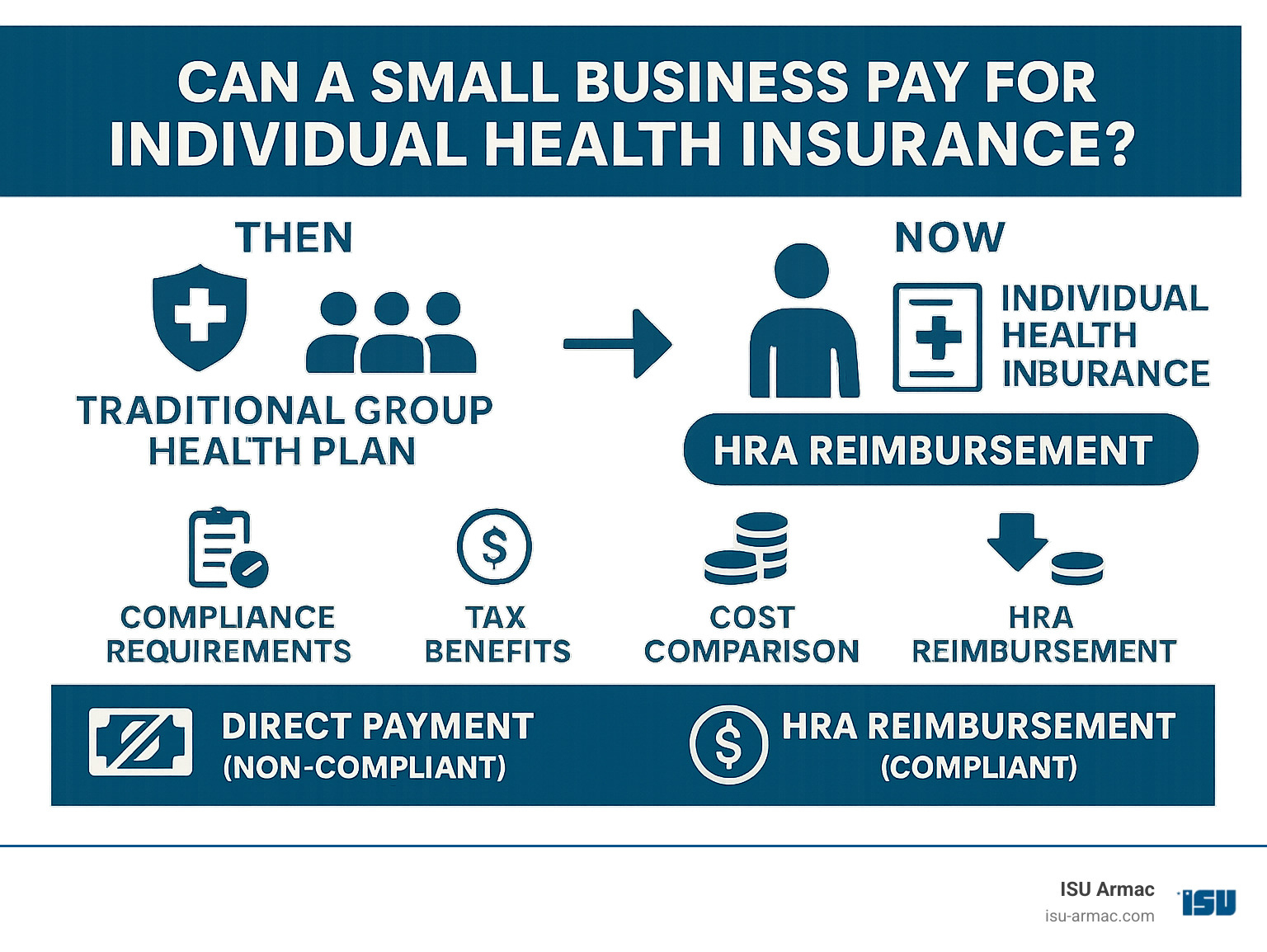
Can a small business pay for individual health insurance? Yes—when it is done through a compliant reimbursement strategy rather than by writing a premium check directly.
Quick answer:
- Direct payment of an employee’s individual premium: Not allowed—creates tax penalties and ACA compliance issues.
- HRA reimbursement: Allowed and tax-favored—premiums and other medical costs are reimbursed tax-free, and the business writes off the expense.
- Best options: QSEHRA (under 50 FTEs) or ICHRA (any size).
- Budget control: Employers set a fixed monthly allowance instead of absorbing unpredictable group-plan renewals.
Although employers with fewer than 50 employees are not required to offer coverage, 53 percent still try because reliable health benefits help attract and keep talent. The 2015 ACA rule change made direct premium payments a compliance minefield, yet modern Health Reimbursement Arrangements (HRAs) give entrepreneurs the best of both worlds—helping staff while protecting the bottom line.
I’m Ryan McEachron, CEO of ISU Insurance Services ARMAC Agency in Victorville. After 25 years helping businesses in Apple Valley, Hesperia, Oak Hills and across Southern California, I’ve seen HRAs revolutionize how smaller firms solve the “we want benefits but can’t afford group insurance” dilemma.
Key terms you’ll see throughout this guide:
- Association health plans for small business
- SHOP Small Business Health Options Program
- Small business health exchange
The Problem with Direct Payments: Legal and Tax Rules

Paying an employee’s individual policy premium directly seems generous but turns into an Employer Payment Plan (EPP)—a type of group health plan that fails ACA market-reform requirements. The IRS spelled this out in Notice 2015-17. Non-compliant EPPs can trigger fines of up to $100 per employee per day.
Why doesn’t it work?
- Creates a de facto group plan that lacks essential ACA protections.
- Premium dollars become taxable wages instead of a tax-free benefit.
- Employers lose the deduction and risk IRS penalties.
Example: A café owner who pays $500 a month toward a barista’s individual policy unwittingly hands the employee an extra $6,000 in taxable wages and exposes the business to thousands in potential penalties. Bottom line—direct payment is the most expensive “cheap” benefit you can offer.
For a deeper dive, read our guide on Are Small Businesses Required to Provide Health Insurance?.
The Solution: How a Small Business Can Pay for Individual Health Insurance with HRAs
Here’s where the story gets much brighter. Health Reimbursement Arrangements (HRAs) provide the compliant solution that answers the question “can a small business pay for individual health insurance” with a resounding yes.
Think of HRAs as the bridge between what small businesses want to do (help employees with health insurance costs) and what the law allows them to do. These employer-funded benefits let you reimburse employees tax-free for medical expenses, including individual health insurance premiums, without any of the compliance headaches we discussed earlier.
The magic of HRAs is that they’re specifically designed to work with individual health insurance plans while keeping you on the right side of federal tax law and ACA requirements. When you set up an HRA properly, the reimbursements are completely tax-free for employees – no income tax, no payroll taxes, nothing. Meanwhile, your business gets the full tax deduction as a business expense.
We’ve helped dozens of small businesses in the Victor Valley transition from risky direct payment arrangements to compliant HRAs. The relief on business owners’ faces when they realize they can finally offer meaningful health benefits without the legal risks is genuinely rewarding.
According to recent research, 81% of employees consider benefits packages important when accepting a job, and 92% specifically value health benefits. HRAs allow small businesses to compete for talent with larger companies that offer traditional group plans, but often with more flexibility and lower costs.
For comprehensive information about your options, visit our Small Business Medical Insurance page.
How Do Health Reimbursement Arrangements (HRAs) Work?
The HRA process is refreshingly straightforward. Unlike the complex world of group health insurance, HRAs work in a simple cycle that benefits everyone involved.
First, you establish the HRA plan. This involves creating a formal plan document (don’t worry, there are templates), setting monthly allowance amounts for your employees, and deciding what expenses you’ll cover. Most businesses cover premiums plus out-of-pocket costs like deductibles and copays.
Next, your employees shop for individual health insurance. This is where HRAs really shine – employees can choose any plan that meets basic coverage requirements. They’re not stuck with whatever group plan you picked. They can prioritize their favorite doctor, preferred hospital, or specific prescription coverage.
When employees have medical expenses, they submit receipts through your HRA administration system. This could be as simple as email and spreadsheets for very small businesses, or you might use specialized HRA software that handles everything automatically.
Finally, you reimburse them tax-free up to their monthly allowance limit. The employee gets their money back without paying a penny in taxes, and you get the full business tax deduction. It’s a win-win that actually works within the law.
The administration piece is typically much simpler than group health insurance. No renewal meetings with insurance brokers, no surprise rate increases, no minimum participation requirements. You set a budget, stick to it, and let employees make their own healthcare decisions.
What are the different types of HRAs for small businesses?
When it comes to how a small business can pay for individual health insurance through HRAs, you have two main options, each designed for different business situations.
The Qualified Small Employer HRA (QSEHRA) is perfect for businesses with fewer than 50 full-time equivalent employees. Think of it as the “small business special” – it’s designed specifically for companies like yours. The trade-off for this simplicity is that you can’t offer a group health plan at the same time, and all eligible employees must receive the same allowance amount.
For 2025, QSEHRA contribution limits are $6,350 for single coverage and $12,800 for family coverage. These limits are set by the IRS and adjust annually for inflation. The setup is straightforward, and the compliance requirements are manageable for most small business owners.
The Individual Coverage HRA (ICHRA) is the more flexible option available to businesses of any size. You can create different employee classes (like full-time versus part-time) and offer different allowance amounts to each class. You can even offer ICHRA to some employees while maintaining a group health plan for others.
The ICHRA has no federal contribution limits, so you can be as generous as your budget allows. However, this flexibility comes with more complex administration and compliance requirements.
| Feature | QSEHRA | ICHRA |
|---|---|---|
| Business Size | Fewer than 50 FTE employees | Any size business |
| Employee Eligibility | All eligible employees must be offered same terms | Can create different employee classes |
| Group Health Plan | Cannot offer group health plan | Can offer alongside group plan to different classes |
| 2025 Contribution Limits | $6,350 single / $12,800 family | No federal limits |
| Plan Design | Limited customization | Highly flexible |
| Administrative Complexity | Simpler to implement | More complex but more options |
For most small businesses we work with in Southern California, the QSEHRA is the ideal starting point. It answers the question “can a small business pay for individual health insurance” with a simple, compliant solution that doesn’t require a law degree to understand.
Comparing HRAs and HSAs to Traditional Group Health Plans

Understanding the moving parts helps you choose the right tool:
Traditional group health
- One carrier, one plan, employer shoulders unpredictable renewal hikes.
- Must hit minimum-participation thresholds (often 70 %).
- Average 2024 premium: $7,813 single / $21,804 family.
Health Reimbursement Arrangements (HRAs)
- Employer funds a tax-free allowance; staff buy the plan they like.
- No participation minimums; costs are fixed by you.
- Works with any ACA-compliant individual policy.
Health Savings Accounts (HSAs)
- Employee-owned; contributions tax-deductible, growth tax-free.
- Must pair with a High-Deductible Health Plan (HDHP).
- Funds roll over and follow the worker when they leave.
Why many High Desert employers pick HRAs:
- Budget certainty: you cap monthly spend and skip carrier rate drama.
- Tax efficiency: reimbursements are deductible and payroll-tax-free.
- Recruiting edge: workers appreciate choosing their own doctors, not the one network your small group plan offers.
See more details in our explainer on Employer Sponsored Health Insurance.
Special Considerations and Common Pitfalls

When it comes to can a small business pay for individual health insurance, the smallest businesses face the trickiest situations. We’ve seen plenty of well-meaning business owners in Victorville and Apple Valley stumble into compliance issues simply because they didn’t understand the unique rules that apply to very small operations.
The most common mistake? Assuming that what works for a 20-person company will work the same way for a sole proprietor or husband-and-wife team. The reality is that business structure matters enormously when it comes to health insurance benefits.
Business owners often fall into these traps: thinking their business insurance automatically covers personal health needs, believing direct payment is simpler than setting up an HRA, or assuming they can just write a check for health premiums without tax consequences. Each of these approaches can create serious problems down the road.
The compliance mistakes we see most often include: failing to establish proper HRA plan documents, not following IRS guidelines for what counts as eligible expenses, mixing compliant and non-compliant reimbursement methods, and keeping inadequate records for tax purposes. These aren’t just paperwork issues – they can trigger audits and penalties.
The good news is that these problems are entirely preventable when you understand the rules and set things up correctly from the start. That’s why we always recommend getting professional guidance before implementing any health benefit strategy.
For comprehensive guidance on navigating these challenges, visit our resource on How to Get Health Insurance for My Small Business.
Can a small business pay for individual health insurance for the owner?
This question comes up constantly, and the answer isn’t as straightforward as most business owners hope. Whether a small business can pay for individual health insurance for the owner depends entirely on how your business is structured and whether you can establish yourself as an employee.
S-Corporation owners have the clearest path forward. Since the IRS treats S-Corp owners as employees for health insurance purposes, they can participate in HRAs just like any other employee. The key is establishing a formal employment relationship and treating yourself consistently as an employee for tax purposes.
Sole proprietors face more restrictions. Since you can’t be an employee of your own business, you can’t participate in an HRA as the only participant. However, you may be able to deduct health insurance premiums using the self-employed health insurance deduction on your personal tax return.
LLC owners fall somewhere in between, depending on how their LLC elects to be taxed. If you’ve elected S-Corp tax treatment, you’re treated like an S-Corp owner. If you’re taxed as a sole proprietorship, you follow those rules instead.
The most important requirement for any owner participation is establishing a legitimate employer-employee relationship. This means creating formal HRA plan documents, ensuring compliance with non-discrimination rules, and maintaining proper documentation that will satisfy IRS scrutiny.
We’ve helped numerous business owners structure these arrangements correctly, and the key is always starting with your specific business structure and building the right solution from there.
What are the rules for very small businesses, like an owner and spouse?
Owner-plus-spouse businesses represent one of the most common small business structures, but they also face some of the most complex health insurance rules. The question of can a small business pay for individual health insurance becomes particularly nuanced when you’re dealing with family members.
The spouse must be a legitimate W-2 employee – not just a paper employee created for insurance purposes. This means they need to perform actual work for the business and receive reasonable compensation for their services. The IRS scrutinizes these arrangements closely, so documentation is crucial.
Both spouses can participate in a QSEHRA if the employment relationship is legitimate. ICHRA may also be available depending on your business structure. The key is following non-discrimination rules and treating both spouses equally in terms of benefits.
Traditional group plans often don’t work well for owner-plus-spouse businesses because most carriers require minimum participation of 2-3 employees, and you may not meet other participation requirements. Individual plans through an HRA are often more practical and involve much less administrative burden.
Avoiding discrimination issues means treating all eligible employees equally, documenting legitimate employment relationships, maintaining consistent benefit offerings, and following IRS guidelines for employee classification. This isn’t just about fairness – it’s about compliance.
We’ve seen too many small family businesses get into trouble by treating health insurance casually. The rules apply just as strictly to a husband-and-wife team as they do to larger companies. The difference is that smaller businesses have fewer margin for error.
For businesses considering marketplace options, our guide on SHOP Small Business Health Options Program provides additional context for very small employers.
Frequently Asked Questions about Small Business Health Reimbursements
Small business owners often have questions about how HRAs work in practice. After helping hundreds of businesses in the High Desert region implement these benefits, we’ve compiled the most common questions and concerns.
What is the difference between an HRA and an HSA?
The main difference comes down to ownership and control. An HRA (Health Reimbursement Arrangement) is owned and funded entirely by your business – you set the rules and control the money. An HSA (Health Savings Account) belongs to your employee and can be funded by both of you.
HRAs are employer-controlled. You decide how much to contribute each month, what expenses qualify for reimbursement, and you own the account. If an employee leaves, any unused funds stay with your business. HRAs work with any individual health insurance plan that meets minimum coverage requirements.
HSAs are employee-owned. Your employee controls the account, can invest the money for growth, and takes it with them if they change jobs. However, HSAs only work with high-deductible health plans (HDHPs), which isn’t right for every employee’s situation.
For most small businesses wondering can a small business pay for individual health insurance, HRAs provide more control and flexibility. You can predict your exact costs and help employees with any type of individual plan they choose.
Are HRA contributions considered taxable income for the employee?
No – and this is one of the biggest advantages of using HRAs properly. When you reimburse employees through a compliant HRA for qualified medical expenses (including individual health insurance premiums), they receive that money 100% tax-free.
This means no income tax, no payroll taxes, and no state taxes on the reimbursements. It’s like giving your employees a tax-free raise that can only be used for healthcare.
The key is proper structure. Your HRA must be documented correctly, employees must have qualifying health insurance coverage, and reimbursements must be for legitimate medical expenses as defined by the IRS. When these boxes are checked, both you and your employees win – you get a business tax deduction while they get tax-free benefits.
Compare this to direct payment methods, where the employee would owe taxes on the full amount you pay toward their premiums. With an HRA, a $500 monthly reimbursement stays $500 in their pocket.
Do I need a certain number of employees to offer an HRA?
Not at all – HRAs are incredibly flexible when it comes to business size. Whether you have one employee or fifty, there’s an HRA option that can work for your situation.
QSEHRA (Qualified Small Employer HRA) is designed specifically for businesses with fewer than 50 full-time equivalent employees. There’s no minimum number required – even if you’re a business owner with just one employee, you can set up a QSEHRA.
ICHRA (Individual Coverage HRA) has no size restrictions whatsoever. Businesses of any size can offer ICHRAs, from solo operations to large corporations.
This flexibility makes HRAs particularly attractive for small businesses that want to offer health benefits without the complexity of traditional group plans. You don’t need to worry about minimum participation rates or finding enough employees to qualify for group coverage.
Even owner-only businesses can sometimes use HRAs, though special rules apply depending on your business structure. The key is working with an experienced agent who understands the nuances of small business health benefits.
Conclusion

So can a small business pay for individual health insurance? Absolutely – but the path to success lies in choosing the right approach. While direct payment might seem simpler, it creates a maze of tax penalties and compliance headaches that no business owner wants to steer.
Health Reimbursement Arrangements have emerged as the clear winner for small businesses wanting to support their employees’ healthcare needs. Think of HRAs as the bridge between wanting to help your team and actually being able to do it legally and effectively.
The beauty of this solution is how it transforms what used to be a complex problem into a straightforward benefit. Your employees get the freedom to choose their own doctors and plans, while you get predictable costs and tax advantages. It’s genuinely a win-win situation that makes everyone happier.
We’ve seen this change with our clients throughout the Victor Valley. Small business owners who were frustrated with group plan costs and restrictions are now offering competitive health benefits that their employees actually appreciate. The cost control aspect alone has been a game-changer for many businesses trying to manage their budgets.
Whether you choose a QSEHRA for your smaller team or an ICHRA for more flexibility, you’re investing in a modern benefits solution that grows with your business. The days of being stuck with whatever your group plan offers are over.
At ISU Armac, we understand that every small business is unique. That’s why we take the time to understand your specific situation before recommending the best approach. Our ability to shop multiple carriers means your employees will have excellent individual plan options while you maintain full compliance and peace of mind.
The shift toward individual coverage supported by HRAs isn’t just a trend – it’s the future of small business health benefits. It’s more flexible, more cost-effective, and more employee-friendly than traditional group plans ever were.
Ready to give your team the health benefits they deserve without the headaches you don’t? Explore your small business medical insurance options with us. We’ll help you find the perfect solution that fits your business size, budget, and goals – because that’s what we do best.