
Understanding Your Personal Auto Policy: What You Need to Know
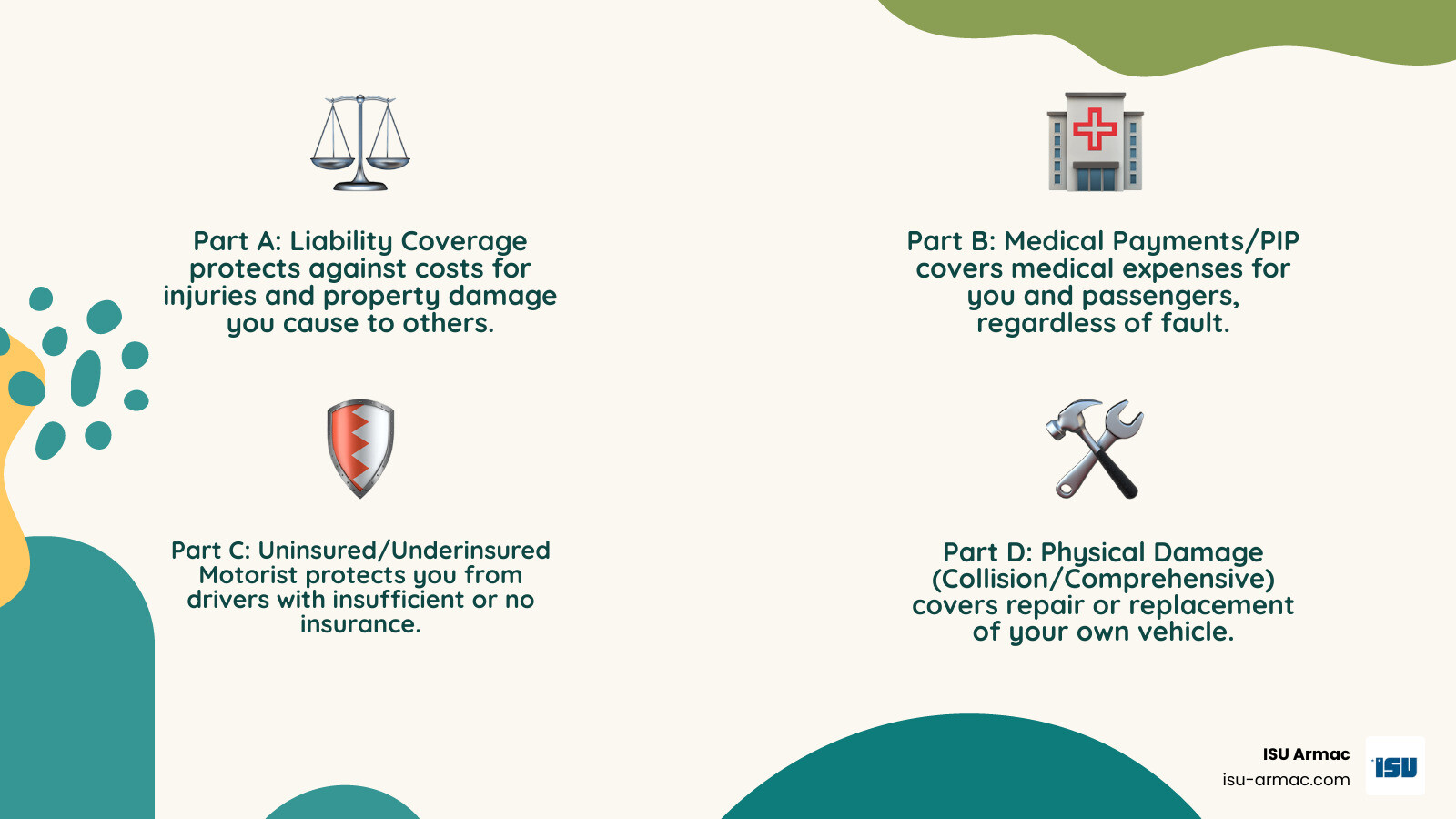
A personal automobile policy is a contract that provides financial protection for you, your vehicle, and others in an accident. It covers private passenger vehicles—cars, pickups, and vans—used for personal reasons like commuting or errands. Key coverages include:
- Liability: Pays for injuries and property damage you cause to others.
- Medical Payments/PIP: Covers medical costs for you and your passengers.
- Uninsured/Underinsured Motorist: Protects you if the at-fault driver has little or no insurance.
- Physical Damage (Collision/Comprehensive): Pays to repair or replace your vehicle.
Most policies follow a standard Insurance Services Office (ISO) form for consistency. In California, drivers must carry minimum liability insurance ($15,000 per person for bodily injury, $30,000 per accident, and $5,000 for property damage), though higher limits are recommended to protect your assets.
Unlike commercial auto insurance, a personal policy doesn’t cover business activities like delivery or ridesharing. As CEO of ISU Insurance Services ARMAC Agency, I’ve helped Southern California residents find the right personal automobile policy for over two decades, protecting families across the High Desert.
Basic personal automobile policy glossary:
- Does Auto Insurance Follow the Car or the Person?
- Auto Insurance Quotes for High-Risk Drivers
- Personal Auto Insurance for Uber Drivers
The Core Components of a Personal Automobile Policy
Your personal automobile policy is a blend of different coverages, each designed to protect you from various financial risks. While policies can be customized, these standard components form the backbone of every policy.
Part A: Liability Coverage (Bodily Injury & Property Damage)
Liability coverage is the foundation of a personal automobile policy and is legally required in California. It protects you financially if you’re at fault for an accident.
- Bodily Injury (BI) Liability: Pays for medical expenses, lost wages, and pain and suffering for people you injure.
- Property Damage (PD) Liability: Covers damage to other people’s property, like their car or a fence.
California’s minimums are $15,000 BI per person, $30,000 BI per accident, and $5,000 PD per accident. These can be exhausted quickly in a serious accident, leaving your assets at risk. Many experts recommend higher limits, often expressed as “split limits” like 50/100/50 ($50k per person / $100k per accident / $50k property damage). Your liability policy generally covers you, resident family members, and anyone using your car with permission. For maximum protection, consider a personal umbrella policy. Learn more about personal umbrella liability insurance.
Part B: Medical Payments (MedPay) and Personal Injury Protection (PIP)
This coverage helps with medical expenses for you and your passengers, regardless of who was at fault.
Medical Payments (MedPay) Coverage:
In California, MedPay is an optional coverage that pays for reasonable medical and funeral expenses from an auto accident. It covers you, your family members, and passengers in your vehicle. MedPay can supplement your health insurance by covering deductibles and co-pays, and it often pays out faster. Explore health insurance options in Victorville, CA.
Personal Injury Protection (PIP) Coverage:
PIP, or “no-fault” insurance, is not required in California but is mandatory in other states. It’s more comprehensive than MedPay, also covering lost wages and replacement services for tasks you can no longer perform due to injury.
Part C: Uninsured/Underinsured Motorist (UM/UIM) Coverage

What happens if you’re hit by a driver with no insurance or not enough to cover your bills? Uninsured/Underinsured Motorist (UM/UIM) coverage is designed for this common and frustrating scenario.
- Uninsured Motorist (UM) Coverage: Protects you if you’re hit by an uninsured driver or in a hit-and-run. It can cover your medical bills, lost wages, and in some cases, vehicle damage.
- Underinsured Motorist (UIM) Coverage: Applies when the at-fault driver has insurance, but their limits are too low to cover your costs. UIM bridges the gap between their limit and the cost of your damages, up to your UIM limit.
In California, insurers must offer UM/UIM coverage. While you can reject it in writing, we strongly recommend keeping it. It’s an inexpensive way to protect yourself from the financial consequences of another driver’s negligence.
Part D: Physical Damage Coverage (Collision vs. Comprehensive)
While other coverages protect people, Physical Damage coverage protects your car. It’s usually split into two parts and is often required by lenders for financed or leased vehicles.
Collision Coverage:
This pays for damage to your vehicle from a collision with another car or an object (like a fence or pole), or if your car rolls over, regardless of fault.
Comprehensive Coverage (Other Than Collision):
This covers damage from non-collision events. Common examples include:
- Theft and vandalism
- Fire, flood, hail, and earthquakes
- Falling objects
- Contact with animals (like hitting a deer)
- Glass breakage
Both coverages require you to pay a deductible—the amount you pay out-of-pocket before insurance pays the rest. Choosing a higher deductible can lower your premium.
| Feature | Collision Coverage | Comprehensive Coverage (Other Than Collision) |
|---|---|---|
| Covered Perils | Impact with another vehicle or object, rollovers. | Theft, vandalism, fire, flood, hail, falling objects, animal contact. |
| When Applies | When your car hits something or rolls over. | When your car is damaged by non-collision events. |
| Deductible | Yes, you choose an amount (e.g., $500, $1,000). | Yes, you choose an amount (e.g., $100, $250, $500). |
| Required By | Often by lenders/lessors for financed/leased cars. | Often by lenders/lessors for financed/leased cars. |
Expanding Your Protection: Optional Coverages and Endorsements
Beyond the core parts, you can customize your personal automobile policy with endorsements (or riders) to fit your needs. Popular options include:
- Rental Reimbursement: Covers rental car costs while your vehicle is being repaired after a covered loss.
- Towing and Labor: Pays for towing and roadside labor like changing a flat tire. Find car insurance with roadside assistance in Victorville, CA.
- Gap Insurance: If your car is totaled, this covers the “gap” between its cash value and what you still owe on your loan or lease.
- Custom Equipment Coverage: Protects aftermarket parts like custom stereos or wheels that aren’t covered by a standard policy.
- Accident Forgiveness: Prevents your premium from increasing after your first at-fault accident.
- Glass Coverage: Offers a lower (or no) deductible for windshield repair or replacement.
- Miscellaneous Type Vehicle Endorsement: Extends coverage to vehicles like motorhomes or golf carts.
Selecting the right endorsements ensures your policy provides complete protection for your unique situation.
Understanding Policy Rules, Costs, and Limitations

A personal automobile policy is a legal contract with rules and conditions that determine its cost. Understanding these elements is key to managing your insurance effectively.
Factors That Influence the Cost of a Personal Auto Policy
The price of your personal automobile policy depends on your risk profile, which insurers assess using several factors:
- Driving Record: Accidents and tickets increase premiums.
- Vehicle Type: Expensive, high-performance, or frequently stolen cars cost more to insure.
- Location: Urban areas with more traffic and theft, like parts of Southern California, have higher rates.
- Age and Gender: Younger, less experienced drivers typically pay more.
- Coverage & Deductibles: Higher limits increase premiums; higher deductibles lower them.
- Annual Mileage: Driving more increases risk and rates.
- Credit History: In many states, credit-based insurance scores can affect premiums.
- Discounts: Ask about multi-car, multi-policy (bundling), good student, and other discounts.
As an independent agency, ISU Armac shops multiple carriers to find you the best rates. Find cheap auto insurance in Victorville, CA.
Your Duties and General Provisions in a Personal Automobile Policy
Your policy is a contract with duties for both you and the insurer. Understanding them is key to a smooth claims process.
Your Duties After an Accident or Loss:
You are generally required to:
- Notify your insurer promptly.
- Cooperate with the investigation and settlement.
- Forward all legal documents you receive.
- Notify the police in cases of theft or a hit-and-run.
- Protect your vehicle from further damage and allow inspection.
Failure to meet these duties can jeopardize your claim.
General Provisions:
These are the policy’s ground rules, covering the policy period and territory (typically the U.S. and Canada), how to make changes, rules against fraud, the insurer’s right to recover payment (subrogation), and termination (cancellation and non-renewal) conditions. Auto Insurance Basics | III.
Common Exclusions: When Your Personal Automobile Policy Doesn’t Apply
A personal automobile policy doesn’t cover everything. Exclusions are specific situations where coverage does not apply. Be aware of these common ones:
- Business Use: This is a major exclusion. Using your car for activities like delivery, ridesharing (Uber/Lyft), or hauling tools for work requires a commercial policy. Does my personal auto insurance cover business use?.
- Intentional Acts: No coverage for deliberately causing injury or damage.
- Racing: Any form of competitive driving is excluded.
- Wear and Tear/Mechanical Breakdown: Your policy is not a vehicle warranty.
- Public or Livery Conveyance: Using your vehicle as a taxi or for-hire service is excluded.
- Using a vehicle without permission.
If your vehicle use changes, contact us at ISU Armac to ensure you don’t have a coverage gap.
Personal vs. Commercial Auto Insurance: Knowing the Difference
One of the most common points of confusion for vehicle owners is understanding when a personal automobile policy is sufficient and when a commercial auto policy becomes necessary. The difference is critical for ensuring you’re properly covered.
A personal auto policy is for private use: commuting, errands, and road trips. It covers you and your family members for personal activities.
A commercial auto policy is for vehicles used for business. You likely need one if your vehicle is used to:
- Transport goods, tools, or equipment for a business.
- Deliver items or transport people for a fee (including ridesharing).
- Be driven by employees for work purposes.
- Be registered in a business’s name.
Key Differences:
| Feature | Personal Auto Policy | Commercial Auto Policy |
|---|---|---|
| Primary Use | Personal transportation, commuting, errands. | Business operations, transporting goods/people for profit. |
| Who’s Covered | You, family members, permissive users for personal use. | You, employees, and often clients or cargo related to business. |
| Coverage Limits | Generally lower, focused on personal assets. | Higher limits to protect business assets and liabilities. |
| Vehicle Types | Private passenger cars, light trucks/vans. | Can cover a broader range: sedans, trucks, vans, specialized vehicles. |
| Cost | Typically lower premiums. | Generally higher premiums due to increased risk and liability. |
| Legal Requirement | Mandatory for personal vehicles. | Often legally required for business-owned vehicles in most states. |
Commercial auto insurance generally costs more due to the higher risks and liability limits involved. If you use your vehicle for both personal and business tasks, the line can be blurry. It’s crucial to have the right policy to avoid a denied claim. We can help you determine which policy is right for your situation. Do I need both commercial and personal auto insurance?.
Frequently Asked Questions about Personal Auto Policies
Here are quick answers to common questions we hear from clients about their personal automobile policy.
How do I prove I have auto insurance?
You can provide proof with:
- Insurance ID Card: A physical card from your insurer. Keep it in your vehicle.
- Digital Proof: An electronic ID card on your smartphone, which is accepted in California.
- SR-22 Form: A certificate filed by your insurer with the DMV if required after certain violations.
Failing to provide proof can result in fines and other penalties.
Does my personal auto policy cover a rental car?
Yes, your policy’s coverages typically extend to a rental car for personal use.
- Liability: Your liability limits apply to the rental.
- Physical Damage: If you have collision/comprehensive on your own car, it usually extends to the rental, but your deductible still applies.
Be aware that your personal policy may not cover “loss of use” fees from the rental company or rentals for business or international travel. Before accepting the rental company’s expensive waiver (LDW/CDW), check your policy and credit card benefits, as some cards offer coverage.
What is a deductible and how does it work?
A deductible is the amount you pay out-of-pocket for a collision or comprehensive claim before your insurance pays. For example, if you have a $500 deductible and a $3,000 repair bill, you pay $500 and your insurer pays $2,500.
Choosing a higher deductible (e.g., $1,000 instead of $250) will lower your premium because you are taking on more of the initial risk.
Conclusion: Securing the Right Policy for Your Peace of Mind
Understanding your personal automobile policy is key to your financial security. From required liability coverage to optional add-ons that protect your vehicle, each part works to give you peace of mind on the road.
We’ve covered the core components, optional endorsements, cost factors, and the critical distinction between personal and commercial use. A well-structured policy is more than a legal requirement—it’s a shield for you, your family, and your assets.
At ISU Armac, we believe in empowering our clients with knowledge to balance cost and coverage. Let us help you find the best protection at the right price.