
Why Your Regular Insurance Isn’t Enough
Personal umbrella liability insurance is extra liability coverage that goes beyond the limits of your regular home, auto, or watercraft insurance policies. It provides an additional layer of financial protection when you’re sued for damages that exceed your standard policy limits.
Quick Facts About Personal Umbrella Liability Insurance:
- What it does: Covers liability claims above your existing insurance limits
- Who needs it: Anyone with assets to protect or high lawsuit risk
- Average cost: $150-$300 per year for $1 million in coverage
- Key benefit: Protects your savings, home, and future earnings from lawsuits
- Coverage: Bodily injury, property damage, libel, slander, and legal defense costs
Think about it this way: your homeowners policy might cover $300,000 in liability, and your auto policy another $250,000. But what happens if you cause a serious accident that results in $2 million in damages?
You’d be personally responsible for the remaining $1.45 million.
This is where personal umbrella liability insurance becomes crucial. As one lawsuit can change everything, having this extra protection shields not just your current assets but also your future earnings from catastrophic claims.
The statistics are eye-opening: 70% of umbrella claims are auto-related, and 25% stem from distracted driving incidents. In our litigious society, even everyday activities like hosting a backyard party or walking your dog can expose you to significant financial risk.
I’m Ryan McEachron, CEO of ISU Insurance Services ARMAC Agency in Victorville, and I’ve helped countless High Desert residents understand how personal umbrella liability insurance can protect their financial future. With over 25 years of experience in the insurance industry, I’ve seen how this affordable coverage can mean the difference between financial security and devastating loss.
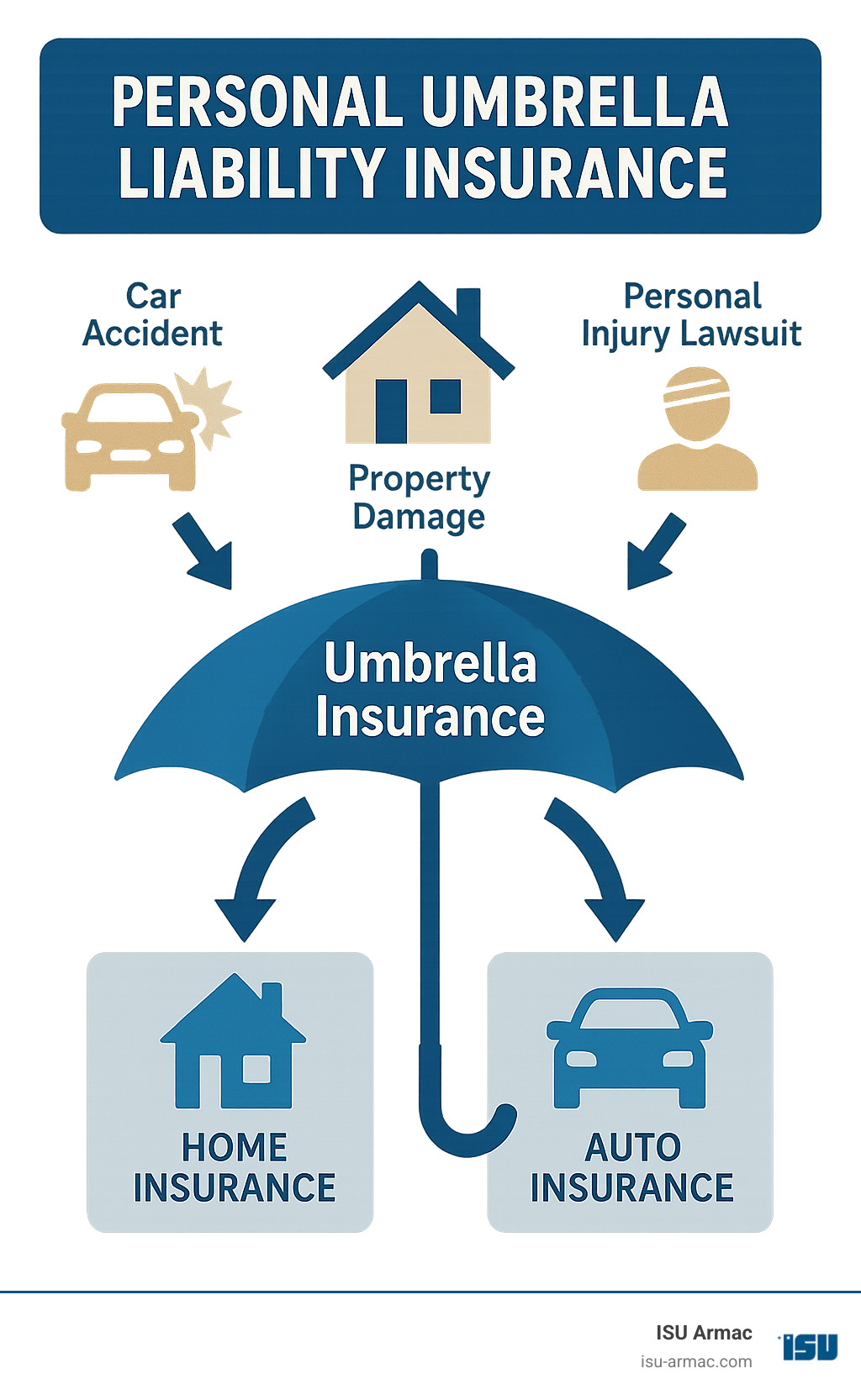
How an Umbrella Policy Works: A Safety Net for the Unexpected
Think of your home and auto insurance as your first line of defense against life’s unexpected moments. They’re solid, reliable policies that protect you up to certain limits when accidents happen. But here’s the thing – sometimes life throws you a curveball that’s bigger than those limits can handle. That’s exactly when personal umbrella liability insurance becomes your financial lifesaver.
Your umbrella policy works like a safety net, sitting right on top of your existing insurance policies. It doesn’t replace your car or home insurance – it teams up with them. When you’re legally responsible for damages that blow past your primary policy limits, your umbrella coverage steps in to handle the overflow, up to its much higher limits.
Most insurance companies require you to maintain substantial underlying coverage before they’ll issue an umbrella policy. We’re talking about minimum coverage requirements like $250,000 on your auto policy and $300,000 on your homeowners policy. This ensures your underlying policies are doing their job first.
Here’s how it works in practice: Let’s say your auto policy covers up to $300,000 in liability limits, but you cause an accident that results in $1 million in damages. Your auto policy pays its full $300,000 limit first. Then your personal umbrella liability insurance kicks in to cover the remaining $700,000. This process protects your savings, your home, and even your future earnings from devastating lawsuits.
Some policies mention something called Self-Insured Retention (SIR), which is basically a small deductible you pay before the umbrella coverage begins. For most personal umbrella policies, this amount is typically minimal – often just a few hundred dollars.
Understanding your current coverage is crucial. You can learn more about What Does Liability Insurance Actually Cover? and review our Home Insurance and Auto Insurance options to ensure you have the right foundation.

A Real-World Example of a Claim
Let me share a scenario that hits close to home for many of our High Desert neighbors. Picture this: you’re driving through Victorville after a busy day, maybe heading home to Apple Valley or Hesperia. Traffic is heavy, and in a moment of distraction, you rear-end another vehicle, causing a chain reaction with multiple cars.
The accident is serious. Several people are injured, requiring extensive medical bills, surgery, and months of rehabilitation. Some victims can’t work for extended periods, resulting in significant lost wages. On top of that, you’re facing substantial legal fees as the case winds through the court system.
When the dust settles, the court awards a total of $1.5 million in damages. Your auto insurance policy has a liability limit of $500,000 – which seemed like plenty when you bought it. But now you’re staring at a $1 million gap that could wipe out your life savings.
This is where your personal umbrella liability insurance becomes a game-changer. After your auto policy pays its $500,000 limit, how the umbrella policy pays the difference is straightforward – it covers that remaining $1 million, protecting your assets and future earnings.
This isn’t just a scary story – it’s reality for many families. Statistics show that 70% of claims are auto-related, with a significant portion stemming from everyday driving situations. A single car accident scenario like this can happen to anyone, which is why many financial experts recommend considering whether you Should I purchase an umbrella liability policy?.
The beauty of umbrella coverage is that it doesn’t just protect you from auto accidents. It also covers incidents like a guest slipping by your pool, your dog unexpectedly biting someone, or even a child accidentally damaging expensive property. When one lawsuit can change everything, having this extra layer of protection gives you real peace of mind.
What’s Covered (and What’s Not) Under an Umbrella Policy
Understanding what your personal umbrella liability insurance actually covers is like getting to know a reliable friend who’s got your back in tough situations. This policy doesn’t just add more money to your existing coverage – it can also step in to protect you from claims that your regular home and auto policies might not touch at all.
Think of it this way: your umbrella policy is designed to be comprehensive, but it’s not a magic wand that covers everything under the sun. Knowing exactly what it does and doesn’t cover helps you make informed decisions and gives you genuine peace of mind about your financial protection.

What Personal Umbrella Liability Insurance Covers
Your personal umbrella liability insurance acts as a financial shield against a surprisingly wide range of liability claims that could otherwise devastate your savings and future earnings.
Bodily injury liability forms the backbone of your umbrella coverage. Whether you cause a serious car accident on Highway 18 or a guest slips and falls at your Victorville home, this protection covers medical expenses, lost wages, and pain and suffering awards when you’re found legally responsible for someone else’s injuries.
Property damage liability steps in when you’re responsible for damaging someone else’s belongings. This could be anything from your teenager backing into a neighbor’s luxury car to your dog somehow getting loose and damaging a friend’s expensive landscaping.
Here’s where umbrella policies really shine: personal injury coverage. This broader protection often covers situations your standard policies won’t touch. Slander and libel claims have become increasingly common in our social media world – imagine facing a lawsuit because someone claims your Facebook post damaged their reputation. Defamation of character and invasion of privacy claims fall under this umbrella too, along with accusations of false arrest or malicious prosecution.
If you’re a landlord, your umbrella policy provides crucial landlord liability protection for incidents at your rental properties. This is especially valuable if you’re renting through platforms like Airbnb, where you might face claims from guests who get injured on your property. For those wondering about vacant land ownership, you can learn more about Does an Umbrella Policy Cover Vacant Land?.
One of the most valuable features is legal defense cost coverage. Even if you’re completely innocent, defending yourself against a frivolous lawsuit can cost tens of thousands of dollars. Your umbrella policy covers these attorney fees and court costs, whether you win or lose.
Many policies also provide worldwide coverage, protecting you from liability claims that happen during your travels outside the United States. This global protection is particularly valuable for frequent travelers or those with international business interests.
Common Exclusions: What Your Policy Won’t Cover
While personal umbrella liability insurance offers broad protection, it’s important to understand its boundaries so you don’t have unrealistic expectations.
Your own injuries and property damage aren’t covered – remember, this is liability insurance designed to protect others from you, not you from the world. If you’re hurt in an accident or your car gets damaged, you’ll rely on your health insurance, auto collision coverage, or homeowners policy.
Business-related losses typically fall outside your personal umbrella’s scope. If you run a home-based business and face a liability claim related to that business, you’ll need commercial insurance. The exception might be certain non-profit board activities, but these usually require specific endorsements.
Intentional or criminal acts won’t be covered either. If you deliberately harm someone or their property, or if you’re convicted of a crime that leads to damages, your umbrella policy won’t pay. This includes punitive damages that courts sometimes award to punish particularly reckless behavior.
Liability assumed under contract is another common exclusion. If you sign a contract that makes you responsible for certain damages or liabilities, your umbrella policy generally won’t cover those contractual obligations.
The key to maximizing your umbrella policy’s value is understanding these coverage boundaries and working with an experienced agent who can help you identify any gaps in your protection. That’s where our expertise at ISU Armac really makes a difference – we’ll review your specific situation and make sure you understand exactly what you’re getting.
Do You Need Personal Umbrella Liability Insurance? Assessing Your Risk
The question isn’t really whether you could face a lawsuit – it’s whether you can afford to lose everything you’ve worked for when one happens. Even the most careful people can find themselves on the wrong end of a million-dollar judgment. The real question becomes: what do you have to lose?
Personal umbrella liability insurance makes the most sense when you’ve built up assets worth protecting. This includes your savings account, investment portfolio, your home, and even your future earning potential. Here’s something many people don’t realize: courts don’t just look at what you own today. They can also consider your ability to earn money in the future when determining how much you should pay.
Think about it this way – if you’re a teacher, nurse, or business owner with 20 years left in your career, a court might factor in those future earnings when deciding on a settlement. That’s why financial advisors often recommend having liability coverage that matches not just your current net worth, but also considers your lifetime earning potential.
For those with substantial assets or complex financial situations, we offer specialized Private Client Insurance services that go beyond standard coverage to provide comprehensive protection custom to your unique needs.

Key Risk Factors to Consider
While anyone can benefit from umbrella coverage, certain lifestyle factors make you a more likely target for lawsuits. If you have significant savings or assets, you’re naturally more attractive to potential claimants and their attorneys. The more you have, the more there is to go after.
Owning property – whether it’s your primary home, a vacation cabin, or a rental unit – increases your liability exposure. This is especially true if you rent out property through platforms like Airbnb or Vrbo, where you’re constantly having strangers on your property.
Some of the biggest liability risks come from seemingly innocent things. Owning a swimming pool or trampoline puts you in the “attractive nuisance” category, where children might be drawn to your property and potentially get hurt. Having pets, especially certain dog breeds, can lead to bite claims that easily exceed your homeowner’s policy limits.
Having teenage drivers in your household significantly increases your auto liability risk. 70% of umbrella claims are auto-related, and young drivers are statistically more likely to be involved in serious accidents. With 25% of claims stemming from distracted driving, this risk is higher than ever.
Your social activities matter too. Hosting large parties or gatherings means more people on your property and more chances for something to go wrong. Serving on a non-profit board can expose you to liability claims related to the organization’s decisions and actions.
If you’re a public figure or high-profile individual in your community, you face additional risks from libel, slander, or defamation claims. Participating in high-risk sports like skiing or hunting can lead to situations where you might accidentally injure someone else.
Even engaging in volunteer work – as admirable as it is – can create liability if an accident occurs under your supervision or due to your actions.
The reality is that most of us are potential targets for legal action, even when we’re just going about our daily lives. For the relatively small cost of personal umbrella liability insurance, you can protect everything you’ve worked so hard to build.
The Financials and Logistics of Umbrella Coverage
When most people hear about personal umbrella liability insurance, their first thought is usually about cost. The good news? You’ll likely be pleasantly surprised by how affordable this protection really is. The even better news? Getting a policy is straightforward, especially when you work with an independent agency that can shop multiple carriers for you.
How Much Does Personal Umbrella Liability Insurance Cost?
Here’s what might shock you: $1 million in personal umbrella liability insurance typically costs just $150 to $300 per year. That’s less than a dollar a day for protection that could save your entire financial future. When you consider that a single lawsuit could cost millions, this premium represents incredible value.
The cost becomes even more reasonable as you increase your coverage. Want $2 million in protection? You’ll pay about $75 more per year than the $1 million policy. Each additional million beyond that typically adds around $50 annually. This means a $5 million policy might still cost under $600 per year for most people.
Several factors influence your premium, and understanding them can help you get the best rate. Your driving record plays a significant role since most umbrella claims are auto-related. A clean record keeps costs down, while accidents or violations can increase your premium. Your location matters too – living in Victorville, Apple Valley, or Hesperia each carries different risk factors that insurers consider.
Your credit history can also affect pricing in many states, as insurers have found correlations between credit scores and claim frequency. The amount of coverage you choose naturally impacts cost, but as we’ve seen, the increases are quite modest. Finally, your risk profile – things like owning pools, trampolines, or rental properties – can influence your rate.
Given the potential financial devastation of a major lawsuit, most people find personal umbrella liability insurance to be one of the best investments they can make. It’s worth exploring Why Is Umbrella Insurance Worth Getting? to understand the full picture.
Umbrella vs. Excess Liability Insurance: What’s the Difference?
You might hear these terms used interchangeably, but there’s an important distinction that could affect your coverage. Think of it this way: excess liability insurance is like getting a bigger bucket to catch the same rain, while umbrella insurance is like getting a bigger bucket that can also catch rain from new directions.
| Feature | Umbrella Insurance | Excess Liability Insurance |
|---|---|---|
| Coverage Scope | Broader coverage that fills gaps and increases limits | Only increases existing limits |
| Fills Gaps | Covers claims not covered by underlying policies (libel, slander, defamation) | Only adds money to what’s already covered |
| Primary Use | Comprehensive protection against wider range of liability claims | Simply increases maximum payout for existing coverage types |
Umbrella insurance provides broader coverage, protecting you from claims that your standard policies might not cover at all – like libel, slander, or defamation. It also increases your limits for everything your current policies already cover. Excess liability insurance only does the latter – it simply adds more money to your existing coverage types without expanding what’s covered.
For most people, personal umbrella liability insurance is the better choice because it provides more comprehensive protection. You can learn more about the differences at Personal Umbrella and Excess Liability Insurance.
How to Purchase Your Policy
Getting personal umbrella liability insurance doesn’t have to be complicated. Here’s how we guide our clients through the process to ensure they get the right coverage at the best price.
Start by assessing your net worth and risk. Add up your assets – home equity, savings, investments, retirement accounts – and consider your future earning potential. This gives you a baseline for how much coverage makes sense. Don’t forget to review those risk factors we discussed earlier.
Review your existing policies next. Gather your current auto, homeowners, and any other liability policies. Note their liability limits because most insurers require minimum underlying coverage before they’ll issue an umbrella policy. Typically, you’ll need around $250,000 for auto and $300,000 for homeowners.
Contact an independent insurance agent – this is where our expertise really shines. As an independent agency in Victorville, ISU Armac works with multiple carriers, which means we can shop around on your behalf. While some insurers might require you to bundle your umbrella with their other policies, we can steer these requirements and find the best overall package for you.
Consider bundling opportunities for potential discounts. Often, you can save money by keeping your personal umbrella liability insurance with the same carrier that provides your home and auto coverage. We’ll explore all your options to find the best combination of coverage and savings.
The beauty of working with us is that we handle the heavy lifting. We’ll get quotes from various reputable insurers, explain the coverage details, and help you make an informed decision. Our goal is making sure you get comprehensive protection without overpaying, so you can have peace of mind knowing your financial future is secure.
Conclusion: Securing Your Financial Future with Confidence
When life throws you a curveball – and it inevitably will – personal umbrella liability insurance becomes your financial superhero. It’s that remarkably affordable shield that stands between you and the kind of lawsuit that could wipe out decades of hard work in a single judgment.
Throughout this guide, we’ve seen how this extra layer of protection works as your safety net when standard insurance limits just aren’t enough. Whether it’s a serious car accident, a slip-and-fall at your home, or even a defamation claim in our social media world, umbrella coverage protects both your current assets like your home and savings, and your future earnings that could otherwise be garnished for years to come.
The beauty of personal umbrella liability insurance lies in its comprehensive nature. Unlike excess liability insurance that simply adds more money to existing coverage, umbrella policies actually fill gaps in your protection while providing those higher limits. It’s broader coverage that catches claims your standard policies might miss entirely.
For many of our neighbors here in Victorville, Apple Valley, Hesperia, and Oak Hills, the decision becomes clear when they realize the math: spending $150-$300 annually to protect millions in assets and future income is simply smart financial planning. Whether you own rental property, have teenage drivers, or just want to sleep better at night knowing you’re protected, this coverage offers incredible value.
At ISU Armac, we’ve built our reputation on one simple promise: shopping multiple carriers to find you the best coverage at the lowest rates. We’re not tied to any single insurance company, which means we can truly advocate for your best interests. Our team understands the unique risks and lifestyle factors here in Southern California, and we’re committed to helping you find the right level of protection for your specific situation.
Don’t wait for that unexpected lawsuit to remind you why financial protection matters. Take the proactive step today to secure your financial future with personal umbrella liability insurance.
For a complete review of your coverage needs, explore our Personal Insurance Services. We’re here to help you build a comprehensive protection plan that fits your life and budget.
To learn more about safeguarding your assets, read The ABCs of Personal Lines Insurance: Protecting Your Assets.