
Why Business Life Insurance Is Essential for Protecting Your Company
Business life insurance is a specialized type of life insurance designed to protect a company from the financial consequences of losing an owner, partner, or key employee. Here’s what you need to know:
- Key Person Insurance: Covers the business against the loss of a critical employee, with the company as the beneficiary
- Buy-Sell Agreement Funding: Provides funds for surviving partners to purchase a deceased owner’s shares
- Personal Life Insurance for Business: Protects a business owner’s family from business-related debts and ensures business continuity
Why it matters: Nearly three-quarters of small businesses are heavily dependent on one or two key people for their success, yet less than a quarter have key person life insurance in place. Without proper coverage, the death of an owner or key employee can force a business to liquidate, leave partners unable to buy out a deceased owner’s shares, or burden families with business debts.
As a business owner in Victorville, you face unique risks. Your business might carry significant debt, employ family members who depend on its success, or rely on your personal expertise to generate revenue. When you’re gone, your business needs a financial safety net to keep operating, pay off loans, and transition smoothly to new ownership.
I’m Ryan McEachron, Chief Executive Officer of ISU Insurance Services ARMAC Agency in Victorville, and I’ve spent decades helping business owners protect their enterprises with Business life insurance strategies custom to their specific needs. Understanding how to structure these policies correctly can mean the difference between your business thriving or closing after an unexpected loss.
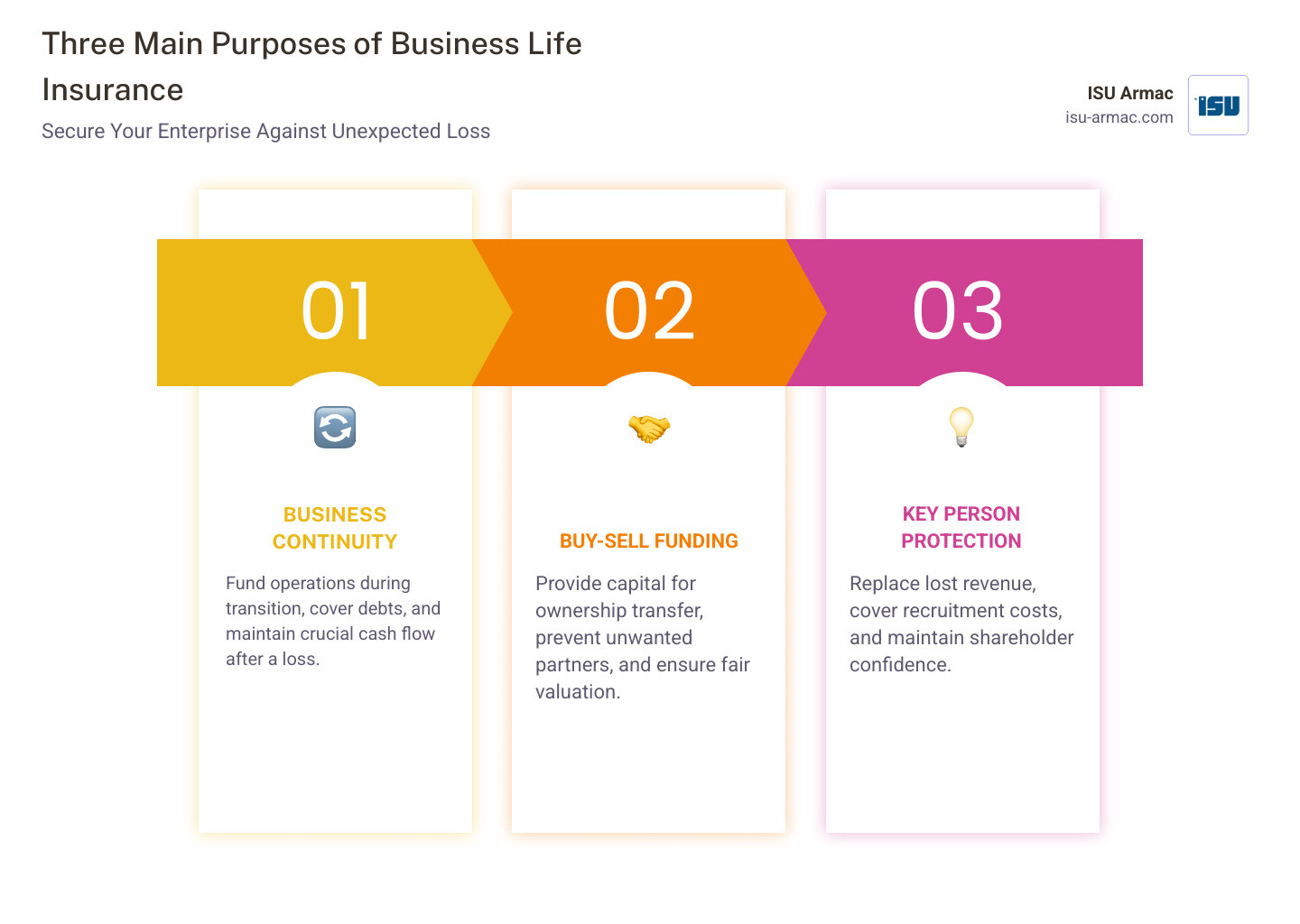
Basic Business life insurance vocab:
Understanding Business Life Insurance and Its Critical Role
While personal life insurance protects loved ones, Business life insurance serves an equally vital purpose: safeguarding your business. It’s a strategic financial tool designed to provide stability and continuity following the death of an owner, partner, or key employee.
For businesses in Apple Valley, Hesperia, or Oak Hills, the sudden loss of an indispensable individual can trigger a domino effect of financial distress. Without Business life insurance, this event could lead to the collapse of the enterprise you’ve worked so hard to build. This type of policy protects the business itself, covering the human capital that drives your success, unlike property or liability insurance that covers tangible assets.
The payout from a Business life insurance policy can be used for several critical needs:
- Covering Debts: Pay off outstanding business loans, mortgages, or lines of credit to prevent creditors from seizing assets.
- Providing Cash Flow: Bridge financial gaps by covering daily operating expenses like payroll and rent during a transition period.
- Funding Transitions: Provide capital to recruit, hire, and train a replacement or facilitate a smooth ownership transfer.
- Ensuring Business Continuity: The ultimate goal is to ensure the business can continue operating and meet its obligations.

For many Southern California businesses, success hinges on one or two key individuals. Yet, surprisingly few have key person life insurance. This highlights a significant vulnerability we at ISU Armac can help you address. For more insights, you can learn about the importance of key person policies.
How Life Insurance Ensures Business Continuity
Business life insurance is a cornerstone of continuity planning, ensuring your business can operate without significant disruption after losing a key individual.
- Succession Planning: It can fund a buy-sell agreement for a clear ownership transfer, preventing disputes. For sole proprietors, it provides funds for a successor or an orderly wind-down.
- Operational Stability: The payout provides immediate liquidity to prevent a cash crunch, ensuring bills and employees are paid.
- Shareholder Confidence: A plan backed by insurance reassures investors, partners, and employees about the business’s long-term viability.
- Debt Repayment: It ensures business loans can be paid off, protecting the company’s financial health and the personal assets of remaining owners.
- Employee Retention: A robust continuity plan helps maintain employee morale and stability during uncertain times.
Why It’s a Must-Have for Modern Business Owners
Proactive risk management is essential for survival in today’s business environment.
- Mitigating Financial Risk: The loss of a key person involves lost revenue, recruitment costs, and training expenses. Business life insurance provides a financial buffer against these costs.
- Protecting Personal Assets: For many business owners, personal and business finances are intertwined. This insurance prevents business debts from jeopardizing your family’s financial security.
- Securing a Legacy: It helps ensure your business endures, continuing to provide for your family and community.
- Attracting and Retaining Talent: Offering benefits like key person policies demonstrates a sophisticated, stable approach to business management, which can be a strong draw for top talent.
Key Types of Business Life Insurance Policies
Just as there are different types of businesses in Victorville, there are various forms of Business life insurance, each designed for specific needs. Understanding these categories is the first step in crafting a robust protection strategy. These policies are customized to protect the business itself.

Key Person Insurance
Key person insurance is a policy taken out by the business on a crucial individual—an owner, top salesperson, or skilled technician. The business is the beneficiary, receiving the death benefit directly.
- Purpose: To protect the business from the financial fallout if a key person dies or becomes disabled.
- Use of Funds: The payout can cover lost revenue, pay off loans, or fund the recruitment and training of a successor.
- Covering Lost Revenue and Recruitment: It provides liquidity to weather the immediate impact on sales or production and covers the high costs of finding a replacement.
- Coverage Rule of Thumb: A common guideline is to secure coverage worth five to 10 times the key employee’s annual salary, accounting for their revenue contribution and replacement cost.
- A specialized life insurance policy: Key person insurance is designed specifically for the business’s benefit. You can read more about it here: A specialized life insurance policy.
Buy-Sell Agreement Funding
For businesses with multiple owners, a buy-sell agreement dictates what happens to a deceased owner’s share. Life insurance is the most efficient way to fund this agreement.
- Definition: A legally binding contract among co-owners that dictates how a partner’s interest is bought or sold upon death, disability, or retirement.
- How it Works: The business (entity-purchase) or partners (cross-purchase) buy policies on each other. When a partner dies, the payout provides the capital for the surviving partners or business to purchase the deceased’s shares from their estate.
- Benefits: This ensures a smooth ownership transfer, prevents financial strain on surviving partners, and keeps inexperienced heirs from becoming unwanted partners.
Personal Life Insurance for Business Needs
A personal life insurance policy can also play a crucial role, especially for sole proprietors or owners with personal guarantees on business loans.
- Using Personal Policies: An owner can name a co-owner, family member, or the business as a beneficiary to receive funds.
- Covering Business Loans: If you have personally guaranteed business loans, a personal policy can provide funds to pay them off, protecting your family from the debt.
- Protecting Personal Assets: This coverage ensures your family’s financial future isn’t jeopardized by business-related liabilities.
- Flexibility: Naming a business partner as a partial beneficiary can provide them with funds to help the company recover, offering a flexible solution for smaller partnerships.
Structuring Your Policy: Ownership and Coverage
Structuring your Business life insurance policy correctly is crucial. Key decisions about ownership and coverage amount can significantly impact the policy’s effectiveness, tax implications, and benefits for your Southern California business.
Corporate vs. Personal Ownership: The Pros and Cons
Deciding whether the business or an individual owns the policy is a critical choice.
| Feature | Corporate Ownership | Personal Ownership |
|---|---|---|
| Beneficiary | The business | Individual (family, estate, partner) |
| Premium Source | Business funds (after-tax) | Personal funds (after-tax) |
| Tax Implications | Premiums not deductible; death benefit usually tax-free to the corporation. | Premiums not deductible; death benefit usually tax-free to beneficiaries. |
| Creditor Protection | Varies by state; can be vulnerable to business creditors. | Generally stronger creditor protection. |
| Liquidity | Directly to the business. | Directly to individuals. |
| Control | Business controls the policy. | Individual controls the policy. |
| Transferability | More complex if business is sold. | Simpler for individual estate planning. |
- Corporate Ownership: This ensures the death benefit goes directly to the company for continuity, debt repayment, or funding a buy-sell agreement.
- Personal Ownership: This offers simplicity and control for estate planning. It’s often preferred for sole proprietors or to protect an owner’s family from personal guarantees on business loans.
How to Determine the Right Amount of Business Life Insurance Coverage
The right amount of coverage requires a careful assessment of your business’s financial needs.
- Calculating Coverage Needs: Key factors include:
- Business Debts and Loans: Total all outstanding loans, lines of credit, and mortgages.
- Annual Operating Expenses: Estimate one year of expenses (payroll, rent, etc.) to ensure the business can run during a transition.
- Revenue Replacement: Consider the revenue generated by the key person and how long it would take to replace it.
- Buyout Agreement Costs: The coverage must match the value of shares to be purchased under a buy-sell agreement.
- Rule of Thumb: A common guideline is to total all business loans plus 3–5 times the owner’s annual contribution to revenue, adjusted for any buyout agreements.
The Role of Cash Value in Business Life Insurance
It’s important to distinguish between term and permanent policies, especially regarding cash value.
- Permanent vs. Term Life Insurance:
- Term life provides affordable coverage for a specific period (e.g., 10-30 years) but does not build cash value. It’s ideal for startups needing cost-effective protection.
- Permanent life (whole or universal) provides lifelong coverage and includes a cash value component that grows over time, typically tax-deferred.
- Using Cash Value: Business owners can borrow against the cash value for needs like expansion or to cover cash flow shortages. It can also be used as collateral for a business loan, potentially securing better lending terms. This makes permanent life a valuable asset for mature businesses.
Financial and Tax Implications
Navigating the financial and tax landscape of Business life insurance can seem complex, but understanding the basics is key to making informed decisions for your Southern California business. We’ll clarify how premiums are treated and how death benefit proceeds are typically handled.
Are Life Insurance Premiums a Deductible Business Expense?
This is one of the most common questions we hear, and the answer, like many things in tax law, is nuanced.
- General Rule: Not Deductible: In most cases, Business life insurance premiums are generally not tax-deductible as a business expense. The IRS views life insurance as providing a future benefit (the death benefit) rather than an ordinary and necessary expense for current income generation. Premiums are therefore typically paid with after-tax dollars.
- Exception for Collateral Assignment: There is a significant exception. If a life insurance policy is required by a lender as collateral for a business loan, and the business assigns the policy to the lender, the portion of the premiums attributable to that collateral assignment might be deductible. This is a specific scenario that needs careful review with a tax professional.
- Taxable Employee Benefit Scenarios: If a business pays premiums on a life insurance policy for an employee, and the employee has ownership rights or the ability to name the beneficiary, the premiums might be considered a taxable benefit to the employee. This is less common for typical Business life insurance (like key person where the business is the beneficiary) but can arise in certain executive compensation plans.
Understanding Tax-Advantaged Payouts
While premiums are generally not deductible, the death benefit proceeds from Business life insurance often enjoy significant tax advantages.
- Income-Tax-Free Death Benefit: One of the most attractive features of life insurance is that the death benefit paid to the beneficiary is typically income-tax-free. This applies whether the beneficiary is an individual or the business itself. This means that when your business receives a payout from a key person policy, it generally won’t owe income tax on that amount.
- Corporate-Owned Policy Proceeds: When a corporation owns a policy and is the beneficiary, the death benefit is usually received income-tax-free by the corporation. These funds then become part of the company’s assets and can be used for business continuity, debt repayment, or other corporate purposes.
- Shareholder Distributions: If the corporation then distributes these funds to shareholders (e.g., to buy out a deceased owner’s shares), the tax treatment of that distribution depends on how it’s structured. For instance, if it’s part of a properly executed buy-sell agreement, it can facilitate a tax-efficient transfer of ownership. However, if it’s simply distributed as a dividend, it could be taxable to the shareholders. Careful planning with legal and tax advisors is essential here to ensure the most tax-efficient outcome.
- Tax-Efficient Liquidity: The income-tax-free nature of the death benefit provides immediate and substantial liquidity exactly when the business needs it most, without the burden of additional tax liabilities on the payout itself. This can be a lifeline for businesses facing the loss of a critical individual.
Frequently Asked Questions about Business Life Insurance
We know that delving into Business life insurance can bring up many questions. Here are some of the most common inquiries we receive from business owners in Southern California, along with our expert answers.
What is the typical cost of business life insurance?
The cost of Business life insurance is highly variable, much like personal life insurance. It’s not a fixed price tag, and several factors influence the premiums:
- Factors Affecting Premiums:
- Age and Health of the Insured: Younger, healthier individuals generally pay lower premiums. This is why it’s often advisable to secure coverage earlier rather than later.
- Type of Policy: Term life insurance is typically more affordable than permanent life insurance, as it covers a specific period and does not build cash value.
- Coverage Amount: The higher the death benefit, the higher the premium.
- Occupation/Risk: Certain high-risk occupations might lead to higher premiums.
- Smoker Status: Non-smokers almost always pay significantly less.
- Statistic on Cost Overestimation: It’s interesting to note that nearly 3 in 4 U.S. adults (72%) overestimate the cost of life insurance. Many business owners are pleasantly surprised by how affordable it can be, especially for term policies.
- Example Cost for a Term Policy: For instance, a healthy, nonsmoking 40-year-old man could pay around $332 a year for an individual 20-year term policy with a $500,000 death benefit. A 30-year-old man in excellent health might get a 20-year term policy worth $250,000 for just around $10.87 per month. These examples highlight that protection can be quite accessible.
What’s the difference between business life insurance and a business owner’s policy (BOP)?
This is a great question, as both are crucial for business protection but serve very different roles.
- Business Life Insurance Covers People: As we’ve discussed, Business life insurance (like key person or buy-sell funding) is designed to protect the business from the financial impact of the death of a key individual. It’s about human capital.
- BOP Covers Property and Liability: A Business Owner’s Policy (BOP) is a package policy that typically combines general liability insurance and property insurance.
- General Liability protects your business from claims of bodily injury or property damage that occur on your premises or as a result of your operations.
- Property Insurance protects your business’s physical assets, such as your building, equipment, and inventory, from perils like fire, theft, or vandalism.
- In essence: Think of Business life insurance as protecting the “brain” and “heart” of your operation, while a BOP protects the “body” and “surroundings.” Both are essential for a comprehensive risk management strategy.
Can a sole proprietorship get business life insurance?
Absolutely! While sole proprietorships might not have partners for a buy-sell agreement, Business life insurance is incredibly important for them.
- Using Personal Policies for Business Debts: As a sole proprietor, your personal and business finances are often intertwined. Many business loans require your personal guarantee. A personal life insurance policy, with your family or even the business as a beneficiary, can ensure these debts are covered if you pass away. This prevents your family from inheriting business liabilities.
- Protecting Family from Business Liabilities: The death benefit can provide funds to pay off business creditors, allowing your family to walk away from the business without being burdened by its financial obligations.
- Key Person Insurance for Critical Employees: Even if you’re the sole owner, you might have employees whose specialized skills are crucial to your operation. You can take out a key person insurance policy on these individuals to protect your business from their loss.
- Succession Planning for Sole Proprietors: While there might not be a “buyout” in the traditional sense, life insurance can provide funds for a designated successor to purchase the business, or for an orderly winding down of operations, maximizing its value for your heirs.
Conclusion: Secure Your Business’s Future Today
As we’ve explored, Business life insurance is far more than just another expense; it’s a critical investment in the stability, continuity, and long-term success of your enterprise. From protecting against the unexpected loss of a key employee to ensuring a smooth transition of ownership, it serves as a robust financial safety net for your business in Southern California.
We’ve seen how it mitigates financial risk by covering debts, providing essential cash flow, and funding the recruitment of successors. We’ve digd into the specifics of key person insurance, the indispensable role of life insurance in funding buy-sell agreements, and how even personal policies can safeguard your business’s future. Understanding the nuances of corporate versus personal ownership and the tax implications of premiums and payouts are vital steps in structuring the right plan.
In a competitive landscape, the ability to manage risk effectively sets successful businesses apart. By proactively addressing the potential impact of an unforeseen loss, you not only protect your company’s financial health but also secure your legacy and provide peace of mind for your partners, employees, and family.
At ISU Armac, we pride ourselves on helping businesses in Victorville, Apple Valley, Hesperia, and Oak Hills craft custom Business life insurance strategies that align with their unique goals and challenges. We understand the local market and the specific needs of Southern California businesses. Don’t leave your business’s future to chance.
To take the next step in securing your enterprise, we invite you to consult with an expert on key person insurance or explore our other comprehensive business insurance solutions. Let us help you build a resilient foundation for your business’s tomorrow.