
Why Your Business’s Most Valuable Assets Walk Out the Door Every Night
Key person benefits are the financial protections a business gains by insuring its most critical employees—the people whose skills, relationships, or leadership are essential to success. Key person insurance provides:
Core Benefits of Key Person Insurance:
- Financial cushion to cover lost revenue during transition periods
- Funds to recruit, hire, and train a replacement
- Capital to repay business debts or meet loan obligations
- Resources to fund buy-sell agreements
- Peace of mind for investors, lenders, and suppliers
- Time and money to find a successor or wind down operations
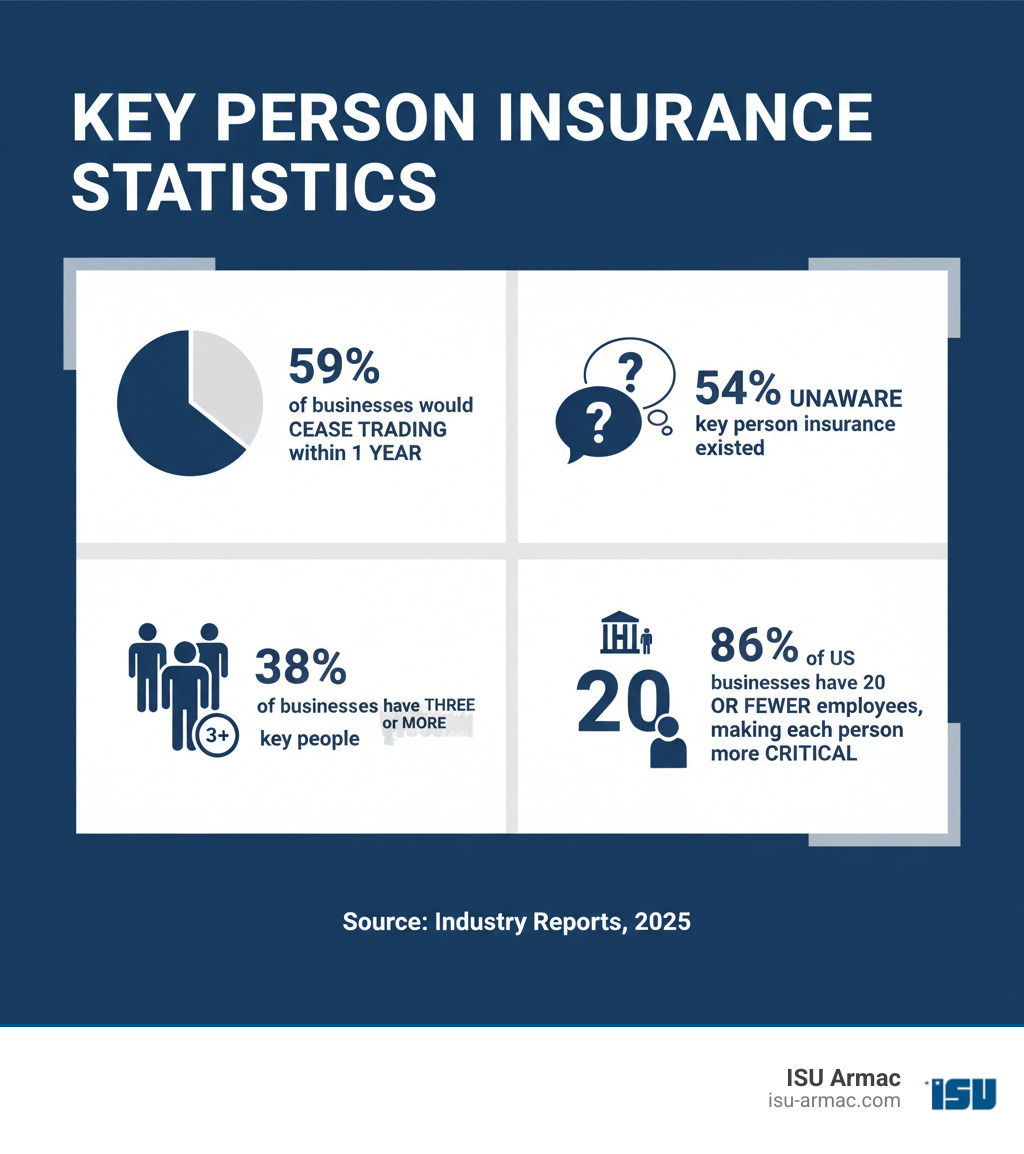
The stakes are high. Research shows that 59% of businesses believe they would have to stop trading within a year after losing a key person. Yet 54% of businesses admit they didn’t even know key person insurance was an option.
As Ryan McEachron, CEO of ISU Insurance Services ARMAC Agency in Victorville, I’ve seen how key person benefits protect High Desert companies from financial devastation. My two decades in business insurance have proven that proactive planning is the key to survival.
The Core Key Person Benefits for Business Continuity
Think about the people who make your business work—your top salesperson, your technical genius, or the founder whose vision drives everything. If something happened to one of them, would your business survive?

This is where key person benefits become critical. At ISU Armac, we’ve seen this protection transform a potential catastrophe into a manageable transition. It’s a financial shield that protects your company when you lose someone irreplaceable.
The numbers are sobering: 59% of businesses believe they’d have to close within a year of losing a key person. Key person insurance provides financial stability when revenue drops, operational resilience to keep things running, and stakeholder confidence that reassures everyone you’re prepared. It can mean the difference between business survival and becoming another statistic.
For a deeper dive into how this protection strengthens your company, check out our guide on Benefits of Keyman Insurance.
Understanding the Financial Key Person Benefits
After losing a key person, bills are still due, but your revenue engine may have stalled. This is where the immediate key person benefits kick in: a cash influx to keep your business stable. The insurance payout works across multiple fronts:
- Covering Lost Revenue: The payout bridges the income gap when a top salesperson or engineer is gone, ensuring you can still make payroll and keep the lights on.
- Debt Repayment: Many business loans are secured by key person insurance. The death benefit can be used to repay these loans, protecting the business and the deceased’s estate.
- Funding Buy-Sell Agreements: For partnerships, the funds allow surviving partners to buy out a deceased co-owner’s share from their family without draining personal savings.
- Covering Replacement Costs: Finding and training a replacement is expensive. The benefit covers recruitment fees, temporary staffing, and lost productivity during the transition.
Without these financial key person benefits, even profitable businesses can face a cash crisis that spirals out of control.
Strategic Key Person Benefits Beyond the Payout
The power of key person insurance often shows up before you ever file a claim. Maintaining investor confidence is huge. Having a policy tells investors and lenders you’re managing risk and protecting their investment. It sends a clear message to suppliers that you’re a stable, well-managed business partner, which in turn protects shareholder value.
Sometimes, the loss of a key person means the business can’t continue. In these cases, having funds for an orderly business wind-down is invaluable. You can pay final wages, settle with suppliers, and close with dignity rather than declaring bankruptcy.
Don’t underestimate the impact on employee morale. Knowing the company has financial protection helps the remaining staff feel secure and stay focused. For family businesses, it provides funds for heirs to manage or close the business, giving them time and resources to make good decisions without immediate financial pressure.
These strategic key person benefits transform insurance from a simple payout into a comprehensive business continuity tool.
How to Structure Your Key Person Insurance Policy
Setting up key person insurance is straightforward once you understand the basics. Your business owns the policy, pays the premiums, and receives the death benefit. This structure ensures the key person benefits go directly to stabilizing the company when needed.

At ISU Armac, we walk our Southern California clients through this process step by step. A key difference from personal insurance is that you’re insuring someone else’s life, which requires their written consent. The key employee must participate in the application, including any medical exams. Handled correctly, this conversation shows the employee how valuable they are to the organization. To understand the process from start to finish, take a look at our guide on How Does Keyman Insurance Work?.
Identifying and Valuing Your Key Person
First, identify who is truly essential. A key person is anyone whose sudden absence would cause significant financial harm. This often includes founders, top executives, star salespeople, and technical experts with irreplaceable knowledge. The common thread is that their departure would measurably hurt your bottom line. For more insights, check out our resource: Under a Key Person Policy the Key Employee Is The.
Next, you must calculate the financial impact of their loss. We’re not valuing a person, but the financial hole their absence would create. Common methods include:
- Salary Multiple Method: A simple approach, insuring the person for 5-10 times their annual salary.
- Contribution to Profits Method: This calculates coverage based on the percentage of profits the person generates.
- Cost to Replace Method: This comprehensive method adds up all expenses to fill the role, from recruiter fees to lost revenue during the transition.
Getting this valuation right is critical to ensuring your key person benefits are sufficient.
Choosing the Right Coverage and Policy Type
After valuing your key person, you must choose a coverage amount and policy type. The coverage should reflect the real financial impact, including lost revenue, recruitment costs, debt obligations, and operational disruptions. For a detailed breakdown of how to calculate your needs, visit our article: How Much Does Keyman Insurance Cost?.
Your two main policy options are:
- Term Life Insurance: Covers a specific period (e.g., 10-20 years) with lower, level premiums. It’s ideal for covering risks tied to a specific timeframe, like a business loan.
- Permanent Life Insurance: Provides lifetime coverage and builds cash value the business can access. It costs more but is suited for long-term protection of founders or partners.
Consider adding a disability coverage rider, which pays out if the key person becomes disabled and can no longer work. This significantly improves your key person benefits, as disability is more common than premature death.
| Feature | Term Life Insurance | Permanent Life Insurance |
|---|---|---|
| Coverage Duration | Specific period (e.g., 10, 20, 30 years) | Entire lifetime |
| Cost | Generally lower premiums | Higher premiums |
| Cash Value | No cash value accumulation | Builds cash value over time |
| Flexibility | Less flexible, expires at term end | More flexible, can borrow against cash value |
| Purpose | Short-to-medium term risks, specific projects | Long-term protection, potential retirement benefits |
The right choice depends on your business’s budget and long-term plans. At ISU Armac, we shop multiple carriers to find the best coverage at competitive rates.
Advanced Considerations and Potential Limitations
Key person benefits are powerful, but your strategy must evolve with your business. At ISU Armac, we help Southern California businesses steer these complexities to ensure coverage remains effective.
What happens if a key person leaves? You have options. You can surrender the policy; for a term policy, you just stop payments. If it’s a permanent policy with cash value, you’ll receive that value back (less any surrender charges). Alternatively, you could sell the policy to the departing employee or their new employer, allowing your business to recoup some of its investment.
It’s also important to understand the policy’s limitations. A financial payout provides crucial support, but it can’t replace intangible assets like a unique creative vision, deep client relationships, or the company culture a leader cultivated. The payout gives you time and resources to address these gaps, but some contributions are irreplaceable. Understanding these limits helps you set realistic expectations and build complementary strategies like succession planning. Our guide to Keyman Insurance Policy offers more insights.
Navigating Tax Implications
Tax treatment is an area where details matter, and getting it wrong can reduce your key person benefits. We always advise clients to consult a qualified tax professional, but here are the general rules:
- Premiums are generally not tax-deductible. The IRS views them as an investment in a future asset (the death benefit), not an ordinary business expense. For more on this, see our article Is Keyman Insurance a Business Expense?.
- Death benefits are generally received income tax-free. This is a major advantage, ensuring the full policy amount is available to your business.
- Cash value in permanent policies grows tax-deferred. If you access this value, policy loans are typically tax-free, while withdrawals are tax-free up to the amount of premiums paid.
These tax nuances impact your coverage’s true value, which is why understanding Key Man Life Insurance Tax Treatment is so important. We work alongside your tax advisors to ensure your strategy is optimized.
Frequently Asked Questions about Key Person Insurance
When business owners explore key person benefits, the same questions often arise. Here are answers to the most common ones.
How does key person insurance differ from a standard life insurance policy?
The key difference is who is being protected. A standard life insurance policy protects your family; you own it, and your loved ones are the beneficiaries. Key person insurance protects your business; the company owns the policy, pays the premiums, and receives the death benefit to ensure business continuity.
One is a personal safety net, the other is a business survival tool. For a more detailed comparison, our article Key Man Insurance vs. Life Insurance: Which Is Right For Your Business? breaks down the distinctions.
When should a business consider this type of insurance?
If losing a specific person would seriously hurt your business, you should consider it. It becomes critical in several situations:
- During the startup phase, when the business relies on a few founders.
- When taking on debt, as lenders often require it as collateral.
- During rapid growth, to protect the leaders steering the expansion.
- As part of succession planning, to fund a transition if something unexpected happens.
Essentially, if you can’t imagine your business functioning without someone, it’s time to explore your options. Our guide Do I Need Keyman Insurance? can help you assess your specific situation.
Can a business have policies on multiple key people?
Absolutely, and it’s a smart strategy. Success rarely depends on just one person. Your business might have a visionary CEO, a sales superstar, and a technical genius. Losing any one of them would be a major blow.
Research shows that 38% of businesses have identified three or more key people. Insuring multiple individuals spreads your risk and creates a more comprehensive safety net. This approach acknowledges that your business’s success depends on a team of critical individuals, and protecting all of them maximizes your key person benefits. You can learn more about these trends in this report.
Secure Your Business’s Future with the Right Protection

Your business is powered by the talent and dedication of your people. Understanding the key person benefits we’ve explored is a crucial step toward protecting what you’ve built. We’ve seen how this insurance provides a financial cushion, covers replacement costs, and maintains stakeholder confidence during a crisis.
The businesses that thrive are the ones that engage in proactive risk management. Securing key person insurance isn’t pessimistic—it’s a clear-eyed acknowledgment that your business and legacy deserve preservation.
At ISU Armac, we’ve spent years helping Southern California business owners make these exact decisions. Based in Victorville, we understand the challenges facing businesses in our region. As an independent agency, we shop multiple carriers to find you the best coverage at the most competitive rates. We don’t believe in one-size-fits-all solutions; your insurance strategy should be as unique as your business.
The statistics are sobering—59% of businesses could fail within a year of losing a key person. The question isn’t whether you can afford key person insurance; it’s whether you can afford to go without it.
Don’t wait to protect what matters most. The key person benefits of proper coverage can mean the difference between survival and closure. Learn more about Keyman Insurance options for your business and find out how we can help you build a comprehensive protection strategy.
Your business’s future is too important to leave to chance. Reach out to ISU Armac today to secure it properly.