
Why Health Benefits Matter for Your Growing Startup
Health benefits for startups aren’t just a nice-to-have—they’re essential for attracting talent, keeping your team happy, and building a thriving business. Here’s what you need to know:
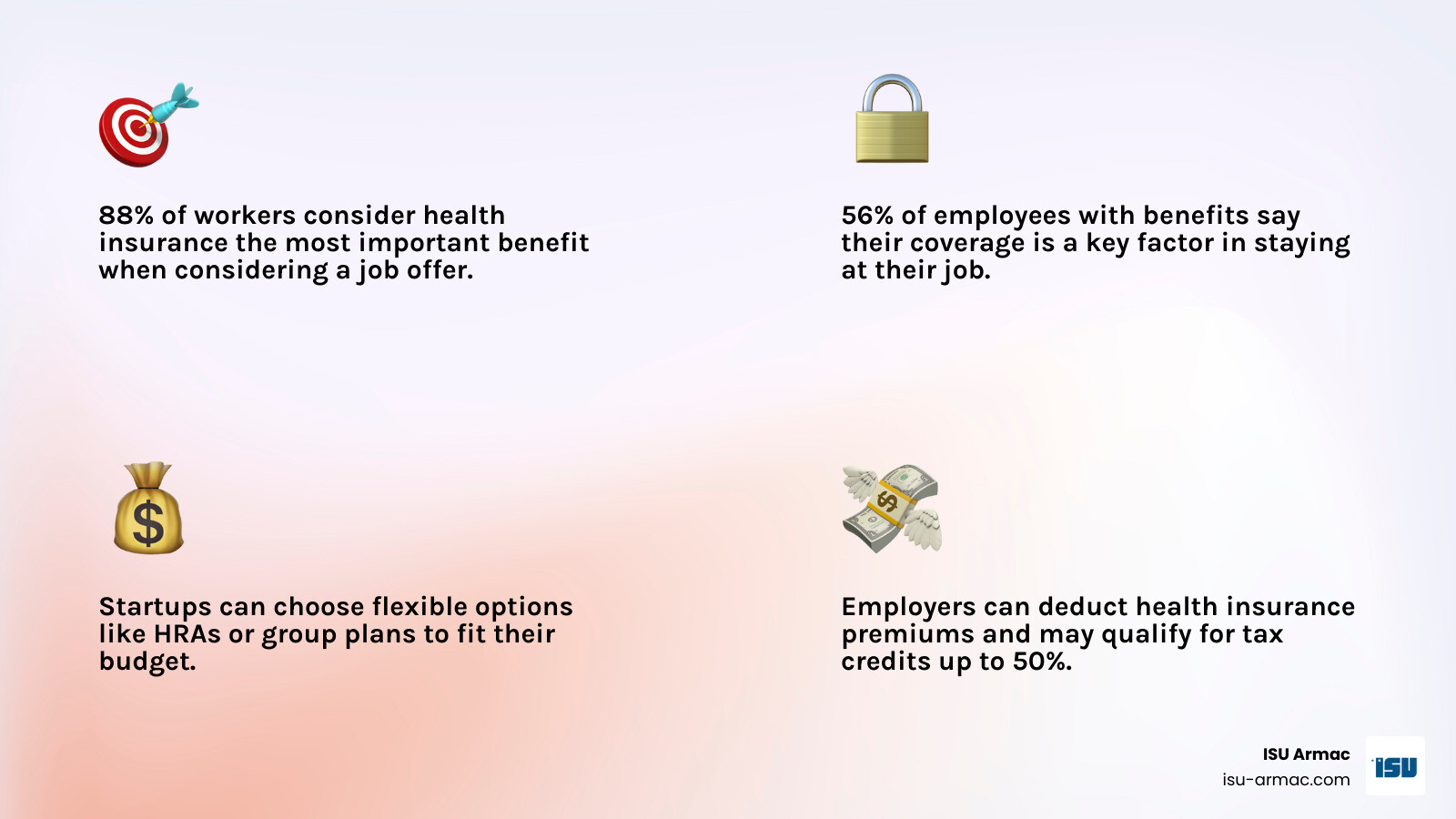
- Recruitment advantage: 88% of workers say health insurance is the most important benefit when considering a job offer
- Retention power: 56% of adults with employer-sponsored health benefits say their coverage is a key factor in staying at their current job
- Cost control: Startups can choose from flexible options like HRAs, group plans, or level-funded arrangements that fit their budget
- Legal requirements: Companies with 50+ full-time employees must offer affordable health plans under the ACA
- Tax benefits: Employers can deduct health insurance premiums, and small businesses may qualify for tax credits up to 50% of premiums
Starting a business in Southern California means competing for talent in a tough market. You’re up against established companies with deep pockets and comprehensive benefits packages. But here’s the good news: offering health coverage doesn’t have to break the bank, and it can be your secret weapon for building a loyal, productive team.
The data is clear. Health insurance ranks as the most valued employee benefit—even above salary bonuses, vacation time, and flexible hours. When employees know their health and their family’s health are covered, they’re less stressed, more focused, and more likely to stick around for the long haul.
But many startup founders feel overwhelmed by the options, the costs, and the compliance requirements. Which plan type makes sense for a team of five versus fifty? How do you balance affordability with comprehensive coverage? What happens when you hit that 50-employee threshold and the ACA kicks in?
The good news: you have more options than you might think, from traditional group plans to innovative health reimbursement arrangements that give employees choice while giving you budget control.
I’m Ryan McEachron, Chief Executive Officer of ISU Insurance Services ARMAC Agency in Victorville, and I’ve spent years helping local businesses steer health benefits for startups and small companies. My experience on the Victorville City Council and with various business organizations has shown me how the right benefits strategy can transform a struggling startup into a thriving local employer.
This guide will walk you through everything you need to know—from understanding your options to implementing a plan that works for your budget and your team.
Know your Health benefits for startups terms:
- employee health coverage
- association health plans for small business
- can a small business pay for individual health insurance
Why Health Benefits for Startups are a Secret Weapon
In the world of startups, it’s easy to see health benefits as a cost rather than a strategic investment. However, for businesses in Victorville, Apple Valley, and across Southern California, offering health benefits for startups is a powerful tool for building a resilient, high-performing team. Providing quality health coverage shows employees you are committed to their well-being, which translates directly into tangible business advantages.
With 4.4 million new businesses starting each year in the U.S., the competition for skilled employees is fierce. A compelling benefits package is essential to attract the best talent away from more established companies.
The Impact on Recruitment and Retention
Health benefits are a cornerstone of recruitment and retention. Since health insurance is the most important benefit for 88% of workers considering a job, not offering it puts your startup at a major disadvantage.
Beyond attracting new hires, benefits are crucial for keeping your team. For 56% of US adults, health coverage is a key factor in deciding to stay at their job. High turnover is costly, leading to recruitment expenses, lost knowledge, and lower morale. Thoughtful benefits foster employee loyalty and job satisfaction, significantly reducing these hidden costs.
Boosting Productivity and a Healthy Workplace
Healthy employees are productive employees. When your team has access to quality healthcare, they can address health issues promptly, preventing minor problems from causing extended absences. Ill health costs US employers an estimated $575 billion annually in lost productivity.
Startup environments can be stressful. Offering comprehensive health benefits for startups, including mental health support, is a game-changer. According to the CDC, workplace health programs can decrease healthcare and workers’ compensation costs by up to 25%. Supported employees are more engaged, focused, and productive.
Key Challenges for Offering Health Benefits for Startups
While the advantages are clear, startups face real problems when providing health coverage. Our clients in Victorville and Hesperia often cite these concerns:
- Budget Constraints: With average 2023 small firm costs at $8,435 for single and $23,968 for family coverage, affordability is a major challenge for 36% of small business owners.
- Administrative Complexity: Navigating plans, enrollment, and compliance is overwhelming for small teams without dedicated HR staff.
- Lack of Expertise: Founders are experts in their field, not benefits administration. Understanding plan types and legal rules is a steep learning curve.
- Scalability Concerns: A plan for five employees may not work for fifty. Startups need solutions that grow with them.
- Navigating Regulations: The Affordable Care Act (ACA) and other regulations add complexity as your team grows.
These challenges are significant but not impossible. At ISU Armac, we simplify this process, helping you find solutions that fit your budget and strategic goals.
Decoding Your Health Insurance Options
Choosing the right health benefit plan for your startup involves understanding options that vary in cost, flexibility, and administration. Our goal is to help you make an informed decision for your team in Southern California.

Traditional Group Health Insurance Plans
These are the classic employer-sponsored plans where your startup selects a plan from a carrier and contributes to employee premiums.
- Fully-Insured Plans: The most common option for small businesses. You pay a fixed monthly premium to an insurance carrier, which then assumes the financial risk for your employees’ healthcare claims and manages administration.
- HMO vs. PPO: These are common network types.
- HMO (Health Maintenance Organization): Offers lower out-of-pocket costs but requires using in-network providers and getting referrals for specialists.
- PPO (Preferred Provider Organization): Provides more flexibility to see in-network and out-of-network providers but typically has higher out-of-pocket costs.
- High-Deductible Health Plans (HDHPs): These plans have lower monthly premiums but higher deductibles. They can be paired with a Health Savings Account (HSA), allowing employees to save tax-free for medical expenses.
- Small Business Health Options Program (SHOP): A federal marketplace helping businesses with 1-50 employees provide medical and dental insurance. We can help you determine if your Southern California business is eligible. Find more info about SHOP plans here.
For S-Corporations with 50+ employees, offering health insurance under the ACA is mandatory. Smaller S-Corps can still offer various group plans.
Flexible Health Reimbursement Arrangements (HRAs)
HRAs are employer-funded benefits that reimburse employees tax-free for medical expenses, including individual health insurance premiums. They offer excellent flexibility and budget control.
- ICHRA (Individual Coverage HRA): For employers of any size, an ICHRA reimburses employees for individual health insurance and other medical costs. It has no contribution limits and allows for different allowance amounts across 11 employee classes (e.g., full-time vs. part-time), giving you budget control and your team more choice.
- QSEHRA (Qualified Small Employer HRA): Designed for employers with fewer than 50 full-time equivalent employees. It reimburses for individual health insurance and medical expenses up to an annual IRS-mandated cap. It’s a great tax-advantaged alternative to a traditional group plan.
- Key HRA Advantages:
- Tax Benefits: Reimbursements are tax-free for employees and tax-deductible for your startup.
- Employee Choice: Employees buy their own individual plans, choosing coverage that best fits their needs.
- Budget Control: You set the reimbursement limits, creating predictable, defined costs.
Alternative and Innovative Approaches
Beyond traditional plans and HRAs, other options can provide valuable coverage.
- Level-Funded Plans: A hybrid of fully-insured and self-funded plans. You pay a fixed monthly premium, but you can get a refund if claims are lower than expected. Your liability is capped if claims are higher. In 2022, 35% of employees at small firms were covered by a level-funded plan.
- Self-Funded Plans: Your startup pays for employee healthcare claims directly, offering control over plan design and potential cost savings. This approach carries financial risk and is usually paired with “stop-loss” insurance to protect against catastrophic claims.
- Wellness Stipends: Taxable allowances for employees to cover health-related costs. While not a replacement for insurance, they are a simple way to support well-being.
- Direct Primary Care Memberships: Services like One Medical offer memberships for improved primary care access. This can be a standalone benefit or part of a broader strategy, and studies show it can lower total employer costs by up to 45%.
Crafting Your Startup’s Health Benefits Strategy
Choosing the right health benefit plan requires a clear strategy based on your budget, team needs, and growth plans. As your advisors in Southern California, we help you build a strategy that is both effective and sustainable.
Step 1: Determine Your Budget and Employee Needs
First, get a clear picture of your financial capacity and employee expectations.
- Assessing Affordability: Analyze your cash flow to determine how much your startup can realistically allocate to health benefits.
- Surveying Employees: Use anonymous surveys or informal discussions to learn what employees value most, such as low deductibles, wide doctor networks, or mental health support.
- Analyzing Demographics: Consider your team’s age, family status, and general health. A young, single workforce may have different needs than a team with families.
- Balancing Premiums and Deductibles: Lower-premium plans usually have higher deductibles. We help you find a balance that provides meaningful coverage without creating high out-of-pocket costs for employees. The average deductible at small firms is significantly higher ($2,434) than at large firms ($1,478).
- Cost-Sharing Strategies: Decide on the contribution split between your startup and your employees for premiums. A shared-cost model is a common approach.
Step 2: Choosing the Right Health Benefits for Startups
With a budget and needs assessment, you can explore the best-fit options, which often depend on your startup’s size.
| Feature | Traditional Group Plan | Health Reimbursement Arrangement (HRA) | Level-Funded Plan |
|---|---|---|---|
| Cost Predictability | Fixed monthly premiums | Employer sets reimbursement limits | Fixed monthly premiums, with potential refunds |
| Employer Risk | Low (carrier assumes risk) | Low (employer’s cost is capped) | Moderate (employer assumes some risk, capped) |
| Employee Choice | Limited to plan options selected by employer | High (employees choose their own individual plans) | Limited to plan options selected by employer |
| Tax Advantages | Premiums are tax-deductible for employer | Reimbursements are tax-free for employees & deductible for employer | Premiums are tax-deductible for employer |
| Administrative Effort | Moderate (carrier handles claims) | Moderate (often managed by HRA administrator) | Moderate (TPA handles claims, employer manages risk) |
| Scalability | Can be complex to scale, minimum participation rules | Highly scalable, flexible for growth | Moderately scalable |
- Aligning with Company Size:
- Seed Stage (1-10 employees): HRAs (like QSEHRAs) and SHOP plans are often ideal for their flexibility and budget control.
- Growth Stage (11-49 employees): ICHRAs offer greater flexibility, while traditional group plans and level-funded plans become more viable.
- Scaling Stage (50+ employees): As an Applicable Large Employer (ALE), you must offer affordable group health insurance. ICHRAs, fully-insured, or self-funded plans are all strategic options.
- Remote vs. In-Office Teams: For remote teams, HRAs are highly effective, as they allow employees to choose local plans that fit their needs.
Step 3: Implementation and Communication
After selecting a plan, the focus shifts to setup and communication.
- Working with a Broker: As an independent agency in Victorville, Hesperia, and Oak Hills, ISU Armac shops multiple carriers to find the best rates. We simplify the process, from comparing quotes to ensuring compliance.
- Setting Up Enrollment: We guide you through setting up enrollment, defining eligibility criteria, and establishing clear policies.
- Communicating Value to Employees: Clearly explain plan options, costs, and enrollment through guides or meetings. Emphasize how the benefits support their well-being.
- Open Enrollment Process: For group plans, we help you manage the annual open enrollment period where employees can make changes.
- Using Benefits Administration Software: Platforms can streamline benefits management, reducing the administrative burden on your team.

Navigating Legal, Tax, and Compliance Requirements
Understanding the legal and tax landscape of employee health benefits is crucial for any startup, especially to avoid costly penalties. We’ll help you stay compliant with federal and state regulations applicable in Southern California.
Understanding the Affordable Care Act (ACA)
The Affordable Care Act (ACA) has significant implications for startups, particularly as they grow.
- Applicable Large Employers (ALEs): Startups with 50 or more full-time equivalent employees (ALEs) are required under the ACA to offer affordable health insurance that meets minimum value requirements. Failure to do so can result in significant financial penalties.
- 50+ Employee Threshold: This threshold includes both full-time employees and full-time equivalent (FTE) employees (calculated by combining hours of part-time employees). It’s important to track your employee count carefully as you approach this number.
- Minimum Value and Affordability Standards: The health plans offered must cover at least 60% of the total allowed cost of benefits and be considered “affordable” (meaning the employee’s share of the premium for self-only coverage does not exceed a certain percentage of their household income).
- Reporting Requirements: ALEs also have specific reporting obligations to the IRS and to their employees regarding the health coverage offered.
- HIPAA: If your startup handles protected health information (PHI), compliance with HIPAA (Health Insurance Portability and Accountability Act) is essential to safeguard sensitive data. This is particularly relevant for any health-related businesses or those managing employee health records.
Tax Implications and Potential Savings
Offering health benefits for startups isn’t just a cost; it can also come with significant tax advantages.
- Employer Premium Deductions: Generally, premiums paid by your startup for employee health insurance are tax-deductible business expenses. This helps offset the cost of providing benefits. For C-Corporations, the entire cost of employee health insurance premiums is deductible.
- Small Business Health Care Tax Credit: If your startup has fewer than 25 full-time equivalent employees and you pay at least 50% of your employees’ premium costs, you may be eligible for a tax credit of up to 50% of the cost of their premiums. This can be a substantial saving for smaller businesses.
- Tax-Free HRA Reimbursements: As discussed, reimbursements made through QSEHRAs and ICHRAs are tax-free for employees and deductible for your startup, within annual IRS limits. This makes HRAs a highly tax-efficient way to provide health benefits.
- Employee Premium Tax Deductibility Rules: Employees who itemize deductions on their tax returns can write off out-of-pocket health insurance costs, including premiums, that exceed 7.5% of their adjusted gross income. However, any premiums reimbursed by their employer through an HRA or stipend are not deductible by the employee.
- S-Corporation Considerations: For S-Corporations, health insurance for non-owner employees is a tax-free benefit. However, for shareholder-employees who own 2% or more of the company, their health insurance is counted as taxable income, but the S-Corp can still deduct their health insurance as a business expense.
“If there’s one thing I wish I had known before, there are tax benefits to offering health insurance to your business. Not only is it a great way to get and keep top talent, but it’s also a great way to make money for your company,” shares Matt Little, Co-owner of Damien McEnvoy Plumbing. This sentiment echoes what we often tell our clients in the local Southern California business community.
Frequently Asked Questions about Startup Health Benefits
We hear a lot of common questions from startup founders about health benefits. Here are some of the most frequent inquiries we address for our clients in Victorville, Apple Valley, and beyond.
How much does health insurance cost for a startup?
The cost of health insurance for your startup can vary significantly based on several factors, including your location in Southern California, the type of plan you choose, the level of coverage, and the age and health demographics of your employees.
According to the 2023 KFF Employer Health Benefits Survey, for small firms (which includes many startups), the average annual premium is:
- $23,621 for family coverage, with workers contributing $8,334 on average.
- $8,722 for single coverage, with workers contributing $5,889 on average.
It’s also worth noting that the average deductible amount for single coverage is much higher at small firms ($2,434) compared to large firms ($1,478). We work with you to understand these costs and find a plan that balances affordability with comprehensive care.
When is a startup legally required to offer health insurance?
Under the Affordable Care Act (ACA), your startup is legally required to offer affordable health insurance that meets minimum value standards if you have 50 or more full-time equivalent (FTE) employees. These businesses are known as Applicable Large Employers (ALEs). If you meet this threshold and do not offer compliant coverage, you could face financial penalties.
For startups with fewer than 50 FTEs, offering health insurance is optional from a federal legal standpoint. However, as we’ve discussed, it’s highly recommended for strategic reasons.
Can a startup with fewer than 50 employees still offer health benefits?
Absolutely! And we strongly encourage it. Even if you’re not legally mandated, offering health benefits for startups with fewer than 50 employees is a powerful way to attract and retain talent, boost morale, and improve productivity.
For these smaller businesses, there are several excellent options:
- QSEHRAs (Qualified Small Employer HRAs): These allow you to reimburse employees tax-free for individual health insurance premiums and other medical expenses, giving them choice while controlling your budget.
- ICHRAs (Individual Coverage HRAs): This option offers even more flexibility than QSEHRAs and can be used by businesses of any size, allowing for varied allowances across different employee classes.
- SHOP Marketplace Plans: The Small Business Health Options Program (SHOP) provides a way for small businesses to offer health and dental insurance to their employees.
- Traditional Group Plans: Many insurance carriers offer group health insurance plans specifically designed for small businesses, often requiring as few as two employees.
We can help your startup in Southern California explore these options to find the best fit for your team and budget.
Conclusion
Offering health benefits for startups is more than just a line item in your budget; it’s a strategic investment in the heart of your business—your people. From attracting the brightest minds in Southern California to fostering a healthy, productive, and loyal workforce, the right health coverage plan can be your secret weapon for sustained growth and success.
We understand that navigating the complexities of health insurance can feel overwhelming, especially for busy founders. That’s why we’re here. At ISU Armac, we specialize in simplifying this process, providing expert guidance custom to the unique needs of startups in Victorville, Apple Valley, Hesperia, Oak Hills, and throughout Southern California. We’ll help you decode your options, craft a personalized strategy, and ensure you meet all legal and tax requirements, so you can focus on what you do best: building your dream.
Don’t let the challenge of health benefits deter you from empowering your team. Let us help you open up employee happiness and build a stronger, more resilient startup.
Get a quote for your small business medical insurance plan today and find how we can help your startup thrive.