
Table of Contents
- Does contractors insurance cover faulty workmanship?
- What contractors general liability insurance is designed to address
- Faulty workmanship versus resulting damage
- How the “your work” exclusion and subcontractor exception may matter
- Examples: what may be excluded, and what deserves review
- What contractors insurance may not pay for
- Other policies and risk controls contractors may consider
- California contractor insurance and licensing: what to verify
- What to do when a customer reports faulty work
- How I help contractors compare coverage in Victorville and California
Does contractors insurance cover faulty workmanship?
When a customer says a job was done incorrectly, the first question I often hear is whether contractors insurance will pay to fix it. The short answer is that general liability insurance typically is not a warranty for a contractor’s own work. The cost of removing and redoing a defective installation is different from a claim alleging that the installation caused bodily injury or damage to other property. That second type of claim deserves a closer review, but it is not automatically covered.
I work with businesses in Victorville, nearby High Desert communities, and throughout California. I encourage contractors to look beyond a simple yes-or-no answer. The policy’s insuring agreement, definitions, exclusions, endorsements, limits, and notice conditions all matter, as do the facts of the loss. A customer’s description of “faulty work” may involve several different costs, each of which can receive a different coverage analysis.
What contractors general liability insurance is designed to address
Commercial general liability insurance is generally intended to address qualifying claims of bodily injury or property damage for which a business may be legally responsible, subject to the policy’s terms. It may also include separate coverage for certain personal and advertising injury claims. It is not designed to make every completed job satisfactory, reimburse every disappointed customer, or guarantee that a contractor will fulfill a contract.
When I review a possible faulty-work claim, I start by separating the alleged harm from the work that produced it. Is the customer asking solely for the deficient work to be corrected? Are they alleging physical damage to something else? Has someone reportedly been injured? A demand letter may combine repair costs, lost income, and other amounts, but listing them together does not mean an insurer will treat them all alike.
Even if a claim alleges property damage or bodily injury, the next question is whether it satisfies the policy’s requirements, including any applicable definition of an occurrence. Exclusions and endorsements may then narrow or change coverage. A contractor should also check who is insured, when the alleged damage happened, where it happened, and which policy period may apply. These details are why I avoid deciding coverage from a brief account of a project.
General liability is only one part of a contractor’s insurance program. It should be evaluated alongside the contractor’s actual operations, employees, vehicles, equipment, contracts, and use of subcontractors—not treated as an all-purpose solution to construction risk.
Faulty workmanship versus resulting damage
Consider a hypothetical Victorville job in which a contractor installs a component incorrectly. If the customer asks the contractor to remove that component and install it properly, the request concerns correcting the work itself. A general liability policy typically should not be assumed to pay that cost. The contractor may still have a contractual or other responsibility to resolve the problem; the question is whether an insurance policy responds.
Now suppose the installation is alleged to have caused physical damage beyond the component the contractor installed. The additional damage presents a different question. Depending on the facts and policy language, a resulting-damage claim may warrant review under general liability coverage. That does not mean every damaged surface, adjoining item, or part of a project qualifies. The insurer must determine what property was damaged, what work the insured performed, what caused the loss, and which provisions apply.
A California Court of Appeal decision discussing a “your work” exclusion illustrates why the distinction between repair or replacement of the insured’s work and damage to other property can matter. It is not a shortcut to the outcome of another claim. I would want a contractor to have their own policy and the specific damage reviewed before relying on any general example—including one in this article.
How the “your work” exclusion and subcontractor exception may matter
Many general liability policies contain provisions commonly discussed as exclusions for damage to “your work.” In broad terms, these provisions can limit coverage for property damage to work performed by the insured or on the insured’s behalf. What counts as the insured’s work can be an important question on a project with multiple trades, phases, or contractors.
Some policy forms contain an exception involving work performed by a subcontractor. A contractor should not assume that hiring a subcontractor makes a claim covered. The exact wording, any endorsements that modify it, the identity of the insured, the nature of the alleged damage, and other policy requirements still matter. Nor should a contractor assume that every policy contains the same exception.
I suggest reviewing these provisions before a dispute arises. Ask what the policy says about completed work, work performed on your behalf, and subcontractors. If a contract calls for specific coverage or additional insured status, review the relevant forms rather than relying on a general description. My guide to how to read an insurance policy can help you locate declarations, exclusions, and endorsements, although the carrier must evaluate any actual claim.
Examples: what may be excluded, and what deserves review
Scenario A: The customer wants the defective work redone. A tile contractor is told that newly installed tile is uneven. The customer asks for removal and a new installation, with no other damage or injury reported. That sounds primarily like a demand to correct the contractor’s own work, rather than a straightforward general liability claim. Still, I would not determine coverage from those facts alone. The contract, policy, and complete circumstances need review.
Scenario B: An alleged error damages other property. An improperly installed connection is alleged to have caused water damage beyond the connection itself. There may be a question about resulting property damage that should be reported and examined. The insurer would still need to assess the cause, timing, affected property, policy terms, and any applicable exclusions. The possibility of a claim worth reviewing is not a promise that the cost of correcting the connection—or every associated expense—will be paid.
Scenario C: A subcontractor performed the work. A general contractor receives a complaint that work completed by a subcontractor caused damage on a project. The contractor may want to examine both its own policy and the subcontractor’s coverage documents. A subcontractor exception in one policy might be relevant, but other terms and factual questions remain. The short description does not establish whether either insurer owes coverage.
I use these examples to frame questions, not to assign outcomes. A claim can involve overlapping repair work and alleged resulting damage. Sorting those costs may require inspection reports, photographs, contracts, invoices, and a careful account of what happened. Reporting a matter for review is more reliable than assuming that its label—“construction defect,” “bad installation,” or “property damage”—settles the issue.
What contractors insurance may not pay for
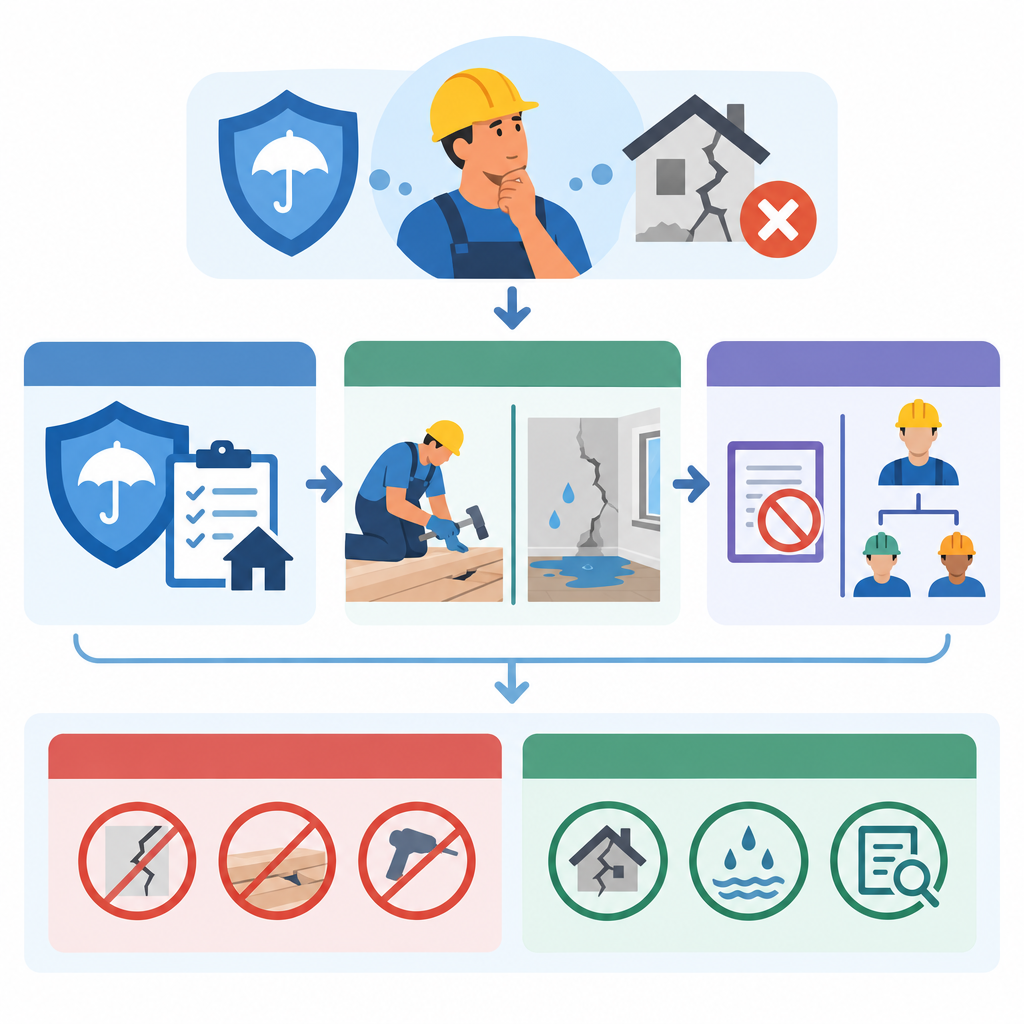
The clearest potential gap is the cost of making deficient work conform to the agreed scope. A contractor should not budget for general liability insurance to serve as a workmanship warranty. Similarly, a dispute about delay, an unpaid invoice, a promised performance standard, or a customer’s lost expected benefit may raise issues different from physical injury or property damage. Purely economic loss does not become covered property damage simply because a customer seeks compensation.
Other policy provisions can affect the answer. Exclusions, deductibles or self-insured retentions, limits, conditions, and endorsements can change what an insurer may pay and what a contractor must do to preserve potential coverage. An insurer may also distinguish between the cost to fix the original faulty work and the cost to address separately damaged property. I recommend reviewing the actual forms instead of relying on a certificate or a quote summary.
Insurance, a workmanship warranty, and a surety bond serve different purposes. A warranty concerns promises about work or materials; a bond is a separate arrangement with its own terms; and an insurance policy responds only as its language provides. None of them erases a contractor’s obligations under a contract. If a customer makes a formal demand, I would consider it especially important to keep the coverage question separate from the question of what the contractor may owe.
Other policies and risk controls contractors may consider
The right insurance mix depends on the business. Workers’ compensation addresses qualifying employee work-related injuries rather than the customer’s request to repair defective construction. Commercial auto may address covered vehicle-related losses. Tools and equipment coverage may help with covered losses to business equipment, while builders risk may be relevant to certain property under construction. Professional liability or pollution liability may be worth discussing when a contractor’s services or exposures call for them. None of these policies should be assumed to cover a particular faulty-work demand without reviewing its terms.
I also encourage contractors to take practical steps that make both project management and later claim review easier. Keep written scopes of work, approved change orders, inspection records, photographs, invoices, and communications organized by job. Document which trade performed which work and when. These records can help clarify what a customer is requesting and what property may have been affected; they do not, by themselves, create insurance coverage.
When subcontractors are involved, I would review the subcontract’s insurance requirements before work begins. Request the coverage evidence the agreement requires and follow up on any required endorsements. A certificate of insurance is useful evidence of information reported at a point in time, but it is not a substitute for reviewing the actual policy and endorsements when coverage language matters. I would also check renewal dates and whether the documents correspond to the work being performed.
Contracts deserve attention before bidding, not just after a complaint. The California Department of General Services’ contract-insurance guidance notes that requirements can involve multiple lines of coverage and advises checking them before bidding or performing work. It also cautions that the contract or subcontract governs if it conflicts with its informational guidance. If a job calls for limits, forms, or endorsements you do not currently have, it is better to address that before accepting the obligation. For a separate discussion of limits, see my guide on how much general liability insurance a business may need.
California contractor insurance and licensing: what to verify
California licensing and insurance rules are important, but they do not answer whether an insurer will cover a particular faulty-work claim. The Contractors State License Board’s applicant materials identify circumstances in which workers’ compensation insurance is required, including when a contractor has employees, and describe an exemption process for some contractors without employees. They also identify specific classifications with workers’ compensation requirements. Contractors should verify the current rules for their own classification and staffing rather than assuming that having no employees always settles the question.
Those CSLB materials also describe liability-insurance requirements for LLC contractor licenses, with the required amount tied to personnel of record and stated within a $1 million to $5 million range. That is an LLC-specific point, not a claim that every California contractor has the same general liability mandate. Licensing, required insurance, contract requirements, and whether a policy covers an individual loss are separate questions.
If you are deciding whether a project requires a license or what applies to your business, I would start with the CSLB’s current guidance for contractor license applicants. Requirements depend on the work and circumstances, so a general article cannot resolve an individual licensing question. I can help discuss insurance options; licensing or legal questions may require guidance from the appropriate agency or a qualified professional.
What to do when a customer reports faulty work
First, take the report seriously without promising a particular repair, payment, or insurance outcome. Find out what the customer says happened, whether there is active damage or a safety concern, and what property or people may be affected. Take reasonable steps to prevent further harm where appropriate, while preserving evidence of the original conditions.
Next, read your policy’s notice provisions and promptly contact your insurer or agent if the matter may trigger them. Do not wait for a lawsuit if the policy requires earlier notice of a claim or circumstance. Provide accurate information and retain the customer’s complaint, contract, change orders, photographs, inspection records, invoices, and relevant messages. If a subcontractor’s work is involved, preserve the subcontract and available insurance documents as well.
Follow the insurer’s instructions about documentation and inspection. Avoid admitting liability on the insurer’s behalf or telling the customer that insurance will pay; those decisions require review. If you receive a formal demand, a lawsuit, or a substantial contract dispute, consider qualified legal counsel. I can help you identify policy documents and communicate coverage questions to a carrier, but I cannot guarantee how a carrier will decide a claim.
How I help contractors compare coverage in Victorville and California
At ISU Armac Insurance Services, I help clients in Victorville, surrounding communities, and across California compare available insurance options from multiple carriers. For a contractor, I would begin with the work you actually perform: your trades, project sizes, employees, vehicles, equipment, subcontractor arrangements, and the insurance terms your customers put in contracts. Those details help make a coverage conversation more useful than asking for “contractors insurance” in the abstract.
If you are concerned about faulty workmanship, I can help you review policy documents and bring specific questions to carriers before a loss occurs. We can discuss general liability alongside other policies that may fit your operations, while recognizing that eligibility, pricing, limits, exclusions, and claim decisions depend on the carrier and policy. Bring a current policy, a sample customer contract, and any subcontractor requirements to the conversation. I will help you compare what is available and identify questions worth resolving before your next job begins.