

Table of Contents
- Why comparing dental insurance plans takes more than comparing premiums
- What dental insurance plans may cover
- DHMO or PPO: which network style fits your needs?
- What to check before enrolling in a dental plan
- Dental coverage options for California individuals and families
- A simple way to compare plans using your likely care
- How I help clients compare dental insurance plans
- Frequently asked questions about dental insurance plans
- Make a confident coverage decision in Victorville
When I help someone compare dental insurance plans in Victorville, I start with a question that a monthly premium cannot answer: What care do you expect to use, and where do you want to receive it? A plan that looks inexpensive at enrollment may cost more if your dentist is outside its network or a planned procedure has a waiting period. Another plan may have a higher premium but give you access to the dentist you already trust.
Those choices matter throughout the High Desert, including Victorville and nearby communities such as Hesperia and Apple Valley. A network is useful only if its participating offices are practical for your household to visit and are accepting patients. I use this guide to explain the terms I would check with you before you enroll, so you can compare coverage against your likely care rather than a headline price.
Why comparing dental insurance plans takes more than comparing premiums
A dental premium is the amount you pay to keep coverage in force. It does not tell you what you will owe for a filling, whether you can visit a particular specialist, or how much the plan will pay toward a crown. To understand the full cost, I look at the network, service prices or cost-sharing, deductibles, waiting periods, annual benefit maximums, and exclusions together.
I also separate a plan’s description of a covered service from a promise that your particular treatment will be paid for. The dentist’s diagnosis, the procedure billed, the plan’s rules, and its remaining benefits can all affect the result. Covered California’s dental information shows differences among plans in premiums, service costs, waiting periods, and benefit limits. I treat those details as reasons to read the current documents for each plan, not as reasons to assume all dental coverage works alike.
What dental insurance plans may cover
Plan materials often group treatment into preventive, basic, and major services. Those labels help organize a comparison, but they are not universal definitions. I check the specific procedure description and benefit schedule before estimating what you might pay.
Preventive care: exams, cleanings, and X-rays
Routine visits can include exams, cleanings, and X-rays. Even when a plan lists preventive care, I check how often each service is available, whether the dentist must be in-network, and whether a visit or particular type of X-ray counts toward a limit. A household with several members may use routine care differently from a person who visits only once a year, so I compare the rules with each person’s habits.
Basic services: fillings and other common treatment
If you expect a filling or another common treatment, I ask how the plan classifies the procedure, what your share will be, and whether coverage begins immediately. The word “covered” alone does not tell you whether you owe a copay, a percentage of an allowed charge, or an amount above what the plan recognizes. When possible, I recommend getting the procedure details from your dentist before comparing plans.
Major services: crowns, root canals, and other complex care
More involved treatment deserves a closer review because service classifications and payment rules can vary. A crown, for example, may have a different waiting period or member cost than a routine cleaning. Root canals, periodontal treatment, dentures, and other procedures should be checked by their exact plan descriptions rather than assumed to fall into the same category. If a dentist has already proposed treatment, an itemized estimate gives us a better starting point than a general statement that you may need “major work.”
DHMO or PPO: which network style fits your needs?
Covered California describes dental health maintenance organization, or DHMO, plans as generally requiring in-network care and specialist referrals. Its listed family DHMO plans use set service prices and have no deductible. Dental preferred provider organization, or DPPO, plans offer in-network and out-of-network options without specialist referrals; they generally have a deductible and share costs between the plan and the member. Those are useful starting points, but I still read the individual plan’s terms before recommending a network style.
When a DHMO may make sense
I would consider a DHMO with someone who is comfortable using participating dentists and wants to evaluate a schedule of stated service prices. The first practical step is confirming that a convenient office participates in the exact plan—not merely that it accepts insurance from the same company. I would also ask how a specialist referral works if your dentist anticipates treatment outside routine care. A low apparent cost does little good if you cannot reasonably access the providers required by the plan.
When a PPO may offer useful flexibility
A PPO may appeal to you if keeping a particular dentist or having an out-of-network option is important. Flexibility does not necessarily mean the same cost at every office. I check the in-network and out-of-network payment rules separately, including whether the dentist’s charge could exceed the amount the plan uses to calculate benefits. I also review any deductible and annual maximum before treating that flexibility as a financial advantage.
What to check before enrolling in a dental plan
I use the following questions as a practical review. They help reveal differences that are easy to miss when two dental insurance plans appear similar on a summary page.
Dentist participation and access near Victorville
Start with the people who will provide the care. Is your current dentist in the specific plan network? Is the office accepting new patients? If you need a specialist, is there a participating option you can reach from Victorville, Hesperia, Apple Valley, or wherever you live or work? Provider directories can change, so I suggest checking with both the plan and the dental office before making a decision. Ask the office to confirm the exact plan name, not just the insurer.
Deductibles, copays, coinsurance, and plan fees
A deductible is an amount you may need to pay before certain plan benefits apply. A copay is a stated amount for a service; coinsurance is a percentage of a cost defined under the plan. I check which services each rule applies to and whether in-network and out-of-network calculations differ. The American Dental Association explains that plan fee schedules can affect what members pay out of pocket. That is why I would not calculate your likely bill from a coverage percentage alone.
Waiting periods and coverage start dates
If treatment may be needed soon, timing can be as important as price. I check when the policy becomes effective and whether a waiting period applies to the particular service. A plan might let you schedule routine care earlier than other work; the current benefit documents determine the answer. If you are replacing existing coverage, I also ask the prospective plan how it handles prior coverage. I do not assume a previous plan’s waiting period will be credited.
Annual benefit maximums and service limits
Many dental plans have an annual maximum: a cap on what the plan may reimburse during its defined year, as the American Dental Association notes. That is different from a cap on everything you could personally spend. I check when the plan year begins, which payments count toward the maximum, and whether any procedure has its own limit. If you expect several treatments, benefits available early in the year may not remain available for a later procedure.
Exclusions, frequency rules, and orthodontia
I also look for services the plan does not cover and restrictions on how often it pays for a service. If braces or other orthodontic treatment matter to your family, I check whether orthodontia is included, who is eligible, and whether separate limits apply. I do the same for any anticipated work that is especially important to you. A broad category on a brochure is not a substitute for the plan’s specific exclusions and limitations.
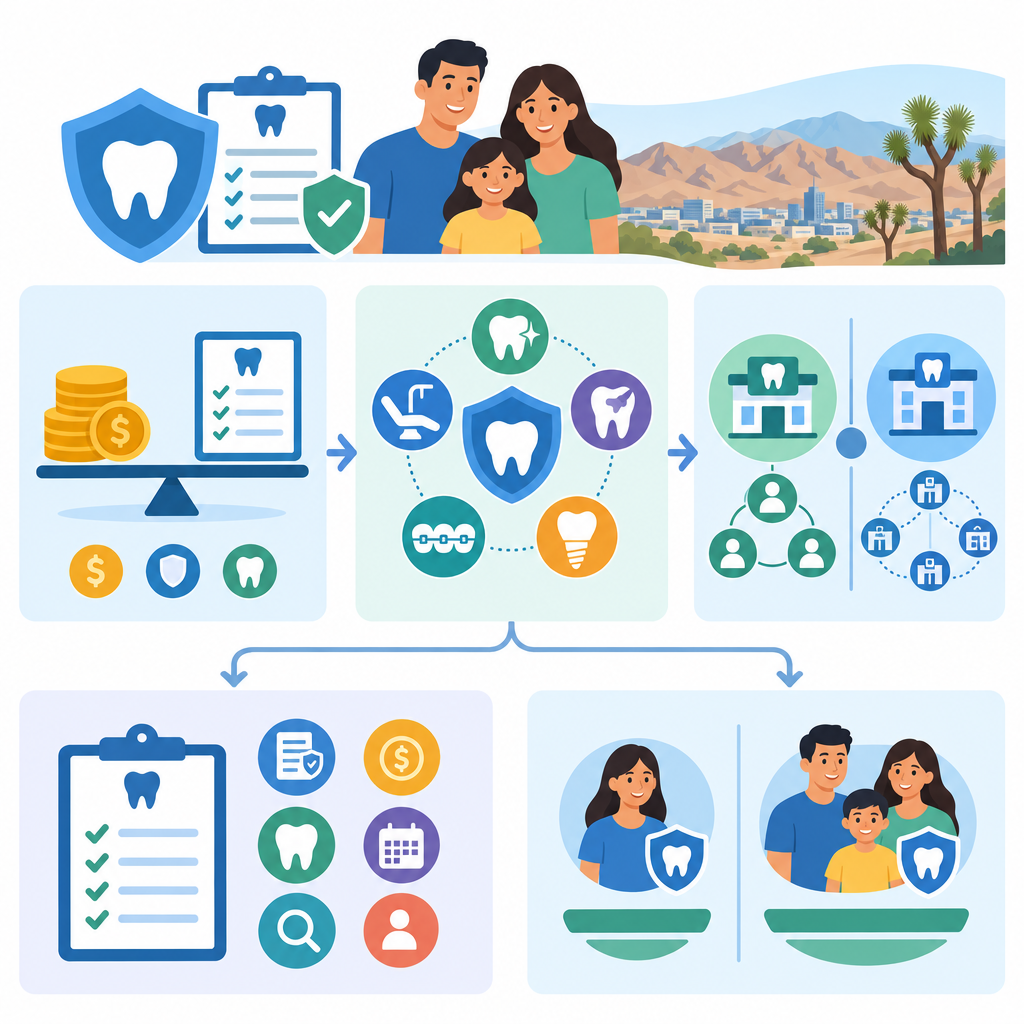
Dental coverage options for California individuals and families
Where you obtain coverage affects the choices you need to review. I distinguish an adult buying dental coverage, a parent checking a child’s benefits, and a person who may qualify for Medi-Cal Dental. I would not assume the enrollment process or benefits are identical across those situations.
Covered California and adult dental plans
Covered California says adults can add a family dental plan during its enrollment process after selecting a health plan. It also says financial help for dental coverage does not apply to those adult dental plans. If you are shopping there, I would compare the dental premium separately from the health plan premium and review the dental plan’s own network, costs, and limitations. Enrollment availability and effective dates should be confirmed through the current Covered California process.
Dental benefits for children
Covered California says dental coverage is included with its health plans for children under 19, while adult dental coverage is handled separately. For a family, I would first identify which members already have dental benefits through their health coverage. Then I would examine those benefits and available providers before deciding whether to add adult dental coverage. That avoids comparing a proposed family purchase with an incomplete picture of what the children already have.
Medi-Cal Dental: eligibility and provider rules
For eligible Californians, California’s Department of Health Care Services describes Medi-Cal Dental services that can include exams, X-rays, cleanings, fillings, root canals, crowns, periodontal care, and dentures, subject to program conditions and provider participation. Members use enrolled providers, and DHCS offers a member service line for help finding one.
I would verify eligibility and the particular member’s current benefits directly with DHCS or the county rather than assume that every listed service is available in every circumstance. That is especially important because DHCS describes Medi-Cal Dental benefit changes taking effect in 2026 and 2027 for certain adults based on eligibility and immigration status. For someone in Victorville, confirming both benefits and a participating provider is more useful than relying on a general coverage list.
A simple way to compare plans using your likely care
I find that a short, written comparison makes the trade-offs easier to see. It will not predict every dental need, but it can keep a tempting premium from overshadowing a network or treatment limitation.
List your household’s expected dental needs
For each person, note routine visits, any treatment already recommended, the preferred dentist, and whether specialist care may be needed. Separate confirmed treatment from a possibility. If a procedure is already planned, ask the dental office for its description and an itemized estimate. I use that information to ask more precise benefit questions; I do not treat an estimate as a guarantee of the final insurance payment.
Verify providers and request a treatment estimate
Next, check the exact plan with the dental office and the insurer. For a proposed procedure, ask what the dentist expects to charge and what information the plan needs to estimate benefits. Confirm that the office’s network status applies to the dentist who will perform the work. If a plan uses referrals, ask how one would be arranged. These steps are particularly valuable when the nearest suitable participating specialist may not be in your immediate neighborhood.
Compare total likely costs, not just monthly premiums
I then place the plans side by side. For each one, I note the yearly premium, expected member charges for routine visits and proposed treatment, any deductible, and the annual benefit maximum. I flag waiting periods or network problems rather than hiding them inside a cost estimate. A plan with the lowest premium may still be the wrong fit if it delays needed care; a higher-priced plan is not automatically better if you are unlikely to use its added flexibility.
How I help clients compare dental insurance plans
At ISU Armac Insurance Services, I approach dental coverage as a personal decision, not a one-size-fits-all product. I can help you organize your questions, compare available options and carrier quotes where appropriate, and identify terms that deserve a direct answer before you enroll. My role is to make the differences understandable so you can decide what fits your budget, your providers, and your household’s anticipated care.
If you want a shorter checklist alongside this guide, my article on choosing dental insurance plans in California covers the key comparison points. For Victorville-area clients, I would still bring the discussion back to the particular dentists you can visit and the treatment you may actually need.
Frequently asked questions about dental insurance plans
Does dental insurance cover every procedure?
No plan should be assumed to cover every procedure. I check the specific benefit schedule for exclusions, service definitions, frequency rules, waiting periods, and limits. Even for a listed service, your cost can depend on the provider and the plan’s payment rules. If treatment is already recommended, ask for its details before choosing coverage.
Can I buy an adult dental plan through Covered California?
Covered California says adults can add a family dental plan during enrollment after selecting a health plan. It says dental financial help does not apply to those plans. I would confirm the available plans, enrollment timing, and effective date through its current process before counting on a particular option.
Will switching plans affect a waiting period?
It may, but I would not assume that prior coverage removes a new plan’s waiting period. Ask the prospective plan whether it recognizes previous coverage, which services the rule affects, and what documentation it requires. Get the answer for the specific plan before ending existing coverage.
Make a confident coverage decision in Victorville
The best dental insurance plans for your household are the ones whose actual rules work with your dentists, expected care, timing, and budget. I recommend verifying those details before comparing final prices. If you live in Victorville or a surrounding High Desert community and want help sorting through the choices, contact me at ISU Armac Insurance Services. I will help you ask the right questions and compare options without treating the lowest premium as the whole answer.