Table of Contents
- How Much Does Church Bus Insurance Cost?
- Why Church Bus Insurance Prices Vary
- What Church Bus Insurance May Cover
- A Price Example Is Not a Victorville Quote
- California Rules Churches Should Check Before a Trip
- How to Compare Church Bus Insurance Quotes
- Practical Ways to Manage the Premium Without Creating Gaps
- Questions to Ask Before Buying or Renewing
- Getting a Church Bus Quote in Victorville
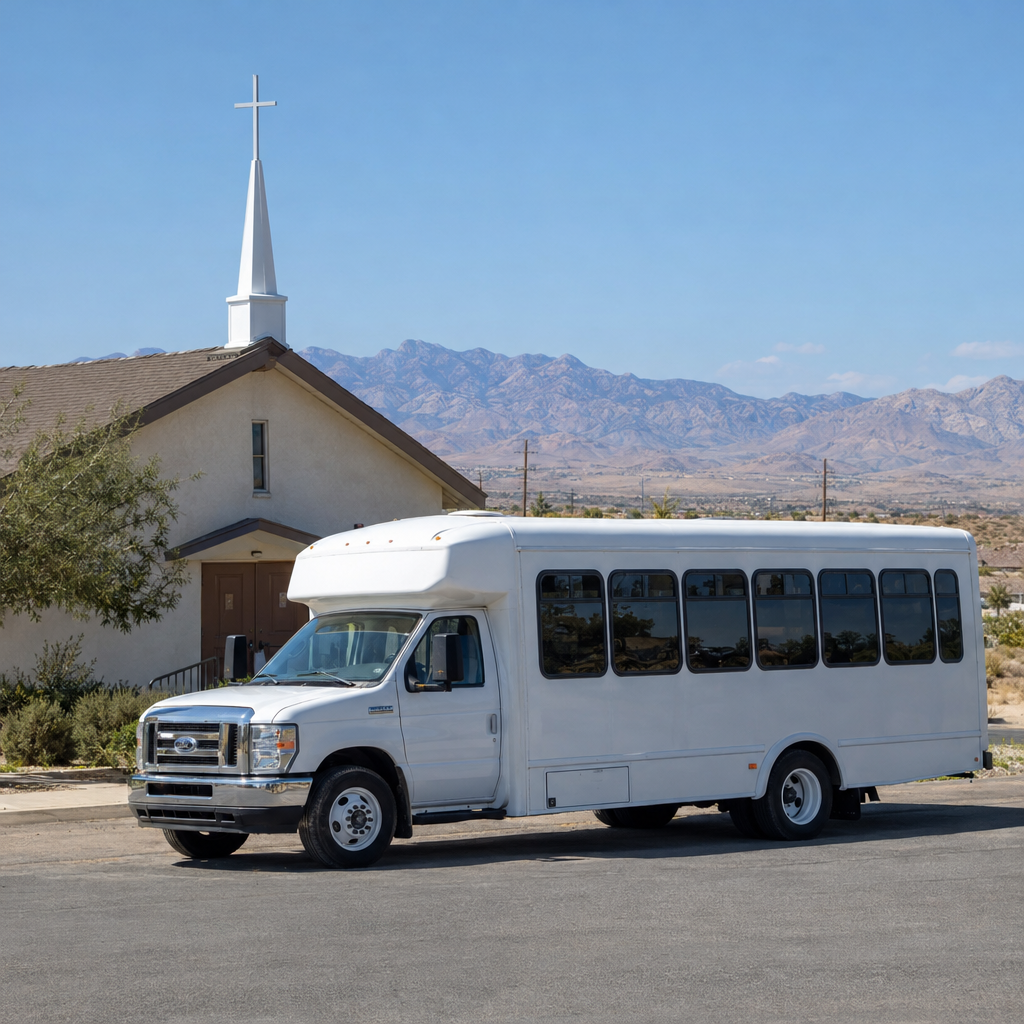
A church bus makes it possible to bring people together for services, youth activities, retreats and community events. It also creates a transportation risk that deserves its own place in the budget. When a Victorville congregation asks me about church bus insurance cost, my first question is not simply, “What kind of bus is it?” I also need to understand who drives it, where it goes, who rides in it and what coverage the church expects.
I help clients in Victorville and throughout California compare insurance options. For a church in Apple Valley, Hesperia or another High Desert community, the most useful starting point is a clear description of the vehicle and its actual use—not an advertised price that may have little in common with its operations.
How Much Does Church Bus Insurance Cost?
There is no reliable one-size-fits-all annual premium for a church bus. The price depends on the vehicle, drivers, trips, coverage limits, deductibles and an insurer’s underwriting decision. Two published figures show why an estimate needs context. A church-focused insurance agency reports about $800 per bus per year among churches it insures. A broader bus-insurance overview gives a range of $1,000 to $36,500 annually across bus operators.
Neither figure is a California-specific quote or a dependable budget for a particular Victorville church. They describe different groups of insureds, and the broader range is not a church-specific range. I would not use either number as a promised starting premium, an upper limit or a substitute for current quotes.
If your congregation needs a budget figure, gather its vehicle and operating details first. Then request quotes that use the same coverage assumptions. That approach gives a finance committee something more useful than a published estimate: prices tied to the church’s own bus and proposed protection.
Why Church Bus Insurance Prices Vary
The bus itself matters. Seating capacity, vehicle type, age, condition and value can affect what an insurer is willing to cover and how it prices the policy. A church seeking coverage for damage to its own bus should also be prepared to discuss its value and repair considerations. Two vehicles described casually as “church buses” may present very different exposures.
Actual use matters just as much. An insurer will want to know how often the bus runs, its estimated annual mileage, normal trip radius and destinations. Regular local transportation, occasional retreats and trips beyond California should all be described accurately. I also ask churches to identify the groups they carry, whether they collect any transportation-related fees and whether the vehicle is ever used outside church activities. Those details can matter to both underwriting and regulatory questions.
Drivers and coverage choices change the comparison. Insurers may consider driving records, experience, eligibility rules and the church’s driver-selection and training practices. Liability limits, comprehensive and collision selections, deductibles and applicable endorsements can change both premium and protection. Prior claims and documented safety procedures may also be considered, although I would never assume a particular practice earns a discount without checking with the carrier.
Finally, tell the agent where the bus is garaged and where it normally travels. For a Victorville-area church, that means explaining its High Desert routes rather than assuming a generic California quote reflects them. Accurate information helps an insurer evaluate the operation and helps the church avoid comparing prices built on conflicting descriptions.
What Church Bus Insurance May Cover
Commercial auto liability is a central part of the discussion. Subject to the policy’s terms, it may address covered bodily injury or property damage claims arising from use of the insured bus. I encourage churches to review the limits as well as the policy wording: the number on a quote does not, by itself, explain every covered driver, vehicle, activity or exclusion.
Physical damage coverage addresses a different concern: damage to the church’s own bus. Comprehensive and collision may be available, but the church needs to confirm what it selected, how the vehicle would be valued, what deductible applies and which losses are excluded. If the bus would be difficult to replace quickly, ask about available valuation and vehicle-downtime options rather than assuming they are included.
Other options to discuss include uninsured or underinsured motorist coverage and medical payments coverage. Availability and terms vary, so I would ask the insurer how each option works for the vehicle and its occupants. I would also specifically verify how the policy treats passengers, youth activities, volunteer drivers, and loading and unloading. Describing a trip to the insurer is more useful than assuming that every church-sponsored activity is treated identically.
Hired and non-owned auto liability is separate from insuring an owned bus. A church safety and insurance handbook discusses this protection for organizational liability associated with employees’ or volunteers’ use of rented or personal vehicles on church business. It does not replace insurance written for a bus the church owns. If your congregation uses both a bus and volunteers’ cars, ask how each exposure is covered.
A commercial umbrella or excess liability policy may be worth discussing alongside the bus policy. I would verify that the underlying auto policy qualifies and that the policies work together as intended. No label—whether “umbrella” or “church package”—guarantees that a particular bus or trip is covered.
A Price Example Is Not a Victorville Quote
The approximately $800 annual figure comes from one church-focused agency’s insured churches. The $1,000-to-$36,500 figure describes a much wider bus-insurance market, where the cited overview identifies bus type, passenger capacity, routes, driver records and limits as cost factors. Adding those figures together, averaging them or calling them a California range would create a misleading result.
Published estimates can differ because their underlying vehicles, locations, trip patterns, policy arrangements and coverage assumptions differ. A figure also may not tell you whether physical damage was selected or which deductible and liability limits were used. I treat both published numbers as reminders to investigate, not as a prediction of what a church in Victorville, Hesperia or Apple Valley will pay.
When I compare quotes, I aim to keep the bus description, drivers, use, limits and deductibles consistent across carriers. If one proposal costs less because it leaves out a coverage the church requested, that is a coverage difference—not necessarily a better insurance value.
California Rules Churches Should Check Before a Trip
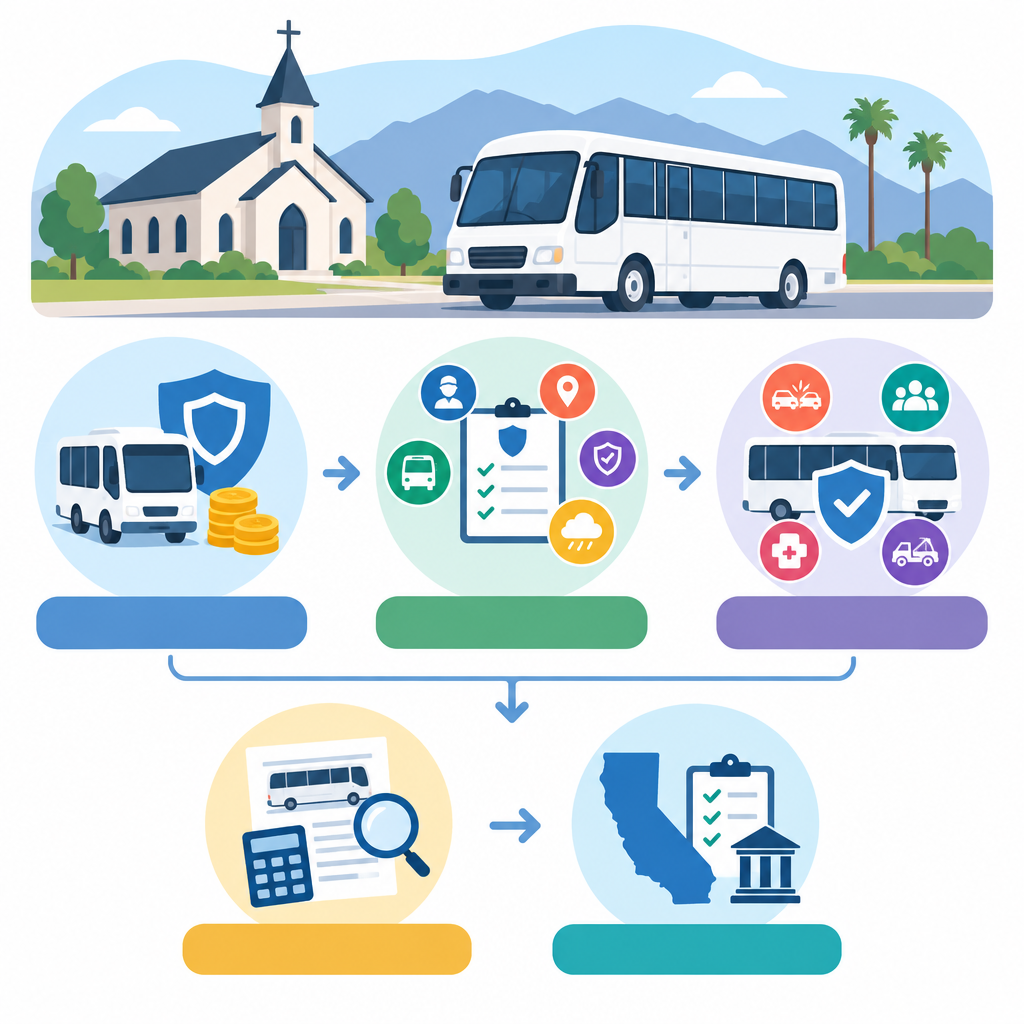
Insurance is only one part of operating a passenger vehicle. Before relying on a quote or scheduling a trip, a church should confirm how California classifies its particular vehicle. The California DMV’s bus definition includes a vehicle designed, used or maintained to carry more than 15 people, including the driver. It also includes a vehicle carrying more than 10 people, including the driver, when used by a nonprofit organization or group, among other described uses. Seating and use are therefore important details; a church should not rely on the vehicle’s nickname alone.
Driver qualifications need their own check. The California Commercial Driver Handbook describes a CDL with a passenger endorsement for drivers of vehicles designed to transport more than 10 people, including the driver, in the passenger-transport context it addresses. I recommend confirming the requirements for the exact vehicle, driver and operation with the DMV or qualified counsel. Do not assume that holding an ordinary driver’s license—or that driving as a volunteer—settles the question.
The DMV’s Private Carrier of Passengers program says private carriers transporting passengers in California are required to obtain a certificate and identifies particular exempt activities. Whether a church’s operation falls within that program or an exemption depends on its facts. I would have the church check rather than assume either that every church vehicle needs a certificate or that churches are automatically exempt.
If a trip crosses state lines, another review may be necessary. Federal Motor Carrier Safety Administration guidance for faith-based transportation explains that vehicle size, passenger capacity and for-hire status can affect federal requirements. It also gives examples in which transportation payment is bundled with other trip costs. For applicable for-hire interstate passenger operations, the guidance identifies federal financial-responsibility amounts of $1.5 million for vehicles seating 15 or fewer and $5 million for vehicles seating 16 or more, including the driver. Applicability and exemptions must be verified for the specific trip; not every church bus is automatically a for-hire carrier.
California’s ordinary minimum auto liability amounts are $30,000 for injury or death to one person, $60,000 for injury or death to more than one person, and $15,000 for property damage. The DMV notes that additional requirements may apply to commercial or fleet vehicles. Those ordinary minimums are not a recommended church bus limit, and they should not be mistaken for an answer to every passenger-carrier requirement. I encourage churches to verify regulatory obligations separately from deciding what liability protection is prudent for their passengers and organization.
How to Compare Church Bus Insurance Quotes
Start by giving each agent or insurer the same facts: the bus’s year, make, model, vehicle identification number and seating capacity; where it is garaged; its estimated annual mileage; and its normal trip radius. Add a description of regular runs, occasional outings, passenger groups, any fees collected, interstate travel and use outside church activities. If your church has a current policy, bring its declarations and relevant endorsements so the proposed coverage can be compared with what is in place.
Be ready to provide the requested driver information and explain how the church approves drivers. Written procedures for license and endorsement checks, driving-record reviews, inspections and maintenance help describe the operation. They do not guarantee acceptance or a lower premium, but they give an insurer a clearer picture than an incomplete application.
Then compare each proposal line by line. I look at liability limits, covered vehicles and drivers, passenger treatment, physical damage, valuation, deductibles and exclusions before judging the premium. I also ask about claims handling, towing, available downtime protection and conditions tied to driver eligibility. My guide to comparing auto insurance quotes explains the same basic discipline: match coverage before comparing price, while recognizing that a church bus needs its own commercial-vehicle review.
Ask for important assumptions and unanswered questions in writing. An insurance quote does not determine how a government agency classifies a vehicle or operation. For regulatory interpretation, check with the appropriate California DMV or other relevant state or federal authority, or seek qualified counsel.
Practical Ways to Manage the Premium Without Creating Gaps
Good preparation can make a church easier to evaluate, even when it does not produce a guaranteed discount. Keep an up-to-date list of authorized drivers and document the process for approving them. Maintain pre-trip inspection and maintenance records, and provide them when an insurer requests them. At renewal, check whether the estimated mileage, destinations, passenger use or driver roster has changed.
Review deductibles against the church’s actual cash reserves. A higher deductible may change a quote, but the resulting premium is not a bargain if the church could not comfortably pay its share after a loss. Likewise, reducing liability limits solely to meet a budget target can leave a congregation with a very different level of protection. I would assess passenger exposure and organizational assets before making that trade-off.
Comparing available carriers with consistent limits and terms is another practical step. If the church has a broader insurance program, coordinate the bus discussion with it—but confirm that the vehicle and intended activities are expressly addressed in the applicable policy. A package policy should never be treated as proof of bus coverage without reviewing its documents. My guide to reading an insurance policy can help a committee identify the declarations, exclusions and endorsements worth examining.
At ISU Armac Insurance Services, I can help Victorville-area churches organize these details and explore quotes from available carriers. Final eligibility, coverage terms, pricing and any savings remain subject to each insurer’s underwriting.
Questions to Ask Before Buying or Renewing
I suggest bringing the following questions to a coverage review and recording the answers alongside the proposal:
- Is the policy written for the bus’s actual owner, seating capacity and church use?
- Are retreats, youth trips, volunteer drivers and travel beyond the local area covered as described?
- What bodily injury and property damage limits apply, and are there passenger-related sublimits or exclusions?
- Is damage to the bus itself covered? How is its value determined, and what deductible applies?
- What driver age, experience, license or endorsement conditions must the church meet?
- What must be reported if the church replaces the bus, changes its seating, collects transportation fees or begins interstate trips?
- Would hired and non-owned auto or umbrella coverage address separate exposures, and how would those policies interact with the bus policy?
- Which insurance, vehicle and driver documents should be kept in the bus and in church records?
If an answer is unclear, ask for the relevant policy language or written clarification before treating the issue as resolved.
Getting a Church Bus Quote in Victorville
For a useful quote, gather the bus details, driver information, mileage and routes, trip purposes, current-policy documents and any questions about passenger or volunteer use. I can use that information to help a Victorville or surrounding High Desert congregation compare available carrier proposals on more than price.
This article is general insurance guidance, not a coverage determination or legal interpretation. Before putting passengers on the road, review the actual policy documents and verify the rules that apply to your specific vehicle and operation.