
Why Your Business Needs Long-Term Liability Protection
Products completed operations liability is critical insurance that protects your business from claims arising from your products or completed work long after they’ve left your control. This coverage addresses the gap between when you finish a project or sell a product and when problems surface months or even years later.
Key aspects of products completed operations liability:
- Products coverage – protects against claims from items you manufacture, sell, or distribute
- Completed operations coverage – shields you from liability for work you’ve finished at other locations
- Long-term protection – covers incidents that occur years after project completion
- Included in general liability – typically bundled within your commercial general liability policy
- Aggregate limits – separate coverage limits specifically for these claims
Your business remains vulnerable to lawsuits long after a project is done. A deck you built three years ago could collapse, or a product could malfunction and cause injury. These risks can follow you for up to 10 years or more, even after you’ve sold your business or retired.
A single claim can cost thousands or millions in legal fees, medical bills, and repairs. Without this protection, one incident from your past work could devastate your business’s financial future.
As Ryan McEachron, CEO of ISU Insurance Services ARMAC Agency, I’ve helped countless Victorville businesses secure the right coverage. My experience with local contractors has shown me how vital this protection is for our community.
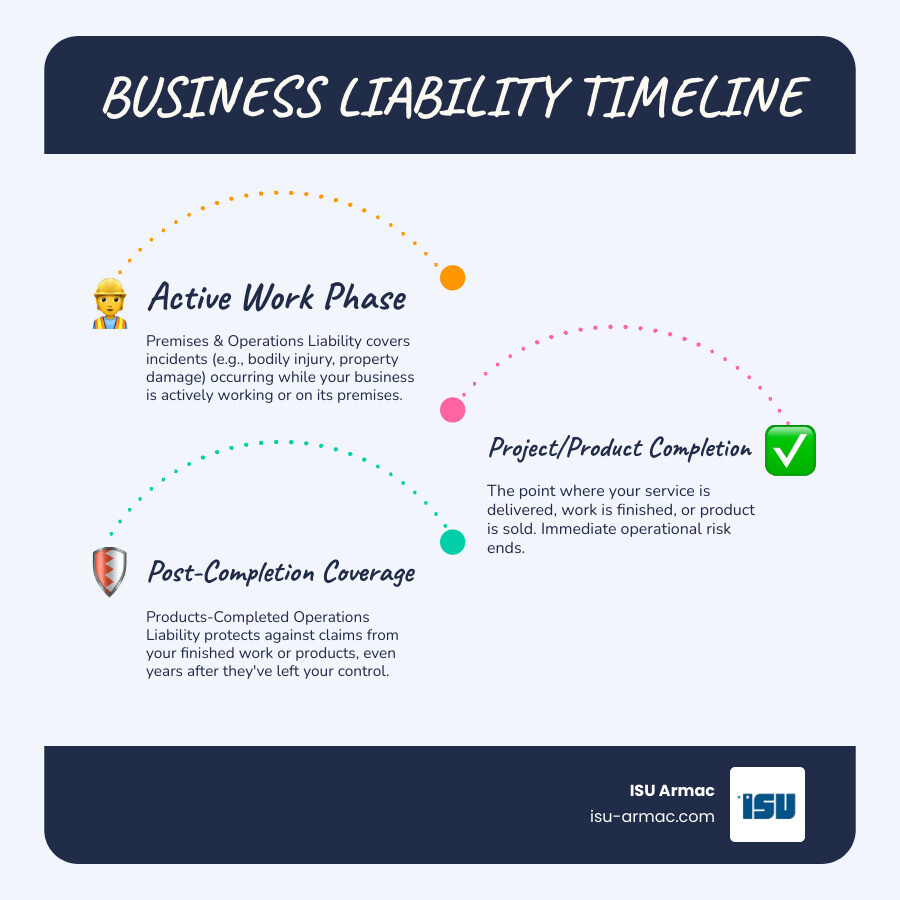
Quick look at products completed operations liability:
What is Products-Completed Operations (PCO) Liability?
Imagine you finish building a deck or your factory ships a batch of heaters. The work is done. But what happens six months later when the deck collapses or a heater catches fire? This is where products completed operations liability comes in. Often called PCO liability, it’s a vital part of your Commercial General Liability (CGL) policy that activates when things go wrong after your work is finished or your products have left your hands.

Essentially, products completed operations liability protects you from claims involving bodily injury or property damage that occur after your product is sold or your work is completed. While your CGL policy covers incidents during ongoing operations, PCO liability fills the crucial gap that exists once you’ve moved on. Understanding this is key to grasping What is Commercial General Liability Insurance Coverage?.
The “Products” Component Explained
Your product includes everything you manufacture, sell, handle, or distribute. Once it leaves your control, you are potentially responsible for what it does. This includes:
- Manufacturing defects: Faulty wiring in an appliance or contamination during production.
- Design flaws: A product made as intended, but the design itself is dangerous, like a chair with a low weight limit.
- Failure to warn: Inadequate safety instructions or warnings, such as for a chemical product or power tool.
This supply chain liability means that manufacturers, wholesalers, distributors, and retailers can all be named in a lawsuit. Retailer responsibility holds you accountable for selling a harmful product, even if you didn’t make it.
The “Completed Operations” Component Explained
This side focuses on your work—the services you provide. Once the job is done and the client can use what you’ve built or repaired, this coverage protects you.
- Completed services: A cleaning company leaves a slippery residue that causes a fall, or a consultant’s advice leads to property damage.
- Installation and construction projects: A foundation settles incorrectly or an electrical installation fails years later. Insurance for General Contractors: What You Need to Know explores these risks.
- Repair work: A plumber fixes a pipe, but the connection fails later, flooding a basement.
- Abandoned operations: If you start a project but don’t finish, you’re still liable for issues arising from the completed portion.
Work is considered “completed” as soon as the client can use it for its intended purpose, even if minor touch-ups are needed later. Once that deck is ready for a barbecue, the completed operations coverage period has begun.
Why This Coverage is a Non-Negotiable Business Asset
Imagine getting a call that a deck you built three years ago collapsed, injuring someone. This scenario highlights why products completed operations liability is essential protection for your business’s survival. Problems from past work don’t follow a timeline; a product defect or construction flaw can surface years later, bringing devastating financial consequences.

This coverage is your lifeline for asset protection. Without it, a single lawsuit could drain your accounts or force you into bankruptcy. It also provides financial stability and peace of mind, allowing you to focus on growth instead of worrying about past projects. Furthermore, contractual requirements for larger jobs often mandate PCO coverage—no insurance can mean no contract.
The key is managing long-term risk. PCO addresses hidden dangers that emerge years down the road. The statute of repose in many states allows claims to be filed up to 10 years or more after work is completed, creating a decade of potential exposure.
Who Needs Products-Completed Operations Liability Coverage?
Most businesses need this protection, but some face higher risks:
- Contractors: General contractors, plumbers, electricians, and landscapers all create potential future liability with every job.
- Manufacturers: A design flaw or manufacturing defect in any product, from appliances to toys, can cause harm years later.
- Retailers and Wholesalers: You can be held responsible for selling a defective product, even if you didn’t make it.
- Food Service Businesses: Risks from catering or food distribution, like food poisoning or allergic reactions, can lead to substantial claims.
- Service Providers: Auto repair shops, salons, and cleaning services all have liability that extends beyond the moment the job is finished.
The Importance of Long-Term Protection
These liabilities have a “long tail,” stretching out for years. This makes long-term protection vital in several scenarios:
- Statute of Limitations: Laws allow injured parties to file claims long after the work is done, sometimes up to 10 years or more.
- Discontinued Operations: If you stop offering a service, like electrical work, you are still liable for the work you completed in the past.
- Business Sale: When you sell your business, you typically remain exposed for work completed under your ownership.
- Retirement Exposure: Claims can arise years after you retire. Without coverage, you could face a lawsuit with no insurance protection.
This long-term nature makes products completed operations liability a crucial part of your Business Liability Insurance strategy, protecting both your business today and your financial future.
Understanding Your Policy: Inclusions, Exclusions, and Limits
Understanding your products completed operations liability policy is key to protecting your business. This coverage is a financial safety net for when your past work or products cause problems. A policy typically covers legal defense costs, medical expenses for injuries, repair costs for property damage, and settlements or judgments if you’re found liable.
Crucially, coverage is tied to when the injury or damage occurs, not when you did the work. The incident must happen during your active policy period to be covered.

Common Exclusions and Limitations
Your PCO coverage has limits. Understanding exclusions is vital and a key part of knowing What is Not Covered Under Commercial Liability Insurance?.
- Damage to your product or work: PCO won’t pay to replace your faulty appliance or rebuild your collapsed deck. It covers the resulting damage, like a fire caused by the appliance or injuries from the collapse.
- Impaired property: This excludes property that is unusable because it contains your defective work but isn’t physically damaged itself. The interaction of these clauses can be complex, as detailed in The collision of “your work” exclusions and PCO clauses.
- Product recalls: The cost to pull a product from the market requires separate coverage.
- Intentional damage: Acts of gross negligence or intentional harm are not covered.
Timing also matters. An injury in your store falls under premises liability, while damage during a project is covered by operations liability, not PCO. This often raises questions like Does Contractor Insurance Cover Poor Workmanship?.
How Policy Limits Work for Products-Completed Operations Liability
Policy limits define how much protection you have.
- Per-occurrence limit: The maximum your insurer pays for a single incident.
- Aggregate limit: The total coverage for all claims within your policy period (usually one year).
Many policies have a separate PCO aggregate limit, giving you dedicated protection for these long-tail claims. Once you hit this limit, your coverage is exhausted until renewal. For this reason, businesses with high exposure often get umbrella policies for an extra layer of protection against catastrophic claims.
PCO vs. Product Liability: A Critical Distinction
Many business owners confuse “products liability” with “products completed operations liability,” but they are quite different. Understanding the distinction is crucial. Standard product liability is for your products; PCO liability is for your products and your services, long after the job is done.
| Feature | Products-Completed Operations Liability (PCO) | Product Liability Insurance (Standard) |
|---|---|---|
| Scope | Covers both products (after sale/distribution) and completed services/work (after completion). | Focuses exclusively on products (manufacturing, design, warning defects). |
| Trigger | Incidents occur after the product has left your control or the service/work has been completed. | Incidents typically occur while the product is in your possession or the customer’s possession. |
| Timing of Incident | Can be months or years after the sale/completion. | Usually occurs relatively soon after purchase or during use. |
| Typical Insured | Manufacturers, retailers, contractors, service providers (anyone with post-completion exposure). | Manufacturers, distributors, wholesalers, retailers (anyone involved in the product’s supply chain). |
| Policy Inclusion | Typically a specific hazard included within a Commercial General Liability (CGL) policy. | Can be a standalone policy or a component of CGL, sometimes referred to as “products coverage.” |
| Coverage Focus | Long-tail liability for finished goods and services. | Liability for defective products themselves. |
The key difference is scope and timing. Standard Product Liability Insurance covers harm from a defective product. PCO goes further, covering incidents from your products and your completed work that happen months or years later.
For example, if a cabinet door you’re installing falls and hits someone, that’s ongoing operations liability. If it falls six months later, that’s a PCO claim.
Don’t confuse PCO with Premises and Operations Liability either. Premises liability covers incidents on your property (a slip-and-fall), while ongoing operations covers incidents during active work. PCO is for what happens after you’ve finished the job.
Conveniently, products completed operations liability is typically built into your Commercial General Liability policy, bundling protection for both products and completed work.
Real-World Scenarios: PCO Claims in Action
Real-world examples show how easily a past project can lead to a costly claim involving negligence or breach of warranty. Here’s how products completed operations liability works in practice.

Example 1: The Construction Contractor
- Deck Collapse: A deck built months ago collapses during a party, injuring guests. PCO covers the guests’ medical bills and legal defense. This is a classic case of Completed Operations Liability.
- Faulty Plumbing: A plumber’s faulty installation causes a major leak months later. PCO pays for the extensive water damage to the property.
- Electrical Fire: Faulty wiring from a job completed years ago causes a fire. PCO provides legal defense and covers damages if the contractor is found liable.
Example 2: The Product Manufacturer
- Defective Appliance: A heater sold by a store has faulty wiring and causes a fire. The store’s PCO covers the property damage and medical expenses.
- Design Flaw: A child is injured on a swing set due to a defective chain. The manufacturer’s PCO covers the medical bills and any resulting lawsuit.
- Consumer Injury: A power tool malfunctions and injures a customer. The seller’s PCO covers medical treatment and legal fees.
Example 3: The Food Service Provider
- Food Poisoning: A caterer’s food for a wedding causes food poisoning. PCO covers guests’ medical expenses and lost wages.
- Allergic Reaction: A food stand’s product causes an allergic reaction due to cross-contamination. PCO covers the emergency medical costs.
- Foreign Object: A customer chips a tooth on a foreign object in their food. The restaurant’s PCO covers the dental bills.
These examples show that products completed operations liability is a real-world necessity, protecting businesses from the unpredictable consequences of their past work.
Securing Your Business’s Future
Your success today doesn’t guarantee protection from yesterday’s work. This makes products completed operations liability a crucial investment for your company’s long-term survival. It’s a safety net for when past projects or products create future problems, preserving everything you’ve worked to build. A single claim from years ago could be financially devastating, but with proper PCO coverage, you can operate with confidence.
This coverage is so valuable because it acknowledges that your responsibility doesn’t end when a job is done. True business security requires looking both forward and backward.
Navigating commercial insurance is complex. Policies can seem identical but have subtle differences that leave you vulnerable. This is where experienced professionals are invaluable. At ISU Armac, we understand that every business has unique risks. We take the time to learn about your industry and exposure to long-term liability.
Our team shops multiple carriers to find the coverage that best fits your needs and budget. We compare policies to ensure you get the best value, often finding coverage gaps or savings opportunities. This peace of mind allows you to focus on growing your business without worrying about claims from past work.
Whether you’re a contractor, manufacturer, or service provider, the right coverage strategy makes all the difference. Don’t let uncertainty about past work limit your future potential.
Secure your business with the right General Liability Insurance policy.