
Why Premises and Operations Liability Coverage Matters for Your Business
Premises and operations liability is one of the most important hazard categories covered under a Commercial General Liability (CGL) policy. It protects your business from financial losses when someone gets hurt on your property or during your business operations.
What premises and operations liability covers:
- Bodily injury to customers, visitors, or third parties on your premises
- Property damage caused by your business operations
- Legal defense costs and settlements from liability claims
- Medical payments (typically $5,000-$15,000 per person) regardless of fault
Key differences from other liability:
- Premises liability = injuries that happen at your business location
- Operations liability = injuries that happen during your work activities
- Products/completed operations = injuries that happen after your work is finished
This coverage is essential because almost every business faces these exposures. A recent survey found that 33.6% of Canadian small business owners don’t have commercial insurance, leaving them exposed to potentially devastating financial losses.
I’m Ryan McEachron, CEO of ISU Insurance Services ARMAC Agency in Victorville, with over 25 years of experience helping High Desert businesses understand premises and operations liability and secure proper coverage.
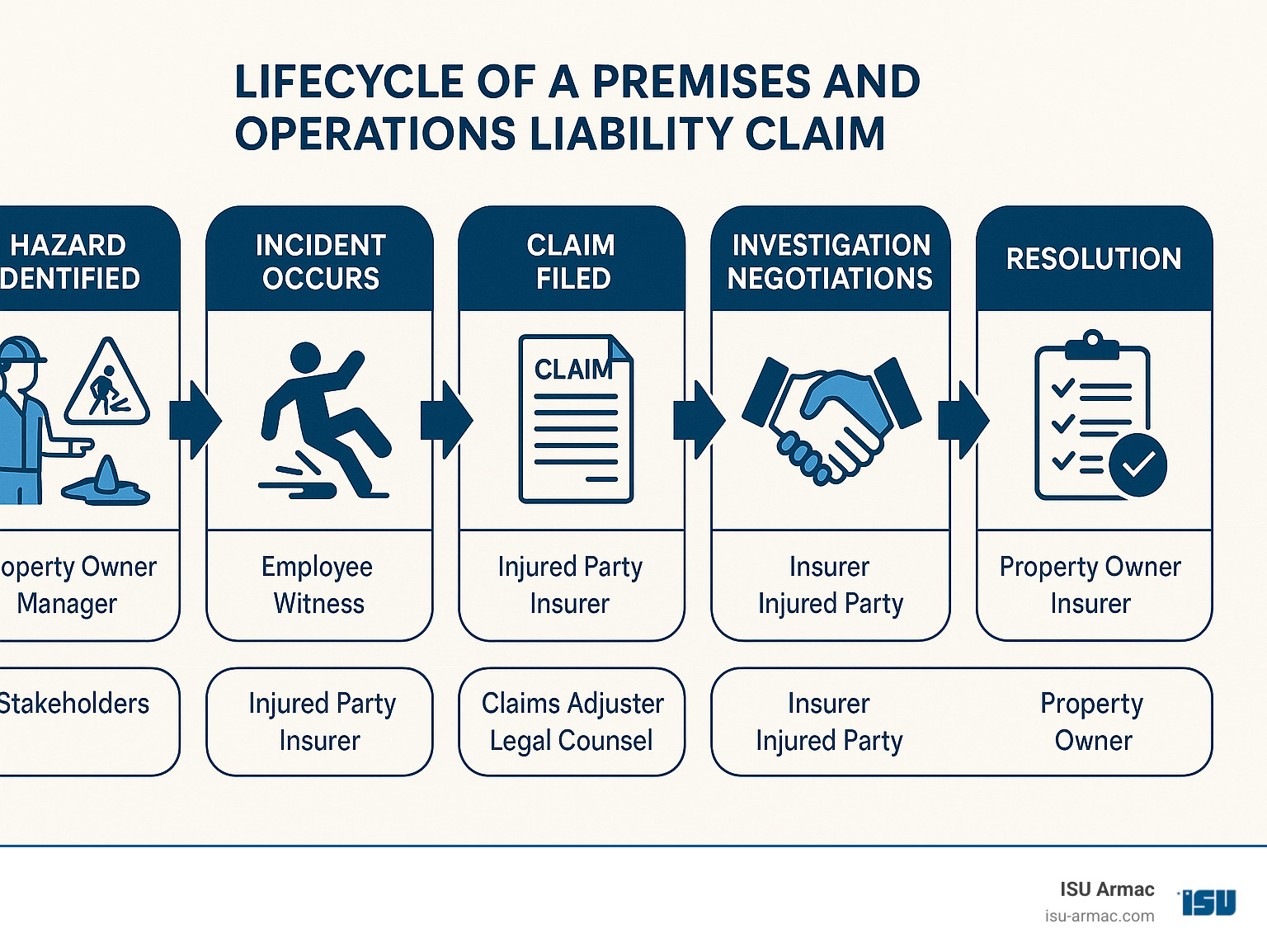
Simple premises and operations liability glossary:
What Is Premises and Operations Liability?
Premises and operations liability is your business’s safety net for everyday risks. Whether someone slips on your freshly mopped floor or gets injured while you’re performing services at their location, this coverage protects you from the financial fallout.
Premises and operations liability is one of the core hazard categories covered under Commercial General Liability policies. It steps in when someone suffers bodily injury or property damage either on your business premises or during your ongoing business operations.
The coverage works in two main ways. Premises liability protects you when incidents happen on property you own, lease, or control. Operations liability kicks in during your actual business activities, whether you’re working on your own property or somewhere else.
Core Definition & Key Differences
The IRMI definition of premises-operations describes it as coverage for liability arising from your premises or business operations in progress – basically, the here-and-now risks of running your business.
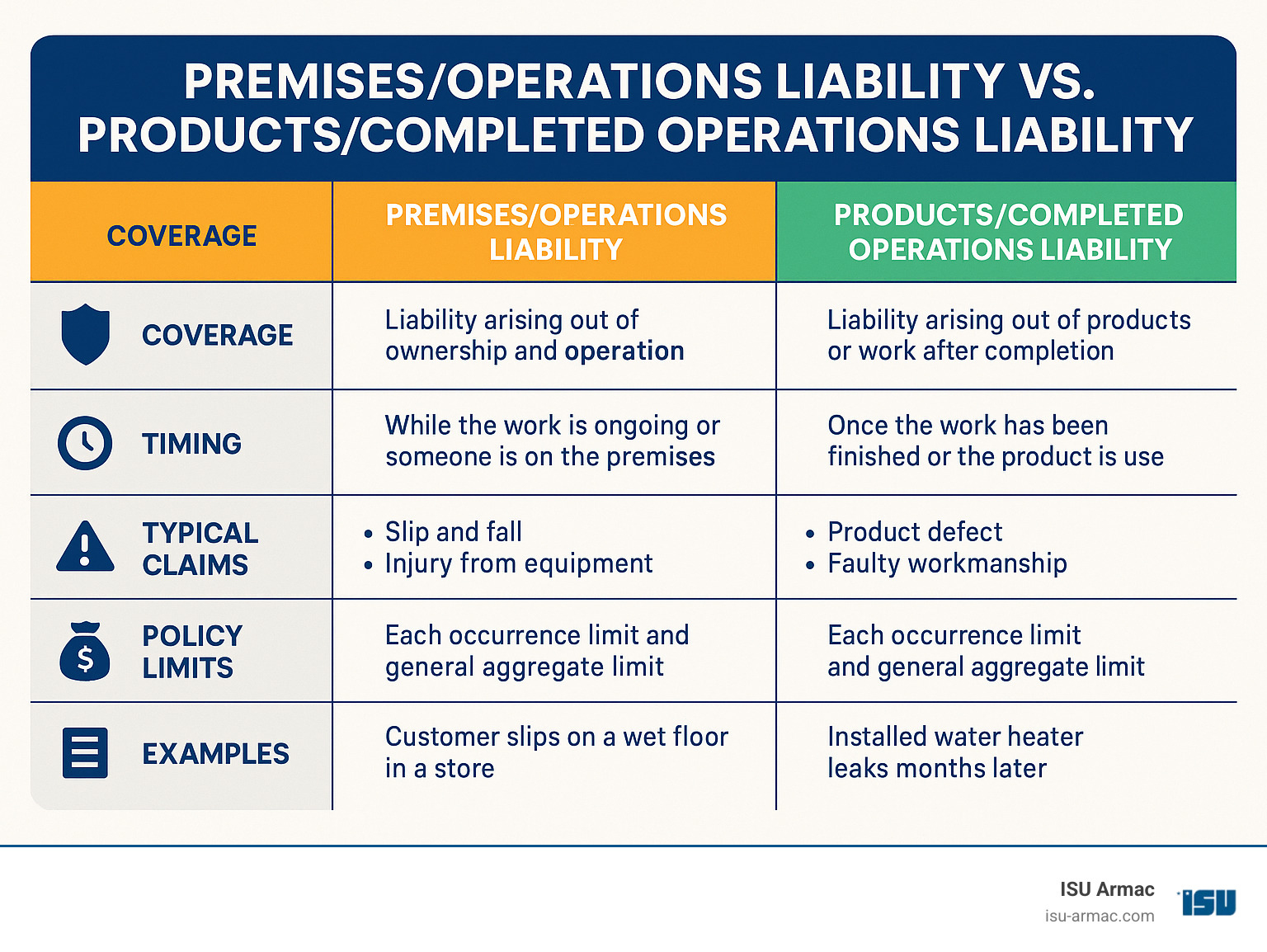
Timing becomes crucial for premises and operations liability. This coverage applies when incidents happen during active work or while someone is present on your premises. But once your work is finished and handed over to the customer, you’re looking at products/completed operations territory instead.
Let’s say you’re a plumber. If you drop a wrench while installing a water heater and it injures someone, that’s operations liability. But if that same water heater starts leaking six months later and floods the basement, that falls under products/completed operations coverage.
Visitor Status and Duty of Care
Not everyone who steps onto your property gets the same level of protection under the law. Understanding these differences helps you manage your risk.
Invitees are your VIPs from a legal standpoint – customers, clients, delivery drivers, contractors. You owe them the highest duty of care, which means keeping your premises reasonably safe and warning them about any hidden dangers.
Licensees have your permission to be there, but they’re not there for your business benefit. You need to warn them about hazards you actually know about, but you don’t have to go looking for problems.
Trespassers are there without permission. Generally, you only have a duty not to intentionally harm them.
The landmark California case Rowland v. Christian in 1968 started shifting toward a more flexible approach based on foreseeability rather than rigid visitor classifications. Many states now focus more on whether harm was reasonably foreseeable rather than technical visitor categories.
How It Fits Inside a Commercial General Liability (CGL) Policy
Premises and operations liability coverage is woven directly into your CGL policy as one of the fundamental hazard categories that every business needs.
Your CGL policy is structured around three main coverage areas. Coverage A handles Bodily Injury and Property Damage Liability – this is where your premises and operations protection lives. Coverage B takes care of Personal and Advertising Injury Liability. Coverage C provides Medical Payments to quickly address minor injuries without admitting fault.
Your premises and operations liability claims are subject to two key limits: the “each occurrence” limit (typically $1 million) and the “general aggregate” limit (usually $2 million). These limits are shared between premises/operations claims and products/completed operations claims.
The medical payments portion typically provides $5,000 to $15,000 per person for immediate medical expenses, regardless of whether you’re actually at fault.
Premises and Operations Liability in the Declarations Page
When you flip to your policy declarations page, you won’t see premises and operations liability listed separately. Instead, it’s bundled together as part of your Coverage A limits.
Your declarations page shows your coverage limits. The each occurrence limit applies to premises and operations claims just like it does to product liability claims. The general aggregate limit caps the total amount your insurer will pay across all covered claims during your policy period.
Many businesses add additional insured endorsements to their policies. When you add your landlord, a general contractor, or a client as an additional insured, you’re extending your premises and operations coverage to protect them too.
For a deeper dive into how all these coverage pieces work together, check out our comprehensive guide on Commercial General Liability Insurance Coverage.
Premises Liability Insurance vs General Liability Insurance
“Do I need separate premises liability insurance if I already have a CGL policy?” The short answer is no – premises and operations liability comes built into your general liability coverage.
Some insurers do market standalone “premises liability” policies, which are essentially stripped-down versions of general liability. These basic policies might work for very simple businesses, but most businesses benefit from the comprehensive protection of a full CGL policy.
General liability insurance covers your business comprehensively. You get product liability coverage, completed operations protection, personal and advertising injury coverage, and contractual liability coverage.
The price difference between basic premises liability and comprehensive general liability is usually small enough that choosing the limited coverage doesn’t make financial sense. Most commercial leases and business contracts specifically require general liability coverage, not just premises liability.
Typical Claims, Legal Responsibilities & Real-World Examples
Understanding the most common premises and operations liability claims helps you recognize potential risks and take steps to protect your business before problems occur.
Slip and fall incidents top the list of premises liability claims. These accidents happen when customers encounter wet floors, uneven surfaces, poor lighting, or obstacles blocking walkways.
Falling objects present another significant risk, particularly for businesses with overhead storage or tall displays. Picture merchandise tumbling from high shelves onto a customer or tools dropped by workers during maintenance.
Negligent security claims arise when inadequate security measures contribute to criminal acts on your property. Courts examine whether crime was foreseeable and if your security measures matched the level of risk.
During your business operations, tool drops and equipment accidents create operations liability exposure. A plumber dropping a wrench that injures a bystander or a contractor’s equipment falling and damaging client property are common examples.
Building system failures like sprinkler malfunctions can cause extensive property damage to tenants, customers, or neighboring businesses.
Real-World Case Snapshots
Real cases demonstrate how quickly premises and operations liability situations can escalate into major financial exposures.
A student shooting case at a gated apartment complex resulted in a $15.7 million award when two intruders bypassed security measures and shot a resident three times. The court found the property owner liable for negligent security.
A retail trip-and-fall incident occurred when a customer tripped over merchandise that had fallen from a shelf and suffered a concussion. The medical bills alone exceeded $16,000, not including pain and suffering damages or legal fees.
An independent contractor injury happened when a plumber working on-site broke an office chair and fell, incurring $5,000 in medical expenses. Since independent contractors aren’t covered by workers’ compensation, this became a premises liability claim.
These examples underscore why the statistics about uninsured businesses are troubling. With 33.6% of small business owners lacking commercial insurance and 22% planning to pay damages out of pocket, many businesses are one serious incident away from financial disaster.
Consequences of Liability Findings
When a court determines you’re liable for a premises and operations liability claim, the financial consequences can threaten your business’s survival.
Compensatory damages cover the injured party’s actual losses, including medical expenses, lost wages, property damage, and pain and suffering. These awards can easily reach six or seven figures for serious injuries.
Punitive damages may be awarded if your conduct was particularly reckless. While not common in typical premises liability cases, they can apply when you ignored obvious hazards.
Legal defense costs can be substantial even if you ultimately win the case. A simple premises liability case might cost $25,000 to defend, while complex cases can exceed $100,000 in legal fees alone.
Reputational harm from liability claims can damage your business relationships and customer trust, with lasting effects on your business’s reputation and revenue.
Risk Management & Insurance Strategy
The smartest approach to premises and operations liability combines prevention with protection. Think of it like wearing a seatbelt while driving safely – you do everything possible to avoid accidents, but you’re prepared if something goes wrong.
Regular hazard inspections are your first line of defense. Walk through your property weekly, looking for problems that could hurt someone. Check for cracked sidewalks, burnt-out lights, and loose handrails. Keep detailed records of these inspections.
Proper maintenance goes hand-in-hand with inspections. Fix problems quickly once you identify them. A small crack in concrete costs $50 to repair today but could cost $50,000 in damages if someone trips and breaks a hip.
Employee training is crucial because your staff are your eyes and ears. Teach them to spot hazards, report problems immediately, and respond appropriately when incidents occur.
Security measures should match your risk level. Consider your location’s crime statistics and the nature of your business when deciding on lighting, cameras, or security personnel.
Securing Adequate Premises and Operations Coverage
Getting the right premises and operations liability coverage starts with honest assessment of your risks. A busy restaurant faces different exposures than a quiet accounting office.
Coverage limits typically start at $1 million per occurrence and $2 million aggregate, but many businesses need more. Consider what you could lose if faced with a serious claim.
Umbrella policies provide extra protection above your basic limits for surprisingly little cost. An additional $1 million in coverage might cost only $200-400 per year.
For comprehensive guidance on selecting the right coverage amounts and types, check out our detailed guide on Understanding Commercial General Liability Insurance Coverage.
After an Incident: Step-by-Step Response Plan
When a premises and operations liability incident happens, your response in the first few hours can make or break your case.
Take care of people first. Make sure anyone injured gets proper medical attention immediately. Call 911 if there’s any doubt about the severity of injuries.
Secure the scene to prevent additional injuries. If someone slipped on a wet floor, block off the area and clean it up.
Document everything thoroughly. Take photos from multiple angles showing the scene, any hazards, and the surrounding area. Write down exactly what happened while it’s fresh in your memory.
Notify your insurance company immediately, even for seemingly minor incidents. Insurance companies prefer early notification and can provide guidance on handling the situation.
Avoid admitting fault or speculating about what happened. You can express concern and offer help without accepting responsibility.

Frequently Asked Questions about Premises and Operations Liability
How does the status of a visitor change my liability?
The legal status of people on your property plays a huge role in determining your responsibility if someone gets hurt.
Invitees are your most important visitors from a legal standpoint. These include customers, clients, delivery people, and anyone else who comes to your property for business purposes. You owe invitees the highest duty of care, which means you must exercise reasonable care to keep your premises safe and warn them about any hazards you know about or should reasonably know about.
Licensees are people who enter your property with permission but for their own purposes rather than your business benefit. For licensees, you only need to warn them about hidden dangers you actually know about.
Trespassers enter your property without permission. Generally, you only owe trespassers a duty not to willfully or intentionally harm them.
Many states have moved away from these rigid categories. Instead of focusing solely on visitor status, courts increasingly look at whether harm was reasonably foreseeable and the overall relationship between you and the visitor.
Do I need separate premises liability insurance if I already carry a CGL policy?
This is one of the most common questions we hear, and the answer is almost always no. Premises and operations liability coverage is automatically built into your Commercial General Liability policy.
Some insurance companies do market standalone “premises liability” policies, but these are typically stripped-down versions of general liability insurance. They focus mainly on incidents that happen on your property but leave you exposed to many other risks.
Your CGL policy provides much broader protection that includes operations liability when you’re working at other locations, product liability for items you sell, completed operations coverage for work you’ve finished, and personal injury protection. The cost difference between basic premises liability and comprehensive general liability is usually so small that the full CGL policy is clearly the better value.
What limits and aggregates should a small business choose?
Choosing the right coverage limits for premises and operations liability is one of the most important decisions you’ll make about your business insurance.
Industry risk level is your starting point for determining appropriate limits. If you run a retail store, restaurant, or entertainment venue with lots of foot traffic, you’ll typically need higher limits than a small office or warehouse operation.
Asset protection should guide your coverage decisions too. Your limits should be high enough to protect both your current business assets and your future earning potential.
Most small businesses start with $1 million per occurrence and $2 million aggregate limits, but many find they need higher protection as they grow. An umbrella policy can provide additional coverage at relatively low cost.
The best approach is working with an experienced agent who can assess your specific situation and shop multiple carriers to find the right balance of coverage and cost.
Conclusion & Next Steps
Premises and operations liability isn’t just insurance jargon – it’s the foundation that protects your business from the everyday risks that come with opening your doors to customers, clients, and the public.
The numbers tell a sobering story. With over one-third of small businesses operating without commercial insurance, many business owners are essentially playing Russian roulette with their financial future. A single slip-and-fall incident or dropped tool can generate medical bills, legal fees, and damage awards that could wipe out years of hard work.
The good news: premises and operations liability protection doesn’t have to be complicated or expensive. It’s automatically included in your Commercial General Liability policy, which means you’re not juggling multiple policies.
The most successful business owners we work with understand that effective liability protection works on two levels. First, they focus on prevention – maintaining safe premises, training employees properly, and staying alert to potential hazards. Second, they secure adequate insurance coverage that matches their actual risk exposure.
At ISU Armac, we’ve been helping High Desert businesses steer these waters for over 25 years. Our independent agency status means we’re not tied to any single insurance company – we shop multiple carriers to find you the best premises and operations liability coverage at rates that make sense for your budget.
We’ve seen too many businesses struggle after preventable incidents because they either had no coverage or inadequate limits. Don’t let that be your story.
The time to act is now, while you can still control the outcome. Review your current coverage, assess your actual risks, and make sure your policy limits reflect the reality of today’s legal environment.
Ready to take the next step? Visit our General Liability Insurance Coverage page to learn more about comprehensive business protection, or give us a call for a no-obligation review of your current coverage.
The best insurance claim is the one that never happens – but when accidents do occur, you’ll be glad you prepared for them properly.