
Why Drivers Without Cars Still Need Insurance
A non owner insurance policy provides liability coverage for drivers who don’t own a vehicle but occasionally rent or borrow one. It acts as secondary insurance, covering bodily injury and property damage you cause to others when the car owner’s policy is insufficient. It’s an affordable alternative to standard auto insurance, typically costing around $414 per year.
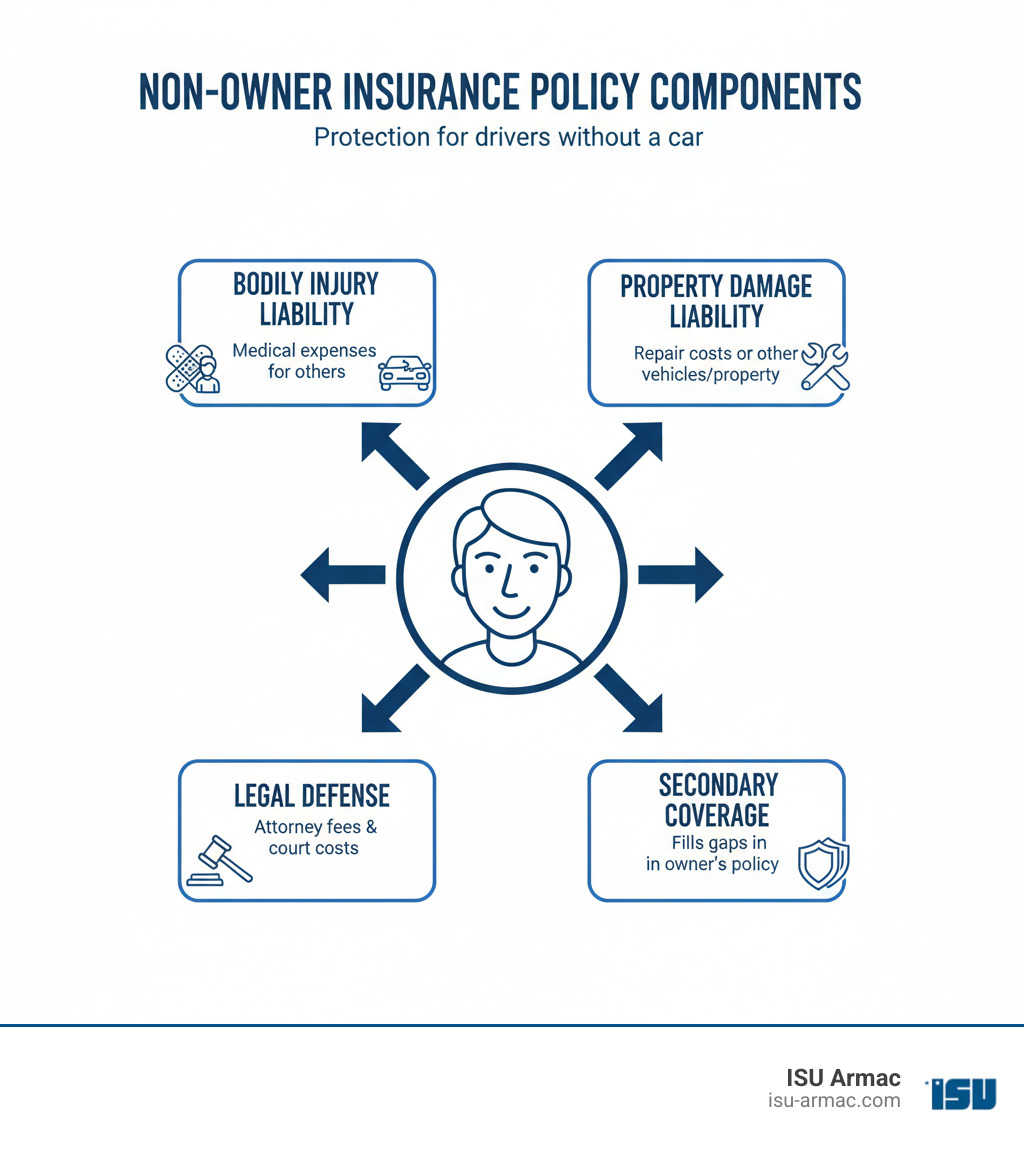
What a Non-Owner Insurance Policy Covers:
- Bodily injury liability – Medical expenses for others injured in an accident you cause
- Property damage liability – Repair costs for other vehicles or property you damage
- Legal defense costs – Attorney fees and court costs if you’re sued
- Secondary protection – Coverage after the car owner’s policy limits are exhausted
What It Does NOT Cover:
- Damage to the vehicle you’re driving
- Your own medical bills (unless you add optional coverage)
- Business-related driving
- Vehicles you regularly access or that belong to household members
Whether you use rideshares, rent vehicles for trips, or borrow a friend’s car for errands, you face significant financial risk behind the wheel. A single at-fault accident could leave you liable for thousands of dollars in damages and medical bills.
I’m Ryan McEachron, CEO of ISU Insurance Services ARMAC Agency in Victorville. For nearly 30 years, I’ve helped High Desert residents find the right coverage, including non owner insurance policy solutions. My work in our community, including on the Victorville City Council, has shown me how vital the right insurance is for peace of mind.
What is a Non-Owner Auto Insurance Policy?
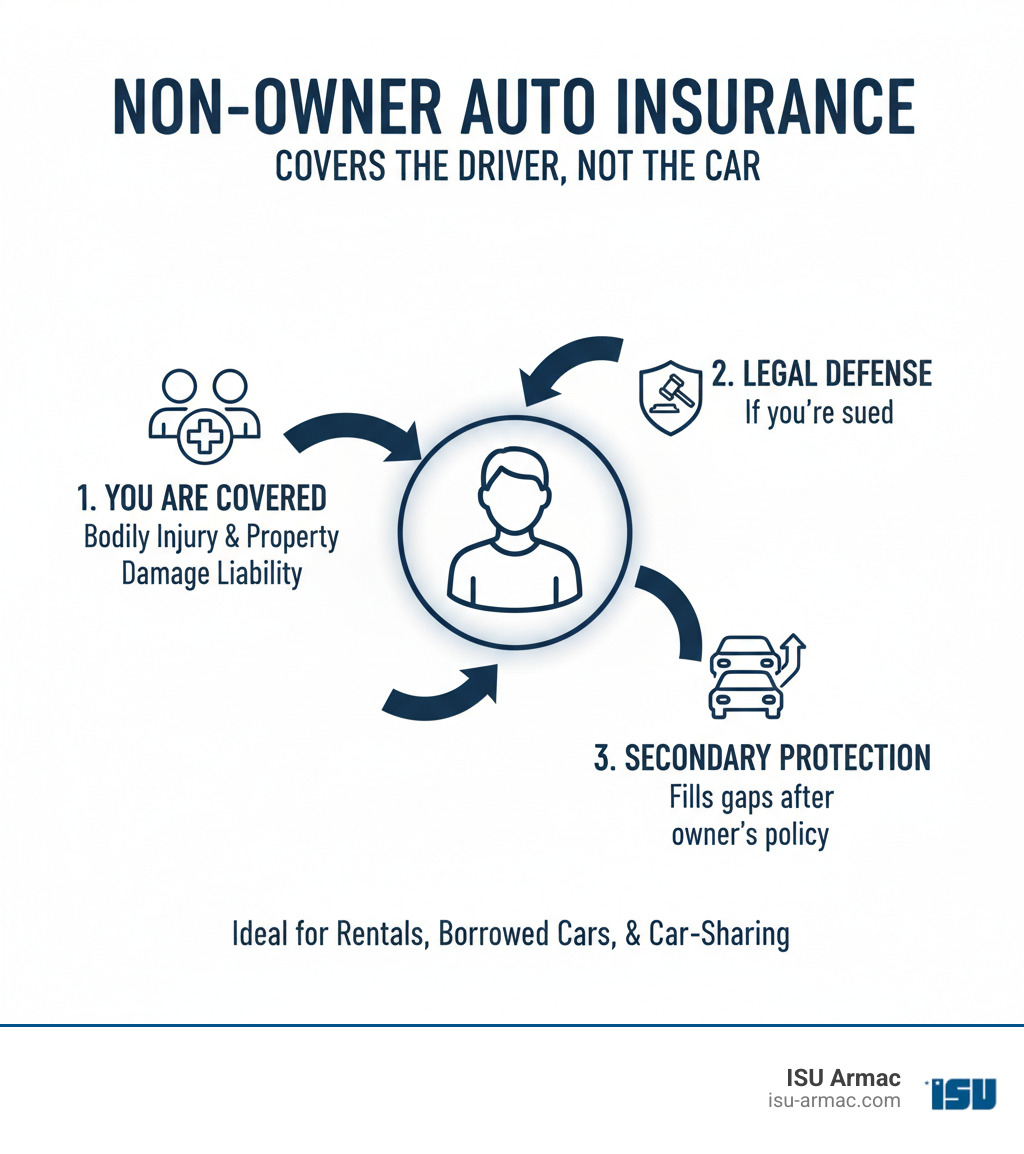
A non owner insurance policy is insurance that follows you, not a specific car. This coverage, also called a named operator policy, attaches to you as the driver, providing liability protection whenever you’re behind the wheel of a vehicle you don’t own, borrow, or rent.
Here’s how the financial protection works: If you cause an accident, your non-owner policy provides liability coverage for bodily injury to people and property damage to their vehicles or other property.
It typically functions as secondary insurance. If you cause an accident, the car owner’s policy pays first. If damages exceed the owner’s limits, your non-owner policy covers the remaining costs up to your own limit. This layered protection prevents you from paying out-of-pocket for catastrophic expenses.
Without it, a serious accident could leave you responsible for massive medical bills, vehicle repairs, and legal fees. For our clients throughout the High Desert—from Victorville to Adelanto—the peace of mind this policy provides is invaluable. You can drive knowing you’re protected, whether helping a friend move or renting a car for a family vacation.
Who Needs This Coverage and Why?

Who Should Get a Non-Owner Insurance Policy?
Many people assume that not owning a car means not needing insurance, but your liability doesn’t disappear just because the vehicle isn’t yours. This specialized coverage makes sense for several situations we see at our Victorville office:
- Frequent renters can save money by avoiding the rental company’s daily liability fees.
- Car-sharing users get more robust protection, as services like Zipcar or Turo often provide only minimum state-required coverage.
- Occasional borrowers can protect their finances and friendships by having coverage that pays for damages exceeding the car owner’s limits.
- Drivers needing an SR-22 or FR-44 can meet legal requirements to reinstate their license without having to own and insure a vehicle.
- City dwellers who rely on public transport but sometimes drive, and people between vehicles, can maintain continuous coverage to avoid future premium hikes.
Key Benefits: Continuous Coverage and Cost Savings
A key benefit is maintaining continuous coverage. Insurers penalize coverage gaps with higher premiums. A non-owner policy demonstrates responsibility and helps you secure better rates when you buy standard auto insurance later.
The cost savings are also significant. A non-owner policy is cheaper than standard insurance, saving drivers an average of $74 annually. With a clean record, you might pay around $414 annually. Even with an accident, the cost is about $576, compared to $741 for standard coverage.
Nationally, non-owner coverage averages around $748 annually, but rates vary. Some options start as low as $202 per year. At ISU Armac, we shop multiple carriers to find the best rate for your situation in Hesperia, Apple Valley, or anywhere in the High Desert.
State insurance requirements vary, so understanding your local obligations is essential. You can review information on state insurance laws to understand minimums in California and other states.
When is a Non-Owner Policy Not Necessary?
This policy isn’t for everyone. You may not need it in these situations:
- You rarely drive: If you drive only a few times a year, the annual cost may not be justified. Relying on the owner’s policy or buying rental coverage for one-off trips might be more economical.
- You live with the car owner: If you regularly drive a car belonging to a household member, you must be added as a named driver to their standard auto policy.
- You use a company car: Your employer’s commercial policy usually provides coverage, but always confirm the details with your employer.
- Permissive use is enough: Standard policies include permissive use, which extends the owner’s coverage to you. However, if damages exceed their limits, you’re personally liable for the rest. A non-owner policy covers this gap.
Understanding Your Non-Owner Insurance Policy: Coverage and Exclusions
Knowing what your non owner insurance policy covers—and what it doesn’t—can save you from major financial surprises. Here’s a roadmap to your protection.

What a Non-Owner Policy Typically Covers
The foundation of your policy is liability protection, which stands between you and financial disaster when driving someone else’s car.
- Bodily injury liability covers medical bills, lost income, and other costs for people injured in an accident you cause.
- Property damage liability pays to repair or replace other people’s vehicles or property you damage in an accident.
- As secondary insurance, your policy covers costs that exceed the car owner’s policy limits, protecting you from personal liability for the remaining amount.
- Legal defense costs are also included. Your insurer provides attorneys and covers court fees if you’re sued after an accident.
Optional Coverages to Consider
While liability is the core, you can add optional protections for more comprehensive coverage.
- Medical payments (MedPay) covers your own and your passengers’ medical bills after an accident, regardless of fault. This fills a key gap, as basic liability only covers others’ injuries.
- Personal Injury Protection (PIP) is more comprehensive, covering medical bills and lost wages if you can’t work due to injuries. It’s required in some states.
- Uninsured/underinsured motorist coverage protects you if you’re hit by a driver with little or no insurance. It ensures your medical bills and other damages are covered.
These additions increase your premium but transform your policy from basic liability to comprehensive personal coverage. At ISU Armac, we help you evaluate if these options make sense for your risk tolerance.
What Is Explicitly Excluded from Coverage
Understanding exclusions is critical. Your non owner insurance policy does not cover:
- Damage to the vehicle you’re driving. For rental cars, you’ll need to buy the rental company’s collision damage waiver (CDW) or use a credit card that offers this benefit.
- Comprehensive coverage for theft, vandalism, or weather damage.
- Your own injuries, unless you add optional MedPay or PIP.
- Personal belongings damaged in or stolen from the car. This would fall under a homeowner’s or renter’s policy.
- Business use. Driving for work, including ridesharing, requires a commercial policy.
- Vehicles you own or have regular access to, including those of household members. You must be listed on a standard policy for those cars.
Non-Owner vs. Standard Auto Insurance
Choosing the right protection means understanding the key differences between a non owner insurance policy and a standard auto policy. They serve very different purposes.
A non owner insurance policy follows you, the driver, providing liability coverage when you operate a vehicle you don’t own. In contrast, a standard auto policy is attached to a specific vehicle and the drivers listed on its policy.
Because a non-owner policy is primarily liability-only coverage, it doesn’t include collision or comprehensive protection for the vehicle being driven. This makes it much less expensive than a standard policy, which can include these costly physical damage coverages.
If you own a car, you need a standard auto policy. If you’re a driver without a car who borrows or rents vehicles, a non-owner policy provides essential liability protection at a lower cost.
Here’s a quick reference comparing the two:
| Feature | Non-Owner Auto Insurance | Standard Auto Insurance |
|---|---|---|
| Primary Purpose | Covers the driver when operating non-owned vehicles | Covers a specific vehicle and its listed drivers |
| Vehicle Covered | Any non-owned vehicle (borrowed, rented, car-share) | One or more vehicles owned by the policyholder |
| Core Coverage | Primarily liability (bodily injury & property damage) | Liability, plus optional collision, comprehensive, etc. |
| Cost | Generally less expensive (liability only) | More expensive (covers vehicle, broader options) |
| Ideal User | Drivers without a car who frequently drive others’ | Car owners who drive their own vehicles |
At ISU Armac, we help High Desert clients find the coverage that fits their lifestyle. Many have saved by switching to a non-owner policy after selling their car. We shop multiple carriers to find the best rate for your needs.
For more comprehensive information on standard vehicle coverage, visit our personal auto insurance page to explore all your options.
How to Get a Policy and What It Costs
Obtaining a non owner insurance policy is simpler than you might think. Knowing where to look and what you’ll need can save you time and frustration.

Steps to Obtain a Non-Owner Policy
Getting a non owner insurance policy is straightforward. While many major insurers offer it, working with an independent agent like ISU Armac allows you to shop multiple carriers at once to find the best rate and coverage.
To get a quote, you’ll need your driver’s license, Social Security Number, and address. Insurers will review your driving history for accidents and violations. Proof of prior insurance can also help secure better rates.
Always compare quotes from at least three insurers, ensuring the liability limits are identical for a fair comparison. Before buying, check the insurer’s financial stability and complaint history using a tool like the one from the National Association of Insurance Commissioners.
Factors That Influence the Cost of a Non-Owner Insurance Policy
While a non owner insurance policy is generally affordable, the exact cost varies. Your driving record is the biggest cost factor. A clean record can result in a premium around $414 annually. An accident might raise it to $576, while a DUI could lead to a cost of around $892. These rates are still significantly lower than standard insurance.
Your location also matters; urban areas like those in Southern California often have higher rates than rural ones due to traffic density. Your age, experience, selected coverage limits, and (in most states) credit score also influence the final price.
The national average is about $748 annually, but rates can be as low as $202 for ideal candidates. At ISU Armac, we leverage our network of carriers to find competitive rates for High Desert residents, ensuring you get quality coverage that fits your budget.
Frequently Asked Questions about Non-Owner Insurance
We often encounter several common questions about non owner insurance policy options. Let’s address the most important ones.
Does non-owner insurance cover rental cars?
Yes, a non owner insurance policy typically provides liability coverage for rental cars. This allows you to decline the rental company’s expensive daily liability insurance.
However, it does not cover physical damage to the rental car. For that, you need to buy the collision damage waiver (CDW) from the rental agency or use a credit card that provides this benefit. Before renting, check your credit card’s benefits, as many offer rental car coverage that can fill this gap. Be sure to understand the terms and activation requirements.
Can I get a non-owner policy to satisfy an SR-22 or FR-44 requirement?
Yes. This is a common reason to buy a non owner insurance policy. If your license is suspended, the DMV may require an SR-22 filing to prove you have liability insurance. A non-owner policy fulfills this requirement without needing to own a car.
Even for high-risk drivers, these policies are more affordable. A non-owner SR-22 policy averages around $603 annually, far less than a standard policy. We help drivers across the High Desert steer these requirements to get back on the road.
How does a non-owner policy work if I borrow a friend’s car?
When you borrow a friend’s car, their auto insurance is primary. It pays first in an at-fault accident, up to the policy limits.
Your non owner insurance policy acts as secondary coverage. It pays for damages that exceed your friend’s policy limits, protecting you from personal liability. This is crucial, as many drivers only carry low state-minimum limits that a serious accident can easily surpass.
This also protects your friendship by preventing your friend from facing higher premiums or being sued if their coverage is insufficient. Note: If you live with the car’s owner and drive it regularly, you must be added to their standard policy. A non-owner policy will not provide coverage in this situation.
Find the Right Protection for Your Driving Needs
Driving a borrowed or rented vehicle comes with real financial responsibility. A non owner insurance policy is a personal safety net that travels with you, protecting your finances whenever you drive a car you don’t own.
This coverage is ideal for frequent renters, car-sharing users, and occasional borrowers. It fills critical protection gaps, maintains your continuous insurance history to secure lower future premiums, and provides peace of mind against liability claims. Costing around $414 annually for drivers with clean records, it’s an affordable way to secure your financial future—that’s protection for just over a dollar a day.
At ISU Armac, our reputation is built on shopping multiple carriers to find you the best coverage at the lowest rates. Serving Victorville, Apple Valley, Hesperia, and all of Southern California, we understand the unique needs of High Desert drivers. We take the time to explain your options so you get the right protection without overpaying.
Your financial security shouldn’t be left to chance. We’re here to have a real conversation about your situation and help you drive confidently, knowing you’re properly protected.
Explore your personal insurance options with us today. Give us a call or stop by our office—we’re always happy to answer your questions and help you find the right protection for your driving needs.