
Why Health Insurance for Salaried Employees Matters More Than Ever
Health insurance for salaried employees has become one of the most valuable parts of your compensation package. With annual premiums for employer-sponsored family health coverage reaching $22,463 in 2022, understanding your benefits can save you thousands of dollars while protecting your family’s health and financial security.
Key facts about employee health insurance:
- 87-91% of Canadian employers offer extended health care benefits to salaried employees
- 77% of employers pay 100% of the premium for basic coverage
- Workers contribute an average of $6,106 toward family coverage costs annually
- The average deductible is $1,763 for single coverage plans
- Smaller companies typically require higher employee contributions than larger firms
Your employer-sponsored health plan isn’t just a nice-to-have benefit – it’s a critical financial tool that bridges the gap between basic government coverage and the real cost of medical care. Whether you’re dealing with prescription drugs, dental work, or unexpected medical emergencies, your employee benefits package provides protection that would cost significantly more if purchased individually.
The complexity of modern health plans means many employees don’t fully understand what they have or how to use it effectively. From HMOs and PPOs to HSAs and HRAs, the alphabet soup of health insurance can feel overwhelming. But taking time to understand your options during open enrollment can make a huge difference in your out-of-pocket costs and access to care.
As Ryan McEachron, CEO of ISU Insurance Services ARMAC Agency, I’ve spent over two decades helping employees and businesses steer the complexities of health insurance for salaried employees. My experience in both the insurance industry and local government has shown me how critical it is for workers to understand and maximize their employer-provided benefits.

Health insurance for salaried employees basics:
- benefits of offering health insurance to employees
- employee benefits consulting firm
- employee life insurance benefits
Understanding Your Employee Benefits Package
When you start a salaried position, your compensation package is more than just your paycheck. It includes valuable employee benefits designed to attract top talent, promote wellness, and provide financial security. These benefits bridge the gap between what government programs offer and what you’d otherwise pay for essential services.
While every employer is different, a solid benefits package usually includes health, dental, and vision coverage, often alongside life and disability insurance and retirement plans. This “hidden paycheck” adds significant value to your overall compensation. It’s no wonder that health insurance for salaried employees is consistently ranked as the most important perk, making it a powerful tool for employers to attract and retain the best people.
Why Benefits are Crucial for Salaried Employees
Understanding why these benefits are so important is about smart financial planning and making them work for you.
- Financial Protection: Employee benefits shield you from potentially budget-busting expenses. Unexpected medical bills, new prescriptions, or even regular check-ups can be costly without proper coverage.
- Access to Care: A good plan ensures you can get the care you need when you need it, from routine doctor visits to specialized therapies and mental health counseling. This access leads to improved well-being, both physically and mentally.
- Tax Advantages: In the U.S., your contributions to employer-sponsored health insurance for salaried employees are typically made with pre-tax dollars. This lowers your taxable income for the year—a benefit you wouldn’t get buying insurance on your own.
- Peace of Mind: Knowing you and your loved ones are covered in case of illness or injury lets you focus on your career and personal life without the constant worry of medical bills. It’s a cornerstone of financial planning and a sign that your employer is invested in you.
To learn More on Employee Benefits Insurance, we encourage you to explore further resources.
Decoding Your Health Insurance for Salaried Employees

So, you’ve got health insurance for salaried employees through your job. But what does it all mean? Let’s explain some of the key terms you’ll encounter in your group health insurance plan.
Your employer-sponsored plan is a form of Group Medical Insurance. This means your employer negotiates with an insurance carrier to provide coverage to a group of employees, often at lower rates than individuals could get on their own.
Here are the essential terms we need to understand:
- Premiums: This is the fixed amount you (and your employer, usually) pay regularly—typically monthly—to the insurance company to keep your coverage active. In 2022, annual premiums for employer-sponsored family health coverage reached an average of $22,463, with workers paying about $6,106 of that cost.
- Deductibles: This is the amount of money you must pay out of pocket for covered medical services before your insurance company starts to pay. For single coverage, the average deductible in 2022 was $1,763. Once you hit this amount, your insurance kicks in.
- Copayments (Copays): A fixed amount you pay for a covered health service after you’ve met your deductible. For example, a $30 copay for a doctor’s visit.
- Coinsurance: Your share of the costs of a covered health care service, calculated as a percentage (e.g., 20%) of the allowed amount for the service. You pay coinsurance after you’ve met your deductible. If your plan pays 80% and you have 20% coinsurance, you’ll pay 20% of the bill after your deductible is met.
- Out-of-Pocket Maximum: This is the most you’ll have to pay for covered services in a plan year. Once you reach this limit, your health plan pays 100% of the costs of covered benefits for the rest of the year. This is your ultimate financial safety net.
Understanding these terms is crucial for managing your healthcare budget and avoiding surprises. We recommend reviewing your plan’s Summary of Benefits and Coverage (SBC) to see your specific numbers. For a deeper dive into industry trends and costs, you can consult Data from the 2022 Employer Health Benefits Survey.
Common Types of Health Plans
When it comes to health insurance for salaried employees, you’ll typically encounter a few common types of plans. Each has its own structure, affecting your choices of doctors, costs, and referral requirements.
Let’s explore the most prevalent ones:
- Health Maintenance Organization (HMO): With an HMO, you choose a primary care physician (PCP) within the plan’s network, who then coordinates all your care and provides referrals to specialists. HMOs generally have lower monthly premiums and out-of-pocket costs, but they offer less flexibility in choosing providers outside their network.
- Preferred Provider Organization (PPO): PPO plans offer more flexibility than HMOs. You don’t usually need a PCP referral to see a specialist, and you can see out-of-network providers, though you’ll pay more for those services. PPOs typically have higher premiums and potentially higher deductibles or copays.
- Point of Service (POS): A POS plan combines elements of both HMO and PPO plans. You choose a PCP within the network, but you can also go out of network for care, often with a referral and at a higher cost.
- High-Deductible Health Plan (HDHP): HDHPs have higher deductibles than traditional plans but often come with lower monthly premiums. They are frequently paired with a Health Savings Account (HSA), which we’ll discuss shortly, allowing you to save and spend money on healthcare tax-free.
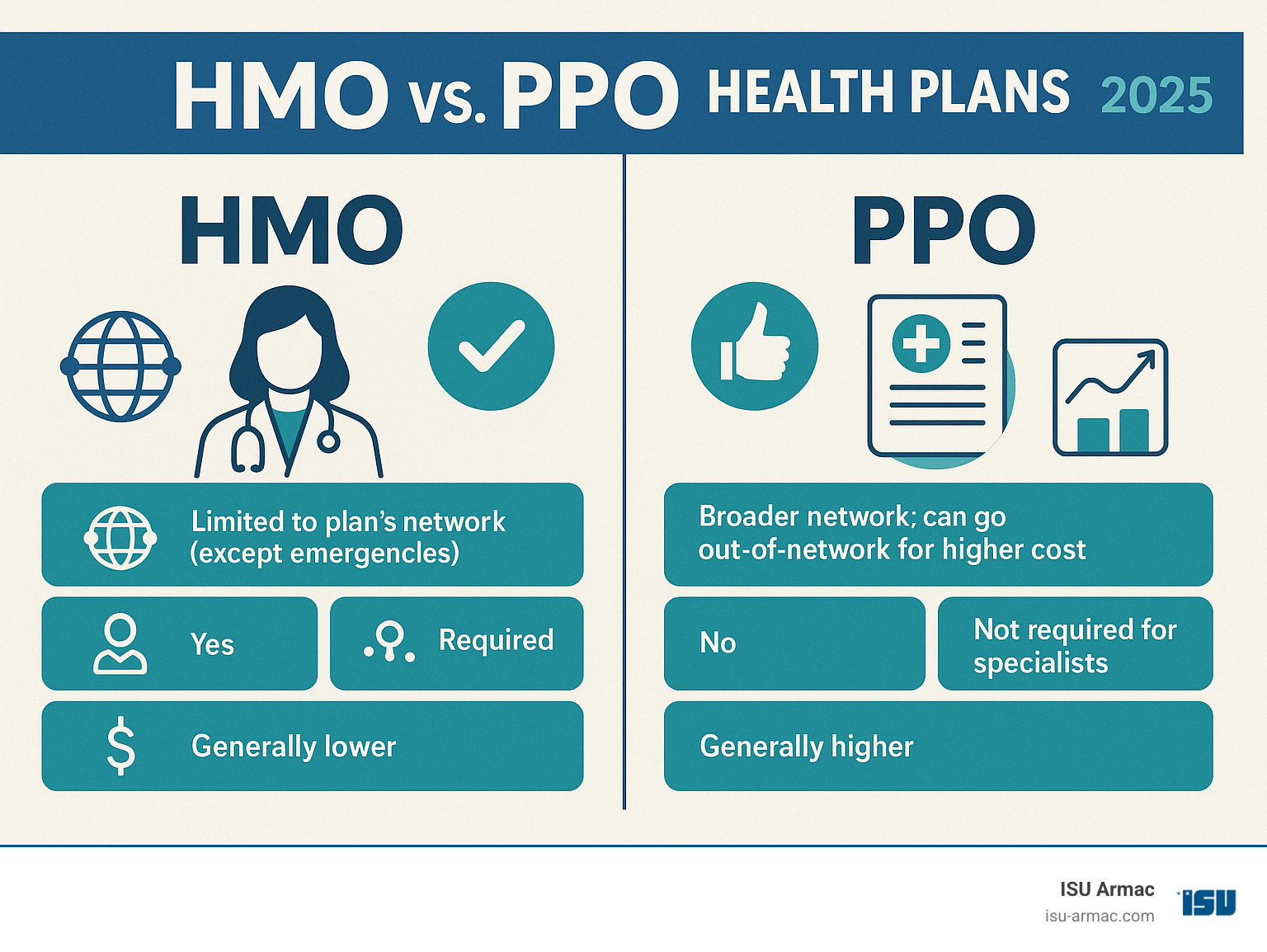
Here’s a quick comparison of HMO vs. PPO to help you visualize the differences:
| Feature | Health Maintenance Organization (HMO) | Preferred Provider Organization (PPO) |
|---|---|---|
| Network | Limited to plan’s network (except emergencies) | Broader network; can go out-of-network for higher cost |
| PCP Required? | Yes, you must choose one | No, but recommended |
| Referrals | Required for specialists | Not required for specialists |
| Cost | Generally lower premiums, lower out-of-pocket for in-network | Generally higher premiums, more flexibility, higher out-of-pocket for out-of-network |
| Flexibility | Less flexibility, more coordinated care | More flexibility, less coordinated care |
Knowing these plan types will help us steer the choices offered by our employers.
Navigating Enrollment and Making the Right Choice
Choosing the right health insurance for salaried employees requires understanding when and how to enroll.

The primary time to select or change your health plan is during Open Enrollment, which typically occurs once a year in the fall. Your HR department will provide the specific dates to sign up, switch plans, or add/remove family members.
If a major life change occurs outside of this period, a Qualifying Life Event (QLE) may allow you to alter your coverage. Common QLEs include marriage, divorce, birth or adoption of a child, loss of other health coverage, or moving to a new area. You typically have 30 to 60 days after the event to make changes.
New employees may face Waiting periods of 30 to 90 days before their health insurance for salaried employees becomes active. Confirm this timeline with your HR department.
When reviewing your options, assess your and your family’s anticipated health needs for the coming year. Consider ongoing conditions, planned procedures, or medications. Comparing plan costs involves looking at the total potential cost, including premiums, deductibles, copays, and the out-of-pocket maximum. A plan with a higher premium might save you money if you anticipate more frequent medical care. For a comprehensive overview of options, we can help you explore various Health Insurance Products custom to your situation.
How to Choose the Best Health Insurance for Salaried Employees
Finding the “best” health insurance for salaried employees means finding the perfect fit for you. Here’s how to make that choice:
- Review the SBC: Always check the Summary of Benefits and Coverage (SBC). Your employer provides this easy-to-read document, which lays out what each plan covers and costs, helping you compare them side-by-side.
- Check the Provider Network: If you have preferred doctors or specialists, make sure they are in the plan’s provider network to avoid higher costs. Also, check if your local hospitals are included.
- Examine the Drug Formulary: If you take regular medications, dive into the plan’s prescription drug formulary. This is the list of covered drugs; confirm your medications are on it and understand their cost.
- Calculate Total Potential Costs: Don’t just look at the monthly premium. Add up your share of premiums, the deductible, estimated copays, and coinsurance. Always keep the out-of-pocket maximum in mind—it’s your financial safety net.
Maximizing Your Health Insurance for Salaried Employees
Once you’ve chosen your plan, it’s time to make the most of your health insurance for salaried employees.
- Use Preventive Care: Most plans cover services like annual physicals, screenings, and immunizations at no extra cost. These are key to catching potential issues early.
- Join Wellness Programs: Many employers offer programs like gym discounts or health coaching. They’re designed to help you live healthier and may even offer rewards.
- Explore Telemedicine: Many plans now offer telemedicine, letting you talk to a doctor by phone or video for minor issues. It’s a convenient way to get care from home.
- Understand the Claims Process: Know how to submit claims and keep your medical bills and Explanation of Benefits (EOB) statements organized. If you have questions, contact your HR department or the insurance company.
Flexible Spending and Savings Accounts
Beyond your core health insurance for salaried employees plan, many employers offer additional accounts that can help you save and pay for healthcare expenses. These are fantastic tools for managing costs and maximizing your benefits.
- Health Savings Accounts (HSAs): These are tax-advantaged savings accounts that can only be paired with a High-Deductible Health Plan (HDHP). HSAs offer a “triple-tax advantage”:
- Contributions are tax-deductible (or made pre-tax through payroll).
- The money grows tax-free.
- Withdrawals for qualified medical expenses are tax-free.
Unlike Flexible Spending Accounts (FSAs), HSA funds roll over year to year and are portable, meaning you take them with you if you change jobs or retire. They’re essentially a retirement account for healthcare!
- Health Reimbursement Arrangements (HRAs): HRAs are employer-funded accounts that reimburse employees for qualified medical expenses and, in some cases, insurance premiums. They are considered a type of group health plan and are structured as employer-funded accounts that reimburse employees tax-free. The employer sets the rules for what expenses are covered and how much money is available. Unlike HSAs, HRAs are employer-owned, and the funds typically do not roll over if you leave the company. There are different types of HRAs, such as Qualified Small Employer HRAs (QSEHRAs) and Individual Coverage HRAs (ICHRAs), depending on business size and arrangement. HRAs as group health plans have been a growing area for employers looking to offer flexible benefits.

These accounts offer powerful ways to manage your healthcare finances, so be sure to investigate if your employer offers them and how they might fit into your overall financial and health strategy.
Life After the Job: Health Coverage When You Leave or Retire
One of the biggest questions for salaried employees is what happens to their health insurance when they leave a job or retire. The good news is, you usually have options, though they may require some proactive planning and come with different costs.
When you leave your job, your employer-sponsored coverage typically ends. However, you might be eligible for:
- COBRA Continuation Coverage: The Consolidated Omnibus Budget Reconciliation Act (COBRA) allows you to temporarily continue your employer-sponsored health coverage if you lose your job (unless terminated for gross misconduct) or experience other qualifying events. COBRA coverage can last for 18 months (sometimes longer for certain events) and covers the same benefits you had. The catch? You’ll likely pay the full premium yourself, plus a small administrative fee, which can be significantly more expensive than what you paid as an active employee since your employer is no longer contributing. It’s a lifeline, but often a costly one. You can find More on COBRA law if you need to consider this option.
- State Continuation Programs: Some states have “mini-COBRA” laws that provide similar continuation rights for employees of smaller companies (those with fewer than 20 employees) that aren’t subject to federal COBRA. These programs typically offer coverage for up to a year.
- Health Insurance Marketplace: You can purchase individual health insurance through the Health Insurance Marketplace (also known as the ACA exchanges) at Healthcare.gov. Losing job-based coverage is a Qualifying Life Event, granting you a Special Enrollment Period to sign up. Depending on your income, you might qualify for subsidies to help lower your premium costs.
- Individual Medical Insurance options: For those who don’t qualify for subsidies or prefer to explore private market options, we at ISU Armac specialize in helping individuals find the best Individual Medical Insurance options from multiple carriers to ensure you get the right coverage at the lowest rates. This is especially useful for residents of Southern California looking for custom solutions.
- Retirement and Medicare: If you’re retiring, your health coverage transitions. For most, this means enrolling in Medicare. Medicare is the federal health insurance program for people 65 or older, certain younger people with disabilities, and people with End-Stage Renal Disease. You’ll need to understand Medicare Parts A, B, C, and D, and potentially supplemental plans (Medigap) to cover gaps in original Medicare. Some employers also offer retiree health benefits, which can supplement Medicare.
It’s vital to talk to your HR department as soon as you know you’ll be leaving your job or retiring. They can explain your specific options and deadlines. Don’t let your coverage lapse!
Frequently Asked Questions about Employee Health Insurance
We get it – navigating health insurance for salaried employees can feel like learning a new language! It’s perfectly normal to have questions. You’re not alone! Here are answers to some of the most common inquiries we hear, designed to help clear things up for you.
What’s the difference between group and individual health insurance?
Think of it this way: Group health insurance is like buying in bulk. Your employer offers this coverage to a group of employees, and because the insurance company is covering many people at once, the risk is spread out. This often means lower premiums and better benefits compared to what you might find on your own. Plus, your employer usually picks up a good chunk of the cost, which is a fantastic perk of being a salaried employee!
On the flip side, individual health insurance is something you purchase directly for yourself. You’d buy this from an insurance company or through a marketplace like Healthcare.gov. Since you’re the only one on the hook, you pay the full premium yourself. This can often make individual plans more expensive, as the risk isn’t shared across a larger group. It’s all about how that coverage is obtained and structured.
Are my health insurance premiums tax-deductible?
This is a great question that can save you money! For most salaried employees in the U.S., the portion of your health insurance premiums you pay for an employer-sponsored plan is typically taken out of your paycheck using pre-tax dollars. What does this mean? It means that money is deducted before your federal (and often state and local) income taxes are figured out. This effectively lowers your overall taxable income for the year. It’s a neat trick, usually handled through something called a “Section 125” or “cafeteria” plan. So, while you don’t claim it as a direct deduction on your tax return like a self-employed person might, it still works to reduce your taxable income. And here’s more good news: any contributions your employer makes to your health plan are generally not considered taxable income to you!
Can my employer cancel my health insurance at any time?
Generally, no, they can’t just cancel your health insurance for salaried employees whenever they feel like it! Your coverage is typically guaranteed for the plan year. This is the specific period your benefits are active, often 12 months (like January 1st to December 31st, or aligned with your company’s fiscal year).
An employer usually cannot arbitrarily cancel your coverage in the middle of this period unless very specific circumstances pop up. These rare situations might include:
- You leave your job, whether you resign or are terminated. In this case, your coverage will end, though you might have options like COBRA.
- You fail to pay your required premium contributions. If you don’t pay your share, your coverage can be dropped.
- The employer decides to terminate the entire health plan for all employees. This is quite rare and usually requires significant advance notice and a valid business reason. It’s not about singling out an individual.
- The employer goes out of business. If the company ceases operations, the plan would naturally end.
Rest assured, your employer has a contractual agreement with both the insurance carrier and its employees for the duration of that plan year. So, mid-year cancellations are not common for individual employees unless one of these very specific situations arises.
Conclusion
Your journey through understanding health insurance for salaried employees doesn’t end with reading this guide – it’s really just the beginning. Think of this knowledge as your toolkit for making smart decisions about one of the most valuable parts of your compensation package.
The most important thing you can do is be proactive about managing your benefits. Mark your calendar for open enrollment each year and treat it like the important financial decision it is. This isn’t the time to just click “renew” and hope for the best. Take those few hours to review your options, compare costs, and think about what your family might need in the coming year.
Don’t hesitate to ask questions when something doesn’t make sense. Your HR department is there to help, and so are the customer service representatives at your insurance company. Understanding your coverage before you need it saves stress and money when medical situations arise.
Remember to take advantage of the preventive care services that come with your plan. Those annual check-ups, screenings, and vaccinations aren’t just good for your health – they’re already paid for through your premiums. It’s like leaving money on the table when you skip them.
Here in Southern California, we see too many employees who find gaps in their understanding only when they’re facing a medical emergency or job transition. At ISU Armac, we’ve spent over two decades helping people in Victorville and throughout the region understand their options and find the best coverage for their unique situations.
Whether you’re maximizing your current employer plan, transitioning between jobs, or exploring individual options, the right guidance makes all the difference. We shop multiple carriers to ensure you get comprehensive protection at rates that fit your budget.
Your health and financial security are too important to leave to chance. We invite you to Explore your Employee Benefits options today and find how proper planning can give you the peace of mind you deserve.