
Why Health Benefits are a Small Business Superpower
Group health insurance options are a powerful tool for small businesses to attract top talent. When employees dedicate their time to help your organization grow, they expect you to care for their wellbeing in return.
Quick Overview of Group Health Insurance Options:
- Traditional Group Plans: HMO, PPO, POS, and EPO managed care options
- Health Savings Accounts (HSAs): High-deductible plans with tax-advantaged savings
- Individual Coverage HRAs (ICHRAs): Employer-funded reimbursement for individual plans
- Association Health Plans: Group buying power for small businesses and self-employed
- Ancillary Benefits: Dental, vision, life, and disability insurance add-ons
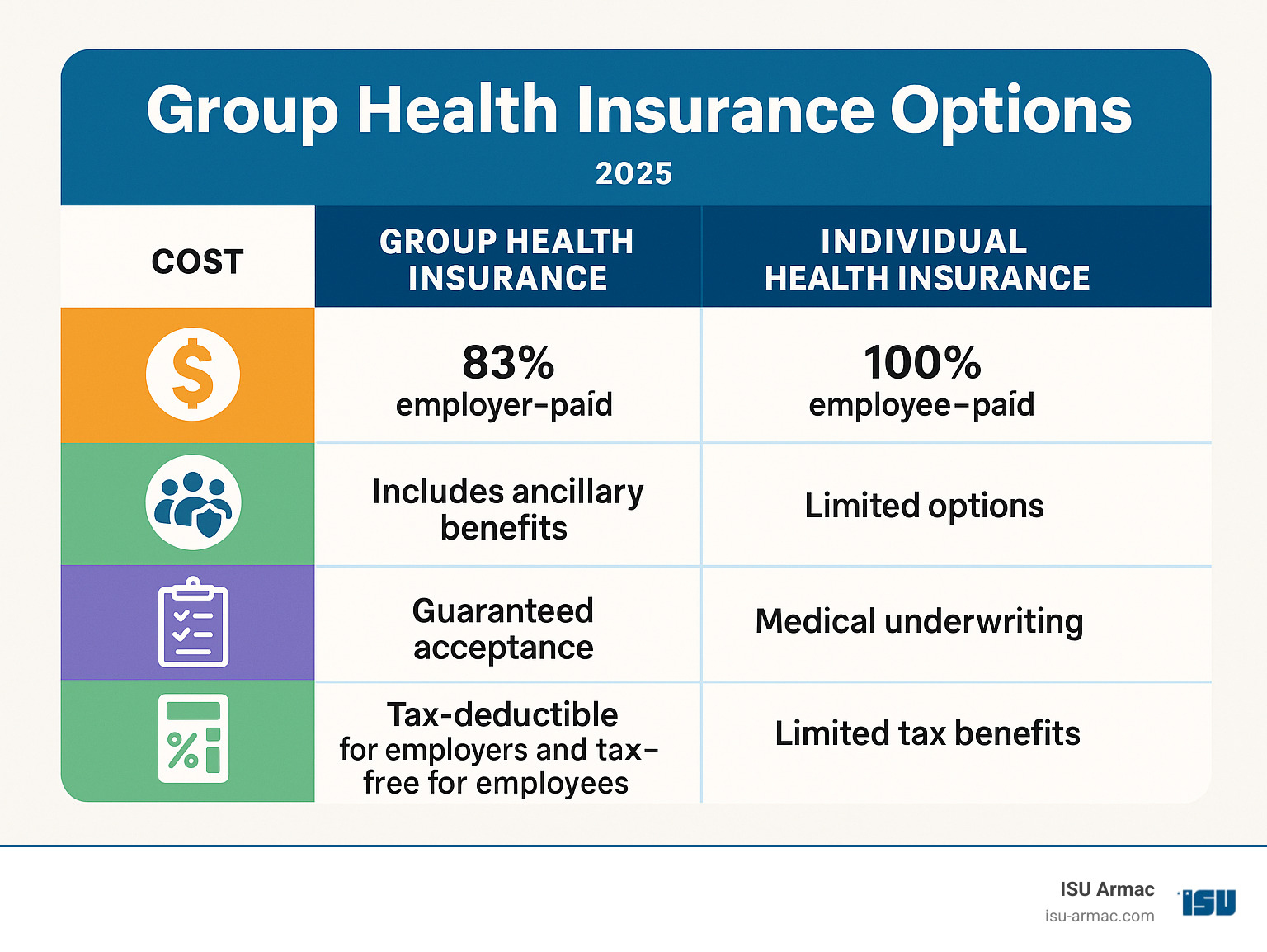
Unlike individual plans, group health insurance spreads risk across your workforce, creating lower premiums and better coverage. In 2023, the average group policy for an individual cost $8,435 annually (with employees paying just 17%), while family coverage averaged $23,968 (with employees paying about 29%). This risk pooling makes group plans more affordable.
Group plans also offer guaranteed coverage regardless of pre-existing conditions. Plus, your business can deduct premiums as a tax-deductible expense while providing tax-free benefits to your team. Businesses that pay at least 50% of the insurance premium may even qualify for a 50% tax credit!
I’m Ryan McEachron, CEO of ISU Insurance Services ARMAC Agency. For over two decades, I’ve helped Victorville area businesses steer group health insurance options. My experience on the Victorville City Council and with local employers has shown me how the right benefits package transforms a small business’s ability to compete for talent.
We understand that navigating small business healthcare can be confusing. That’s why we’re here to help you explore your options, from understanding if your business can pay for individual health insurance for your employees to leveraging programs like the Shop Small Business Health Options Program or even exploring Association Health Plans for Small Business.
Decoding Traditional Group Health Insurance Options

Exploring traditional group health insurance options can feel overwhelming, but understanding the basic plan types makes the choice much easier.
With traditional group plans, your business contracts with an insurance carrier, giving employees access to a network of providers. You gain the Group Health Insurance Benefits of offering quality coverage, while managed care helps keep costs reasonable.
Managed Care Plans: HMO, PPO, POS, and EPO
Managed care plans strike a unique balance between cost, flexibility, and provider choice. Let me walk you through the four main players.
Health Maintenance Organization (HMO) plans require employees to choose a Primary Care Physician (PCP) who coordinates all care and provides referrals to specialists. This model keeps costs low, but coverage is limited to the plan’s network (except for emergencies). HMOs offer the lowest premiums, ideal for budget-conscious businesses.
Preferred Provider Organization (PPO) plans offer the freedom to see any doctor, in or out-of-network, without referrals. This flexibility comes with higher premiums and out-of-pocket costs, especially for out-of-network care. PPOs are popular because employees can often keep their existing doctors.
Point of Service (POS) plans are a hybrid. Like HMOs, they use a PCP and referrals for in-network care. Like PPOs, they allow out-of-network care at a higher cost. This offers a middle ground between cost and flexibility.
Exclusive Provider Organization (EPO) plans are like PPOs in that they don’t require referrals for specialists. However, there is no coverage for out-of-network care except in emergencies, which helps keep costs lower than PPOs.
| Feature | HMO | PPO | POS | EPO |
|---|---|---|---|---|
| PCP Required? | Yes | No | Yes | No |
| Referrals Needed? | Yes | No | Yes (for in-network) | No |
| Out-of-Network Coverage | No (except emergencies) | Yes (at higher cost) | Yes (at higher cost) | No (except emergencies) |
| Network Size | Smaller, more restricted | Larger, more flexible | Medium | Medium to Large |
| Cost (Premiums) | Generally Lower | Generally Higher | Moderate | Moderate to High |
| Flexibility | Least | Most | Moderate | Moderate |
The Importance of Ancillary Benefits
Medical coverage alone isn’t enough for a competitive benefits package. Ancillary benefits—extra layers of protection—show you truly care about your employees’ well-being.
Dental insurance covers routine cleanings and major procedures, and can reduce medical claims by addressing issues early. Vision insurance helps with exams, glasses, and contacts, which is essential for many employees.
Life insurance offers financial protection for an employee’s family. Short-term disability replaces a portion of income for several months, while long-term disability provides coverage for more serious, extended conditions.
These Employee Benefits Insurance options transform a basic health plan into a comprehensive safety net. Offering this full package shows your team that their health, security, and peace of mind matter to you.
Alternatives for Small Businesses: Association Health Plans (AHPs)
If your business is too small for traditional group rates or you’re self-employed, Association Health Plans (AHPs) can be a great solution.
AHPs allow small businesses to band together through an association, creating a large group. This group buying power provides access to the same premium rates and benefits that large corporations enjoy.
These plans work particularly well for businesses in specific industries where associations already exist. The Association Health Plans for Small Business option has opened doors for countless small employers who thought quality group coverage was out of reach. Your five-person company can access the same quality coverage and competitive rates as a 500-person corporation.
Modern Flexibility: HSAs and ICHRAs Explained

The evolution of healthcare offers creative benefit solutions for small businesses. Beyond traditional group health insurance options, two modern approaches provide significant advantages: Health Savings Accounts (HSAs) and Individual Coverage HRAs (ICHRAs).
These consumer-driven solutions give employees more control and employers more predictable costs and flexibility, a win-win for Health Insurance for Employees Small Business.
Health Savings Accounts (HSAs)
Health Savings Accounts (HSAs) are versatile tools that offer a unique triple tax advantage. Paired with High-Deductible Health Plans (HDHPs), they create a powerful and popular combination.
The model is simple: employees get lower premiums from the HDHP, and both you and your employees can contribute tax-free money to their HSA to cover the deductible and other medical costs.
The money in the HSA grows tax-free, and withdrawals for qualified medical expenses are also tax-free. It’s the only account in America that offers this triple tax benefit.
A key feature is employee ownership. The HSA belongs to the employee forever, even if they change jobs. After age 65, funds can be used for non-medical expenses, similar to a retirement account. This approach encourages employees to become smarter healthcare consumers, as they tend to shop for better prices when using their own funds.
Individual Coverage HRAs (ICHRAs): A New Approach to Group Health Insurance Options
Individual Coverage HRAs (ICHRAs) are another sophisticated, tax-advantaged alternative to traditional plans.
ICHRAs, introduced in 2020, change the model. Instead of choosing a single plan, you provide a monthly allowance for employees to buy their own individual health insurance. They can shop on the Marketplace coverage information or with an agent to find a plan that fits their needs.
The reimbursement model is straightforward. You set a monthly allowance, employees purchase their own plan, and you reimburse them tax-free up to the set amount after they submit proof of coverage.
For you, this creates unbeatable budget control. You set your contribution amount, and that’s your predictable monthly expense. For employees, it provides incredible flexibility to choose a plan that perfectly matches their needs, rather than a one-size-fits-most solution.
This answers the question many small business owners ask: “Can a Small Business Pay for Individual Health Insurance?” With ICHRAs, absolutely—and it might be the smartest way to do it. ICHRAs work for businesses of any size and allow for different allowance amounts for different employee classes, making them group health insurance options reimagined for the modern workplace.
Understanding the Costs and Contributions

Understanding the cost structure of group health insurance options is essential. The key components are premiums, deductibles, copayments, and coinsurance.
Premiums are the monthly payments to keep the plan active. A deductible is the amount an employee pays out-of-pocket before insurance begins to pay for most services. After the deductible is met, copayments (a flat fee for a service) and coinsurance (a percentage split of the cost) apply. The out-of-pocket maximum is a safety net that caps the employee’s annual spending, after which insurance covers 100% of eligible costs.
This protection against catastrophic costs is a major advantage of group coverage. We can walk you through these numbers and provide a personalized Get a Group Benefits Quote that makes sense for your business.
What Determines Your Premium?
Premiums are calculated based on several key factors insurers use to assess risk.
- Group size is significant. Larger groups often have more predictable risk, leading to better pricing. In California, groups as small as two employees can qualify.
- Employee demographics like age and gender affect rates. A younger workforce generally has lower premiums.
- Your geographic location in Southern California impacts rates, as they reflect local healthcare costs.
- Industry risk also influences costs, as some jobs carry higher health risks than others.
- The plan type selected (e.g., HMO vs. PPO) and the carrier also significantly impact the final premium.
Structuring Cost-Sharing with Employees
Once you know your premium, the next decision is how to split costs with your employees. This balance is critical to your benefits program’s success.
Most carriers require a minimum employer contribution, often 50% of the employee-only premium, to ensure genuine investment in the plan.
You have several approaches. A percentage split (e.g., you cover 75% of single coverage) scales with plan costs. A fixed-dollar amount (e.g., you contribute $400 per employee) gives you more budget control.
Tiered contributions are a popular strategy, where you contribute different amounts for employee-only, employee + spouse, or family coverage. This helps manage costs while still providing substantial support.
The goal is to find a sweet spot where coverage is affordable for employees and sustainable for your business. We can help you strike that perfect balance to make your benefits package attractive to current and future employees.
How to Choose the Right Plan for Your Business

Selecting the right group health insurance options requires balancing budget, purpose, and employee comfort. We’ve helped hundreds of Victorville area businesses find their perfect fit and can guide you through How to Get Health Insurance for My Small Business with confidence.
Key Factors to Evaluate
Every business is unique. We start by evaluating these key factors:
- Workforce needs and health: A young team might prefer lower premiums, while employees with families may need more comprehensive coverage and robust provider networks.
- Budget constraints: We help you find options that deliver real value without being unsustainable for your business.
- Provider network adequacy: This is crucial for employee satisfaction. We ensure recommended plans include the doctors and hospitals your team prefers.
- Administrative burden: We match you with options that fit your comfort level and available time for plan management.
- Plan flexibility: Employees appreciate having choices. When people feel they have some control over their benefits, they value them more highly.
The Strategic Advantage of Using an Insurance Broker
Working with an experienced insurance broker like ISU Armac provides a significant strategic advantage. We bring over two decades of experience helping Southern California businesses steer their insurance needs.
- Shopping multiple carriers: We compare options from dozens of carriers, giving you a complete market view, not just a single company’s offerings.
- Expert guidance: We help you avoid costly mistakes. We translate confusing insurance jargon and explain what each option means for your business and employees.
- Plan comparison: We simplify the process by laying out your options side by side, showing you how plans stack up on cost, coverage, and convenience.
- Enrollment support: We’re there from initial setup through employee meetings and individual enrollments to answer questions and solve problems. We can also help you explore programs like the Shop Small Business Health Options Program.
- Ongoing service: Our relationship doesn’t end with the paperwork. We’re here for claims issues, employee questions, and annual reviews.
Keeping Your Group Health Insurance Options Competitive
The healthcare landscape changes quickly, so a proactive benefits strategy is essential.
- Annual review: This is a health checkup for your plan. We analyze its performance, your claims experience, and new market options to find potential improvements or savings.
- Employee surveys: These provide valuable feedback on what benefits your team values most, revealing opportunities for improvement.
- Benchmarking: We compare your benefits package against similar businesses in your industry and region to ensure you remain competitive.
- Adapting to changing needs: As your business evolves, your benefits strategy should too. We help you stay flexible and responsive.
- Wellness programs: These initiatives can lead to healthier employees and may help control insurance costs over time.
Frequently Asked Questions about Small Business Health Plans
Here are answers to the most common questions we hear from business owners about group health insurance options.
How many employees do I need to qualify for group health insurance?
In California, you don’t need a large workforce. Most carriers require just two W-2 employees to qualify for group health insurance. Typically, the second employee cannot be the owner’s spouse to ensure proper risk distribution.
A “small business” for health insurance purposes is generally 1-100 employees. Once you meet the two-employee minimum, you can access competitive group rates.
Are my contributions to employee premiums tax-deductible?
Yes. This is a major financial advantage. The premiums your business pays for employee health insurance are a tax-deductible business expense.
Furthermore, the benefits your employees receive are typically tax-free income for them, which improves the value of your compensation package. You may also be eligible for the Small Business Health Care Tax Credit. For a complete picture of your obligations and opportunities, see our guide on Are Small Businesses Required to Provide Health Insurance?
Can I start a group health plan at any time of the year?
Unlike individual plans with strict enrollment periods, group health insurance offers year-round flexibility. You can start a plan for your small business any month of the year.
Most carriers will start coverage on the first day of any month, though some offer mid-month dates. You’ll need to submit all paperwork by the carrier’s deadline, usually about two weeks before your desired start date. This flexibility is a huge advantage when you’re hiring and need to get your team covered quickly.
Conclusion: Partnering for a Healthier, Stronger Business
We’ve explored the spectrum of group health insurance options, from traditional HMOs and PPOs to modern Health Savings Accounts and Individual Coverage HRAs. You now have a roadmap for this crucial decision.
We’ve also covered how ancillary benefits complete your package and how understanding costs helps you budget. The key takeaway is that offering health benefits is a strategic investment in employee satisfaction, retention, and talent acquisition.
Providing quality health coverage shows employees you value their well-being. This builds loyalty, reduces turnover, and fosters a positive workplace culture. In today’s competitive job market, especially in Southern California, a strong benefits package is as important as salary. Your group health insurance options can be the deciding factor for top talent.
You don’t have to steer this alone. Expert advice is crucial for handling regulations, comparing carriers, and structuring cost-sharing.
At ISU Armac, we’ve spent over two decades helping Victorville area businesses build effective benefits packages. We shop multiple carriers to find the best solution for your unique situation, whether you’re in Apple Valley, Hesperia, or elsewhere in the region. We understand the local market and its challenges.
Making an informed decision about your health benefits strategy starts with having the right partner. We handle the complexity so you can focus on running your business. From initial plan selection through ongoing support and annual reviews, we’re here to ensure your benefits package remains a small business superpower.
Ready to take the next step? Explore your small business medical insurance options today and let’s work together to build a healthier, stronger future for your business and your team.