
Why General Liability Insurance Is Your Business’s First Line of Defense
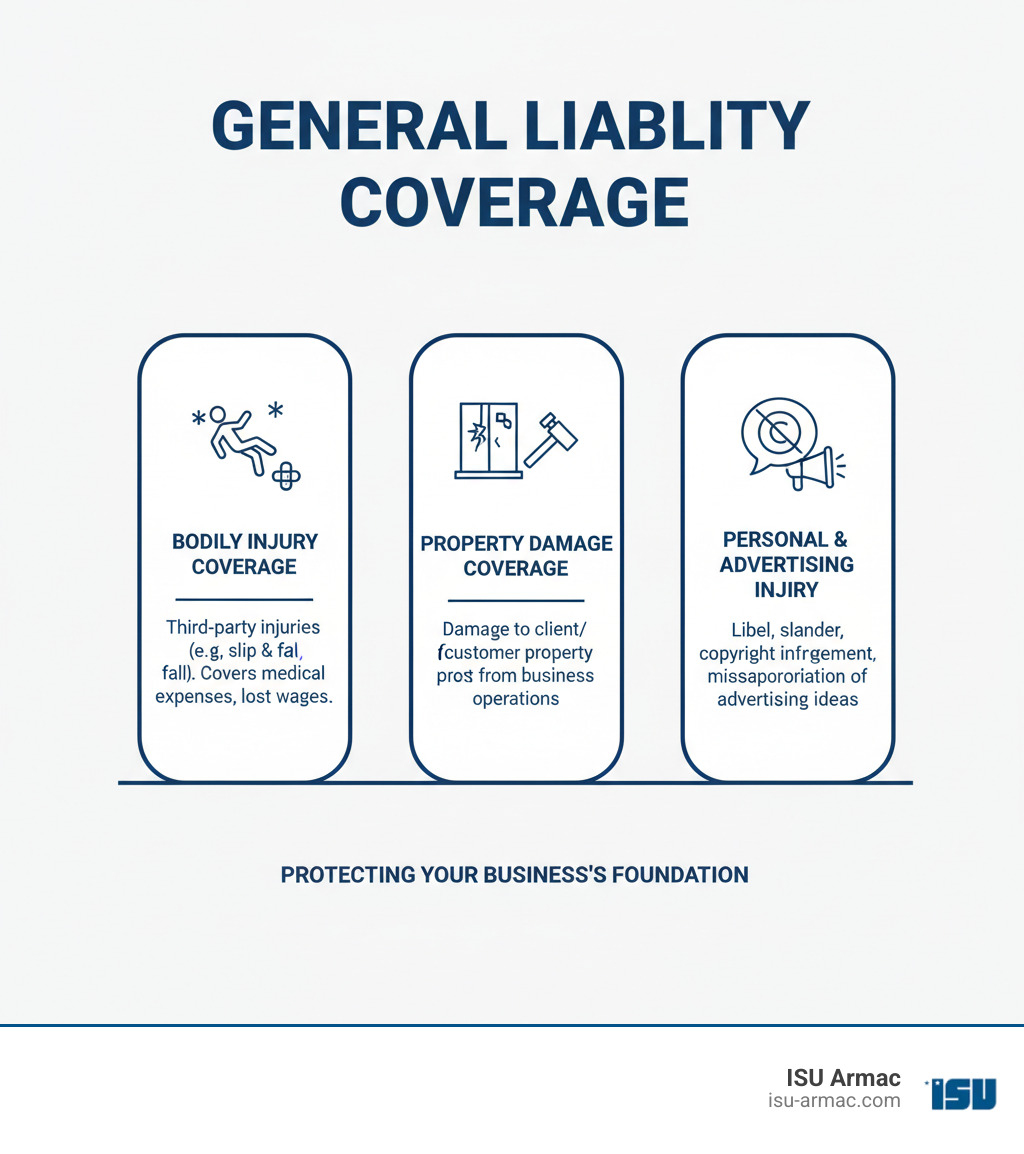
General liability insurance protects your business from claims made by third parties for bodily injury, property damage, and personal or advertising injury. Here’s a quick overview:
- What it covers: Medical bills, legal defense costs, and settlements when someone is injured at your business or their property is damaged by your operations.
- Who needs it: Nearly every business, especially in California where 4 million small businesses employ 48.5% of the workforce.
- Typical cost: Many small businesses pay between $300-$1,000 annually, with many paying less than $25-$45 per month.
- Standard policy limits: $1,000,000 per occurrence / $2,000,000 aggregate.
- Not legally required: But often mandatory for contracts, leases, and client agreements.
General liability is often the first policy purchased because it addresses common risks like a customer slip-and-fall, employee-caused property damage, or a false advertising lawsuit. Without coverage, these incidents could be financially devastating, forcing you to close your doors.
I’m Ryan McEachron, CEO of ISU Insurance Services ARMAC Agency in Victorville. With decades of experience helping California business owners, I know that understanding this foundational coverage is critical to your long-term success, whether you’re a new venture or an established operation.
What General Liability Insurance Covers
General liability insurance is your financial safety net for the everyday risks of doing business. It protects your business when third parties—customers, clients, or vendors—experience harm or loss because of your operations.
Bodily Injury and Property Damage
Consider a common scenario: a customer in your Apple Valley shop trips and breaks their wrist, or a contractor in Hesperia accidentally punctures a water line, flooding a basement. These are real incidents that happen daily.
Bodily injury coverage pays for medical bills, lost wages, and even pain and suffering when someone is physically hurt on your premises or due to your business activities. A simple slip-and-fall can lead to a lawsuit demanding tens of thousands of dollars.
Property damage coverage protects you when your business accidentally damages someone else’s belongings. Whether your cleaning crew in Oak Hills breaks an antique or your delivery driver scratches a client’s car, this coverage ensures you won’t have to pay for repairs out of pocket.
For contractors, these protections are critical. To learn more, read our guide on What does General Liability Insurance Cover for Contractors an Ultimate Guide? for job-specific scenarios.
Personal and Advertising Injury
General liability also covers non-physical harm, known as personal and advertising injury. This protects against claims that your business harmed someone’s reputation or rights.
- Libel and slander: This protection applies if you or an employee makes a false statement that damages someone’s reputation, leading to a defamation lawsuit.
- Copyright infringement: This covers you if you accidentally use a copyrighted image or slogan in your marketing materials.
- Misappropriation of advertising ideas: This applies if you use another’s creative concept without permission.
- Invasion of privacy: This protects you if you use a person’s photo in an ad without their consent.
These risks are more common than ever. Explore the full scope of this policy in our article on What is General Liability Insurance for?.
Medical Payments and Legal Defense
Medical payments coverage, often called “goodwill coverage,” is a smart feature. It allows you to pay for minor injuries immediately, regardless of fault. Paying for a small urgent care visit can prevent a large lawsuit, showing good faith and resolving issues before they escalate.
However, the most significant protection is legal defense coverage. Defending a lawsuit is expensive, with attorney fees easily costing thousands, even if the claim is baseless. Your general liability policy covers these defense costs—including attorney fees, court costs, and investigations—whether the lawsuit has merit or not. If a settlement or judgment is made against you, the policy covers those amounts up to your policy limits.
This protection is crucial when facing negligence claims. To learn more, read our guide on Does General Liability Insurance Cover Negligence?. General liability insurance gives you the freedom to run your business without the constant fear of a single accident leading to financial ruin.
Who Needs This Coverage and Why?
While not always mandated by law, general liability insurance is a practical necessity for nearly every business, providing credibility and crucial financial protection.

High-Risk Industries and Professions
Certain industries have higher exposure and a greater need for this coverage. If your business involves public interaction or working on client property, you have liability risk.
- Construction and Contractors: Plumbers, electricians, and roofers constantly work on client property with tools and equipment, creating significant risk.
- Retail and Restaurants: Any business with a physical storefront is exposed to slip-and-fall accidents daily.
- Cleaning Services: Working in clients’ homes and offices around expensive belongings presents a high risk of property damage claims.
- Fitness Professionals: Gyms and personal trainers face liability from clients pushing their physical limits.
- Real Estate and Consultants: Even office-based professionals face risks, from clients visiting their office to advertising injury claims.
When is General Liability Insurance Required?
While not always required by state law, you’ll find it’s practically mandatory in many situations.
- Contractual Requirements: Many companies require you to carry general liability insurance before they will hire you as a contractor or vendor.
- Commercial Leases: Landlords in Victorville, Hesperia, and Apple Valley will almost certainly require proof of insurance before you can lease a commercial space. They often ask to be named as an “additional insured.”
- Licenses and Permits: Some state and local licensing boards mandate coverage for specific professions to obtain a business permit.
- Client Contracts: Many clients will request a Certificate of Insurance (COI) before allowing you to start work, making it a standard business practice.
For a deeper look at legal requirements, visit our guide on Is General Liability Insurance Required by Law?.
Benefits for Every Small Business
Beyond contractual needs, general liability offers key benefits for your business’s stability and growth.
- Financial Safety Net: It covers legal defense costs, settlements, and judgments that could otherwise bankrupt your business.
- Business Continuity: With insurance handling a claim, you can keep your doors open and maintain revenue without interruption.
- Credibility and Trust: Having insurance signals that you are a serious, professional business, which can help you win larger contracts.
- Peace of Mind: Knowing you’re protected from common accidents lets you focus on growing your business instead of worrying about potential lawsuits.
In California, where over 4 million small businesses employ nearly half the state’s workforce, this protection is vital. As noted in reports like the 2021 Small Business Profile, small businesses are the backbone of the economy, and protecting them with foundational coverage is essential.
Understanding Your General Liability Insurance Policy
Knowing the details of your policy is key to ensuring you have the right protection. Policy limits, costs, and exclusions are critical components to understand.
Key Components: Limits and Deductibles
Understanding your policy’s limits and deductibles is crucial to knowing how protected you are.
- Per-Occurrence Limit: This is the maximum amount your insurer will pay for a single incident. If a claim exceeds this limit, you are responsible for the rest.
- Aggregate Limit: This is the total amount your insurer will pay for all claims combined during your policy period (typically one year). Once this limit is reached, your coverage is exhausted until renewal.
The industry standard for most small businesses is a $1,000,000 per occurrence / $2,000,000 aggregate policy. This offers solid protection, but higher-risk businesses may need an additional Umbrella policy.
Your deductible is the amount you pay out-of-pocket on a claim before your insurance begins to pay. A higher deductible can lower your premium, but be sure it’s an amount you can comfortably afford. For help determining your limits, read our guide on How Much General Liability Insurance for Small Business?.
How is the Cost of General Liability Insurance Determined?

The cost of general liability insurance isn’t fixed; it’s custom to your business’s unique risk profile. Key factors include:
- Industry Risk: High-risk industries like construction or restaurants typically pay more than lower-risk professions like consulting.
- Business Operations and Size: Your annual revenue and number of employees affect your premium, as more activity creates more exposure.
- Business Location: Rates can vary by location due to local claims history and regulations. Operating in Victorville may have a different rate than in downtown Los Angeles.
- Claims History: A clean record can lead to lower rates, while a history of claims signals higher risk to insurers.
- Coverage Limits and Deductibles: Higher limits increase your premium, while a higher deductible can lower it.
Many small businesses pay less than $1,000 annually, with some policies costing as little as $25-$45 per month. At ISU Armac, we shop multiple carriers to find the best rate for you. Learn more on our General Liability Insurance Cost page.
Common Exclusions: What’s NOT Covered?
General liability is powerful, but it doesn’t cover everything. Understanding these exclusions is critical to ensuring you don’t have dangerous gaps in your protection.
- Employee Injuries: These are covered by workers’ compensation insurance, which is legally required for businesses with employees.
- Professional Errors: Financial harm from your professional advice or mistakes is covered by professional liability insurance (E&O), not general liability.
- Commercial Auto Accidents: Accidents involving business vehicles require a separate commercial auto insurance policy.
- Damage to Your Own Property: Your building, equipment, and inventory are protected by commercial property insurance.
- Intentional Acts: Deliberate harm or damage caused by you or an employee is never covered.
- Cyber Liability: Data breaches and other cyber incidents require dedicated cyber liability insurance.
General liability is one piece of the puzzle. For a full overview, see our Complete Business Liability Insurance Guide.
General Liability vs. Other Key Business Coverages
General liability insurance is the cornerstone of a business insurance plan, but it doesn’t cover everything. Understanding how it differs from other policies is vital for comprehensive protection.

General Liability vs. Professional Liability (E&O)
Business owners often confuse general liability and professional liability, but they cover entirely different risks.
The distinction is simple: general liability covers physical risks like bodily injury and property damage. For example, if a client trips in your office or you damage their property.
Professional liability insurance, or Errors & Omissions (E&O), covers financial losses caused by your professional services, advice, or errors. For instance, if an accountant’s mistake leads to tax penalties for a client, E&O insurance would respond. A real estate agent needs general liability for a slip-and-fall at a showing, but professional liability for failing to disclose a property defect.
Many service-based businesses in Southern California need both policies to be fully protected against physical and financial risks.
How It Works with Workers’ Comp and Commercial Auto
General liability specifically excludes risks covered by other essential policies. Two of the most important are workers’ compensation and commercial auto insurance.
- Workers’ Compensation Insurance: This is legally required in California if you have employees. It covers medical bills and lost wages for work-related injuries, protecting both your employees and your business from lawsuits.
- Commercial Auto Insurance: This is necessary for accidents involving business vehicles, whether they are company-owned or personal cars used for work. General liability does not cover vehicle-related claims.
These policies work together with general liability to create a comprehensive safety net with no dangerous gaps.
Does General Liability Insurance Include Product Liability?
Many general liability policies include product liability coverage, which protects you if a product you make or sell causes injury or damage. However, you must verify this is included in your policy, as some insurers offer it as an add-on.
For any business that manufactures, distributes, or sells physical products, this coverage is non-negotiable. A single defective product could lead to multiple lawsuits and devastating financial consequences.
At ISU Armac, we always verify that our clients’ policies include adequate product liability protection. For more details on what your policy might cover, review our page on General Liability Insurance Coverage.
Frequently Asked Questions about General Liability Insurance
Business owners in Victorville and Hesperia often ask the same questions about general liability insurance. Here are clear, concise answers to the most common ones.
Is general liability insurance tax-deductible?
Yes. In most cases, general liability insurance premiums are considered an ordinary and necessary business expense, making them tax-deductible. This helps reduce the net cost of your coverage. However, always consult a qualified tax professional for advice specific to your business.
What is a Certificate of Insurance (COI)?
A Certificate of Insurance (COI) is a one-page document that serves as proof of your insurance coverage. It summarizes your policy types, limits, and effective dates. Clients, landlords, and licensing agencies often require a COI before they will work with you to ensure you’re adequately protected.
Are there common myths about general liability insurance?
Yes, and believing them can be a costly mistake. Here are a few common myths, debunked:
Myth: My LLC offers complete protection.
Reality: An LLC protects your personal assets from business debts, but it doesn’t protect the business itself from lawsuits. General liability insurance protects your business assets.Myth: It’s too expensive for a small business.
Reality: Many small businesses can find affordable policies, often for $300 to $1,000 annually. This is a small price to pay to avoid a lawsuit that could cost tens of thousands of dollars.Myth: It covers professional mistakes.
Reality: General liability covers physical harm and property damage, not financial losses from bad advice. For that, you need separate Professional Liability (E&O) insurance.Myth: Online businesses don’t need it.
Reality: Even without a physical location, online businesses face risks like copyright infringement or slander (advertising injury), which are covered by general liability.
Conclusion
General liability insurance is a fundamental tool for safeguarding your business’s future. It provides the financial stability and peace of mind you need to focus on growth by covering everyday accidents and defending against costly lawsuits.
The risks are real: a slip-and-fall in your Victorville shop, property damage at a Hesperia job site, or an advertising lawsuit. Without general liability insurance, these common incidents can threaten your business’s survival. A single claim can quickly become a financial crisis.
Protection doesn’t have to be complicated or expensive. At ISU Armac, we steer the insurance market to find a policy that fits your unique risks and budget. As a local agency serving Victorville, Apple Valley, Hesperia, and Oak Hills, we understand the challenges Southern California businesses face.
By shopping multiple carriers, we ensure you get comprehensive protection without overpaying. We’ve helped over 35,000 business owners find affordable general liability insurance, often for less than $30 per month—a small investment to protect you from claims that could cost hundreds of thousands.
Your business represents years of hard work and sacrifice. It deserves solid protection. Secure your legacy today. Learn more about our business insurance solutions and let us help you find the right coverage at the right price.