
Why Understanding E&O Insurance Costs Matters for Your Business
The errors and omissions insurance cost varies based on your profession, business size, and risk factors. For most small businesses, this essential protection costs between $500 and $1,000 per year.
Average E&O Insurance Costs:
- Monthly cost: $42-$66 per month (national median/average)
- Annual cost: $500-$1,000 per year for most small businesses
- Range: As low as $19/month to over $250/month
- Most common: 55% of businesses pay under $600 annually
If you provide professional services or advice, a single mistake can lead to a costly lawsuit. E&O insurance protects your business from claims of negligence, errors, or omissions that cause financial harm to clients. Without it, you could face legal costs that threaten your business’s survival. The price of this protection depends on your industry, coverage limits, claims history, and business size.
I’m Ryan McEachron, CEO of ISU Insurance Services ARMAC Agency. With over 25 years of experience, I’ve helped countless businesses in Victorville and beyond steer E&O insurance costs. I know how the right coverage can protect your business from financial ruin while remaining affordable.

Easy errors and omissions insurance cost glossary:
- errors and omissions insurance for insurance agents
- errors and omissions insurance for real estate agents
- errors and omissions insurance for registered investment advisors
What is Errors and Omissions (E&O) Insurance and Why is it Crucial?

E&O insurance, also known as professional liability insurance, is your financial shield against claims of professional negligence, mistakes, and oversights. While general liability insurance covers physical accidents, E&O specifically protects you when clients claim your services caused them financial harm.
Even if you’re innocent, legal defense costs alone can be devastating. I’ve seen professionals spend over $50,000 defending against baseless claims. E&O insurance covers these legal expenses, plus any settlements or judgments if you’re found liable.
Most E&O policies are claims-made policies, meaning the policy must be active both when the error occurred and when the claim is filed. This makes continuous coverage essential to avoid gaps that leave you vulnerable for past work.
E&O insurance typically covers negligence, mistakes, misrepresentation, and failure to deliver promised results. However, it does not cover intentional wrongdoing, criminal acts, fraud, or physical injuries, which fall under other policies.
To get a deeper understanding of how this coverage works in practice, check out our comprehensive guide on What is Errors and Omissions Liability Insurance.
Who Needs E&O Insurance?
If your business provides professional advice or specialized services, you likely need E&O insurance. The question isn’t if you’ll make a mistake, but if you can afford the consequences when a client claims you did.
- Accountants & Bookkeepers: A single miscalculation in tax preparation or financial reporting can trigger costly claims.
- Architects & Engineers: Design errors can lead to construction delays, cost overruns, or safety issues costing millions.
- Consultants (IT, Business, Marketing): When your recommendations don’t deliver expected results, clients may seek to recover their damages from you.
- Real Estate Agents: Errors in contracts or missed disclosures can easily trigger six-figure claims. Many states require E&O insurance for licensing.
- Insurance Agents: Recommending the wrong policy or failing to explain coverage can lead to devastating uninsured losses for clients. That’s why we specialize in Errors and Omissions Insurance for Insurance Agents.
- IT Professionals: System failures, security breaches, or software bugs can disrupt client operations and trigger substantial claims.
- Other Professionals: Travel agents, financial advisors, lawyers, and notaries all face liability risks that E&O insurance addresses.
Beyond these risks, client contracts, state licensing boards, or professional associations often require E&O coverage. The bottom line is simple: if an error in your professional judgment could cost a client money, E&O insurance is a critical part of your risk management strategy. The errors and omissions insurance cost is a small fraction of what you’d pay to defend a single lawsuit.
The Average Errors and Omissions Insurance Cost in 2024

Understanding what you can expect to pay for errors and omissions insurance cost helps you budget wisely. In 2024, most small businesses pay between $42 to $66 per month for E&O coverage. The national median is around $42 monthly, while the average is closer to $66, pulled up by higher-risk professions.
Annually, most business owners can expect to invest between $500 to $1,000 for solid E&O protection. Surprisingly, 55% of small business owners pay less than $600 annually—less than $50 per month. Some policies for low-risk professions start as low as $19 per month. Market trends, as noted in studies like the J.D. Power U.S. Small Commercial Insurance Study, show that while cost is a concern, satisfaction is high when coverage is well-matched to business needs.
The range is wide because risk varies dramatically. When you consider that a single lawsuit could cost tens of thousands in legal fees, even a $1,000 annual premium is smart financial planning. For context, our guide on How Much Does Small Business Liability Insurance Cost provides helpful perspective.
E&O Insurance Cost by Profession
Your profession is the biggest factor in your premium. Insurers use claims data to assess which professions face the highest risk.
- Lower-Risk Professions: Notaries and insurance agents often enjoy the most affordable rates, with some agents paying as little as $26.25 monthly.
- Moderate-Risk Professions: Accountants and real estate agents fall in the middle range, with average costs around $42 to $73 monthly, depending on service complexity.
- Technology Professionals: IT consultants and software developers typically pay $60 to $86 monthly due to risks like system failures and data breaches.
- Higher-Risk Professions: Business consultants and financial advisors see higher rates, averaging $72 to $128 monthly, reflecting their responsibility for client assets and strategic advice.
- Highest-Risk Professions: Architects, engineers, and lawyers face the steepest costs, with premiums ranging from $43 to over $257 monthly. A single design flaw or legal error can create massive liability.
Your actual errors and omissions insurance cost will depend on your specific business size, coverage limits, and claims history. Getting personalized quotes is the best way to understand your true costs.
Key Factors That Influence Your E&O Premium

To determine your errors and omissions insurance cost, insurers examine every aspect of your business to assess your unique risk profile. This is why your premium might be completely different from another business, even in a similar field.
The underwriting process involves sophisticated calculations that weigh multiple interacting factors. At ISU Armac, our experience shopping multiple carriers means we know what different insurers prioritize, which can help you find meaningful savings. For more context, see our guide on What Factors Affect the Price of Commercial Liability Insurance.
Factors Determining Your Errors and Omissions Insurance Cost
Your premium is shaped by several key elements that insurers evaluate. Understanding them helps you see where you might influence your rates.
- Industry and profession: This is the foundation of your risk assessment. An architect faces inherently higher risk than a marketing consultant, and premiums reflect that.
- Coverage limits: This is your policy’s maximum payout. Higher limits mean more risk for the insurer and a higher premium for you. Most small businesses start with $1 million per occurrence/$1 million aggregate limits.
- Deductible amounts: The more you’re willing to pay out of pocket before coverage begins, the lower your premium. A higher deductible can significantly reduce your errors and omissions insurance cost, but be sure you can afford it.
- Business size and revenue: Larger operations present greater exposure. More employees and higher revenues often mean larger projects with bigger financial stakes, leading to higher premiums.
- Geographic location: Rates can be higher in areas with more litigation or stricter professional requirements. Some states also mandate minimum coverage levels.
- Claims history: A clean record signals low risk and can result in preferred rates. A history of claims suggests higher future risk and leads to increased premiums.
- Years in business: Established businesses with proven track records typically enjoy lower rates than new ventures, as insurers view experience as an indicator of competence.
How to Save Money on Your E&O Insurance Policy
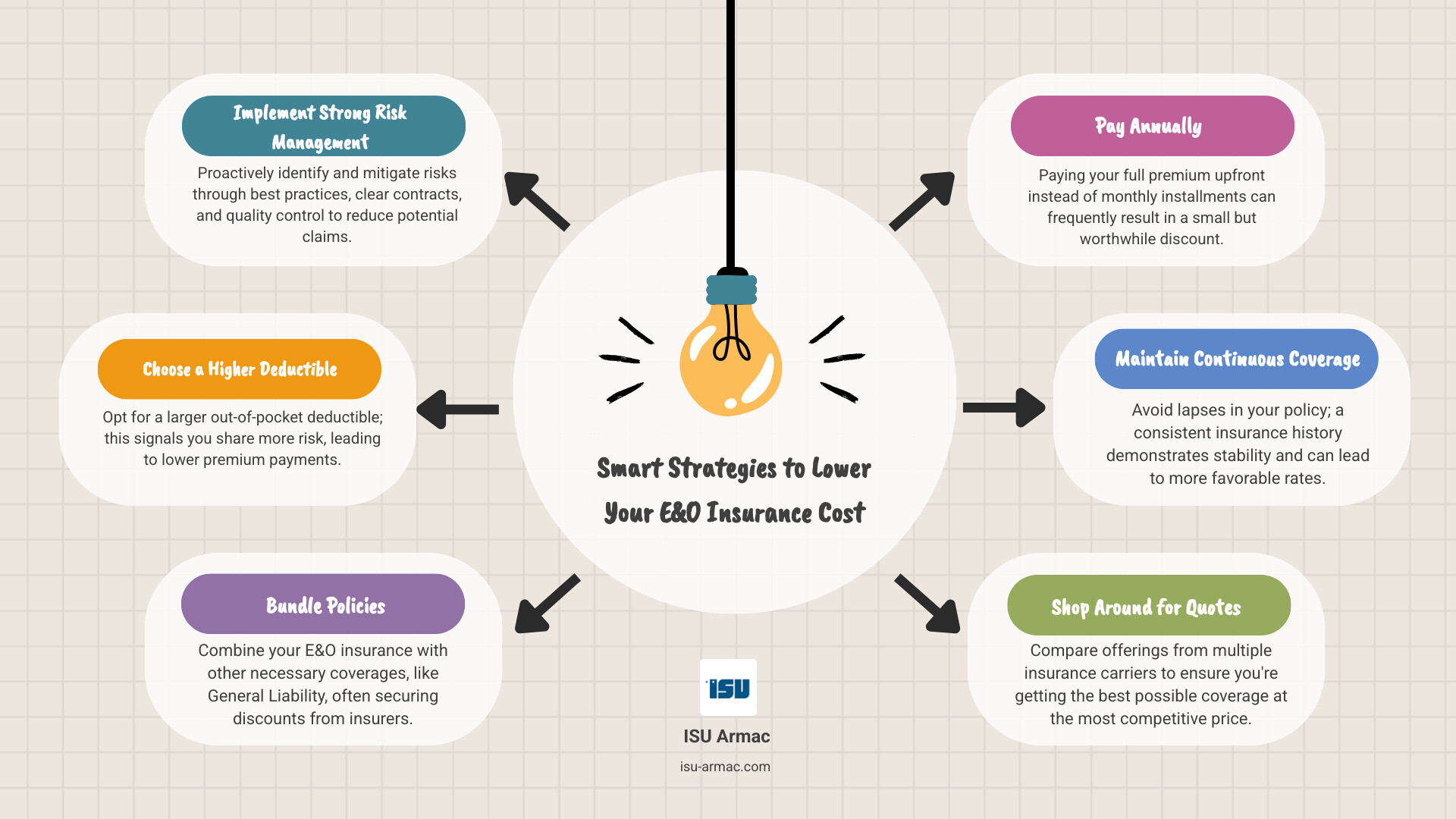
Managing your errors and omissions insurance cost is a crucial part of your business’s financial health. You can lower your premiums without sacrificing necessary coverage by being proactive and strategic. Insurers reward businesses that demonstrate a serious commitment to preventing claims.
Every dollar saved on insurance is a dollar you can reinvest in your business. For a broader look at cost-saving principles, our guide on Business Insurance Cost offers valuable insights.
Smart Strategies to Lower Your Errors and Omissions Insurance Cost
Here are specific actions you can take to reduce your premium while maintaining excellent protection.
- Implement strong risk management: This is your most powerful long-term strategy. Use detailed contracts to outline project scope and deliverables. Maintain clear, documented communication with clients to manage expectations. Establish quality assurance protocols like peer reviews and standardized checklists to reduce errors. Regular employee training also demonstrates your commitment to professional excellence.
- Choose a higher deductible: If your business has healthy cash reserves, opting for a higher deductible is one of the fastest ways to lower your premium. A $5,000 deductible will result in a lower premium than a $1,000 one, but ensure you can comfortably pay it if a claim arises.
- Bundle your policies: Many carriers offer discounts of up to 25% when you purchase E&O with general liability, a business owner’s policy, or cyber liability insurance.
- Pay your premium annually: Insurers often provide a discount for annual payments over monthly installments because it reduces their administrative costs.
- Maintain continuous coverage: Since E&O is “claims-made,” any gap in coverage can leave you exposed for past work and may increase future premiums.
- Shop around for quotes: The errors and omissions insurance cost for identical coverage can vary dramatically between insurers. As an independent agency, ISU Armac handles this for you, comparing multiple carriers to find the best combination of coverage and price for your business.
Frequently Asked Questions about E&O Insurance
Business owners often have questions about E&O insurance. Here are answers to the most common ones we encounter at ISU Armac.
What’s the difference between E&O and General Liability insurance?
This is a crucial distinction. Think of it this way: E&O covers your brain, while General Liability covers your body.
- Errors and Omissions (E&O) insurance covers financial loss to a client due to your professional services, advice, or mistakes. For example, if an accountant’s error leads to tax penalties for a client, E&O would apply.
- General Liability insurance covers physical risks like bodily injury and property damage. For example, if a client slips and falls in your office, General Liability would apply.
The two policies cover different risks and do not overlap. Most businesses need both.
Is E&O insurance required by law?
It depends on your profession and location. While there is no universal federal law, many states require licensed professionals like real estate agents, insurance agents, and architects to carry E&O insurance.
Even when not legally mandated, it’s often a practical necessity. Many clients, especially larger corporations, will require you to show proof of E&O coverage before signing a contract. Professional associations may also require it for membership. In effect, the market often demands it even if the law doesn’t.
How do I choose the right coverage limit?
Selecting the right limit involves balancing protection with your budget. Consider these key areas:
- Industry Risk: High-stakes professions like financial advising require higher limits than lower-risk fields.
- Project Size: Your coverage should be sufficient to cover the potential loss from your largest projects or clients.
- Contract Requirements: Clients often specify the minimum coverage limits you must carry to work with them. This can make the decision for you.
- Budget: Your errors and omissions insurance cost must be affordable. We can help you find the right balance.
An experienced agent can analyze these factors to recommend limits that provide solid protection without breaking your budget.
Conclusion: Securing the Right Protection for Your Business
Understanding the errors and omissions insurance cost is about making a smart investment in your business’s future. For most professionals, this protection costs between $500 and $1,000 annually—a small price to pay to guard against claims that could otherwise be financially devastating.
E&O insurance provides the peace of mind to focus on serving your clients without the constant worry of a single mistake threatening everything you’ve built. Whether you’re in Victorville, Apple Valley, Hesperia, or Oak Hills, this coverage is essential for professionals in our diverse Southern California economy.
As an independent agency, ISU Armac offers a key advantage: choice. We shop multiple top-rated carriers to find you the best coverage that fits your specific needs and budget. You don’t just get a quote; you get the best options available in the market.
Don’t leave your business exposed to professional liability risks. The most important step is getting started.
Get a comprehensive quote for your Errors and Omissions Liability Insurance today and take the first step toward protecting your hard work.