
Why Dental Implant Insurance Matters for Your Wallet
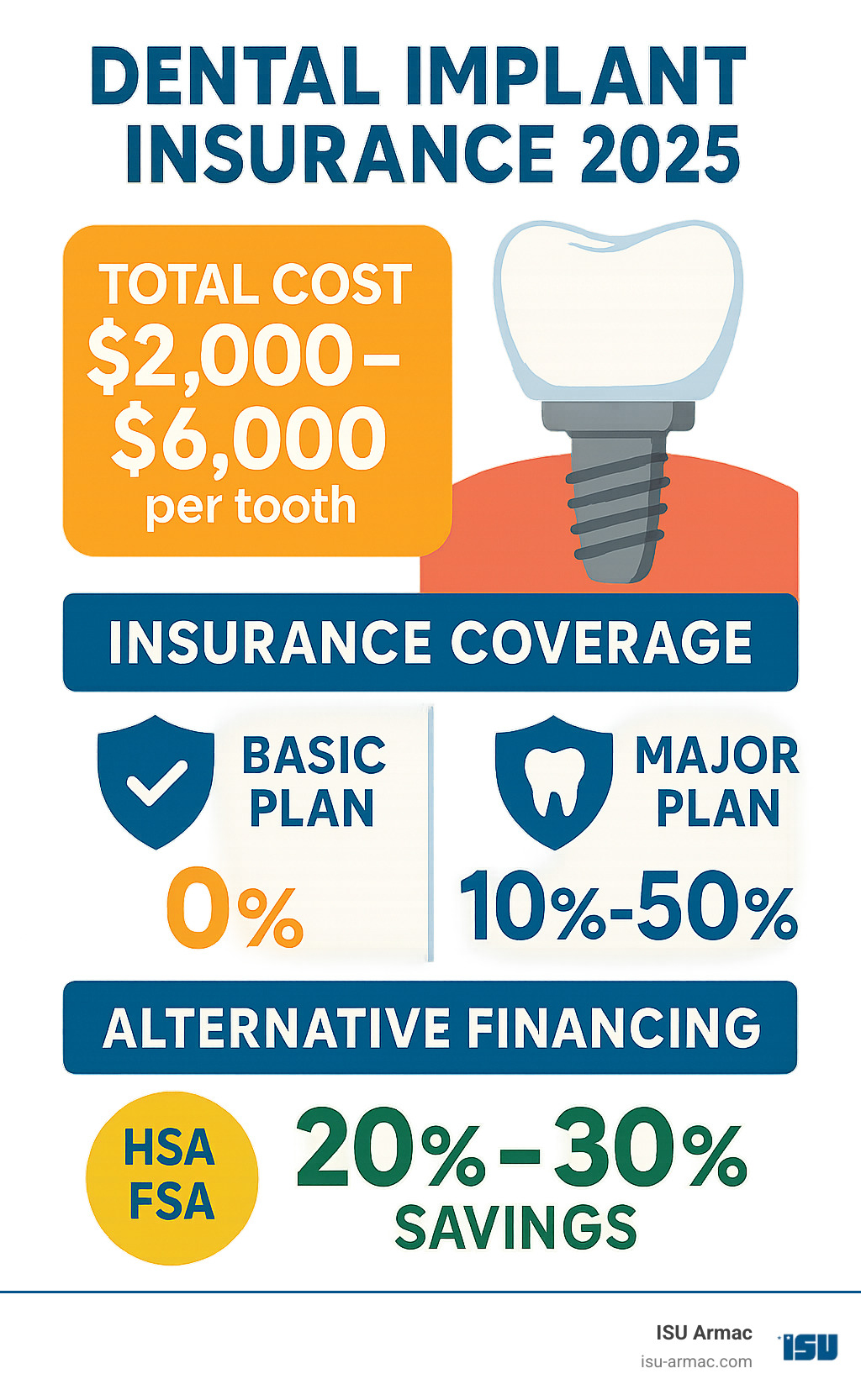
Dental implant insurance is often limited or excluded from most dental plans, with coverage typically ranging from 0% to 50% of costs. Most insurance companies classify implants as elective or cosmetic procedures rather than essential dental care.
Quick Coverage Facts:
- Basic dental plans: Usually don’t cover implants at all
- Major dental coverage: May cover 10-50% of implant costs
- Annual maximums: Typically $1,000-$1,500 limit per year
- Waiting periods: Often 6-12 months for major procedures
- Total implant cost: $2,000-$6,000 per tooth in Southern California
The reality is stark – dental implants can cost thousands of dollars per tooth, yet most dental insurance treats them like luxury items rather than necessary medical care. This leaves many people facing a tough choice between their oral health and their bank account.
Why the limited coverage? Insurance companies often view implants as cosmetic because alternatives like dentures exist. However, implants prevent bone loss and restore full chewing function in ways that removable dentures simply can’t match.
Understanding your specific coverage is crucial before you need treatment. Some plans offer partial coverage for certain components of the implant process, like the crown or initial consultation, even if they won’t pay for the titanium post itself.
As Ryan McEachron, CEO of ISU Armac Insurance Services, I’ve helped countless Victorville residents steer complex insurance situations over my 25+ years in the industry. Through my experience with dental implant insurance claims and policy reviews, I’ve seen how proper planning can significantly reduce out-of-pocket costs for families facing implant treatment.

Key dental implant insurance vocabulary:
The Reality of Dental Implant Costs and Coverage
What Are Dental Implants and Why Are They So Expensive?
A dental implant is essentially an artificial tooth root made of titanium that’s surgically placed into your jawbone. Unlike dentures that sit on top of your gums, implants actually integrate with your bone through a process called osseointegration. This creates a stable foundation for a replacement tooth that looks, feels, and functions like your natural teeth.
The procedure involves three main components:
- The titanium implant post – surgically placed in the jawbone
- The abutment – connects the post to the crown
- The crown – the visible tooth replacement
So why do dental implants cost so much? Several factors contribute to the high price:
Specialist expertise: Implant placement often requires an oral surgeon or periodontist, whose fees reflect years of specialized training. These procedures demand precision and extensive knowledge of facial anatomy.
High-quality materials: Titanium posts are biocompatible and designed to last decades. The crowns are custom-made from durable materials like porcelain or zirconia to match your natural teeth perfectly.
Complex procedures: The process can take several months and multiple appointments. Pre-surgical planning may include 3D imaging and bone grafting if your jawbone lacks sufficient density.
Long-term value: While expensive upfront, implants can last 20-30 years or even a lifetime with proper care. Compare this to bridges that may need replacement every 10-15 years, or dentures that require frequent adjustments.
Across California and much of the United States, a single dental implant generally costs between $3,000 and $5,000. Additional procedures like bone grafting can add $300 to $3,000 to the total cost.
More about the procedure for getting dental implants
Are Dental Implants Covered by Insurance?
Here’s where things get complicated. Most dental insurance plans classify implants as a “major dental procedure,” but that doesn’t guarantee coverage. In fact, many plans specifically exclude implants altogether, viewing them as elective or cosmetic treatments.
The classification problem: Insurance companies often treat implants as cosmetic because alternatives like dentures exist. However, this ignores the significant health benefits implants provide, including:
- Preventing bone loss in the jaw
- Maintaining facial structure
- Restoring full chewing function
- Eliminating the need to damage adjacent healthy teeth (as required for bridges)
Coverage variations: When implants are covered, you’ll typically find:
- Basic plans: Usually offer no coverage for implants
- Major dental coverage: May cover 10-50% of costs, subject to annual maximums
- Workplace plans: Often provide better coverage than individual policies
Government-funded dental programs, such as California’s Medi-Cal Dental, rarely cover implants except in cases of documented medical necessity. This means most residents must rely on private insurance or other financing options for implant treatment.
For those with private insurance, coverage depends heavily on your specific plan. Some policies may cover certain components of the implant process while excluding others. For example, your plan might cover the crown portion but not the titanium post or surgical placement.
At ISU Armac, we help our clients understand their Individual Dental Insurance options and find plans that offer the best possible coverage for their needs.
Decoding Your Dental Insurance Plan for Implants

How to Check Your Specific Dental Implant Insurance Coverage
The biggest mistake people make is assuming their dental implant insurance coverage doesn’t exist without actually checking. I’ve seen clients find unexpected benefits simply by doing their homework first.
Your first stop should be your policy booklet or Summary of Benefits. Look for sections on major dental procedures, prosthodontics, or restorative care. Don’t just search for “implants” – some plans use broader terms that might include implant coverage.
Pay close attention to the key numbers that will affect your wallet. Your annual maximum is probably the most important – this is the total amount your plan will pay per year, typically ranging from $1,000 to $1,500. Your deductible is what you’ll pay out of pocket before insurance kicks in, and your co-insurance percentage determines how much you’ll split with your insurance company after meeting that deductible.
Waiting periods can be a real surprise if you’re not expecting them. Most plans require you to wait 6-12 months before major procedures are covered. If you just signed up for coverage hoping to get implants right away, you might be disappointed.
The most reliable way to get accurate information is to call your insurance provider directly. Ask them specifically about dental implant coverage, your annual maximum, any waiting periods, and whether you need pre-authorization. Don’t rely on general customer service – ask to speak with someone who handles dental benefits.
Before you commit to treatment, have your dentist submit a pre-treatment estimate to your insurance company. This gives you a written breakdown of what will be covered before you’re sitting in the dental chair with a bill in hand.
What Parts of the Implant Procedure Might Be Covered?
Here’s where things get interesting – even if your plan doesn’t cover the full implant procedure, you might find coverage for individual pieces of the puzzle.
Diagnostic services are often your best bet for coverage. Most plans will cover your initial consultation, X-rays, and treatment planning. These 3D scans and detailed examinations can cost hundreds of dollars, so having them covered is a real help.
The surgical components get trickier. If you need a tooth extracted before getting an implant, that’s usually covered under basic or major benefits. Bone grafting might be covered if it’s classified under periodontal benefits rather than implant-specific procedures. The actual implant placement, unfortunately, is rarely covered.
Restorative work offers more hope. Some plans will cover the abutment placement or the final crown, even if they won’t pay for the titanium post. Since crowns are standard dental procedures, your plan might treat the implant crown the same as any other crown.
Don’t forget about related treatments like anesthesia, temporary restorations, or follow-up adjustments. These smaller costs can add up, and having them covered helps reduce your total out-of-pocket expense.
The key is understanding that dental implant insurance coverage isn’t all-or-nothing. Even partial coverage can save you hundreds or thousands of dollars. For more comprehensive options, check out our Dental Insurance for Braces services, which often include broader major dental benefits.
Common Exclusions and Limitations in Dental Implant Insurance
Understanding what your plan won’t cover is just as important as knowing what it will. These exclusions can catch you off guard if you’re not prepared.
The missing tooth clause is probably the most frustrating exclusion. Many plans won’t cover treatment for teeth that were already missing when your coverage started. This prevents people from signing up for insurance specifically to get implant work done, but it can also affect people who had legitimate coverage gaps.
Pre-existing conditions work similarly – if you lost a tooth before your current coverage began, your plan might consider any implant treatment for that tooth a pre-existing condition. This is why maintaining continuous dental coverage is so important.
Annual benefit limits will hit you fast with implant treatment. Even with good coverage, you’ll probably max out your annual benefits with a single implant. With typical limits of $1,000 to $1,500 per year, you might need to spread your treatment across multiple benefit years.
Waiting periods for major services can range from 6 months to a full year. Some plans have even longer waiting periods specifically for implants or major restorative work. If you’re dealing with a dental emergency, these waiting periods can be particularly challenging.
The alternative benefit clause is another sneaky limitation. Your plan might only pay what they would have covered for a cheaper alternative, like a partial denture, regardless of which treatment you actually choose. So even if implants are “covered,” you might only receive partial denture-level reimbursement.
Frequency limitations can affect you down the road. Many plans limit major restorative work to once every 5-8 years per tooth. If you need additional work on the same implant, you might have to wait or pay entirely out of pocket.
At ISU Armac, we help our clients steer these complex coverage rules and find plans that work best for their specific dental needs. Understanding these limitations upfront helps you plan better and avoid unpleasant surprises.
Strategies to Maximize Benefits and Manage Costs

Maximizing Your Existing Insurance Benefits
Think of your dental implant insurance benefits like a puzzle – with the right strategy, you can piece together significantly more coverage than you might expect. After helping hundreds of families steer complex insurance situations, I’ve learned that timing and planning make all the difference.
The calendar strategy is one of the most powerful tools in your arsenal. Since most dental plans reset their annual maximums on January 1st, you can effectively double your benefits by starting treatment in November or December and completing it in the new year. Imagine getting $3,000 in coverage instead of $1,500 just by smart scheduling.
Coordinating benefits between you and your spouse’s plans can create even more opportunities. When both of you have dental coverage, the primary plan pays first, and the secondary plan often covers the remaining balance up to 100%. It’s like having a financial safety net that catches what the first plan misses.
Your Health Savings Account (HSA) or Flexible Spending Account (FSA) can provide immediate tax savings of 20-30% on your implant costs. These accounts let you pay for qualified dental expenses with pre-tax dollars, effectively giving you a discount on every dollar spent.
If you’re working with employer-sponsored coverage, timing becomes even more critical. Changes in employment, retirement, or benefit plan updates can affect your coverage significantly. Our Employee Benefits team helps clients steer these transitions to maximize their dental coverage.
Splitting treatment phases across multiple benefit years is another smart approach. Your dentist can often structure the implant process so that extractions and bone grafting happen in year one, while implant placement and crown work occur in year two. This strategy effectively doubles your available benefits.
Exploring Alternatives When Insurance Falls Short
When your dental implant insurance coverage hits its limits, don’t panic. There are several creative ways to make implant treatment affordable without compromising on quality.
Third-party financing has become increasingly popular and accessible. Companies like CareCredit specialize in healthcare financing and often offer promotional periods with 0% interest for 12-24 months. This allows you to spread the cost over time while your mouth heals and you return to normal function.
Dental school clinics offer a unique opportunity to receive high-quality implant treatment at substantially reduced costs. While the process takes longer because students perform the work under close faculty supervision, the savings can be dramatic. Many patients find the extra time investment worthwhile given the cost reduction.
In-house payment plans directly with your dental practice often provide more flexibility than traditional financing. Many dentists prefer these arrangements because they avoid third-party fees, and they can often offer better terms as a result.
Dental discount plans aren’t insurance, but they can provide meaningful savings. These membership programs offer discounts on dental services, and while you pay the full discounted amount upfront, the savings can make treatment much more affordable.
Don’t overlook the power of negotiating fees with your dental provider. Many practices are willing to work with patients on payment arrangements, especially for larger treatments like implants. Cash payments sometimes qualify for additional discounts.
For those looking to upgrade their coverage for future needs, our Best Dental Insurance Coverage options can help you find plans that offer better implant benefits, though remember that waiting periods typically apply to new coverage.
The key is combining multiple strategies. You might use your HSA for the down payment, coordinate benefits between two insurance plans, and use financing for the remaining balance. With careful planning, even expensive implant treatment becomes manageable.
Frequently Asked Questions about Dental Implant Insurance
Why don’t all dental plans cover implants?
The truth is, dental implant insurance coverage comes down to dollars and cents from the insurance company’s perspective. Implants are expensive procedures that most people will actually use if they have coverage – creating what insurers call “adverse selection.” It’s like everyone suddenly wanting umbrella insurance right before a hurricane.
From our experience helping families in Victorville, we’ve seen how employers struggle with this decision. A small local business might find that adding implant coverage to their employee benefits doubles their dental insurance premiums overnight. That’s a tough pill to swallow when you’re trying to provide good benefits while keeping costs manageable.
Insurance companies also lean on the argument that alternatives exist. They’ll point to dentures and say, “See? There’s a cheaper option available, so implants must be elective.” Of course, anyone who’s compared the two knows that implants offer superior function, comfort, and long-term oral health benefits. But insurance decisions aren’t always made with patient experience in mind.
The classification as “cosmetic” rather than “restorative” treatment is another hurdle. Even though implants prevent bone loss and restore full chewing function in ways that dentures simply can’t match, many plans still treat them like luxury items rather than essential healthcare.
Is there a waiting period for dental implant coverage?
Yes, and these waiting periods can feel like forever when you’re dealing with missing teeth. Most dental plans that do cover implants impose waiting periods to prevent people from signing up, getting expensive treatment, and then canceling their coverage.
Here’s what you’ll typically encounter: preventive care like cleanings starts immediately, basic procedures like fillings require a 3-6 month wait, and major procedures including implants often have 6-12 month waiting periods. Some plans push orthodontics out to 12-24 months.
The key is planning ahead. If you know you’ll need implant treatment, don’t wait until the last minute to get coverage. Factor these waiting periods into your timeline and budget accordingly.
For those approaching retirement, timing becomes even more critical. Our Dental Insurance for Retirees options can help bridge coverage gaps during career transitions, but you’ll still need to account for waiting periods when switching plans.
Can medical insurance ever cover dental implants?
This is where things get interesting. Sometimes your medical insurance can step in where dental coverage falls short, but only under specific circumstances that prove medical necessity rather than cosmetic preference.
Trauma or accidents create the clearest path to medical coverage. If you lose teeth in a car accident or sports injury, your medical insurance might cover implant replacement as part of reconstructive treatment. The key is that the tooth loss resulted from a covered medical event.
Cancer treatment often qualifies for medical coverage too. Implants needed after tumor removal or radiation therapy that damages your jawbone typically fall under medical benefits rather than dental. Your oncologist and dentist will need to work together to document the medical necessity.
Congenital defects present another avenue. Birth defects affecting tooth development or jaw structure might qualify for medical coverage, especially if they significantly impact your ability to eat or speak properly.
The challenge is documentation and pre-authorization. Your dentist and physician may need to collaborate to demonstrate that implants are medically necessary rather than cosmetic preference. This means detailed records, treatment plans, and sometimes appeals when initial claims are denied.
Our Health Insurance Service team can help you understand how your medical coverage might apply to dental implant situations and guide you through the pre-authorization process.
Conclusion: Making an Informed Decision for Your Smile

Your Partner in Navigating Coverage
Navigating dental implant insurance can feel overwhelming, but you don’t have to figure it out alone. After 25+ years of helping families in Victorville, Apple Valley, Hesperia, and Oak Hills with their insurance needs, I’ve learned that the right guidance makes all the difference.
The truth is, dental implant insurance coverage is complicated by design. Insurance companies profit when coverage is confusing and people don’t fully understand their benefits. But armed with the right information, you can make smart decisions that protect both your oral health and your wallet.
Strategic planning is your best tool. Whether that means timing your treatment across two benefit years, maximizing your HSA contributions, or exploring alternative financing options, there are always ways to reduce your out-of-pocket costs. The key is understanding your specific situation before you need treatment.
Partial coverage is still valuable coverage. Even if your plan doesn’t cover the titanium implant post, getting coverage for the crown, extraction, or diagnostic services can save you hundreds or thousands of dollars. Every bit of coverage helps when you’re facing a multi-thousand-dollar procedure.
At ISU Armac, we believe that everyone deserves access to quality dental care without breaking the bank. That’s why we take the time to really understand your needs and shop multiple carriers to find the best possible coverage for your budget.
The best time to explore your options is now – before you need treatment. Waiting periods, annual maximums, and coverage limitations all become much more manageable when you plan ahead rather than scrambling for coverage during a dental emergency.
Your smile is an investment in your long-term health, confidence, and quality of life. While dental implants require a significant upfront cost, they’re often the most cost-effective solution over time. With proper planning and the right coverage, you can make this investment work for your budget.
Finding the right plan doesn’t have to be a challenge, and with the right guidance, you can find a policy that fits your needs and budget. Explore your options for Individual Dental Insurance today.
Contact ISU Armac Insurance Services to discuss your dental implant insurance options. We’ll help you understand your choices, compare plans from multiple carriers, and find coverage that gives you peace of mind. Because when it comes to your smile, you shouldn’t have to choose between your health and your financial security.