
Why Every Business Owner Needs to Understand the Workers’ Compensation Insurance Certificate
A workers compensation insurance certificate is your official proof of coverage for employees injured on the job. Whether you’re a general contractor, small business owner, or subcontractor, this document verifies you have the legally required insurance.
Quick Answer: What is a Workers’ Compensation Insurance Certificate?
- Official proof document from your insurance carrier showing active workers’ comp coverage.
- Not the actual policy – it’s a summary certificate (often called a Certificate of Insurance or COI).
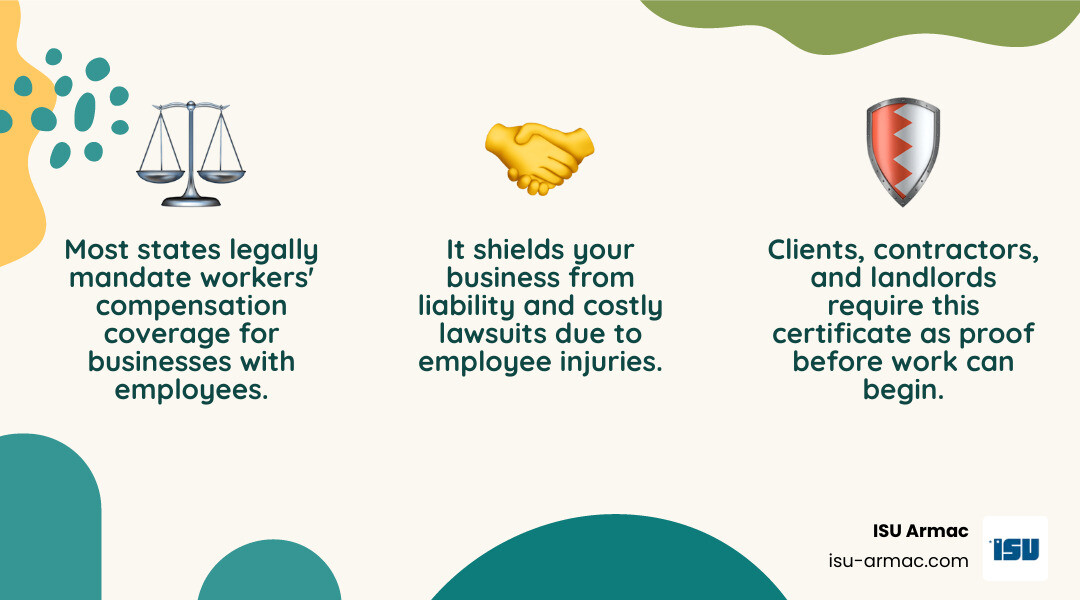
- Required by law in most states for businesses with employees.
- Needed for contracts – clients, general contractors, and landlords request it before work begins.
- Contains key details: policyholder name, insurer, policy number, coverage dates, and certificate holder.
In most states, businesses with at least one employee must carry workers’ compensation insurance. The certificate proves compliance. Without it, you risk fines, lost contracts, or personal liability for employee injuries.
This certificate also protects your business from liability. When hiring subcontractors, you need their certificates to avoid being charged for their payroll or held responsible for their workers’ injuries. For general contractors, collecting these certificates is a critical risk management step.
I’m Ryan McEachron, CEO of ISU Insurance Services ARMAC Agency in Victorville. For over two decades, I’ve helped Southern California business owners manage their workers compensation insurance certificates. This guide explains what this document is, who needs it, how to get one, and why it’s essential for your business.
Workers compensation insurance certificate word roundup:
- what is workers compensation
- how do i get workers compensation insurance
- who needs workers compensation insurance
What is a Workers’ Compensation Insurance Certificate?
A workers compensation insurance certificate, or Certificate of Insurance (COI), is an official document proving you have workers’ compensation coverage. It’s like an insurance ID card for your business, confirming you have an active policy to protect employees from work-related injuries or illnesses.
A COI is not the actual insurance policy. The policy is the full legal contract with all terms and conditions. The certificate is a concise summary designed to quickly show essential policy facts to a third party. Many certificates use a standard format, like the ACORD form, making them universally recognizable.
This document identifies the policyholder (your business) and the insurer, and includes key details like the policy number and effective dates. When you provide a COI to another party, they become the certificate holder, receiving proof that your business is insured.
The workers compensation insurance certificate is always issued by your insurance provider or their authorized agent, as only they can verify your policy’s existence and terms.
For a clearer picture, you can examine a sample document. While forms vary by state, they contain the same core information. For example, New York provides a Sample Certificate of NYS Workers’ Compensation Insurance Coverage, which shows the typical layout.

Decoding the Information on a Workers Compensation Insurance Certificate
Every workers compensation insurance certificate contains critical information for third-party verification. Understanding these elements ensures your certificate is accurate and meets all requirements.
Here’s a list of key data points on a COI:
- Policyholder Name and Address: Your business’s legal name and address, which must match insurance and requesting entity records (like the CSLB for California contractors).
- Insurer Name and Contact Information: The name and contact details of the company underwriting your policy.
- Policy Number: A unique identifier for your workers’ compensation policy.
- Effective & Expiration Dates: These dates show when your coverage begins and ends, and must cover the required period.
- Coverage Limits: May show limits for Employer’s Liability coverage, which protects you if an employee sues for negligence related to a work injury.
- Description of Operations: A brief description of your business activities or your contractor’s license number, as often required by California’s CSLB.
- Certificate Holder Details: The name and address of the entity requesting the certificate.
- Authorized Signature: A signature from an authorized representative of the insurance agency, confirming the certificate’s validity. A stamp is often acceptable; a typed font signature usually is not.
- Jurisdiction: The state(s) where coverage applies (e.g., “State of California”).
Understanding Special Endorsements: The Waiver of Subrogation
A “Waiver of Subrogation” is a common and important endorsement on a workers compensation insurance certificate. While it sounds like legal jargon, it has a practical purpose in business contracts.
What is a Waiver of Subrogation? Normally, if your insurer pays a claim for an injury caused by a third party, they can sue that party to recover their costs. This is called subrogation. A waiver of subrogation is an endorsement where your insurer gives up this right.
With this waiver, your insurer agrees not to sue a specific third party (the certificate holder) to recover claim costs, even if they were at fault.
Why is it requested? General contractors and clients often require this endorsement to minimize their liability. If your employee is injured on their job site, your insurer cannot sue them for recovery. This gives the requesting party an added layer of protection and is a common contractual requirement in construction.
Obtaining a waiver of subrogation requires an endorsement to your policy and may increase your premium. However, it’s often a non-negotiable requirement for securing certain contracts in Southern California.
Who Needs a Certificate and Why Is It Crucial?
Who needs a workers compensation insurance certificate? The answer involves legal mandates, business necessity, and risk management. If you have employees in Southern California, you almost certainly need one to avoid liability and secure contracts.
Workers’ compensation insurance is required in California if you have employees. The certificate is your proof of compliance. Beyond the law, it’s a cornerstone of responsible business practice, protecting your assets from employee injury claims and showing clients and partners that you operate professionally. For more details, you can explore who needs workers compensation insurance.
Requirements for Employers and Business Owners
For most California employers, a workers compensation insurance certificate is non-negotiable.
- State Laws and Employee Count Thresholds: In California, you are legally required to carry workers’ compensation insurance if you have one or more employees (full-time, part-time, or seasonal). The certificate proves compliance.
- Sole Proprietors and Owner Coverage Options: While sole proprietors with no employees often don’t need to cover themselves, California has specific rules for high-risk professions (e.g., roofing, tree service, HVAC). In these fields, sole proprietors must have workers’ comp even without employees. Clients may also request a certificate covering the owner, or an owner might choose coverage for personal protection.
- Protecting Business Assets: Workers’ comp protects your business. Without it, you could be personally liable for an injured employee’s medical bills, lost wages, and potential lawsuits.
- Consequences of Non-Compliance: Failing to carry required insurance in California can lead to severe penalties, including large fines, stop-work orders, and even criminal charges.
The Subcontractor’s Guide to Providing a Certificate
For subcontractors in Southern California, a workers compensation insurance certificate is often a prerequisite for getting work.
- General Contractor Requirements: General contractors (GCs) require subcontractors to provide proof of workers’ comp. If your employee is injured on their site and you’re uninsured, the GC’s policy could be held responsible, increasing their premiums and liability. Your certificate protects the GC.
- Bidding on Jobs: Many bid packages require a current workers compensation insurance certificate to be considered for a project, meaning you’ll miss opportunities without one.
- Proving Coverage & Avoiding Payroll Inclusion: Without a valid certificate, a GC may be forced to include your workers on their policy, increasing their premium costs. Your certificate establishes your independent status and that you carry your own coverage.
- Independent Contractor Status: Having your own workers’ comp policy reinforces your status as an independent contractor for tax and liability purposes. Learn more in our guide on California Workers Compensation.
Legal Mandates vs. Contractual Obligations
The need for a workers compensation insurance certificate comes from two sources: legal mandates and contractual obligations. Understanding the difference is important for Southern California businesses.
- Legal Mandates: In California, workers’ comp is required by law for businesses with employees. High-risk industries like construction face even stricter rules. The California Contractors State License Board (CSLB), for example, has specific California contractor requirements. It’s always wise to understand the general landscape of workers’ compensation laws in your state.
- Contractual Obligations: Even if not legally required (e.g., you’re a sole proprietor in a low-risk field), a client or GC might demand a workers compensation insurance certificate as part of your contract. These requirements protect the requesting party from liability. To get the contract, you must meet their insurance demands, which often includes providing a COI. A missing or incorrect certificate can cause delays or lost business for our clients in Apple Valley, Victorville, and Hesperia.
The A-to-Z Guide to Getting Your Certificate
Getting your workers compensation insurance certificate is a straightforward process once your policy is active. We make it simple for our Southern California clients.

Many insurers offer online portals where you can generate and manage your COIs quickly, often with 24/7 availability.
Step 1: Securing Workers’ Compensation Insurance
Before getting a workers compensation insurance certificate, you must have a policy. This is the foundational step.
- Choosing a Carrier: California’s workers’ comp market is primarily private. As an independent agency, ISU Armac shops multiple carriers to find the best coverage and rates for your business in Oak Hills or anywhere in Southern California.
- Payroll Information: Insurers need detailed payroll and job classifications for all employees to determine risk.
- Business Classification Codes: The Workers’ Compensation Insurance Rating Bureau of California (WCIRB) assigns a classification code to every job role, which is crucial for setting your premium.
- Getting a Quote: To estimate your costs, you’ll need to how do i get workers compensation insurance. This involves providing your business details, employee count, payroll, and industry.
Step 2: How to Obtain Your Workers Compensation Insurance Certificate
Once your policy is active, getting your certificate is quick and easy.
- Request from Insurer: Simply ask your insurance provider or agent. We handle these requests daily for our clients.
- Online Portal Access: Many insurers offer online portals for policyholders to generate certificates instantly, day or night.
- No Additional Cost: Generating a standard workers compensation insurance certificate is typically free for active policyholders.
- Adding a Certificate Holder: You’ll need to provide the name and address of the entity requiring proof of insurance (the certificate holder) so their information is correctly listed.
- Instant Generation: Online tools often allow you to generate a certificate in minutes, which is invaluable when facing a project deadline.
Step 3: Verifying a Certificate’s Validity
Receiving a workers compensation insurance certificate isn’t enough; you must also verify its validity. Both the policyholder and certificate holder should know how to confirm its authenticity.
- Checking Dates: Double-check the effective and expiration dates to ensure coverage is active for the required period.
- Contacting the Insurer: The most reliable method is to contact the insurance company directly using the information on the certificate to confirm the policy is active.
- Online Verification Tools: Some state boards offer online verification. The link to OhioBWC – Service: Certificate of coverage reprints is an example. In California, the CSLB provides tools for verifying contractor’s insurance.
- Ensuring Policy is Active: A certificate is worthless if the policy has lapsed due to non-payment.
- Preventing Fraud: Fraudulent certificates exist. Using official verification methods protects your business from legal and financial trouble.
The Policy Behind the Paper: Costs, Coverage, and Claims
The workers compensation insurance certificate is the proof, but the policy provides the protection. Understanding your policy’s costs, coverage, and claims process is essential for any Southern California business owner.
A certificate is a snapshot; the policy is the safety net. It provides benefits to injured employees while protecting the employer from financial liability and lawsuits. This dual benefit is why understanding how does workers comp work is vital for employers.
How Much Does Workers’ Compensation Insurance Cost?
The cost of workers’ compensation insurance varies. It’s influenced by several factors, which is why ISU Armac works to find you the most competitive rates. For a deeper dive, check out how much does workers compensation insurance cost.
Key factors influencing your premium include:
- Payroll Size: The biggest driver. Premiums are calculated as a rate per $100 of payroll. Higher payroll generally means a higher premium.
- Industry Risk: Riskier industries like construction have higher rates than office work. This is determined by WCIRB classification codes.
- Claims History (Experience Modifier): Your claims history impacts your rates. A good safety record can earn a credit (lower premium), while frequent claims can result in a debit (higher premium).
- State Rates: Each state regulates its own rates. In California, the WCIRB analyzes claims data to recommend rates to the Department of Insurance.
While some low-risk businesses might find policies starting as low as $14/month, these are outliers. Most Southern California businesses, especially in the trades, will have higher costs reflecting their risks.
What Does a Workers’ Comp Policy Cover?
A workers’ compensation policy covers a wide range of expenses and benefits for employees with a work-related injury or illness. Understanding what does workers compensation insurance cover is paramount.
Typically, a policy covers:
- Medical Expenses: Doctor visits, hospital stays, prescriptions, and physical therapy.
- Lost Wages (Temporary Disability Benefits): A percentage of lost income if an employee cannot work during recovery.
- Rehabilitation: Vocational rehabilitation to help injured employees return to work.
- Disability Benefits: Compensation for permanent injuries that impact earning capacity.
- Death Benefits: Funeral expenses and financial support for an employee’s dependents.
- Employer’s Liability: Protects the employer if sued for negligence related to the injury.
It’s important to distinguish workers’ compensation from other types of insurance:
| Feature | Workers’ Compensation Insurance | Health Insurance | Disability Insurance |
|---|---|---|---|
| Purpose | Work-related injuries/illnesses | Non-work-related medical care | Lost income from non-work-related illness/injury |
| Who Pays Premium | Employer | Employer, employee, or both | Employer, employee, or both |
| Mandatory? | Yes, for most businesses with employees in CA | Often optional, or tied to employment | Typically optional |
| Covers Medical Bills? | Yes, for work-related conditions | Yes, for general medical conditions | No, focuses on income replacement |
| Covers Lost Wages? | Yes, for work-related conditions | No | Yes, for non-work-related conditions |
| Benefit Payer | Workers’ comp insurer | Health insurer | Disability insurer |
The Basics of Filing a Claim
When an employee has a work-related injury, the claim must be filed promptly and correctly.
- Reporting the Injury: The employee should report the injury to their employer immediately (within 30 days in California, but sooner is better).
- Employer’s Report of Injury: The employer must complete an “Employer’s Report of Occupational Injury or Illness” (Form 5020 in California) and submit it to their insurer and the DWC.
- Notifying the Insurer: Notify your insurer as soon as possible, ideally within 24-48 hours.
- Medical Treatment: The employee receives medical care, often from a doctor in the employer’s medical provider network (MPN).
- Claim Processing: The insurer reviews the claim and, if approved, begins paying benefits according to California law.
- DWC Oversight: The DWC (Division of Workers’ Compensation) in California oversees the system to ensure compliance and that workers receive benefits.
Conclusion
The workers compensation insurance certificate is a vital tool for any Southern California business. It ensures legal compliance, protects assets, secures contracts, and builds client trust. A properly managed certificate opens doors and prevents headaches for our clients in Victorville, Hesperia, and beyond.
Understanding the certificate, who needs it, how to get it, and the policy behind it means you’re proactively safeguarding your business’s future.
At ISU Armac, we specialize in navigating the complexities of workers’ compensation insurance. We help you understand your needs, find the right coverage from multiple carriers, and ensure you always have the proof of protection you need.
Don’t let uncertainty put your business at risk. Get your comprehensive workers’ compensation insurance quote today and secure the peace of mind that comes with being properly insured.