
Why Landowner Liability Insurance Is Essential for Property Owners
Landowner liability insurance protects property owners from costly lawsuits when someone gets injured or their property is damaged on your land. Whether you own vacant land, farmland, woodland, or hunting property, this specialized coverage fills critical gaps that standard homeowners insurance doesn’t address.
Key facts about landowner liability insurance:
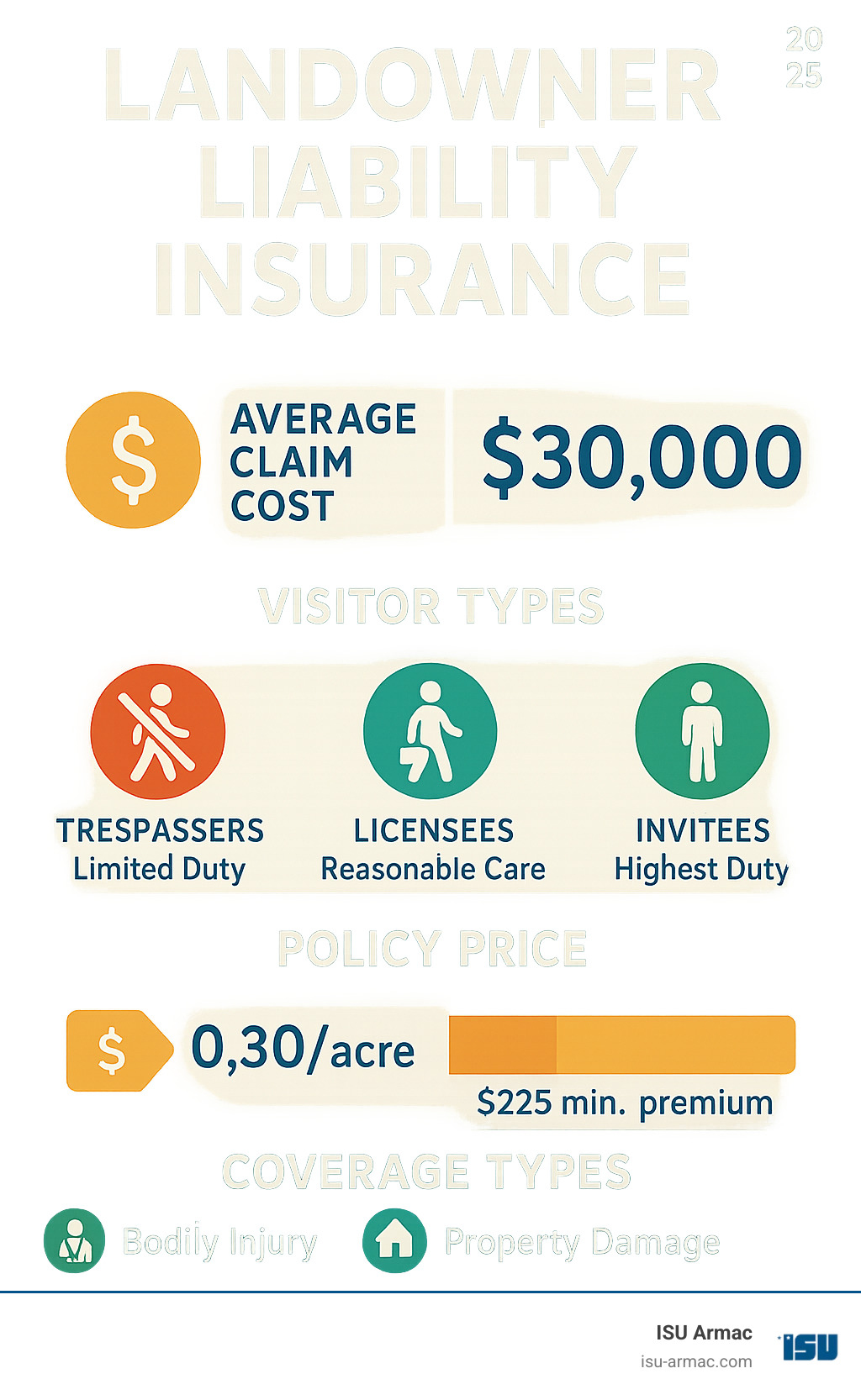
- Average claim cost: $30,000 per incident
- Total annual losses: Over $1.3 billion from 37,000+ premises liability claims in 2020
- Typical coverage: $1 million per occurrence, $2 million aggregate
- Cost: As low as $0.30 per acre with $225 minimum premium
- Who’s covered: Protects against claims from trespassers, guests, and hunters
- What triggers coverage: Slip-and-fall accidents, hunting injuries, ATV collisions, fire damage
The reality is stark: a single personal injury lawsuit can cost six or seven figures, especially when ongoing medical care is needed. Even if you’re not found liable, legal defense costs alone can devastate your finances.
As someone who injures themselves while on your land, you may be held liable – even if it’s not your fault. This includes situations where the injured party was trespassing or you weren’t negligent. The average premises liability claim costs $30,000, but severe injuries can result in settlements reaching hundreds of thousands of dollars.
I’m Ryan McEachron, CEO of ISU Insurance Services ARMAC Agency, and I’ve helped countless Victorville-area property owners secure proper landowner liability insurance coverage over my decades in the insurance industry.
What Is Landowner Liability Insurance?
Landowner liability insurance is your financial shield against unexpected lawsuits. When someone gets hurt on your property – whether it’s a twisted ankle on your hiking trail or a serious hunting accident – this specialized coverage protects you from potentially devastating legal costs.
This insurance addresses your “duty of care” – the legal responsibility you have to keep visitors reasonably safe and warn them about known dangers on your land. The coverage focuses on protecting you from third-party claims for bodily injury and property damage that happen on vacant land, private roads, active farmland, dense woodland, and recreational areas.
Landowner liability insurance vs. homeowners and umbrella policies
Many property owners mistakenly assume their homeowners policy or umbrella coverage protects them for everything. That’s a costly mistake that can leave massive coverage gaps in your protection.
Your standard homeowners policy typically excludes liability for vacant land entirely. And that umbrella policy? It only kicks in if there’s already underlying coverage in place – which there often isn’t for vacant or remote land.
| Coverage Type | Homeowners Policy | Umbrella Policy | Landowner Liability |
|---|---|---|---|
| Vacant land coverage | Usually excluded | Only if underlying coverage exists | Specifically designed for vacant land |
| Remote property | Limited or excluded | Follows underlying policy exclusions | Covers remote parcels |
| Hunting activities | Often excluded | May exclude high-risk activities | Includes hunting-specific coverage |
| Trespasser claims | Very limited | Follows underlying policy | Broader trespasser protection |
| Private roads | May be excluded | Depends on underlying coverage | Specifically covers private roads |
Legal foundations that make landowner liability insurance essential
The legal world divides visitors to your property into three categories with different responsibilities for each.
Invitees get the highest protection under premises liability law. These are people you’ve invited onto your property, especially those who benefit you somehow – like hunters who pay for access. For these visitors, you have the highest duty of care.
Licensees are your social guests – friends who come over to fish in your pond or family members exploring your woodland. You don’t have to inspect every inch for them, but you do need to warn them about dangers you know about.
Trespassers traditionally received the least protection, but even here, the law has evolved. You can’t set traps or intentionally harm someone, even if they’re on your land illegally. The attractive nuisance doctrine creates special responsibilities when children might be drawn to dangerous features on your property.
Recreational use statutes exist nationwide to encourage landowners to open their property for outdoor activities. These laws limit your liability, but they’re not bulletproof protection. If you charge fees, act negligently, or fail to warn about known dangers, you could still face significant liability.
Risks Landowners Face: Why Coverage Matters

Owning land comes with more risks than most people realize. Industry data reveals over 37,000 premises liability claims result in $1.3 billion in losses annually. That’s an average of over $35,000 per claim, and many individual cases reach six or seven figures.
Trip and fall accidents happen more often than you’d think. Uneven terrain, hidden holes, or overgrown paths can send visitors tumbling. Hunting accidents involving firearms, tree stands, or ATVs create serious liability exposure. ATV collisions on private roads or trails can result in severe injuries and property damage. Fire damage from campfires or equipment can spread to neighboring properties, creating massive financial liability.
The Latest public rights-of-way guidance makes clear that landowners maintain significant responsibilities even when public access is involved.
Real-world claim examples and cost breakdowns
A visitor walking on a private road tripped on uneven pavement, breaking their ankle in multiple places. What seemed like a minor maintenance issue became a $30,000 settlement covering medical expenses, lost wages, and pain and suffering.
The stakes get much higher with severe injuries. A hunter fell from a poorly maintained tree stand, suffering spinal injuries that required ongoing medical care. The landowner faced a $500,000 judgment for failing to inspect and maintain the structure properly.
Even trespassers can create liability. A child exploring vacant land fell into an unmarked well, requiring emergency rescue and extensive medical treatment. Despite “No Trespassing” signs, the attractive nuisance doctrine resulted in a $150,000 settlement.
Fire-related claims often produce the largest losses. A campfire on hunting land spread to neighboring properties, destroying structures and requiring expensive firefighting efforts. The total damage reached $2.1 million.
Visitor classifications and your duty of care
Trespasser duty is the most limited, but you still cannot willfully injure people or create hidden traps. Children receive special protection under the attractive nuisance doctrine.
Licensee duty applies to social guests and unpaid visitors. You must warn them about known hazards, but you’re not required to inspect for hidden dangers.
Invitee duty creates the highest level of legal protection and the greatest liability exposure for you. Paying hunters and others who provide you some benefit receive maximum care under the law. You must actively inspect for hazards and make the property reasonably safe.
Any paid access situation typically lifts visitors to invitee status, requiring maximum care and creating the highest liability risk.
Key Coverages, Exclusions, and Costs of Landowner Liability Insurance
When you’re shopping for landowner liability insurance, you’ll typically find policies offering $1 million per occurrence and $2 million aggregate coverage limits. Defense costs are covered in addition to your policy limits, which means legal fees don’t eat into your coverage amount.
Most policies include medical payments coverage, fire legal liability protection, and allow you to add additional insureds. Most policies come with a zero deductible, meaning coverage kicks in immediately when you need it. For More info about Land Liability Insurance Coverage, our team at ISU Armac can walk you through the specific options that make sense for your property.
What landowner liability insurance covers
The heart of landowner liability insurance is bodily injury protection. This covers everything from a twisted ankle to catastrophic injuries requiring lifelong care. When someone gets hurt on your property, you’re protected against medical expenses, lost wages, pain and suffering claims, and rehabilitation costs.
Property damage coverage steps in when your land causes damage to someone else’s belongings. Picture a dead tree falling onto a neighbor’s car during a storm, or a fire starting on your land and spreading to adjacent properties.
The policy extends to guest injuries with full protection and even trespasser claims receive coverage, though with some limitations. Legal fees and defense costs are typically covered above and beyond your policy limits, and the policy handles judgment and settlement payouts up to your limits.
Common exclusions you need to know
Commercial operations typically require separate business liability policies. Environmental pollution claims usually need specialized coverage. Intentional acts are always excluded – coverage only applies to accidents and negligent acts. Structures under construction may need builders risk coverage, and product liability for items you manufacture or sell requires separate coverage.
How much does landowner liability insurance cost?

One of the most pleasant surprises about landowner liability insurance is how affordable it really is. The standard pricing of $0.30 per acre with a $225 minimum makes comprehensive protection accessible whether you own 10 acres or 1,000 acres.
Acreage size drives your base premium, but larger properties benefit from economies of scale. A 100-acre property might cost $300 annually, while 500 acres typically runs around $575, and 1,000 acres often costs about $1,025 per year.
Location factors, intensity of recreational use, and your claims history all affect pricing. Some insurers offer deductible options to reduce premiums, though many policies feature zero deductibles.
Special Situations: Hunting, Vacant Land, and Public Access
Different types of land use create unique liability challenges. Hunting lease operations present some of the highest liability exposures since paying hunters become invitees under the law – which means you owe them the highest duty of care. Add firearms, ATVs, and tree stands to the mix, and you’re looking at serious potential for costly accidents.
Vacant land might seem safer, but it creates its own problems. Empty lots can attract trespassers, especially curious kids who might stumble into hidden dangers. Properties with public easements or rights-of-way add another layer of complexity since you’re dealing with people you didn’t invite and can’t control.
Scientific research on recreational land risks confirms that hunting-related activities generate far more liability claims than other land uses.
Hunting landowner liability insurance essentials
If you lease hunting rights on your property, specialized landowner liability insurance becomes absolutely critical. The per-acre pricing structure makes coverage affordable even for large hunting properties.
Guest waivers are important, but don’t make the mistake of thinking they’re bulletproof protection. Courts regularly find ways around waivers, especially when gross negligence is involved.
Fire legal liability coverage deserves special attention on hunting properties. Between campfires, cooking equipment, and vehicle exhaust, there are countless ways a fire can start and spread to neighboring properties.
Vacant land and remote parcels
Vacant land coverage has specific requirements. The “no structures rule” means your land must be truly vacant – even small buildings like sheds might disqualify you from vacant land rates.
Many lenders require liability coverage for mortgaged vacant land, making landowner liability insurance a financing requirement. Remote response times can complicate emergencies and claims, and wildfire risk is particularly concerning for remote vacant land.
For More info about Vacant Land Insurance, our team can walk you through the specific requirements for your situation.
Managing liability on land with public rights of way
When public trails or easements cross your property, proper signage becomes crucial for limiting liability exposure. Keeping maintenance logs provides important evidence that you’re taking reasonable care of public areas.
Hazard removal takes on greater importance when public access is involved. Indemnity agreements with government entities can sometimes help shift liability for public access areas back to the appropriate agency.
Risk Management Beyond Insurance
Think of landowner liability insurance as your financial safety net, but smart property management is your first line of defense. The best claims are the ones that never happen.
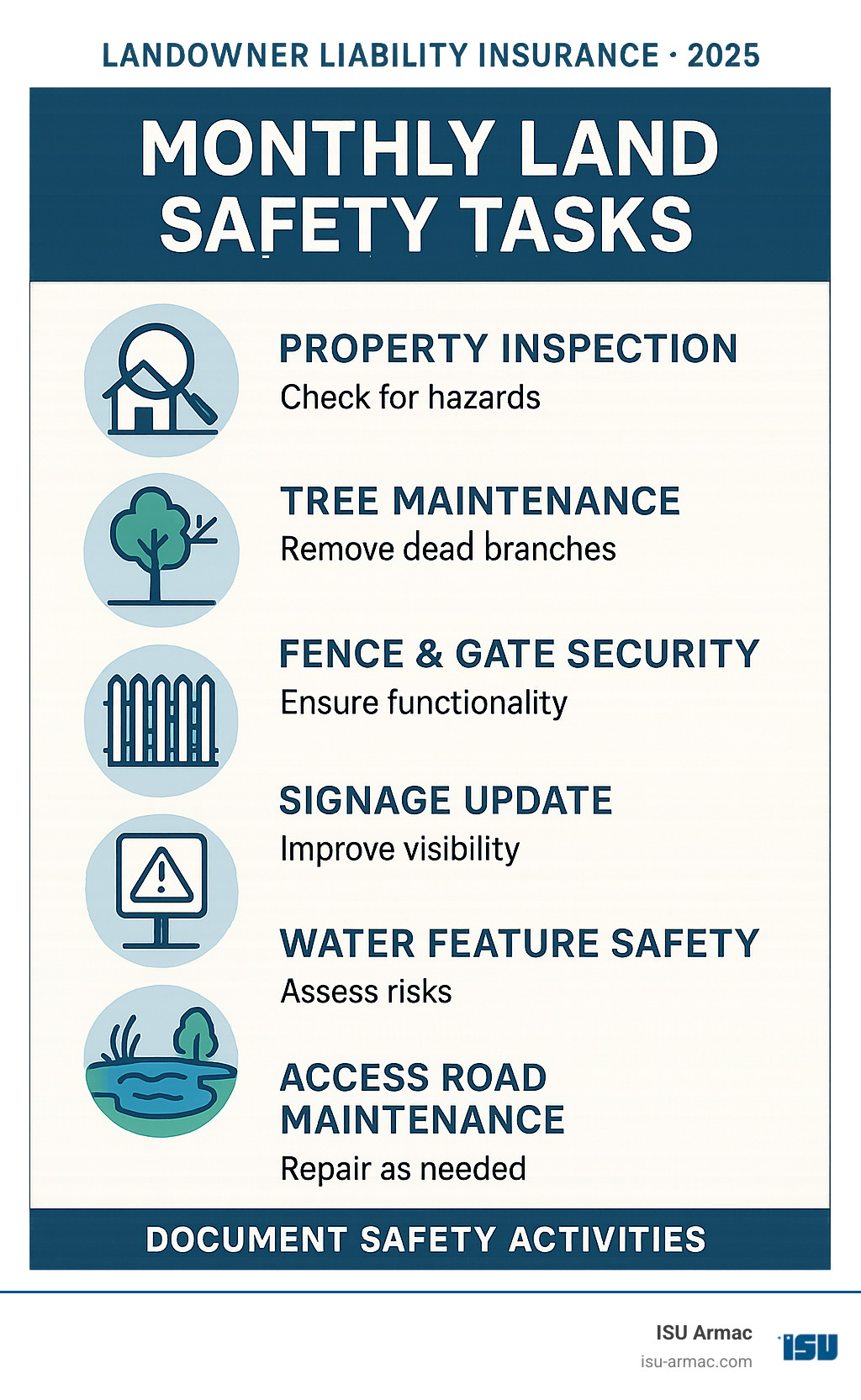
Property inspections don’t need to be complicated – just a systematic look at your land with safety in mind. Hazard removal is almost always cheaper than paying a claim. That dead oak tree leaning toward your private road might cost $500 to remove professionally, but if it falls on someone’s vehicle, you’re looking at thousands in damages plus potential injury claims.
Warning signs serve a dual purpose – they help keep people safe and demonstrate that you’ve met your legal duty to warn about known hazards. Security cameras not only deter trespassing but provide valuable evidence if a claim does occur.
For properties where you invite guests, guest waivers and safety briefings add another layer of protection. Lease agreements should include comprehensive insurance requirements and indemnity clauses.
Practical steps to lower your premium and claims odds
Start with a thorough risk assessment of your property. Documentation becomes your best friend in liability situations – keep records of your safety inspections, hazard removal, and property improvements.
Consider combining policies with one carrier whenever possible. Many clients save money by bundling their landowner liability coverage with their auto, home, or business insurance.
Installing fencing around high-risk areas like ponds, wells, or equipment storage creates a physical barrier that prevents accidents. Finally, engage professionals for high-risk work like tree removal or construction. Professional contractors carry their own insurance and have the expertise to work safely.
Frequently Asked Questions About Landowner Liability Insurance
Does landowner liability insurance cover trespassers?
Landowner liability insurance does provide coverage for trespasser claims, though the protection works differently than coverage for invited guests.
You have a limited duty to trespassers. While you’re not required to inspect your property for hazards or make it safe for uninvited visitors, you still cannot willfully injure someone or create hidden traps.
The willful misconduct exclusion is important – your coverage won’t protect you if you intentionally harm trespassers, but accidental injuries from existing conditions are typically covered. The attractive nuisance doctrine creates special considerations when children are involved, as that old well or swimming pond might create liability even for trespassing children.
Is landowner liability insurance legally required?
Landowner liability insurance isn’t legally mandated like auto insurance. State regulations generally don’t require private landowners to carry liability coverage.
However, lender mandates are extremely common. If you have a mortgage on your property, your bank almost certainly requires liability coverage to protect their investment.
While coverage is optional but critical from a legal standpoint, it’s practically essential from a financial one. A single lawsuit can wipe out decades of savings and put your other assets at risk.
How do I get a quote and what information will I need?
Getting a landowner liability insurance quote is straightforward when you come prepared with the right information.
Your parcel location is the starting point. Acreage is crucial since most policies price coverage on a per-acre basis. Land use details make a big difference in both pricing and coverage options. Your prior claims history matters too, and you should think about your desired limits – I typically recommend $1 million per occurrence and $2 million aggregate as a starting point.
The whole process usually takes just a few minutes once we have this information.
Conclusion
When you own land, you’re not just investing in property – you’re taking on significant financial responsibility. Landowner liability insurance transforms what could be a devastating lawsuit into a manageable situation, protecting both your assets and your peace of mind.
The numbers tell the story clearly. With average claims hitting $30,000 and severe injury cases reaching six or seven figures, going without coverage is essentially gambling with your financial future. Meanwhile, the cost of protection often runs just $0.30 per acre with a $225 minimum premium. That’s less than most people spend on coffee in a month, yet it protects against potentially life-changing financial losses.
What makes landowner liability insurance particularly valuable is its comprehensive approach to protection. Whether you’re dealing with a trespasser who gets injured, a paying hunter who falls from a tree stand, or a fire that spreads to neighboring property, this coverage steps in to handle both the legal defense and any settlements or judgments.
The peace of mind factor cannot be overstated. When you know you’re properly protected, you can actually enjoy your property instead of constantly worrying about potential liability. You can welcome hunters, allow family gatherings, or simply maintain your land without the nagging fear that one accident could wipe out your savings.
At ISU Armac, we’ve seen too many property owners learn about liability risks the hard way. That’s why we work with multiple carriers to find you the best landowner liability insurance coverage at competitive rates. Our team understands the unique challenges facing property owners throughout the High Desert region, from Victorville to Apple Valley and beyond.
The specialized coverage available through More info about Liability Insurance on Vacant Land addresses the specific risks that standard homeowners policies simply don’t cover. Whether you own hunting land, vacant lots, or remote parcels, we can help you secure appropriate protection.
Don’t wait until you’re facing a lawsuit to find the gaps in your coverage. Contact our experienced team today for a comprehensive quote custom to your specific property and situation. We’ll help you understand your risks, explore your options, and secure the protection you need to truly enjoy your land ownership experience.
Your property should be a source of pride and enjoyment, not anxiety about potential liability. With proper landowner liability insurance in place, you can focus on what matters most – making the most of your land investment while keeping your financial future secure.