
Why Insurance is Your Most Important Tool
Independent contractor insurance is essential protection for self-employed professionals against financial ruin from accidents, mistakes, or lawsuits. Unlike employees covered by their employer, contractors must secure their own policies to protect their business.
Key Types of Independent Contractor Insurance:
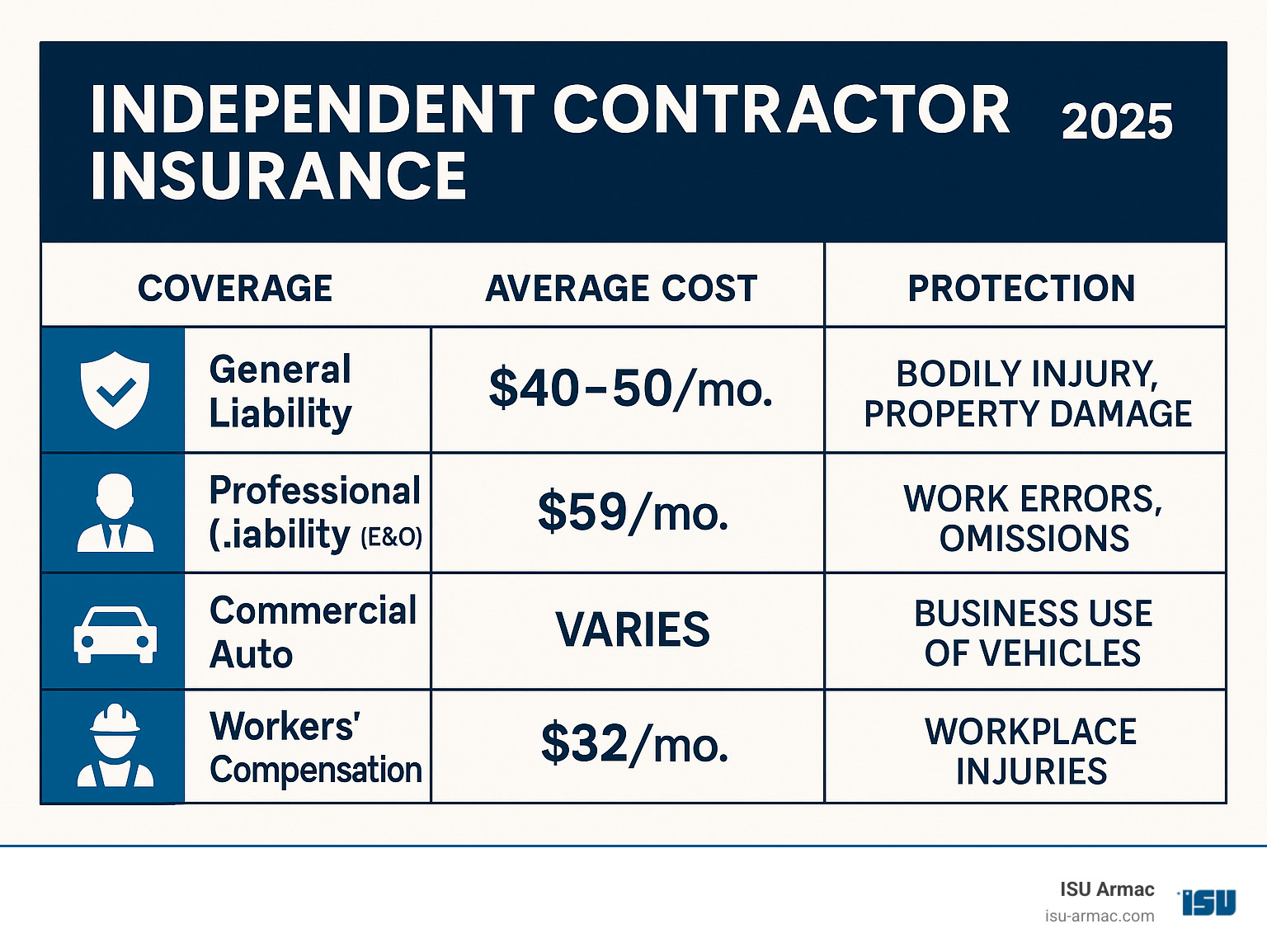
- General Liability – Covers bodily injury and property damage claims ($40-50/month average)
- Professional Liability (E&O) – Protects against work errors and omissions ($59/month average)
- Commercial Auto – Required when using vehicles for business purposes
- Workers’ Compensation – May be required even for solo contractors ($32/month average in some states)
- Tools & Equipment – Protects valuable work equipment from theft or damage
The stakes are high for uninsured contractors. Small businesses pay $35.6 billion out of pocket annually to settle claims, with an average slip-and-fall costing $20,000. Many clients now require proof of insurance, making coverage essential for both protection and winning jobs.
For any contractor, from HVAC technicians to plumbers, insurance is a financial safety net. It covers legal fees, settlements, and damages that could bankrupt your business. Crucially, it shows professionalism to clients who now see insurance as a basic requirement.
I’m Ryan McEachron, CEO of ISU Insurance Services ARMAC Agency, with over 25 years of experience helping contractors in Southern California secure the right independent contractor insurance coverage. My background with the Victorville City Council and local business organizations gives me deep insight into the insurance challenges facing contractors in our region.
Important independent contractor insurance terms:
- do contractors need insurance
- what does general liability insurance cover for a contractor
- are subcontractors covered under contractors insurance
The Core Types of Independent Contractor Insurance You Need

As a contractor, you manage projects, perform skilled work, and run a business. But the role of risk manager is one you can’t overlook. The right independent contractor insurance isn’t just an expense; it’s the foundation that lets you work confidently. Think of it as safety equipment for your business—essential for operating safely. Let’s review the core coverages you need.
General Liability Insurance: Your First Line of Defense
General Liability insurance is your safety net for everyday accidents. For example, if a client trips over your extension cord and breaks their wrist, or you accidentally damage their hardwood floors while installing a fixture, this policy covers the costs. Without it, these common situations can become expensive problems.
General Liability protects you from three main types of claims. Bodily injury coverage kicks in when someone gets hurt because of your work, covering their medical bills and your legal defense. The average slip-and-fall accident alone can cost around $20,000, money that would come straight from your pocket without insurance.
Property damage protection handles moments when your work accidentally damages a client’s property. Whether it’s a wrench through drywall or scratched flooring, this coverage takes care of repair costs.
The third protection, advertising injury, covers claims like slander or copyright issues in your marketing materials.
A commercial general liability (CGL) insurance policy is crucial for contractors as it handles both lawsuits and legal fees, even for baseless claims. In Florida, this coverage costs about $40-$50 monthly ($400-$600 annually). Considering legal defense alone can cost thousands, it’s a wise investment.
Many clients now require proof of General Liability before they’ll hire you. It’s a mark of professionalism that shows you’re serious about protecting both your business and theirs. For more details, check out What Does General Liability Insurance Cover?.
Professional Liability (Errors & Omissions): Protecting Your Expertise
While General Liability handles physical accidents, Professional Liability insurance—also called Errors & Omissions (E&O)—protects you when your professional advice or services lead to financial losses for your clients.
This coverage is critical for consultants, designers, or IT professionals. It’s also valuable for contractors who provide recommendations or plans as part of their services. For example, an HVAC contractor recommends an undersized system, causing business losses for the client. This is where E&O covers the financial loss claims.
Professional Liability covers several scenarios: Negligence (failing to meet professional standards), errors in work (mistakes causing client losses), omissions (failing to do something required), and missed deadlines that cause financial harm.
The role of an Errors and Omissions (E&O) policy extends beyond valid claims; it also handles legal defense costs for groundless claims. Independent contractors typically pay about $59 monthly for E&O coverage. When reputational harm claims average $50,000, this coverage pays for itself if you ever need it.
The peace of mind is worth the investment, letting you focus on great work instead of potential lawsuits. Learn more about professional liability insurance and how it complements other coverage.
Other Essential Coverages for Contractors
Beyond core liability, your independent contractor insurance program may need specialized coverage.
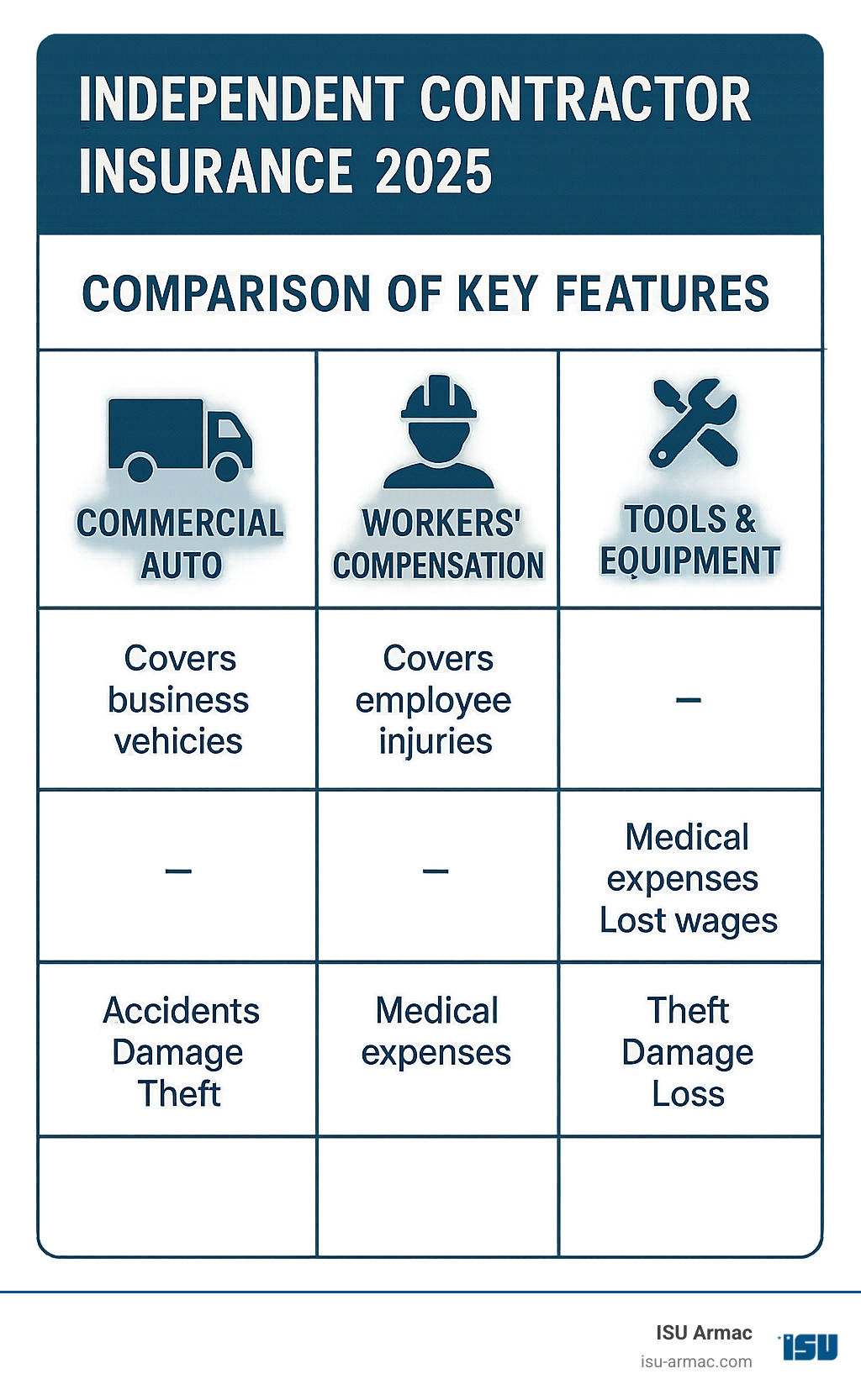
Commercial Auto Insurance is essential if you use a vehicle for business. Your personal auto policy typically excludes business use, leaving you exposed when driving to job sites or hauling tools. Commercial auto provides higher liability limits and the comprehensive protection your business needs.
Workers’ Compensation is often legally required if you have employees, covering their medical costs and lost wages for work-related injuries. Even solo contractors should consider it, as many clients in high-risk industries like construction require it. In Florida, it averages $32 monthly and can be the key to landing a big contract.
Your Tools & Equipment are a major investment at constant risk of theft or damage. Inland Marine insurance protects these valuable assets. This policy can cover both smaller tools and larger equipment, which may require specialized coverage.
Finally, a Business Owner’s Policy (BOP) is a smart choice for contractors with physical offices or significant business property. It bundles General Liability with Commercial Property insurance, often at a lower cost than buying separate policies. A Business Owner’s Policy (BOP) can save money while simplifying your insurance into one comprehensive package.
How to Secure and Pay for Your Coverage

Getting independent contractor insurance doesn’t have to be a puzzle. Once you know what you need, the next step is finding the right policies at a price that fits your budget. With the right approach, you can secure solid protection without overpaying.
Understanding the Cost of Independent Contractor Insurance
Your independent contractor insurance costs are influenced by several key factors that insurers carefully consider.
Industry risk plays the biggest role. An HVAC technician working with electrical systems will pay more than a freelance consultant. Higher-risk jobs mean higher premiums. For example, general liability for a low-risk business might cost $300 to $500 annually, while a high-risk trade like welding could run $1,500 to $2,500.
Your coverage limits and deductibles directly impact your premium. Higher limits or lower deductibles increase the cost. Most contractors opt for standard limits of $1 million per occurrence and $2 million aggregate.
Location matters. Here in Southern California, unique risks like earthquakes and wildfires can affect premiums. Different states have varying regulations and risk profiles that insurers factor into pricing.
Your claims history acts like a report card. A clean record helps keep costs down, while previous claims can signal higher risk and lead to increased premiums.
Basic General Liability coverage typically starts around $450 to $1,000 annually for most contractors. Professional Liability (E&O) insurance usually runs between $500 to $1,000 per year. Your actual costs will depend on your specific situation.
Want to dive deeper? Check our guides on General Liability Insurance Cost and factors influencing cost.
Key Steps to Get Your Independent Contractor Insurance
Securing your independent contractor insurance is a logical process. Here’s how to steer it.
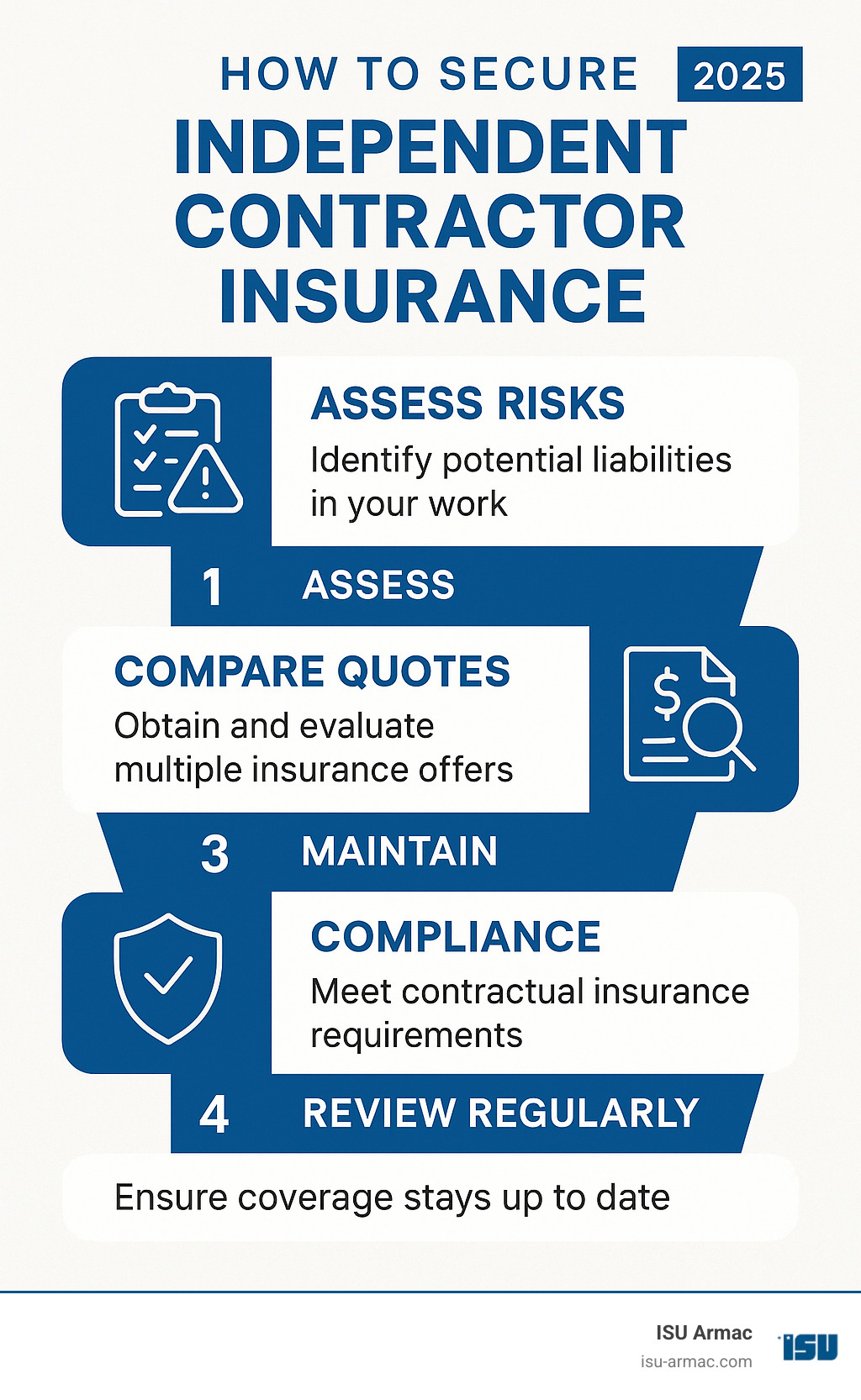
Start by assessing your unique risks. Look at what you do every day. Do you work with dangerous equipment, handle sensitive client data, or drive extensively? Understanding your risks helps you identify the right coverage types and amounts.
Gather your business documents before you start shopping. You’ll need your business registration, licenses, and operational details like annual revenue and services offered. Having this information ready speeds up the quote process.
This is where working with an independent broker really pays off. Instead of calling individual insurance companies, we shop multiple carriers to find you the best coverage at the lowest rates. At ISU Armac, we compare options from various providers to ensure you get a policy customized to your needs and budget.
The value of an experienced broker goes beyond price shopping. We help you understand complex policy language, identify coverage gaps, and guide you through important decisions.
Review your policy details thoroughly before signing. Understand what’s covered, what’s excluded, your limits, and your deductibles. If something is unclear, ask questions. A good broker will explain everything until you’re comfortable.
For more guidance, explore our resource on How to Get Small Business Insurance and learn about working with a trustworthy insurance brokerage firm.
The insurance buying process doesn’t have to be stressful. With the right preparation and guidance, you can secure the protection your business needs.
Managing Risks and Contractual Obligations
As an independent contractor, you’re responsible for all risk management. This includes understanding the consequences of being uninsured and navigating the contractual insurance requirements clients often demand.
The High Cost of Being Uninsured
Too many contractors mistakenly skip independent contractor insurance to save money. This is a gamble with your livelihood, as the potential financial devastation far exceeds any short-term savings.
When disaster strikes an uninsured contractor, financial ruin can follow. You become personally liable for all legal fees, settlements, and judgments. A single serious incident—like a major client injury or significant property damage—can result in six-figure costs that could bankrupt your business and cost you personal assets like your home.
The numbers tell a sobering story. Small businesses collectively pay $35.6 billion out of pocket annually to settle claims because they lacked proper insurance.
Even if you’ve done nothing wrong, legal battles are expensive. An uninsured contractor must cover all legal and court costs personally, often while their business suffers from the distraction.
Being uninsured also limits your earning potential. Many general contractors and clients require proof of independent contractor insurance before hiring you, locking you out of lucrative opportunities. As our research shows, a subcontractor without insurance can face consequences beyond financial risk.
The reputational damage from being unable to cover damages can haunt your business for years. Word travels fast, and a reputation for being uninsured can make it difficult to attract new clients.
Handling “Additional Insured” Requests
The “additional insured” requirement often catches contractors off guard. General contractors or clients frequently request this. Handling these requests professionally is crucial for client relationships and mutual protection.
What exactly does “additional insured” mean? When you add someone as an additional insured, you extend certain coverages—typically your General Liability insurance—to protect them from claims arising from your work. If a third party is injured due to your work and sues both you and the general contractor, your policy would defend both.
This arrangement makes business sense. When you’re a subcontractor, the general contractor wants assurance that if your work causes a problem, their business isn’t left responsible. By requiring you to name them as an additional insured, they ensure your insurance responds first.
Most client requirements for this are reasonable; they’re simply protecting their business interests. Becoming an additional insured explained in more detail shows how this provides defense coverage if the contractor gets sued by a third party over your work.
Adding an additional insured typically doesn’t cause dramatic premium increases. The cost impact is usually minimal, depending on the work’s nature and duration.
When asked, you’ll provide a Certificate of Insurance (COI). This document summarizes your coverage and lists any additional insureds, serving as proof of protection. Having your agent prepare these promptly shows you’re a professional who understands the business side of the industry.
Frequently Asked Questions about Contractor Insurance
Let’s address the questions that keep contractors up at night. After helping thousands of independent contractors, I’ve noticed the same concerns come up repeatedly. Here are the answers you need to make informed decisions about your independent contractor insurance.
Do I need insurance if the general contractor who hired me has it?
This is a dangerous myth. Yes, you absolutely need your own insurance!
Here’s the reality: the general contractor’s policy protects their business, not yours. In fact, independent contractors can be explicitly excluded from the commercial general liability (CGL) insurance policy of the company that hired them. Their insurer isn’t going to pay premiums to cover every subcontractor.
When something goes wrong, their insurance company will look to shift liability onto someone else—namely, you. Without your own coverage, their policy won’t cover your legal defense or any damages you’re liable for, leaving you to pay out-of-pocket.
Having your own independent contractor insurance protects your business, assets, and reputation. It’s what separates professional contractors from amateurs. For a deeper dive, check our guide: Do Independent Contractors Need General Liability Insurance?.
How much liability coverage do I actually need?
The right amount depends on your risk, but here is some practical guidance.
Most independent contractors carry General Liability policies with $1 million per occurrence and a $2 million aggregate limit. This has become the industry standard because it covers most common scenarios without being cost-prohibitive.
Contract minimums often drive this decision. Many clients, especially larger businesses, will require specific coverage amounts. I’ve seen requirements from $500,000 for small projects to $5 million or more for major commercial work. In fact, a minimum of $2 million liability coverage is often required for larger projects.
Your industry’s risk level also matters. An electrician faces different risks than a graphic designer. If a major claim exceeds your policy limits, you’re personally responsible for the difference.
The key is balancing adequate protection with affordability. We can help you assess your risks and recommend appropriate limits. Our guide on Insurance for General Contractors: What You Need to Know provides additional insights.
Does my personal auto insurance cover my work vehicle?
Short answer: Typically no. Your personal auto policy is for everyday activities, not business use.
Personal auto policies include a business use exclusion that can leave you unprotected. If you have an accident while hauling tools or driving to a client meeting, your personal insurer might deny the claim, leaving you responsible for all costs.
Commercial auto insurance addresses these gaps. It provides higher liability limits crucial for business accidents and can protect tools and equipment in your vehicle. It’s designed for business driving, which involves more mileage, different cargo, and frequent travel.
If you use your personal vehicle for any business purpose, you need to address this coverage gap. Sometimes a business use endorsement can be added to a personal policy, but a separate commercial auto policy is often the better solution.
Don’t let this gap put your business at risk. The cost of commercial auto insurance is minimal compared to the financial devastation of an uninsured, business-related accident.
Conclusion: Build Your Business on a Secure Foundation
As an independent contractor, you have the freedom of being your own boss, but also the responsibility to protect what you’ve built. Independent contractor insurance isn’t just an expense; it’s the foundation that lets you operate with confidence, knowing you’re protected from the unexpected.
Throughout this guide, we’ve covered the essential coverage types: General Liability for accidents, Professional Liability (E&O) for your expertise, and specialized policies like Commercial Auto, Workers’ Compensation, and Tools & Equipment coverage for your specific trade.
We’ve also explored how to secure coverage, from understanding cost factors to the importance of working with a trusted broker who can shop multiple carriers for the best rates. The process is manageable with the right guidance.
Most importantly, going without insurance is a gamble you can’t afford. The risks of financial ruin, legal battles, and lost jobs far outweigh any savings. A certificate of insurance demonstrates your professionalism, reliability, and commitment to your craft.
At ISU Armac, we’ve spent over 25 years helping contractors throughout Apple Valley, Victorville, Hesperia, Oak Hills, and the broader Southern California region. We understand the unique challenges you face, from wildfire risks to seismic activity, and we know how to find coverage that fits your needs and budget.
Our approach is simple: we shop multiple carriers to ensure you get the best coverage at the most competitive rates. Our loyalty is to you and finding the right protection for your business.
Don’t leave your hard work vulnerable to a single lawsuit or accident. The peace of mind from proper independent contractor insurance lets you focus on what you do best: delivering exceptional work.
Ready to build your business on a secure foundation? Let us help you protect your craft with the right contractor insurance and secure the future you’re working so hard to create.