
Why Health Insurance Benefits for Employees Are Essential
Health insurance benefits for employees are a critical business decision, serving as a cornerstone for attracting top talent, retaining valuable team members, and ensuring your workforce’s financial security.
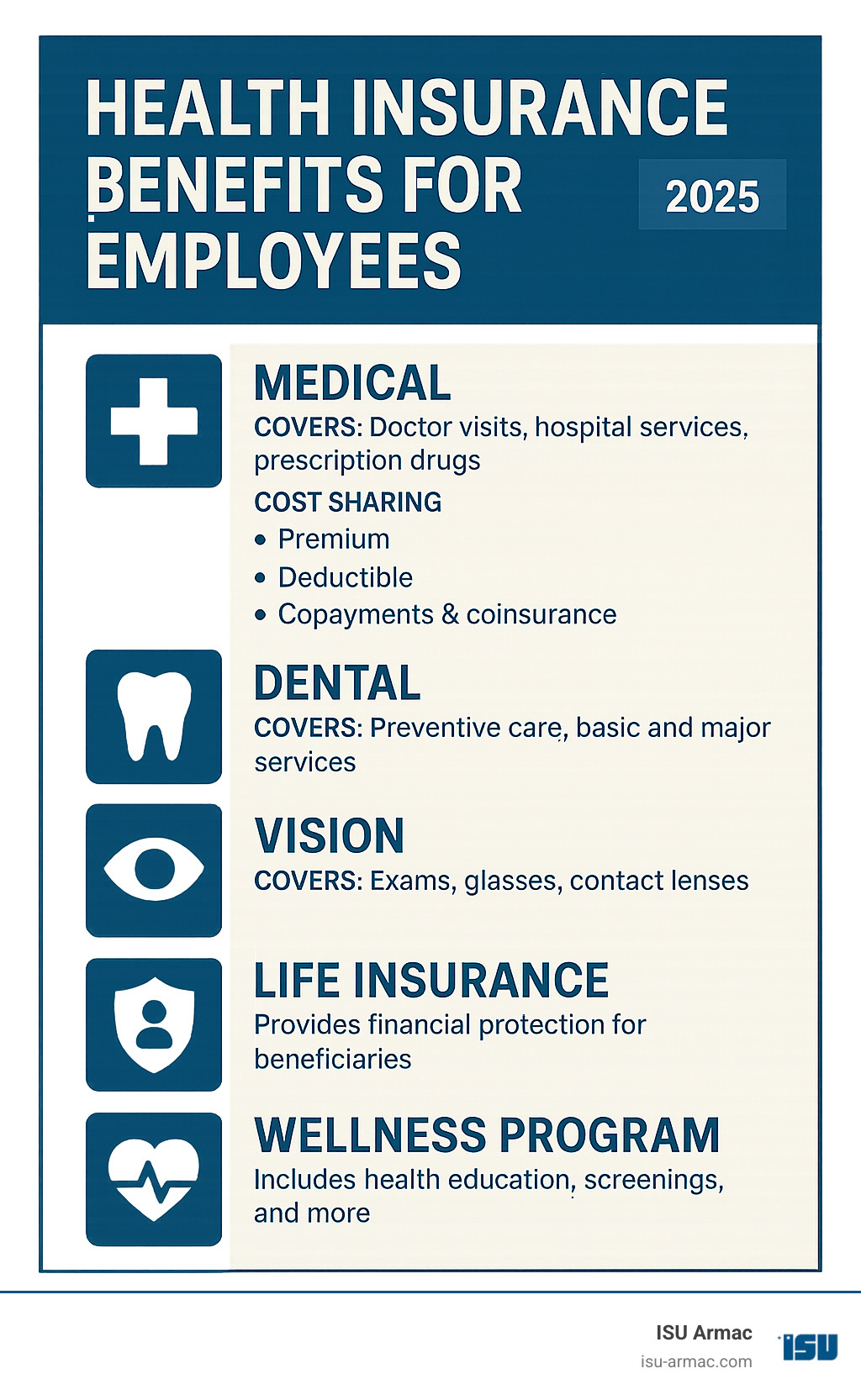
Key Employee Health Benefits Include:
- Medical Insurance – Covers doctor visits, hospital stays, and prescriptions
- Dental Coverage – Preventive care, cleanings, and major procedures
- Vision Insurance – Eye exams, glasses, and contact lenses
- Life Insurance – Financial protection for employees’ families
- Disability Insurance – Income replacement if unable to work
- Wellness Programs – Preventive care and health initiatives
The importance of offering comprehensive health benefits cannot be overstated. Around half of Americans receive their healthcare through their employer, making workplace benefits a vital lifeline. For businesses, these benefits create a competitive advantage in a tight labor market.
Research shows that just under half (49%) of employees would choose health benefits over a raise in pay, highlighting how much workers value quality coverage. Meanwhile, employers who offer robust benefits see returns through improved productivity, reduced absenteeism, and lower turnover.
Presenteeism costs the U.S. economy upwards of $150 billion per year in lost productivity – a figure that demonstrates why investing in employee health is a sound business decision.
As Ryan McEachron, CEO of ISU Insurance Services ARMAC Agency in Victorville, I’ve helped countless Southern California businesses steer the complex world of health insurance benefits for employees. My experience has shown me how the right benefits package can transform both businesses and the lives of their employees.
Handy health insurance benefits for employees terms:
- employee healthcare plans
- employee benefits insurance
- employee life insurance benefits
Why Employee Health Benefits Matter

Offering health insurance benefits for employees is more than a perk; it’s a strategic choice that benefits both businesses and their teams. It creates a win-win situation, fostering a workplace where everyone feels secure, valued, and productive.
For Employers: A Strategic Investment
For employers, offering great health insurance benefits for employees is a smart business move for several reasons:
First, it helps attract top talent. In a competitive job market, a strong benefits package can be a deciding factor for skilled candidates. Health insurance is often the most important benefit to job seekers, and quality coverage shows you care about your team’s well-being.
Second, it boosts employee retention. When team members feel secure about their healthcare, they are more likely to stay long-term. Nearly half of employees would even pick health benefits over a pay raise, demonstrating the value they place on this peace of mind.
Third, it leads to improved morale and productivity. A healthy team is a productive team. When employees have easy access to healthcare, they can address health issues promptly, leading to better overall health, more energy, and a more engaged workforce.
Fourth, it reduces absenteeism and presenteeism. Employees with good health benefits are more likely to get preventive care and treat illnesses early, meaning fewer sick days. They are also less likely to come to work sick but unable to focus (presenteeism). This “presenteeism” costs the U.S. economy upwards of $150 billion per year in lost productivity. Investing in health benefits helps avoid this hidden cost.
Finally, there are significant tax advantages. Employer contributions to health insurance premiums are typically a tax-deductible business expense. For employees, their portion of the cost is often taken out pre-tax, lowering their taxable income.
Offering strong Employee Benefits sends a clear message: “We value you and support your future.”
For Employees: Essential Financial Protection
For employees, health insurance benefits for employees are essential for financial security and well-being.
It provides affordable access to healthcare. Group health plans offer access to doctors and hospitals at a lower cost than individual plans because the risk is shared across a larger group. This cost-sharing makes essential care more affordable.
This also means lower out-of-pocket costs. Employer-sponsored plans usually involve the employer paying a significant portion of the monthly premium, making healthcare more manageable for employees.
Employees also benefit from pre-tax contributions. Their share of the premiums is often paid with pre-tax dollars, reducing their income tax liability.
Many plans include coverage for family members, allowing employees to add spouses and children. This offers vital financial protection for the entire family.
Finally, most plans cover preventive care like annual check-ups, vaccinations, and screenings at no extra cost. This encourages employees to stay on top of their health and catch potential issues early.
Quality Health Insurance gives employees peace of mind, knowing they are protected from unexpected medical costs.
Decoding Common Health Insurance Plans

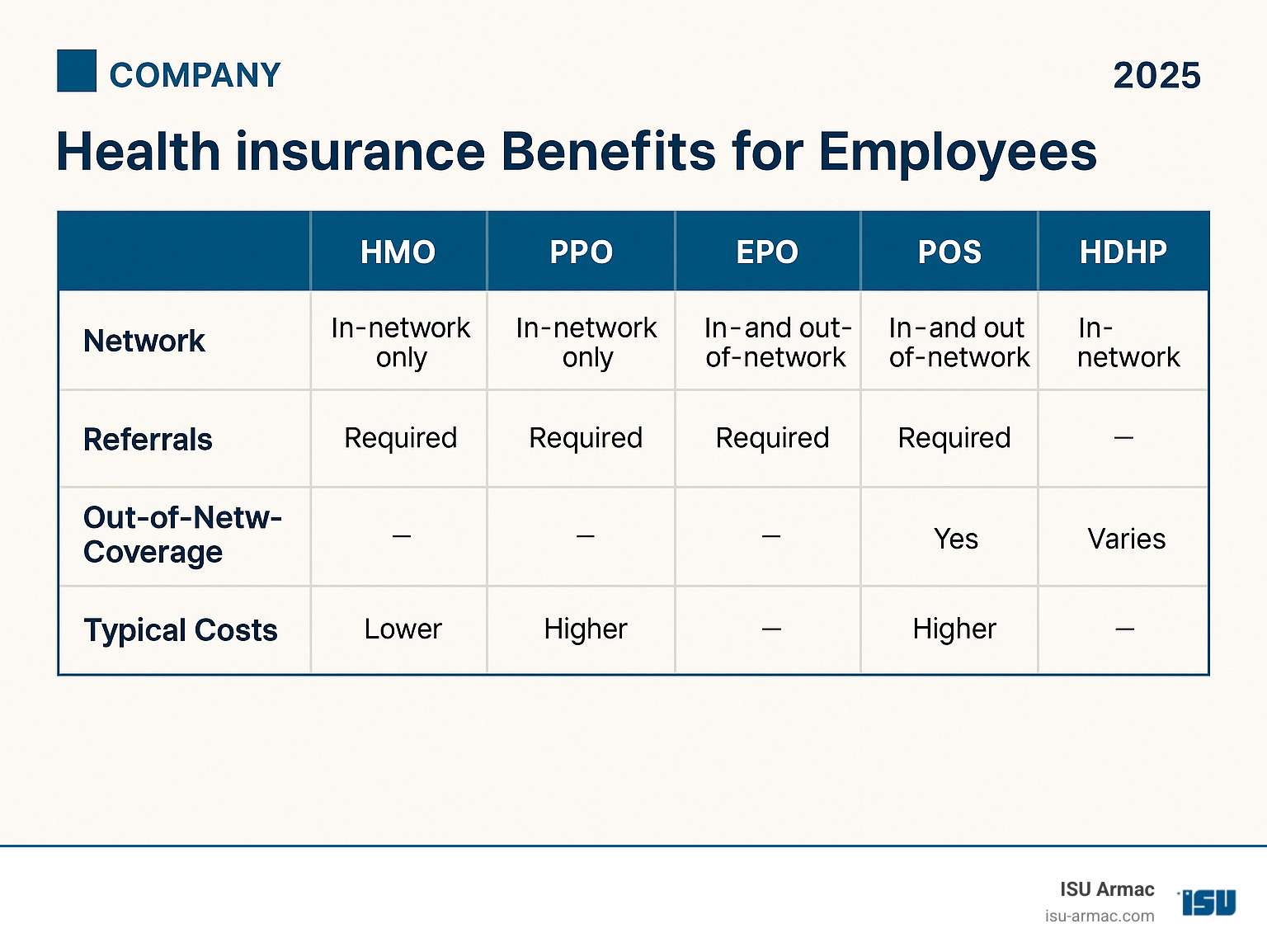
Navigating health insurance benefits for employees requires understanding the main plan types. Each model has unique features, networks, and costs. Understanding the differences in plan types, networks, referrals, and the balance between costs vs. flexibility is key to helping your team find the right fit.
Health Maintenance Organization (HMO)
A Health Maintenance Organization (HMO) requires members to use a specific network of doctors and hospitals. Employees choose a Primary Care Physician (PCP) who acts as a gatekeeper for their care. If they need to see a specialist, their PCP must provide a referral. Care outside the network is generally not covered, except in emergencies. In exchange for these restrictions, HMOs usually have lower monthly premiums and offer well-coordinated care.
Preferred Provider Organization (PPO)
A Preferred Provider Organization (PPO) offers more flexibility. Employees can see doctors both in-network and out-of-network, though staying in-network results in lower costs. They typically don’t need a PCP and can see specialists without a referral. This freedom is a major draw, but it usually comes with higher monthly premiums compared to an HMO.
Other Common Plan Types
Beyond HMOs and PPOs, other plans offer different blends of flexibility and cost.
Exclusive Provider Organization (EPO): Like an HMO, EPOs restrict coverage to a specific network (except in emergencies). However, like a PPO, members usually don’t need a PCP or referrals to see specialists within the network.
Point of Service (POS): A hybrid plan that often requires a PCP and referrals like an HMO but allows for out-of-network care at a higher cost, similar to a PPO.
High-Deductible Health Plan (HDHP): These plans have higher deductibles in exchange for lower monthly premiums. They are often paired with a Health Savings Account (HSA), a tax-advantaged account where employees and employers can contribute money for qualified medical expenses. HSA funds grow tax-free, and unused funds roll over each year, making it a powerful savings tool for future healthcare needs.
Choosing the right plan involves balancing monthly costs with the freedom to choose providers. This quick comparison can help clarify the differences:
Understanding Costs and Supplemental Coverage

Understanding health insurance benefits for employees means looking beyond the plan type to the financial components and supplemental coverage options that create a complete benefits package.
Key Cost Components Explained
Beyond the monthly premium, several terms determine how much employees pay for healthcare.
- Monthly Premium: The regular payment to keep coverage active. The employer typically pays a significant portion, with employees contributing the rest (often $100 to $500 per month).
- Annual Deductible: The amount an employee pays out-of-pocket for covered services before the insurance plan begins to pay. Preventive care is often exempt.
- Copay (Copayment): A fixed amount paid for a covered service, such as a $20 fee for a doctor’s visit.
- Coinsurance: The percentage of costs an employee pays for a service after meeting their deductible. For example, with 20% coinsurance, the employee pays $20 of a $100 bill.
- Out-of-Pocket Maximum: The most an employee will pay for covered services in a plan year. After this limit is reached, the insurance company pays 100% of covered costs, providing a financial safety net.
To estimate annual healthcare costs, employees should review past usage, consider expected needs, and factor in all cost-sharing components for all covered family members.
Beyond Medical: Essential Supplemental Benefits
A comprehensive benefits package goes beyond medical insurance. Supplemental health insurance benefits for employees improve team well-being and loyalty.
- Dental Insurance: Covers preventive care (cleanings), basic procedures (fillings), and major work (crowns). Good oral health is linked to overall health, making Group Dental Insurance a valued benefit.
- Vision Insurance: Helps cover eye exams, eyeglasses, and contact lenses. With modern screen time, Group Vision Insurance is increasingly important.
- Life and AD&D Insurance: Group Life Insurance provides a lump-sum benefit to beneficiaries upon an employee’s death. AD&D adds a benefit for accidental death or dismemberment.
- Disability Insurance: Replaces a portion of income if an employee cannot work due to illness or injury. Short-term (STD) and long-term (LTD) options are available.
- Mental Health Support: Robust mental health coverage and Employee Assistance Programs (EAPs) are vital. Only 61% of employees have access to mental health care through their benefits, a gap employers can address.
- Wellness Programs: These initiatives encourage healthy habits through fitness challenges, nutrition counseling, and health screenings, which can lead to healthier employees and reduced costs.
Employer Guide to Offering Health Insurance Benefits for Employees
Offering health insurance benefits for employees involves more than choosing a plan; it requires understanding legal requirements, ensuring compliance, and implementing a system that supports your team.
Who is Required to Provide Health Benefits?
The Affordable Care Act (ACA) defines who must offer coverage. Businesses with 50 or more full-time equivalent employees (FTEs) are considered Applicable Large Employers (ALEs). ALEs must offer affordable, minimum-value health coverage to full-time staff and their dependents to avoid significant penalties. For details, consult the official IRS rules for employers with 50+ employees.
Businesses with fewer than 50 FTEs are not required by the ACA to offer health insurance. However, many small businesses do so to attract and retain talent. Offering benefits provides a powerful competitive edge and may qualify the business for tax credits through the SHOP Marketplace.
Key Considerations for Your Business’s Health Insurance Benefits for Employees
Designing the right plan requires careful consideration.
- Budgeting: Benefits are a significant investment, often around 30% of total employee compensation costs. Set a realistic budget and explore cost-sharing options with employees.
- Employee Demographics: Analyze your workforce’s needs. Are they young and single, or do you have employees with families? This insight helps in selecting the right plan types, such as an HMO, PPO, or HDHP.
- Carrier Selection: Many insurance companies offer different plans, networks, and service levels. We shop multiple carriers to find the best fit for our Southern California clients, ensuring competitive rates and comprehensive coverage.
- Plan Design: Decide whether to offer a single plan or a choice of plans (e.g., a low-cost HMO alongside a flexible PPO). Offering choices empowers employees to select what best fits their needs and budget.
- Open Enrollment: This is the annual period when employees can enroll in or change their coverage, typically in the late fall. You must also define waiting periods for new hires, which cannot exceed 90 days by federal law.
If you’re ready to explore your options, we can help you Get a Group Benefits Quote customized for your business.
Legal and Compliance Checklist for Employers
Offering Group Medical Insurance comes with legal responsibilities.
- ERISA (Employee Retirement Income Security Act): This federal law sets standards for most private health plans, requiring proper plan documents, reporting, and fiduciary responsibilities.
- HIPAA (Health Insurance Portability and Accountability Act): HIPAA sets strict standards for protecting employees’ confidential health information.
- COBRA (Consolidated Omnibus Budget Reconciliation Act): For businesses with 20 or more employees, COBRA allows employees who lose their benefits to continue their group coverage for a limited time.
- FMLA (Family and Medical Leave Act): For employers with 50+ employees, FMLA provides up to 12 weeks of unpaid, job-protected leave for certain medical reasons, during which group health benefits must be maintained.
- Plan Documents and Reporting: ERISA requires a written Plan Document and a Summary Plan Description (SPD). Larger groups (100+ participants) must also file an annual Form 5500.
How Employees Can Choose the Right Health Plan
Once you’ve established your company’s health insurance benefits for employees, the next step is for your team to choose the right plan during open enrollment. As an employer, you can guide them through this important decision.
Assessing Your Healthcare Needs
The best place to start is with an honest assessment of current and future healthcare needs.
- Chronic conditions: Individuals with conditions like diabetes or asthma will need regular doctor visits and specialist care, making network coverage and referral rules critical.
- Prescription drugs: Employees should check each plan’s formulary (list of covered drugs) to ensure their medications are included and understand the tier level, which affects out-of-pocket costs.
- Expected medical services: Major events like a planned surgery or pregnancy make plans with lower deductibles more attractive, even if premiums are higher.
- Family size: Covering a family involves different cost structures and coverage needs than individual coverage. Family plans often have separate deductibles and out-of-pocket maximums.
- Doctor preferences: For HMO and EPO plans with limited networks, verify that preferred doctors and specialists are in-network before enrolling.
Comparing Your Plan Options
With a clear picture of their needs, employees can compare plans effectively.
- Network coverage: Review the provider directory carefully for current doctors, hospitals, and specialists. A plan is only valuable if preferred providers participate.
- Total costs: Look beyond the monthly premium. Estimate total annual costs by adding the premium to likely out-of-pocket expenses (deductibles, copays, coinsurance) based on health needs.
- Prescription formulary: For those taking regular medications, check the drug formulary to understand coverage and cost-sharing for each prescription.
- Supplemental perks: Some plans offer valuable extras like telemedicine, wellness programs, or health-related discounts that can be a deciding factor.
For more customization, Group Voluntary Benefits allow employees to add specific coverage like improved dental or vision.
The open enrollment period is the primary time to adjust coverage. Changes outside this window are only permitted after qualifying life events like marriage, birth of a child, or loss of other coverage.
Frequently Asked Questions about Employee Health Insurance
It’s natural to have questions about health insurance benefits for employees. Here are answers to some of the most common ones we hear from business owners and their teams.
How much do employee health benefits typically cost?
The cost of health insurance benefits for employees varies based on plan type, coverage level, group size, and location. Employers typically cover a significant portion of the premium, making group plans more affordable than individual coverage. On average, employees contribute between $100 to $500 per month for their share. Overall, employers often spend about 30% of total employee compensation costs on benefits, with health insurance being the largest component.
What is the difference between an HMO and a PPO?
The main difference is the balance between flexibility and cost.
HMOs (Health Maintenance Organizations) generally have lower premiums. They require members to use a specific network, choose a Primary Care Physician (PCP), and get referrals to see specialists. Care is coordinated but less flexible.
PPOs (Preferred Provider Organizations) offer more flexibility but usually have higher premiums. Members can see doctors both in-network and out-of-network without needing a PCP or referrals. This freedom of choice is ideal for those who value it and are willing to pay more.
Are small businesses required to offer health insurance?
No. Under the Affordable Care Act (ACA), businesses with fewer than 50 full-time equivalent (FTE) employees are not required to offer health insurance benefits for employees. However, many small businesses choose to offer benefits to attract and retain top talent. It’s a powerful competitive tool, and businesses that offer coverage through the SHOP Marketplace may qualify for tax credits, making it a smart financial decision.
Conclusion
Navigating health insurance benefits for employees is a worthwhile journey. Understanding plan types, costs, and legal requirements is the foundation for building a thriving business and a secure team.
Offering great health benefits is a smart investment in your team’s well-being and productivity. For employers, it helps attract and retain talent, boosts morale, and offers tax advantages. For employees, it provides a crucial financial safety net, affordable access to healthcare, and invaluable peace of mind.
Here at ISU Armac, we understand the unique needs of businesses in Southern California. We are dedicated to guiding you through the process and finding the right health insurance benefits for employees that fit your budget and your team’s needs. We are your partners in protecting your team and building a healthier, more productive future.
Ready to see what’s possible for your business? Let’s Find the right employee benefits plan for your business today.