
Why Group Life Insurance Policies Matter for Your Business
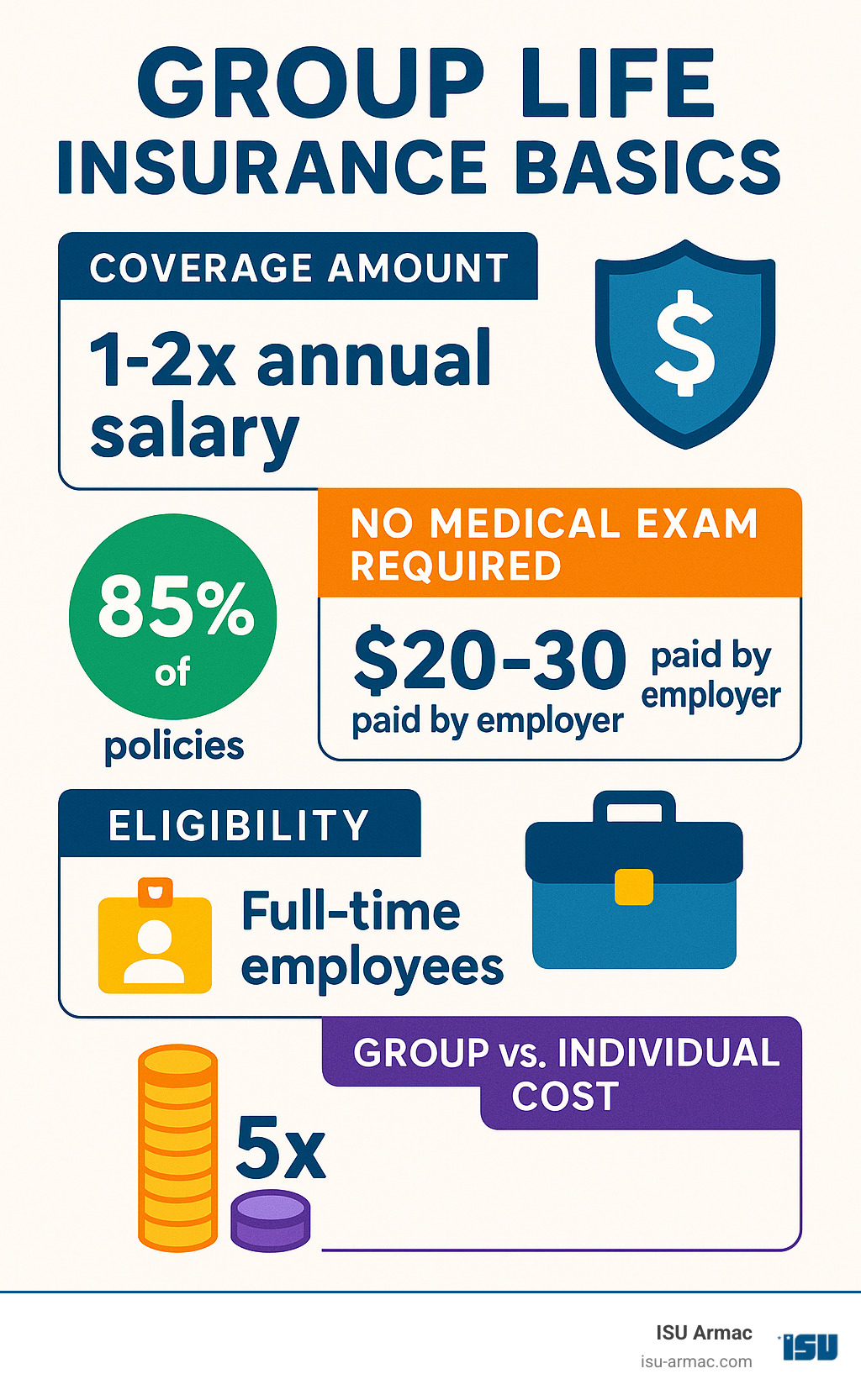
Group life insurance policies are employer-sponsored benefits that provide financial protection for employees and their families through a single master contract. These policies typically offer coverage equal to one or two times an employee’s annual salary, often with no medical exam required and frequently paid entirely by the employer.
Key Features of Group Life Insurance Policies:
- Coverage Amount: Usually 1-2 times annual salary or flat-rate coverage
- Cost: Often provided at no cost to employees
- Medical Requirements: Typically no medical exam needed
- Eligibility: Available to full-time employees after probationary period
- Portability: Coverage usually ends when employment terminates
- Tax Benefits: First $50,000 of employer-paid coverage is tax-free to employees
Work may be just one part of our lives, but employee benefits can play an important role in everything else. Group life insurance serves as a cornerstone of financial planning, helping employers attract and retain talent while providing employees with peace of mind that their loved ones will have financial support if something unexpected happens.
As Ryan McEachron, CEO of ISU Insurance Services ARMAC Agency with over two decades of experience in the insurance industry, I’ve helped countless Victorville businesses implement group life insurance policies that protect their most valuable asset – their employees. My background serving on various community boards has shown me how proper insurance coverage can make the difference between financial security and hardship for local families.
Group life insurance policies word roundup:
What is Group Life Insurance and How Does It Work?
Think of group life insurance policies as a safety net that employers spread under their entire workforce. Instead of each employee shopping for their own life insurance, the company purchases one large “master contract” that covers everyone who qualifies. It’s like buying insurance in bulk – and just like shopping at a warehouse store, everyone gets better prices.
The magic happens through something called group term life insurance. This is temporary coverage that renews each year, similar to how you might rent an apartment rather than buy a house. There’s no cash value building up over time, but that’s actually what keeps the costs so affordable for everyone involved.
Here’s how the process works in practice: Your employer partners with an insurance company to create this master policy. When you join the company and become eligible, you’re automatically covered under this umbrella. If something happens to you, your chosen beneficiaries receive a death benefit – and here’s the really good news – they typically don’t pay taxes on that money.

What makes group coverage special is something called “experience rating.” Your company’s renewal rates depend partly on the group’s claims history and the ages of employees. When everyone’s relatively healthy and young, premiums stay lower. It’s a team effort that benefits everyone.
The enrollment process is refreshingly simple. Most employees can sign up without the hassle of medical exams or lengthy health questionnaires. This “guaranteed issue” approach means even people with health conditions who might struggle to get individual coverage can often qualify. It’s one of the most employee-friendly aspects of employee benefits insurance.
Who is Eligible and What are Typical Coverage Amounts?
Eligibility for group life insurance policies is usually straightforward – if you’re a full-time employee, you’re likely covered. Many companies do have a waiting period, though. You might need to work for 30, 60, or 90 days before your coverage kicks in. This probationary period helps ensure the benefit goes to committed team members.
The coverage often extends beyond just you. Many policies include options for your spouse or domestic partner, plus your unmarried children. Kids are typically covered from about 14 days old up to age 22, or sometimes 24 if they’re full-time students. It’s a family-friendly benefit that recognizes your loved ones need protection too.
When it comes to coverage amounts, most basic policies tie your benefit to your salary. One to two times your annual salary is the standard starting point. So if you earn $60,000, you might have $60,000 or $120,000 in coverage. Some companies prefer flat-rate coverage, giving everyone the same amount regardless of their paycheck.
Here’s something important to consider: financial experts often recommend having about ten times your salary in life insurance. That means your group coverage, while valuable, probably isn’t enough on its own. The good news is that many plans allow you to purchase additional coverage. We’ve seen options ranging from $10,000 up to $1,000,000 in coverage, usually in $10,000 increments.
For spouses, coverage might go up to $1,000,000 as well, though it typically can’t exceed what you have as the employee. Children usually get a flat amount, like $10,000. And here’s a bonus: if you’re under 50 and applying for up to $250,000, you’ll likely just answer a few health questions rather than taking a medical exam. For more information on group term life options, we can help you explore what’s available.
What Happens When Employment Ends?
This is where group life insurance policies show their biggest limitation – they’re tied to your job. When you leave your employer, your coverage typically ends on your last day or at the end of that month. It’s like having a company car that you have to return when you quit.
But you’re not necessarily left empty-handed. Many policies offer something called a “conversion privilege.” This allows you to convert your group term coverage into an individual permanent policy without a medical exam. Sounds great, right? Well, there’s a catch – the premiums for your new individual policy will likely be much higher than what you were paying (or not paying) under the group plan.
Why the price jump? You’re now buying insurance based on your individual age and health profile, without the benefit of group discounts. Most people find the converted policy too expensive and choose not to convert their coverage.
Some policies offer “portability options” that let you continue paying premiums directly to keep similar term coverage. Again, you’ll pay more than the employer-subsidized rate, but it might be more affordable than conversion.
The key takeaway? Don’t wait until you’re job hunting to think about life insurance. If you’re planning a career change, it’s smart to explore your options beforehand. An individual policy purchased while you’re still employed and healthy can provide continuous coverage regardless of where you work. Our team at Group Life Insurance can help you understand your options and plan for seamless coverage transitions.
Types of Group Coverage and Key Comparisons
When most people think about group life insurance policies, they’re usually thinking about group term life insurance. But that’s not the only option out there. Understanding the different types can help you make better decisions about your coverage needs.
The insurance world offers two main flavors of group life coverage, and they’re quite different from each other.
Group term life insurance is by far the most common type you’ll encounter. Think of it like renting an apartment – you pay for coverage month by month or year by year, and when you stop paying, the protection ends. There’s no building equity or cash sitting aside for later. It’s pure protection, plain and simple.
This temporary coverage approach keeps costs low, which is why employers love it. The premiums are typically much lower than permanent insurance options, making it easier for companies to provide this benefit to their entire workforce.
Group universal life insurance takes a completely different approach. This is permanent coverage designed to last your entire lifetime, assuming you keep paying the premiums. Unlike term insurance, group universal life includes a cash value component that grows over time on a tax-deferred basis.
However, here’s where it gets tricky. Group universal life policies often come with strings attached that individual policies don’t have. You might not have easy access to that accumulated cash value, and the investment options could be limited compared to what you’d get with an individual policy. The master contract structure means less flexibility for you as the individual policyholder.
The premium payments for group universal life are also typically higher than term coverage, which is why fewer employers offer this option. Most companies prefer to stick with the cost-effective simplicity of term coverage.
Comparing Group Life Insurance Policies to Individual Plans
Let’s be honest – comparing group life insurance policies to individual plans is like comparing a reliable Honda Civic to a custom-built sports car. Both will get you where you need to go, but they serve very different purposes and come with different price tags.
| Feature | Group Life Insurance Policies | Individual Life Insurance Policies |
|---|---|---|
| Cost | Often free or very low cost to employees (employer-paid or subsidized). Group rates keep premiums down. | You pay the full premium yourself. Costs vary widely based on your age, health, and policy type. |
| Coverage Amount | Usually limited to 1-2 times your annual salary or a flat amount. May not cover all your family’s needs. | Fully customizable coverage amounts, often allowing much higher limits to meet your specific financial goals. |
| Portability | Coverage typically ends when you leave your job. Limited conversion options, usually at much higher costs. | Completely portable – the policy belongs to you and follows you regardless of where you work. |
| Underwriting (Medical Exam) | Often no medical exam needed, especially for basic coverage. Simple enrollment process. | Medical exam typically required, especially for higher coverage amounts. More detailed health questions. |
| Customization | Limited options with a “one-size-fits-all” approach for the entire group. | Highly customizable with various policy types and riders to suit your individual needs. |
The beauty of group coverage lies in its accessibility and cost-effectiveness. If your employer offers it for free, it’s almost always worth taking. But here’s the reality check – that basic coverage probably isn’t enough to fully protect your family’s financial future.
Individual policies give you control and flexibility that group plans simply can’t match. You own the policy, you control the coverage amount, and you’re not dependent on your employer’s decisions about benefits.
Does Group Life Insurance Have a Cash Value?
This question comes up constantly, and I understand why it’s confusing. The short answer for most group life insurance policies is no – there’s no cash value component.
Here’s why: the vast majority of group life insurance is term life insurance. Term insurance is like paying for a gym membership – you get the benefits while you’re paying, but if you stop paying, there’s nothing left over. It provides pure death benefit protection without any savings or investment element.
Term insurance works exactly like your car insurance or homeowners insurance. You pay premiums for protection, and if nothing happens during the coverage period, that’s actually a good thing! But there’s no money building up in an account somewhere with your name on it.
Now, group universal life insurance does technically have a cash value component since it’s designed as permanent coverage. But here’s the catch – accessing that cash value in a group setting can be much more restrictive than with an individual policy. The master contract structure often limits your ability to borrow against or withdraw from the cash value.
Most employees should assume their employer-provided group life insurance is term coverage focused solely on providing a death benefit to their beneficiaries. If building cash value is important to your financial strategy, you’ll likely need to look at individual permanent life insurance options to supplement your group coverage.
The good news? Term insurance does exactly what it’s supposed to do – provide affordable protection when your family needs it most. Sometimes the simplest solution is the best solution.
Evaluating Group Life Insurance Policies: Pros, Cons, and Supplemental Options
When I sit down with business owners in Victorville to discuss group life insurance policies, I always emphasize that they’re like a sturdy foundation for a house – essential, but rarely the complete structure. These policies offer tremendous value, but understanding their strengths and limitations is crucial for making informed decisions about your employees’ financial security.

The beauty of group life insurance policies lies in their accessibility and cost-effectiveness. They create a valuable financial safety net that ensures even employees who might never think to purchase life insurance have some level of protection. This foundational coverage can be a game-changer for families facing unexpected loss, providing immediate financial relief during their most difficult moments.
However, these policies also come with inherent trade-offs. The coverage amounts are typically modest – often just one or two times an employee’s annual salary – which might fall short for families with significant financial obligations. The lack of portability means employees lose this protection when they change jobs, creating potential gaps in coverage. Additionally, the one-size-fits-all approach means limited customization options to meet unique family needs.
Advantages and Disadvantages for Employees
Let me paint a clear picture of what employees can expect from group life insurance policies. On the positive side, cost-effectiveness stands out as the biggest win – many employers cover the entire premium for basic coverage, making it essentially free money for employees. The convenience factor can’t be overstated either; enrollment is typically straightforward with minimal paperwork and often no medical exam required for basic amounts.
This simplified underwriting is particularly valuable for employees with pre-existing health conditions who might struggle to qualify for individual policies. The guaranteed protection aspect means that even those who procrastinate about life insurance have some coverage in place. Plus, the payroll deduction convenience makes premium payments effortless when employees do pay for supplemental coverage.
On the flip side, the limited coverage amounts often don’t align with financial experts’ recommendations of ten times your salary or more. The portability challenge creates real problems – when employees leave their job, they typically lose their coverage entirely. This employment dependency can be particularly problematic for older workers who develop health issues, making individual coverage more expensive or difficult to obtain later.
The lack of customization means employees can’t add riders or modify coverage to fit their specific situations. Finally, most group policies are term life with no cash value accumulation, so there’s no savings component or investment growth over time.
Can Employees Purchase Supplemental Coverage?
Here’s where things get exciting for employees who recognize that basic coverage might not be enough. Supplemental or voluntary life insurance through the group plan allows employees to increase their death benefit to levels that truly protect their families’ financial future.
These voluntary programs work beautifully through payroll deduction, making additional coverage affordable and convenient. Employees can typically purchase coverage in increments – perhaps adding $50,000 or $100,000 to their base amount. Many plans also extend coverage for spouses and children at very reasonable rates, creating comprehensive family protection under one umbrella.
One particularly valuable addition is accidental death and dismemberment (AD&D) coverage, which provides additional benefits if death or serious injury results from an accident. This extra layer of protection addresses specific risks that concern many families.
The underwriting for supplemental coverage often remains simplified compared to individual policies. While higher amounts might require more detailed health questions, moderate increases frequently involve minimal medical inquiries. This makes it an excellent bridge between basic group coverage and comprehensive individual policies.
At ISU Armac, we help employers design Group Voluntary Benefits packages that give employees these valuable options. It’s a win-win approach – employees get the flexibility to customize their protection while employers improve their benefits package without significantly increasing their costs. This supplemental approach helps bridge the gap between basic protection and the comprehensive financial security that modern families need.
Frequently Asked Questions about Group Life Insurance
We understand that group life insurance policies can sometimes seem complex. Here, we address some of the most common questions we receive from employees and employers alike.
Is group life insurance worth it for employees?
Absolutely, yes! If your employer offers group life insurance policies as a free benefit, it is almost always worth taking advantage of. Think of it as a gift – a foundational layer of financial protection at absolutely no cost to you. It provides immediate peace of mind and ensures that your loved ones will receive some financial support if the unthinkable happens.
However, it’s crucial to understand that while it’s “worth it,” it’s often not enough on its own. The coverage limits are typically one to two times your annual salary, which often falls short of the recommended coverage amount (sometimes ten times your salary) needed to truly secure your family’s financial future, cover significant debts like a mortgage, or fund future needs like college tuition.
So, our advice is this: take the free coverage. It’s a valuable start. But for most individuals with dependents or significant financial obligations, we strongly recommend supplementing this basic coverage with an individual life insurance policy or additional voluntary group coverage to ensure comprehensive protection. It’s a piece of your financial puzzle, not the whole picture.
Are the benefits from group life insurance taxable?
This is a critical question with a nuanced answer, but generally, the news is good for beneficiaries.
For the employee, if your employer pays for your group term life insurance, the premiums paid for the first $50,000 of coverage are generally not considered taxable income to you. This means you don’t have to pay income tax on the value of that coverage. However, if your employer provides more than $50,000 in coverage, the cost of the coverage exceeding $50,000 (as calculated by official IRS tables) is considered “imputed income” and is taxable to the employee. This amount will typically show up on your W-2 form.
For the beneficiary, the death benefit received from a group life insurance policy is almost always income-tax-free. This is a significant advantage of life insurance in general. When your beneficiaries receive the payout, they typically won’t owe federal income tax on that money. There can be exceptions for very large estates that are subject to estate taxes, but for most individuals, the death benefit itself is not taxed as income.
What is the difference between basic and supplemental group life insurance?
Understanding the distinction between basic and supplemental group life insurance policies is key to maximizing your employee benefits.
Basic group life insurance is the core coverage automatically provided by an employer to their eligible employees. It’s often fully paid for by the employer, making it a free benefit for the employee. The coverage amount is typically a set amount, such as a uniform flat sum for all employees or a multiple of the employee’s annual salary. Enrollment is usually automatic or very simple, often without a medical exam, and it provides that crucial foundational layer of financial protection.
Supplemental (or voluntary) group life insurance is additional coverage that employees can choose to purchase to increase their total death benefit. This coverage is paid for by the employee, usually through convenient payroll deductions. Because it’s still part of a group plan, the rates are often more competitive than individual policies. Employees can typically select higher coverage amounts in increments, and you might also be able to purchase coverage for your spouse and children.
The enrollment process for supplemental coverage requires active election by the employee. While often simplified, higher amounts might require answering more health questions or even a medical exam. The real value here is that it allows employees to tailor their life insurance coverage to their specific financial needs, supplementing the basic coverage to provide more comprehensive protection for their families.
Think of it this way: basic coverage is the employer’s gift, while supplemental coverage is an employee’s opportunity to build upon that gift to secure a more robust financial future for their loved ones.
Conclusion: Securing Your Team’s Future
Group life insurance policies represent far more than just another line item in your employee benefits package. They’re a bridge between uncertainty and security, offering your team the peace of mind that comes from knowing their families will have financial support when it matters most.
Throughout our exploration, we’ve seen how these policies serve as a foundational layer of financial protection. The beauty lies in their simplicity – often requiring no medical exams, frequently paid entirely by employers, and providing immediate coverage that can make a real difference in a family’s darkest hour. For many employees, this might be their first experience with life insurance, introducing them to the importance of financial planning.
Yet as we’ve finded, basic group life insurance policies are typically just the beginning of a comprehensive financial protection strategy. While that one or two times salary coverage is valuable, it often falls short of what families truly need for long-term security. This is where the conversation naturally evolves to supplemental insurance options and individual policies that can fill those gaps.
At ISU Armac, we’ve spent over two decades helping businesses throughout the High Desert – from Victorville to Apple Valley, Hesperia to Oak Hills – steer these important decisions. We understand that every business is unique, just like every employee’s needs are different. That’s why our approach goes beyond simply offering policies; we take the time to understand your workforce, your budget, and your goals for building a comprehensive benefits package.
Our ability to shop multiple carriers means we’re not tied to any single solution. Instead, we can explore various options to find the coverage that provides the best value for your specific situation. Whether you’re a small business offering your first employee benefits or a larger organization looking to improve your existing package, we’re here to guide you through the process with expert guidance and genuine care.
The conversation about group life insurance policies ultimately comes down to this: protecting what matters most. Your employees are your most valuable asset, and their families deserve the security that comes from proper coverage. When you invest in these benefits, you’re not just offering insurance – you’re demonstrating that you value your team’s well-being beyond the workplace.
Ready to take the next step in securing your team’s future? We invite you to explore your employee benefits options today and find how the right coverage can strengthen both your organization and your employees’ financial security. For personalized guidance on Employee Life Insurance Benefits, our experienced team is here to help you build a benefits package that truly makes a difference.