
Why Group Health Insurance Matters for Your Business
Group health insurance plans are a vital tool for employers, offering health coverage to their employees and often their families. These plans are more than a simple benefit; they are a strategic asset for any business.
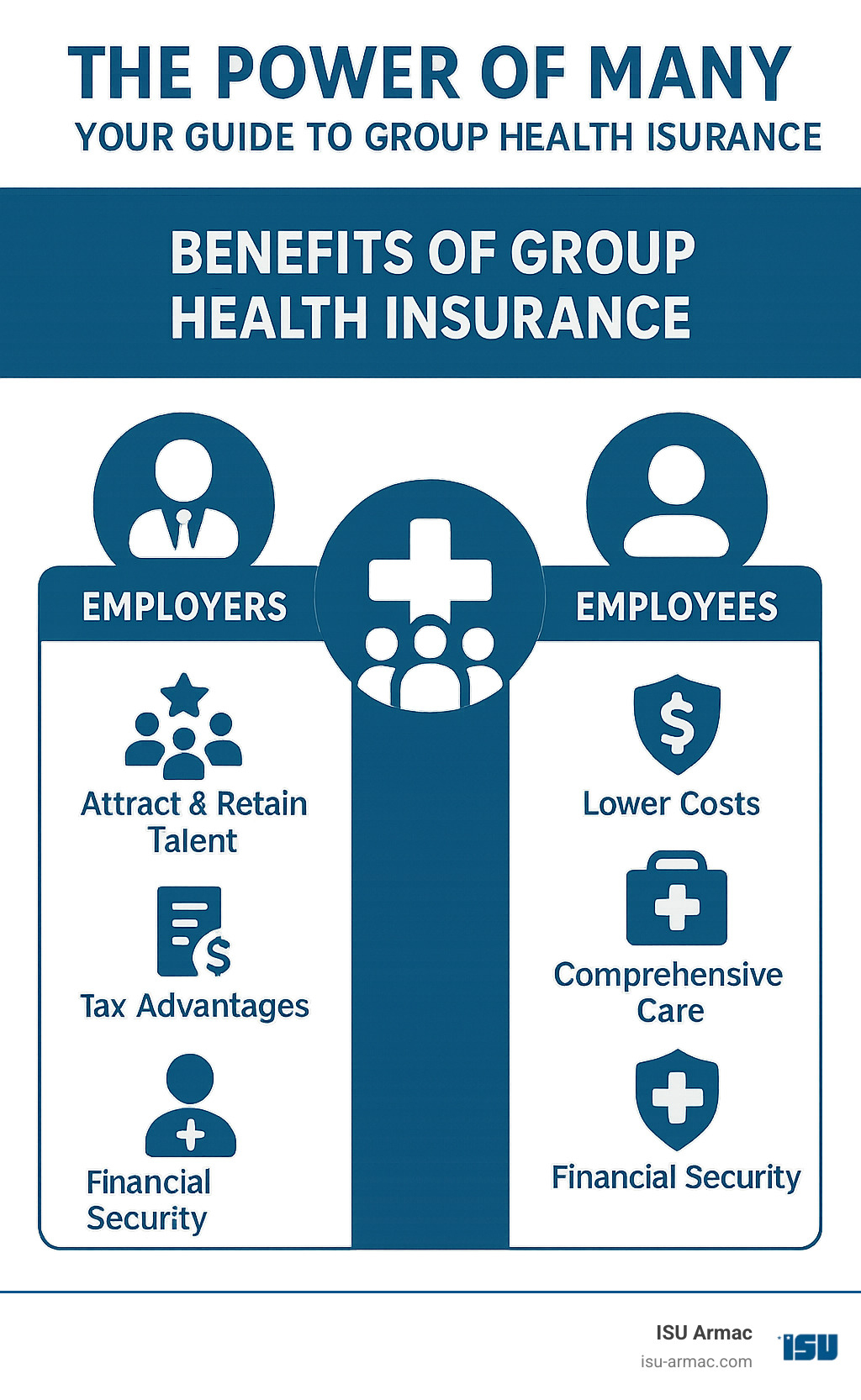
Here’s a quick look at why they are so important:
For Employers:
- Attract & Retain Talent: A powerful incentive in a competitive job market. A staggering 88% of employers consider healthcare benefits crucial for their workforce.
- Tax Advantages: Premiums paid by businesses are often tax-deductible. Small businesses may even qualify for a tax credit of up to 50% of premiums.
- Improved Morale & Productivity: Healthy, secure employees are more focused and loyal.
For Employees:
- Lower Costs: Premiums are typically more affordable than individual plans due to risk-pooling.
- Comprehensive Coverage: Often includes a wider range of benefits and broader provider networks.
- Financial Security: Provides essential protection against unexpected medical expenses.
Choosing the right plan can seem complex, but expert guidance makes all the difference. As Ryan McEachron, CEO of ISU Insurance Services ARMAC Agency, I’ve spent years helping Victorville businesses steer the complexities of group health insurance plans. My experience on the Victorville City Council and Chamber of Commerce Board provides a deep understanding of local business challenges, ensuring you find coverage that meets your unique needs.
Group health insurance plans word roundup:
- employee healthcare plans
- benefits of offering health insurance to employees
- employee benefits insurance
What is Group Health Insurance and How Does It Work?
Think of group health insurance plans as a team approach to healthcare. Instead of individuals buying coverage alone, your business creates a hub to offer a single, comprehensive health plan to your employees.
Here’s the process: Your company partners with an insurance provider to create a “master policy” that covers your entire eligible workforce. Each employee receives a certificate or handbook detailing their specific benefits and how to use their insurance.

The key to its affordability is risk pooling. By combining many people into one group, the financial risk of expensive medical treatments is spread across all members. This pooling effect allows group health insurance plans to offer lower premiums per person compared to individual policies. The cost is typically shared between the business and its employees, making quality healthcare much more accessible.
Most private sector group plans are federally regulated by ERISA (Employee Retirement Income Security Act), which sets standards to protect employees’ rights. You can explore data from the Bureau of Labor Statistics to see how common these benefits are across industries.
Want to dive deeper? Check out our comprehensive guide on employee benefits insurance for more insights.
The Core Benefits for Employers and Employees
Group health insurance plans create a win-win for your business and your team.
What Employers Gain:
- Talent Attraction & Retention: In a competitive market, strong health benefits can be the deciding factor for top candidates and are crucial for retaining valuable employees.
- Tax Advantages: Your business can typically deduct health insurance premiums. Small businesses may even qualify for tax credits to offset the cost.
- Improved Productivity: Healthy employees who feel secure in their coverage are more focused, take fewer sick days, and have higher morale.
What Employees Receive:
- Lower Costs: Group purchasing power and employer contributions make comprehensive coverage significantly more affordable than individual plans.
- Better Coverage: Group plans often feature broader networks and more extensive benefits, including preventive care, prescriptions, and mental health services.
- Financial Security: Protection from devastating medical bills provides invaluable peace of mind for employees and their families.
This investment in your team’s wellbeing pays dividends in loyalty and performance. Learn more in our guide on the benefits of offering health insurance to employees.
Navigating the Types of Group Health Insurance Plans
Choosing the right group health insurance plan means understanding the different ways plans manage care and are funded. Each option offers a unique balance of cost, flexibility, and administrative oversight.

Managed Care Plans: HMO, PPO, and More
Managed care plans are designed to control costs while ensuring quality care. The most common types are HMOs and PPOs.
Health Maintenance Organization (HMO): Members choose a primary care physician (PCP) from a network who coordinates all care and provides referrals to specialists. HMOs generally have lower premiums but require members to stay in-network for care (except in emergencies).
Preferred Provider Organization (PPO): PPOs offer more flexibility. Members are not required to have a PCP or get referrals and can see providers both in-network and out-of-network. This freedom comes with higher premiums and higher costs for out-of-network care. PPO plans are often the most popular type of group health insurance plan due to this balance.
Other Options:
- Exclusive Provider Organization (EPO): A hybrid that doesn’t require a PCP but only covers in-network care.
- Point of Service (POS): Combines HMO and PPO features, requiring a PCP but allowing out-of-network care at a higher cost.
Here’s a quick comparison of the two most common plan types:
| Feature | HMO (Health Maintenance Organization) | PPO (Preferred Provider Organization) |
|---|---|---|
| Cost | Generally lower premiums and out-of-pocket costs | Generally higher premiums, but more flexibility |
| Network | Restricted to in-network providers (except emergencies) | Broader network; can use in-network or out-of-network |
| Referrals | Required for specialists | Not typically required for specialists |
| Flexibility | Less flexible, as care is managed by a PCP | More flexible, with direct access to specialists |
Choosing between a PPO and an HMO is a critical decision that balances cost with provider choice.
Funding Your Plan: Fully-Insured vs. Self-Funded
Beyond network type, plans differ in their financial structure.
Fully-Insured Plans: The traditional model where your business pays a fixed monthly premium to an insurance company. The insurer assumes all financial risk for paying employee claims. This offers predictable costs but less control over plan design.
Self-Funded (Self-Insured) Plans: Your business assumes the financial risk for paying claims directly, setting aside funds to cover these costs. This offers greater control and potential savings but carries more financial risk. Employers often purchase “stop-loss” insurance to protect against catastrophic claims. This model is typically better for larger companies.
Level-Funded Plans: A hybrid model where you pay a fixed monthly amount that covers administrative costs, stop-loss insurance, and a claims fund. If claims are lower than expected, you may receive a refund at the end of the year, offering a balance of predictability and potential savings.
Understanding these models is key to your financial strategy. For more insights, explore our resources on health insurance for small business employees.
Key Factors in Choosing the Right Plan
Selecting the perfect group health insurance plan requires balancing multiple factors to create a solution that fits your budget and your employees’ needs.

At ISU Armac, we help businesses find the sweet spot where cost, coverage, and network access align with your company’s goals. It’s not about finding the cheapest plan, but the right one.
Balancing Cost, Coverage, and Network for Your Team
Evaluating group health insurance plans requires looking at the complete financial picture.
Cost Structure: Look beyond monthly premiums. Consider the employee’s share, including deductibles (what they pay before insurance kicks in), copayments (flat fees for services), and coinsurance (a percentage of costs). The out-of-pocket maximum is a critical safety net that caps annual expenses for employees.
Coverage Quality: Ensure the plan includes the ten essential health benefits required by the ACA. Review the prescription drug formulary and consider if your team needs specialized services like mental health support or chronic disease management.
Network Considerations: A larger provider network offers more choice and convenience. Check the difference between in-network and out-of-network costs, especially with PPO plans. For remote or dispersed teams, geographic coverage is vital. Ensure employees can easily access quality providers where they live and work. Tools like provider directories help find in-network providers and assess a network’s strength.
Understanding Your Workforce’s Needs
Don’t assume you know what your employees want—ask them. A plan should be based on their actual needs and priorities.
Demographics and Preferences: A younger workforce might prioritize low premiums, while employees with families may value comprehensive coverage and low deductibles. Use anonymous surveys to ask about their preferences: lower deductibles vs. lower premiums, the importance of dental/vision, or the choice between an HMO’s low cost and a PPO’s flexibility.
Lifestyle and Budget: If your team travels often, a PPO’s out-of-network options may be essential. Align the plan with what both your business and your employees can realistically afford. A great plan is useless if employees can’t afford to enroll.
We can help you steer these decisions. For next steps, see our guide on how to get health insurance for my small business.
Enhancing Your Offering: Ancillary Benefits and Savings Accounts
To make your group health insurance plans truly competitive, look beyond basic medical coverage. Ancillary benefits and tax-advantaged savings accounts show a commitment to whole-person wellness and help employees manage costs effectively.

These additions transform a standard benefits package into a powerful tool for attracting and retaining top talent.
Popular Ancillary Benefits for a Competitive Edge
Ancillary benefits fill important gaps in a core medical plan.
- Dental Insurance: One of the most requested benefits, dental plans cover preventive care, fillings, and major work, linking oral health to overall wellness.
- Vision Insurance: Essential in a screen-heavy world, vision plans cover eye exams and provide allowances for glasses or contacts, boosting productivity.
- Life Insurance: Group life insurance offers affordable financial protection for employees’ families, providing peace of mind.
- Wellness Programs: These programs actively promote healthy behaviors through fitness challenges, health screenings, and mental health resources, often integrated with virtual care options.
The impact of offering comprehensive dental, vision and life insurance coverage can’t be overstated, often becoming a deciding factor for job candidates.
Tax-Advantaged Health Accounts
These accounts empower employees to manage healthcare costs while providing tax benefits for everyone.
- Health Savings Accounts (HSAs): Paired with High-Deductible Health Plans (HDHPs), HSAs offer a triple tax advantage: contributions are tax-deductible, funds grow tax-free, and withdrawals for medical expenses are tax-free. The funds are owned by the employee and are portable.
- Health Reimbursement Arrangements (HRAs): Funded solely by the employer, HRAs reimburse employees tax-free for qualified medical expenses. This gives employers control over costs and plan design.
- Flexible Spending Accounts (FSAs): Employees set aside pre-tax dollars for medical or dependent care expenses, reducing their taxable income. While they often have a “use-it-or-lose-it” rule, many plans offer grace periods or carryovers.
Integrating these accounts with your group health insurance plans gives employees powerful financial tools to complement their medical coverage.
Legal and Regulatory Compliance for Group Health Insurance Plans
Offering group health insurance plans requires adherence to a critical set of federal laws. Staying compliant with regulations like ERISA, the ACA, COBRA, and HIPAA is essential to avoid significant penalties and legal issues.
ERISA (Employee Retirement Income Security Act): This foundational law sets standards for most private-sector benefit plans. It requires that plan managers (fiduciaries) act in the employees’ best interest, process claims fairly, and provide transparent information about benefits and rights.
ACA (Affordable Care Act): The ACA introduced major reforms. Its Employer Mandate requires Applicable Large Employers (ALEs)—generally those with 50 or more full-time equivalent employees—to offer affordable, minimum essential coverage or face penalties. The ACA also established Essential Health Benefits, eliminated denials for pre-existing conditions, and created the Small Business Health Care Tax Credit for eligible employers. For more details, see our page on whether small businesses are required to provide health insurance. You can also learn more about the Small Business Health Care Tax Credit.
COBRA (Consolidated Omnibus Budget Reconciliation Act): This law acts as a safety net, giving employees and their families the right to temporarily continue their group health coverage after a job loss, reduction in hours, or other qualifying life events. This provides a vital bridge in coverage during transitions. COBRA generally applies to employers with 20 or more employees.
HIPAA (Health Insurance Portability and Accountability Act): HIPAA is primarily about protecting the privacy and security of employees’ protected health information (PHI). It sets strict rules for how health data is handled and shared. HIPAA also includes portability rules that make it easier for individuals to maintain coverage when changing jobs.
Navigating these regulations can be complex, but we are committed to helping our clients ensure their group health insurance plans are fully compliant.
Frequently Asked Questions about Group Health Insurance Plans
We understand that choosing and managing group health insurance plans brings up many questions. Here are answers to the most common concerns we hear from employers.
How many employees are needed for a group health insurance plan?
The requirements are more flexible than many business owners think. Generally, you need at least two employees, including the owner, to qualify for a group plan. In California, small group health insurance is typically available for businesses with 1 to 100 employees. Most carriers require at least one non-owner employee on payroll and that the employer contributes at least 50% of the employee-only premium. Participation requirements (the percentage of eligible employees who must enroll) also apply but can be flexible. We can help you find a carrier that fits your specific situation.
Why is group health insurance generally cheaper than individual plans?
Group health insurance plans are almost always more affordable than individual coverage for a few key reasons:
- Risk Pooling: Spreading risk across many people stabilizes costs. The financial impact of one person’s major medical event is absorbed by the entire group, leading to more predictable and lower rates for everyone.
- Group Purchasing Power: Insurers compete for your business, offering better rates to a group than they would to an individual.
- Employer Contributions: Most employers cover at least 50% of the employee’s premium, significantly reducing the out-of-pocket cost for the employee.
- Administrative Efficiency: It is more cost-effective for an insurer to manage one group policy than dozens of individual ones, and these savings are passed on.
What is the difference between a PPO and an HMO?
This is a common question that boils down to a trade-off between flexibility and cost. As detailed earlier in this guide, the primary distinction is:
PPO (Preferred Provider Organization): Offers maximum flexibility. You can see any doctor, in or out of network, without a referral. This freedom comes with higher monthly premiums.
HMO (Health Maintenance Organization): Focuses on cost savings. You must use doctors within the network and get referrals from a primary care physician (PCP) to see specialists. This structure results in lower monthly premiums and out-of-pocket costs.
The best choice depends on your budget and your employees’ preferences. PPO plans are often the most popular choice for their balance of features, but we can help you analyze both options to find the right fit for your team.
Conclusion
Choosing the right group health insurance plans is one of the smartest investments you can make in your company’s future. These plans are powerful strategic tools that help you attract top talent, retain your best employees, and receive valuable tax benefits.
Navigating the options—from HMOs and PPOs to funding models and regulatory compliance—can feel complex. Balancing costs, coverage, and employee needs requires careful consideration, and it’s easy to feel lost.
But you don’t have to do it alone.
At ISU Armac, we make the complex simple. As an independent agency in Victorville, we help businesses across Southern California find the perfect group health insurance plans. We don’t work for one insurance company; we work for you. Our team shops multiple carriers to find the sweet spot where comprehensive coverage meets your budget.
We take the time to understand your business, your goals, and your team. Then we do the heavy lifting, presenting clear, straightforward recommendations that make sense for your unique situation.
Whether you’re a small business just starting out or an established company looking to optimize your benefits, we’re here to help. The health and financial security of your employees is too important to leave to chance.
Ready to explore the best employee benefits insurance options for your team? Contact us today, and let’s build a healthier, more secure future for your business together.