
Why Errors and Omissions Insurance Coverage is Essential for Your Business
Errors and omissions (E&O) insurance coverage protects your business from financial loss if a client claims you made a mistake, provided inadequate service, or caused financial harm through negligence. This professional liability coverage handles legal defense costs, settlements, and judgments, even for baseless claims.
Key Coverage Areas:
- Professional negligence claims
- Legal defense costs
- Settlements and judgments
- Missed deadlines or omissions
- Misrepresentation claims
The financial stakes are high. Attorney fees for E&O claims can range from $3,000 to $150,000, while a typical small business policy costs around $735 annually. A single lawsuit without coverage could be financially devastating.
Many professionals are required to carry E&O coverage. Over 10 states mandate it for real estate agent licensing, and insurance carriers often require it for agents. Increasingly, clients also demand proof of coverage before signing contracts.
I’m Ryan McEachron, CEO of ISU Insurance Services ARMAC Agency. With decades of experience serving the Victorville and High Desert community, I’ve helped countless businesses steer their errors and omissions insurance coverage needs. This guide will walk you through securing the right professional liability protection for your business.

Explore more about errors and omissions insurance coverage:
- errors and omissions insurance for insurance agents
- errors and omissions insurance for real estate agents
- errors and omissions insurance for travel agents
What is Errors and Omissions (E&O) Insurance?
Errors and omissions insurance coverage is a specialized type of professional liability protection. It steps in when clients claim your professional services caused them financial harm due to mistakes, bad advice, or negligence. Even if you are great at what you do, human error is always a risk. When a missed deadline or miscommunication leads to a client’s financial loss, E&O insurance protects you from the potentially devastating costs of a lawsuit.
This coverage is often called professional liability insurance, or malpractice insurance for healthcare professionals. Regardless of the name, it protects your business when your professional services are questioned. The financial reality is that even a groundless claim can cost $3,000 to $150,000 in legal fees alone. E&O insurance covers these defense costs, whether the claim has merit or not.
More info about what E&O liability insurance is

The Core Purpose of E&O Protection
The primary purpose of errors and omissions insurance coverage is to protect your business assets. A single lawsuit could wipe out your savings, but E&O prevents this by covering legal fees, settlements, and judgments. This allows for business continuity, so you can keep operating instead of shutting down to deal with litigation. Carrying E&O also builds client trust, showing that you take your professional responsibilities seriously. For any service-based business, it’s an essential risk management tool.
E&O vs. Other Business Liability Policies
It’s crucial to understand how E&O differs from other policies:
- General Liability Insurance: Covers physical risks like bodily injury (a client slips and falls) or property damage (you damage a client’s computer). E&O covers financial losses from your professional services. What Does General and Professional Liability Cover?
- Workers’ Compensation: Covers employee injuries that happen on the job. This is legally required in most states if you have employees.
- Cyber Liability Insurance: Protects against data breaches and cyberattacks. While an IT consultant’s E&O might cover a mistake in software installation, cyber liability would handle the costs if hackers steal client data from your servers.
Each policy addresses specific risks. Errors and omissions insurance coverage is uniquely designed for claims arising from your professional advice and services.
Who Needs E&O Insurance and Why Is It Crucial?
If your business provides services, advice, or intellectual property, you likely need errors and omissions insurance coverage. For many professionals, it’s a critical requirement for doing business.
E&O insurance is often mandated by:
- Contractual Requirements: Many corporate clients require their service providers to carry E&O coverage.
- State Licensing Boards: Professions like real estate agents in over 10 states, including California, must have E&O insurance to be licensed.
- Client Mandates: Savvy clients often demand proof of an E&O policy before engaging your services, as it demonstrates accountability.
Beyond mandates, E&O coverage is vital for your financial solvency and reputation. A single lawsuit, even if meritless, can drain your resources and damage your professional standing.

Professions with High E&O Exposure
Certain professions face higher exposure due to the high-stakes nature of their work. Here are some that commonly need errors and omissions insurance coverage:
- Accountants: For errors in financial advice, tax preparation, or audits.
- Real Estate Agents: For mistakes in transactions, disclosures, or client investments. Errors and Omissions Insurance for Real Estate Agents
- Insurance Agents: For incorrect policy recommendations or missed renewal deadlines. Errors and Omissions Insurance for Insurance Agents
- IT Consultants / Tech Firms: For errors in software implementation, data management, or cybersecurity advice. The average cost for tech firms is around $164 a month.
- Architects / Engineers: For design flaws or construction oversight errors.
- Marketing Agencies: For campaigns that fail to deliver or damage a client’s reputation.
- Contractors: For design-build services, project management, or faulty material recommendations. Does Contractor Insurance Cover Poor Workmanship?
- Lawyers: For missed deadlines or erroneous legal counsel.
- Healthcare Professionals: Covered by medical malpractice, a specific form of E&O.
- Other Professionals: Appraisers, web developers, consultants, and event planners who offer expert guidance.
The Financial Impact of a Claim
The value of errors and omissions insurance coverage is clear when you consider the cost of a claim. Even if you are innocent, defending yourself is expensive.
- Legal Defense Costs: Attorney fees average $3,000 to $150,000, not including court costs or expert witness fees.
- Settlements and Judgments: If you are found liable or choose to settle, these costs can range from thousands to millions of dollars.
- Lost Productivity: Defending a lawsuit takes significant time and energy away from running your business.
Without E&O insurance, these expenses come directly out of your pocket, threatening your business and personal assets. E&O acts as a financial buffer, absorbing these unpredictable costs.
Information on how E&O can provide relief for investors
The Ultimate Breakdown of Errors and Omissions Insurance Coverage
Understanding your errors and omissions insurance coverage policy is essential. Most E&O policies are “claims-made,” meaning the policy must be active when a claim is filed against you. The incident that caused the claim must also have occurred after your policy’s “retroactive date.” This date is critical, as it defines how far back your past work is covered. Understanding your policy limits, deductibles, and endorsements is key to avoiding gaps in your coverage.

What’s Typically Covered by E&O Insurance?
Errors and omissions insurance coverage protects you when your professional judgment is questioned. Key covered areas include:
- Negligence: Claims that you failed to meet the professional standards of your industry.
- Errors and Omissions: Actual mistakes (errors) or failure to perform a necessary task (omissions).
- Misrepresentation and Inaccurate Advice: Providing guidance that turns out to be wrong or misleading.
- Violation of Good Faith and Fair Dealing: Allegations that you were not honest or fair in your professional relationships.
- Defense Costs: Covers attorney fees, court costs, and expert witness fees, even if the lawsuit is groundless.
- Settlements and Judgments: Pays for financial damages awarded to a claimant, up to your policy limits.
- Prior Acts: Covers mistakes that happened before your current policy began, as long as you’ve maintained continuous coverage.
- Personal Injury (Libel and Slander): Some policies include coverage for defamation claims arising from your professional services.
What’s Typically Excluded from Errors and Omissions Insurance Coverage?
Knowing what isn’t covered is just as important. Exclusions exist because other policies are designed for these risks or they fall outside the scope of professional mistakes.
Common exclusions include:
- Intentional Wrongdoing: Fraud, criminal acts, or deliberately dishonest acts are not covered.
- Bodily Injury and Property Damage: These are covered by general liability insurance. Does General Liability Insurance Cover Negligence?
- Employee-Related Issues: Employee injuries are covered by workers’ compensation, while wrongful termination or discrimination claims fall under Employment Practices Liability Insurance.
- Claims Before Your Retroactive Date: Any incident that occurred before this date is not covered.
- False Advertising: Often excluded or covered under a general liability policy.
- Known Claims: Problems you were aware of before purchasing the policy are typically excluded.
- Patent/Trade Secret Infringement: These are often specific exclusions, though some policies cover copyright infringement.
- Services Outside Your Professional Scope: An E&O policy for a real estate agent won’t cover financial planning advice.
Choosing and Understanding Your E&O Policy
Selecting the right errors and omissions insurance coverage requires a policy custom to your specific business risks, services, and financial situation. It’s not a one-size-fits-all product. The policy needs to be customized based on your industry, revenue, and risk tolerance. The coverage limits and deductibles you choose will directly impact your premium and your level of protection.
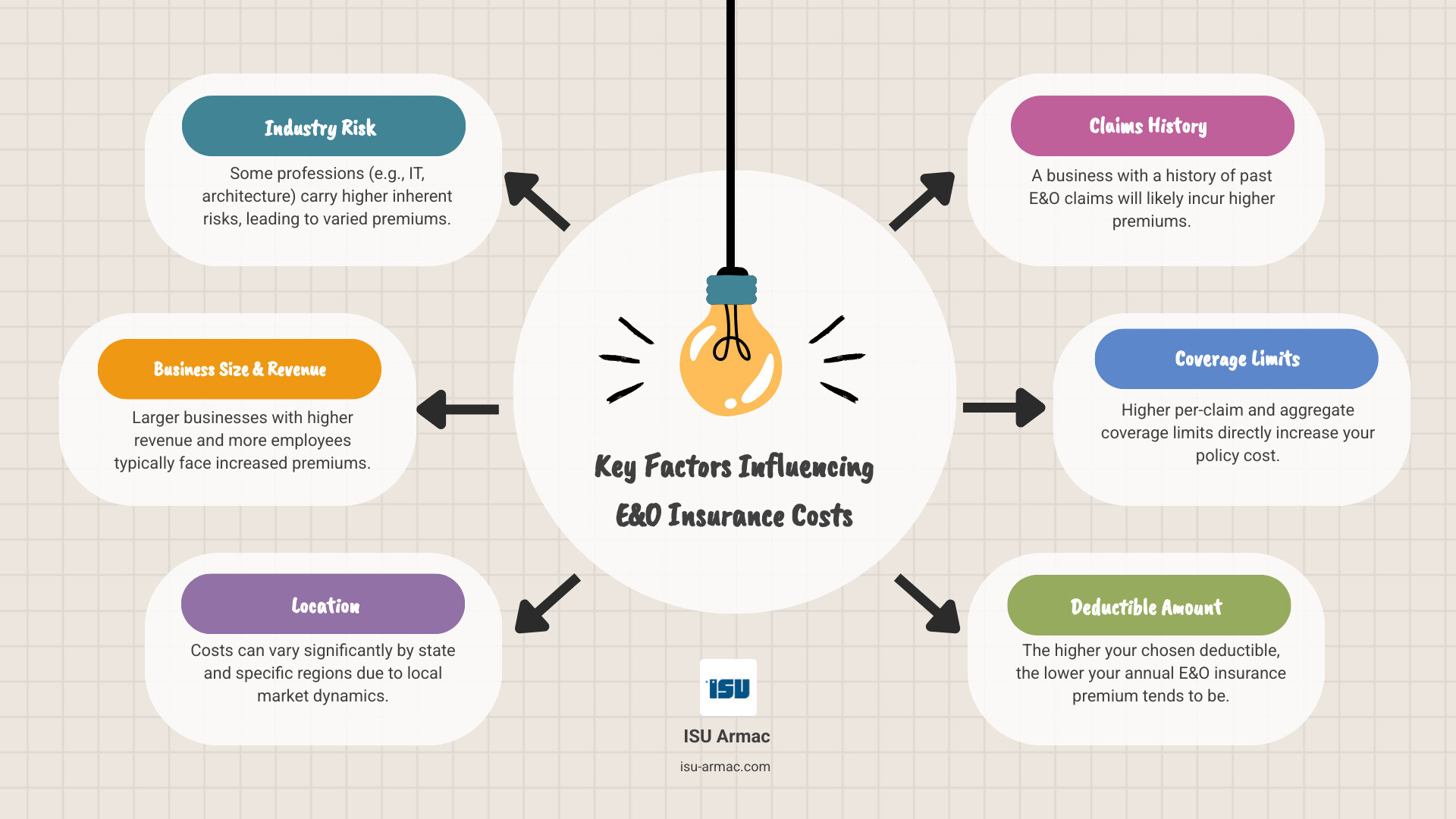
Key Factors That Influence the Cost of Your Errors and Omissions Insurance Coverage
The cost of errors and omissions insurance coverage varies widely. While a small business might pay around $735 annually, your premium depends on several factors:
- Industry Risk: High-risk professions like IT consulting (averaging $164/month) pay more than lower-risk fields.
- Business Size and Revenue: Larger operations with higher revenue face greater exposure and thus higher premiums.
- Location: The legal environment in your area, including Southern California communities like Victorville and Hesperia, affects rates.
- Claims History: A clean record keeps premiums down, while past claims can increase costs.
- Coverage Limits: Higher limits provide more protection but cost more.
- Deductible Amount: A higher deductible lowers your premium but increases your out-of-pocket cost per claim.
- Risk Management: Insurers may offer lower rates to businesses with strong employee training and quality control procedures.
How to Select the Right Policy for Your Business
Choosing the right errors and omissions insurance coverage involves understanding key policy features:
- Claims-Made vs. Occurrence: Most E&O policies are “claims-made,” covering claims filed during the policy period. This differs from “occurrence” policies, which cover incidents that happen during the policy period, regardless of when the claim is filed.
- Per-Claim and Aggregate Limits: The per-claim limit is the max payout for one claim; the aggregate limit is the total for all claims in a policy period. Limits can range from $100,000 to over $1,000,000.
- Retroactive Date: This date sets the earliest point from which your past work is covered. Maintaining continuous coverage is vital to preserve this date.
- Extended Reporting Period (ERP): Also known as “tail coverage,” this allows you to report claims after your policy expires. It’s essential if you retire, sell your business, or change careers.
- Policy Endorsements: These are add-ons that customize your policy for specific risks, such as adding coverage for property management activities to a real estate agent’s policy.
- Policy Language: It’s critical to read and understand your policy’s terms and exclusions. At ISU Armac, we help clients decipher the jargon so you know exactly what protection you have.
Frequently Asked Questions about E&O Insurance
When it comes to errors and omissions insurance coverage, we hear many of the same questions from our clients in Victorville and the High Desert. Here are answers to the most common ones.
Is E&O insurance the same as general liability insurance?
No, they cover different risks. Think of them as two distinct shields for your business.
General liability insurance covers physical risks, such as bodily injury (a client falls in your office) and property damage (you break a client’s equipment). It also handles claims of slander or copyright infringement in your advertising.
Errors and omissions insurance coverage, on the other hand, covers financial losses resulting from your professional services. If a client claims your advice or work caused them financial harm, E&O insurance steps in. Most service-based businesses need both policies for comprehensive protection.
Can I be sued even if I didn’t make a mistake?
Yes, absolutely. Anyone can file a lawsuit against you, regardless of whether the claim has merit. A client might have had unrealistic expectations, or they may simply be looking for someone to blame for their own business failings.
Even if you are innocent, you still have to pay for a legal defense. Attorney fees can range from $3,000 to $150,000, and that’s before other court costs. This is why errors and omissions insurance coverage is so critical. It covers these defense costs for both valid and frivolous lawsuits, protecting your business from a financially draining fight.
Is E&O insurance required by law?
It depends on your profession and location. While not every business is legally required to have it, many licensed professions are.
For example, real estate agents in California and over 10 other states must carry E&O insurance to maintain their license. Lawyers and healthcare professionals (who buy malpractice insurance) also typically face mandatory coverage requirements.
Even when not required by law, it’s often required by clients. Many corporations will not hire a service provider without proof of professional liability coverage. In today’s business world, errors and omissions insurance coverage has become a practical necessity for any professional providing advice or services for a fee.
Conclusion: Securing Your Professional Future
As we’ve seen, errors and omissions insurance coverage is more than just another policy; it’s a financial lifeline for your professional life. You’ve worked hard to build your expertise and your business. E&O insurance protects that hard work from the risk of a costly lawsuit.
The numbers are clear: with legal defense costs averaging $3,000 to $150,000 and a typical policy costing around $735 annually, the value is undeniable. One claim without coverage could be devastating. With coverage, you can weather the storm and continue serving clients with confidence.
Proper E&O protection allows professionals to focus on what they do best. Here in the High Desert, from Victorville to Apple Valley, we’ve seen how the right insurance helps local businesses thrive. It provides the freedom to take on bigger projects and grow without the constant fear of a potential claim.
At ISU Armac, we don’t just sell policies; we build a protective shield around your business. Our ability to shop multiple carriers means we find the errors and omissions insurance coverage that is the best fit for your unique risks and budget. The peace of mind that comes with knowing you’re properly covered is invaluable. Don’t wait for a claim to find a gap in your protection. Secure your professional future today.