
Why Understanding Commercial Bus Insurance Cost Matters
Commercial bus insurance cost varies dramatically based on your specific operation, ranging from as low as $1,000 annually for small non-profit organizations to over $35,000 per year for large commercial operations in high-risk states like New Jersey.
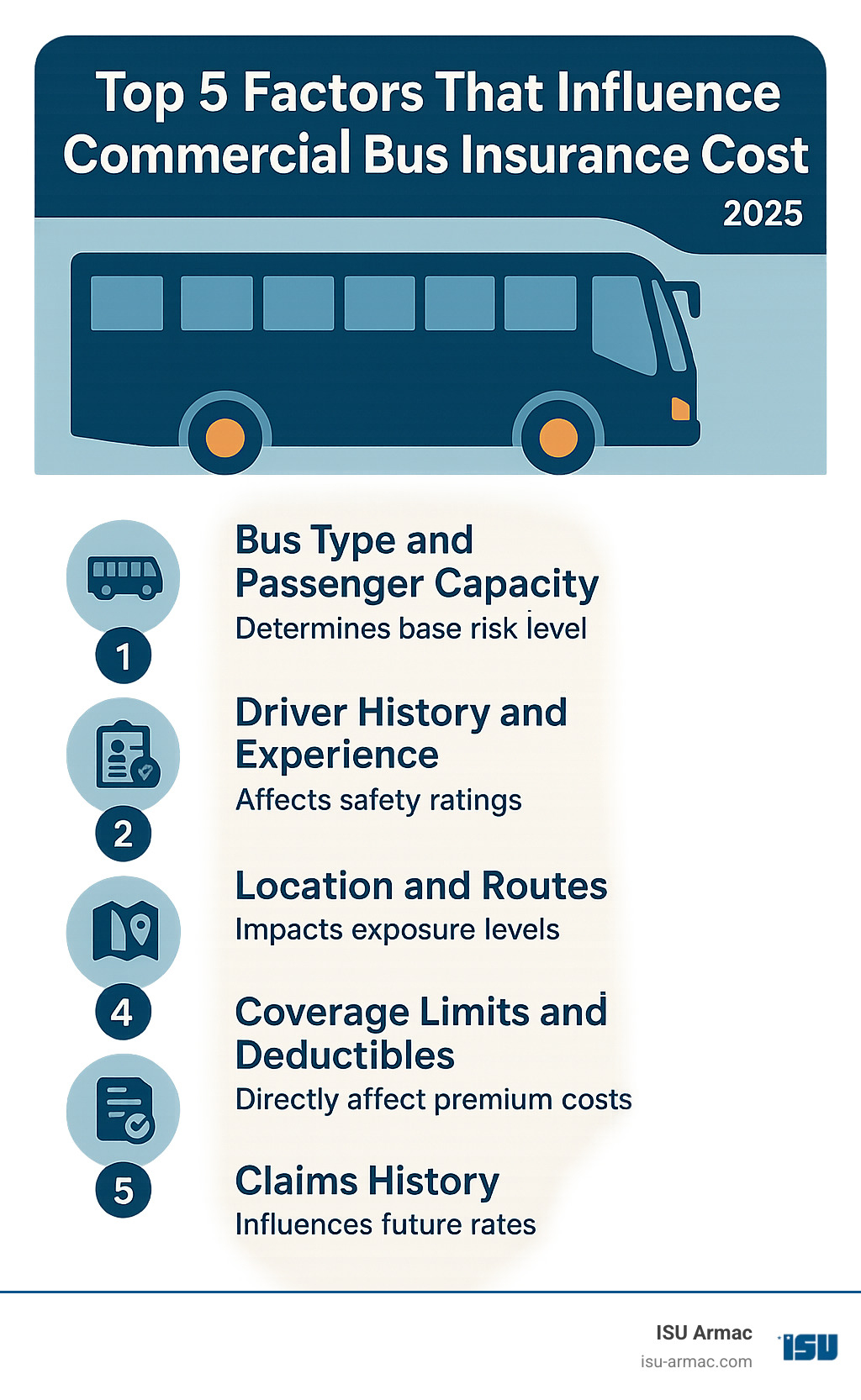
Key Commercial Bus Insurance Cost Factors:
- Bus type and passenger capacity – Under 16 passengers vs. full-size coaches
- Business purpose – Non-profit, school transport, charter service, or tour operations
- Geographic location – Rural vs. urban routes, state regulations
- Driver qualifications – Experience, clean records, proper endorsements
- Coverage limits – Liability, physical damage, and passenger protection levels
Typical Annual Cost Ranges by Coverage Type:
- Primary Liability: $1,000 – $25,000
- Physical Damage: $750 – $5,000
- Umbrella Policy: $500 – $3,500
- Medical Payments: $500 – $10,000
- Workers’ Compensation: $1,000 – $3,000
When you’re transporting passengers, whether for a church group or a commercial tour company, you’re taking on significant financial responsibility. A single accident involving multiple passengers can result in millions of dollars in medical expenses and legal costs. Understanding these costs upfront helps you budget appropriately and select coverage that truly protects your operation.
The 50-state average for commercial 15-passenger bus insurance is $9,420 per year, but your actual premium depends on factors you can control – like driver selection and safety programs – and those you can’t, like your state’s minimum coverage requirements.
I’m Ryan McEachron, CEO of ISU Insurance Services ARMAC Agency, and I’ve been helping Victorville area businesses steer commercial bus insurance cost decisions for over two decades. My experience on the Victorville City Council and involvement with local transportation planning gives me unique insight into the regulatory and practical challenges bus operators face.
What is Commercial Bus Insurance and Why Is It Essential?
Operating a bus, whether for a school, a tour company, or a shuttle service, means you’re entrusted with precious cargo: people. This responsibility goes far beyond just driving from point A to point B. It involves ensuring the safety and well-being of every passenger, and that’s where commercial bus insurance comes in. It’s a specialized type of commercial auto insurance designed to address the unique and significant risks associated with transporting multiple passengers.

Unlike standard commercial auto policies that might cover goods or equipment, commercial bus insurance cost reflects the higher stakes involved when human lives are on board. This specialized coverage is not just a good idea; it’s a legal requirement in most places. Federal and state regulations mandate specific liability limits for passenger carriers, recognizing the potential for catastrophic losses in the event of an accident.
Consider the sheer size and weight of a bus. In an accident, a bus can cause extensive physical damage and injuries. Statistics show that more than 15,000 bus accidents occur annually, with about 47% of these resulting in injuries, and tragically, about 1.5% leading to fatalities. In one recent year alone, over 13,268 individuals were injured in bus accidents. These numbers underscore the inherent risks and why adequate coverage is paramount.
Commercial bus insurance acts as a crucial financial safety net. It protects your business from the potentially devastating financial consequences of an accident, including medical expenses for injured passengers, property damage, and the exorbitant legal fees that can arise from lawsuits. Without it, a single incident could bankrupt your operation. Understanding the intricacies of Commercial Auto Insurance is the first step in protecting your valuable assets and ensuring business continuity.
The Critical Need for Protection
The need for robust commercial bus insurance is multifaceted. Firstly, it’s about public safety. By ensuring you have adequate coverage, you’re guaranteeing that victims of an accident can receive the care and compensation they need without undue burden. This commitment to safety helps foster trust within the communities you serve.
Secondly, it’s vital for business continuity. Accidents happen, even to the most careful operators. Without proper insurance, your business could face crippling lawsuits, vehicle repair or replacement costs, and lost income due to operational downtime. Insurance allows you to recover and continue serving your customers.
Thirdly, it offers crucial lawsuit protection. Buses transport many people, and in the event of an accident, the potential for multiple injuries and subsequent lawsuits is high. Commercial General Liability coverage, for example, protects against injuries to third parties (e.g., slip and falls) or property damage (e.g., passenger baggage). An umbrella policy can further increase your liability coverage, providing an extra layer of protection against hefty lawsuit costs that exceed your primary policy limits.
Finally, it brings peace of mind. Knowing that your business, your drivers, and your passengers are protected allows you to focus on providing excellent service. Federal rules, particularly for buses operating on interstate routes, are typically stricter than state laws and require more comprehensive coverage. This is why specialized policies, often including medical payments insurance, are essential for bus operators. To dig deeper into how these policies function, explore How Does Commercial Auto Insurance Work?.
The Bottom Line: How Much Does Commercial Bus Insurance Cost?
When business owners ask me about commercial bus insurance cost, I always tell them it’s like asking about the price of a home – the answer depends entirely on location, size, and features. The range is genuinely eye-opening, and understanding this variability is crucial for budgeting your operation effectively.

The numbers tell an interesting story. Non-profit organizations often enjoy the most affordable rates, especially when operating smaller vehicles. A church transporting its congregation in a 15-passenger van might pay as little as $1,000 annually for basic coverage. This reflects the lower risk profile insurers assign to occasional, community-focused transportation.
Commercial operations face a different reality entirely. In lower-risk states, a commercial bus operator might secure coverage starting around $4,000 per year. However, the story changes dramatically in high-regulation, high-risk areas. States like New Jersey, with their dense populations and strict requirements, can push annual premiums beyond $35,000 for comprehensive coverage.
The 50-state average sits at $9,420 annually for commercial 15-passenger bus insurance, providing a helpful benchmark. Yet this figure can be misleading – your actual premium might fall well below or significantly above this average based on your specific circumstances.
State-by-state differences play a massive role in pricing. Rural operations in states with fewer regulatory requirements often enjoy lower premiums, while urban operators in heavily regulated markets face steeper costs. Understanding these regional variations helps explain why getting quotes from carriers familiar with your area is essential. For broader context on commercial vehicle costs across different industries, resources like Average Commercial Car Insurance Costs provide valuable comparisons. And remember, bus insurance is just one component of your overall Business Insurance Cost considerations.
Why Bus Insurance Carries a Higher Price Tag
The high cost of bus insurance isn’t arbitrary – it reflects genuine risks that insurers must account for. Understanding these factors helps explain why your premium might seem steep compared to other commercial vehicles.
Passenger risk stands as the primary cost driver. Unlike a delivery truck carrying packages, your bus transports human lives. Every seat represents a potential injury claim, and the possibility of multiple severe injuries in a single accident dramatically increases your insurer’s exposure. This reality necessitates much higher liability limits than other commercial operations require.
Higher liability limits aren’t just recommended – they’re often mandated by law. While a standard commercial auto policy might carry $1 million in liability coverage, bus operations frequently require several million dollars in protection. The Federal Motor Carrier Safety Administration sets strict minimums for interstate carriers, and these requirements directly impact your premium costs.
Vehicle value and repair costs add another layer of expense. Modern buses represent significant investments, with new motorcoaches costing hundreds of thousands of dollars. When accidents occur, replacement or repair costs far exceed those of smaller commercial vehicles. The complexity of bus systems means even minor incidents can result in substantial repair bills.
Specialized equipment further complicates the cost equation. Wheelchair lifts, advanced braking systems, passenger entertainment systems, and other specialized components require expert repair and expensive replacement parts. Insurers factor these high repair costs into their premium calculations.
The reality of increased road exposure cannot be ignored. Buses typically operate longer hours, cover more miles, and frequently travel through high-traffic urban areas or busy highways. More time on the road statistically increases accident probability, which insurers reflect in their pricing models.
These combined factors – transporting multiple passengers, potential for catastrophic claims, high vehicle values, and extensive road exposure – make commercial bus insurance cost inherently higher than other commercial coverages. It’s not just expensive insurance; it’s comprehensive financial protection for a high-risk operation. To dive deeper into the specific factors affecting your liability costs, explore What Factors Affect the Price of Commercial Liability Insurance?.
Key Factors That Drive Your Premium
When insurance companies calculate your commercial bus insurance cost, they’re essentially becoming detectives, carefully examining every detail of your operation to predict the likelihood of future claims. This thorough actuarial analysis and risk assessment process considers dozens of variables that collectively determine your unique premium.

The good news? Understanding these factors puts you in the driver’s seat when it comes to managing your insurance costs. Some factors you can’t control, like where your business is located, but many others are entirely within your power to influence. This underwriting process might seem complex, but it’s designed to ensure you get coverage that matches your actual risk profile.
For a comprehensive look at how we approach comparing different commercial auto insurance options, take a look at our Navigating Business Auto Insurance: A Comprehensive Comparison Guide.
Bus Type, Size, and Usage
The heart of your commercial bus insurance cost calculation starts with what kind of bus you operate and how you use it. Think of it this way: insuring a small church van that carries 12 people to Sunday services is vastly different from covering a 55-passenger motorcoach that travels cross-country daily.
Passenger capacity is often the first consideration. Buses carrying fewer than 16 passengers frequently qualify for different, often more favorable classifications. Here’s an insider tip: sometimes it makes financial sense to remove unused seats from your bus to qualify for these lower-risk categories!
The type of service you provide creates different risk profiles. School buses face unique challenges, including specific regulations and potential liability concerns related to transporting minors. Tour buses and charter buses typically cover longer distances and cross state lines, increasing exposure to accidents and regulatory complexity. Shuttle buses might have shorter routes but higher frequency, while party buses introduce entirely different risks due to their social nature and interior modifications.
Vehicle age and value directly impact your physical damage coverage costs. A brand-new motorcoach worth $500,000 will cost significantly more to insure than a well-maintained older mini-bus. Annual mileage is another critical factor – the more miles your buses accumulate, the higher the statistical probability of incidents.
Whether you operate local versus long-haul routes also matters tremendously. Local operations might face urban traffic challenges, while long-distance routes introduce fatigue factors and varying weather conditions.
Driver Profile and Company History
Your drivers are the most important factor in determining your insurance rates, and for good reason. Insurance companies know that the person behind the wheel ultimately controls whether your bus operation runs safely or faces costly claims.
Driver experience carries significant weight in premium calculations. Seasoned drivers with years of safe commercial driving typically earn you lower rates, while drivers under 25 often trigger higher premiums due to statistical accident rates. Clean driving records from Motor Vehicle Reports (MVRs) are absolutely crucial. Even a single at-fault accident or moving violation can dramatically increase your commercial bus insurance cost.
Here’s something many bus operators don’t realize: some insurers base your entire premium on your worst driver’s record. This means one problematic driver can affect your entire fleet’s rates, making careful driver screening essential from both safety and financial perspectives.
CDL endorsements demonstrate your drivers meet federal standards for passenger transport, but they also confirm you’re operating a high-risk business. Company claims history tells insurers about your track record – frequent or severe claims signal higher future risk and drive up premiums accordingly.
Years in business work in your favor over time. Established operations with proven safety records often qualify for better rates than newer companies. Most importantly, documented safety programs can earn you significant discounts. Regular driver training, vehicle maintenance protocols, and comprehensive safety policies show insurers you’re serious about preventing claims before they happen.
Location, Routes, and Regulatory Environment
Where you park your buses at night, where they travel during the day, and which regulations govern your operation all play major roles in your insurance costs.
Garaging location affects your rates more than many operators realize. Urban areas typically mean higher premiums due to increased traffic density, theft risk, and accident frequency. The difference can be dramatic – while some rural states see commercial bus insurance starting around $4,000 annually, operators in high-cost states like New Jersey might pay over $35,000 for similar coverage.
Route characteristics matter tremendously. Interstate versus intrastate operations face different regulatory requirements, with interstate carriers subject to stricter Federal Motor Carrier Safety Administration (FMCSA) rules. These federal requirements typically demand higher liability limits – often several million dollars – compared to intrastate operations.
The regulatory environment creates a complex web of requirements that directly impact your commercial bus insurance cost. State insurance departments review and approve pricing structures, leading to significant regional variations. Federal oversight adds another layer, particularly for buses crossing state lines.
FMCSA requirements for interstate carriers are particularly demanding, mandating specific liability minimums and safety standards that translate directly into higher insurance costs. However, these requirements exist for good reason – they ensure adequate financial protection for the traveling public.
Understanding how government reviews of insurance pricing work can help you better understand why rates vary so significantly by location and operation type.
Deconstructing Your Policy: Coverages and Their Price Tags
Understanding what’s actually in your commercial bus insurance policy isn’t just about knowing where your money goes – it’s about making sure you’re truly protected when things go wrong. Your commercial bus insurance cost is essentially built from individual pieces, like a puzzle where each coverage type addresses a specific risk your bus operation faces.
Think of your policy structure like layers of protection. Some coverages are mandatory – required by law or federal regulations – while others are optional add-ons that let you customize your protection based on your unique needs. The key is finding the right balance between comprehensive coverage and manageable costs.
Here’s a breakdown of the most common bus insurance coverages and their typical price tags:
| Coverage Type | Purpose | Typical Annual Cost Range |
|---|---|---|
| Primary Liability | Protects you when your bus causes injury or property damage to others. | $3,000 – $15,000 |
| Physical Damage | Protects your bus from collision, theft, vandalism, and weather damage. | $2,000 – $8,000 |
| Medical Payments | Covers immediate medical expenses for injured passengers, regardless of fault. | $500 – $2,500 |
| Uninsured/Underinsured Motorist | Protects you and your passengers if an at-fault driver has insufficient insurance. | $800 – $3,000 |
| Umbrella Liability | Provides extra liability protection above your primary policy limits. | $1,200 – $4,000 (per $1M) |
| Workers’ Compensation | Covers medical costs and lost wages for employees injured on the job. | $2,000 – $5,000+ |
The beauty of understanding these individual components is that you can make informed decisions about where to spend your insurance dollars. Maybe you choose higher deductibles on physical damage to afford broader liability limits. Or perhaps you add medical payments coverage because you frequently transport elderly passengers.
The cheapest policy isn’t always the best value. When you’re responsible for people’s lives, adequate coverage isn’t just smart business – it’s a moral obligation to your passengers and their families.