
Why Commercial Auto Insurance Rates Matter for Your Business
Commercial auto insurance rates can significantly impact your business budget. With costs ranging from $600 per year for light vehicles to over $15,000 for specialized trucks, understanding these rates is crucial for any business using vehicles for work.
Quick Answer: Commercial Auto Insurance Rate Factors
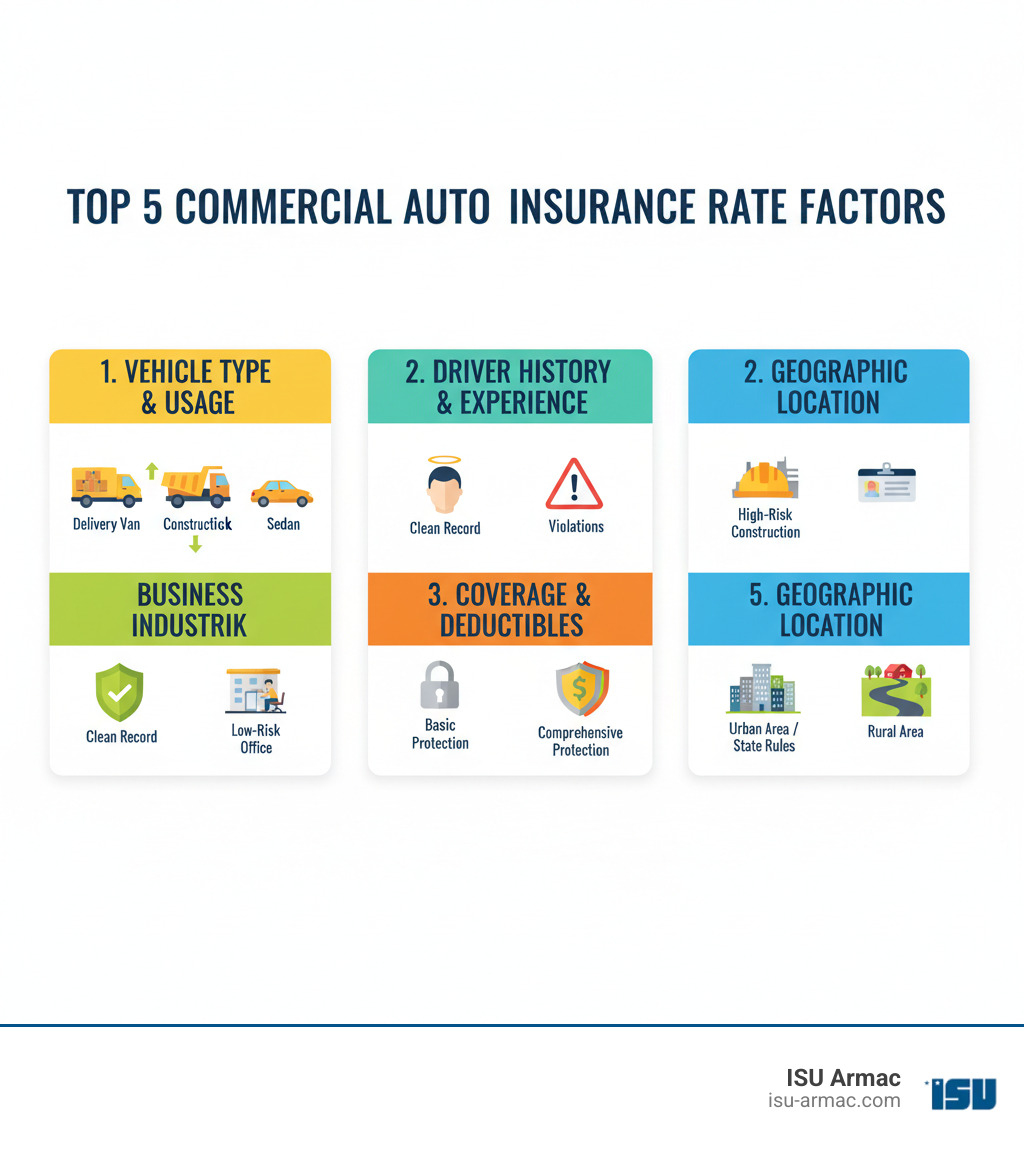
- Vehicle Type: Light vans cost $600-$1,500/year vs. heavy trucks at $5,000-$15,000/year
- Business Use: Delivery, construction, and for-hire services face higher rates
- Driver Records: Clean driving histories can save thousands annually
- Coverage Limits: Higher liability limits increase premiums but provide better protection
- Location: California rates vary significantly by city and county
- Claims History: Past accidents and claims directly impact future rates
The current average cost is around $147 per month or $1,762 per year for small businesses, but your actual rate depends on many factors unique to your operation.
Whether you’re a contractor in Victorville or run a delivery service across the High Desert, the right commercial auto coverage protects your business from financial disaster. I’m Ryan McEachron, CEO of ISU Insurance Services ARMAC Agency. With over two decades of experience helping Victorville businesses, I have a unique insight into the challenges our community faces with commercial vehicle insurance.
Related content about commercial auto insurance rates:
- what does commercial auto insurance cover
- when do i need commercial auto insurance
- do i need both commercial and personal auto insurance
What’s the Difference Between Commercial and Personal Auto Insurance?
Many business owners wonder if their personal auto policy is enough. The short answer is no. Commercial auto insurance is a distinct product designed for the greater risks of business use.
The primary difference is the scope of coverage and liability limits. Personal policies are for individual use, while commercial policies are built for business operations. This means commercial insurance has significantly higher liability limits—often $1 million or more—to protect your business assets from substantial claims. A personal policy’s limits are typically much lower.
Another key distinction is who and what is covered. Commercial policies cover employees driving company vehicles, which a personal policy would deny. They also cover a broader range of vehicle types, from standard cars to specialized equipment like tow trucks or flatbeds. Finally, commercial policies address business-specific risks like transporting goods or passengers, which personal policies ignore. For more details, see our guide on Do I Need Both Commercial and Personal Auto Insurance?.
| Feature | Personal Auto Insurance | Commercial Auto Insurance |
|---|---|---|
| Coverage Limits | Lower, designed for individual risk | Higher, designed for business and public risk |
| Covered Drivers | Named individuals and household members | Employees, owners, and sometimes temporary drivers |
| Covered Vehicles | Personal cars, SUVs, light trucks (non-business use) | Any vehicle used for business, including specialized vehicles |
| Cost | Generally lower, based on personal driving habits | Generally higher, based on business risk, usage, and industry |
| Primary Use | Commuting, personal errands, recreational | Transporting goods/people, job site travel, service delivery |
| Liability | Protects personal assets | Protects business assets, covers employee actions |
Commercial Auto vs. Fleet Insurance
While both protect business vehicles, commercial auto and fleet insurance serve different scales of operation.
Commercial auto insurance typically covers one or a few vehicles, with each rated individually. This is ideal for small businesses with a few vehicles.
Fleet insurance is a specialized policy covering five or more vehicles under a single master policy. This bundling offers cost management and administrative efficiency. Insurers assess the fleet’s overall risk, which can lead to more competitive commercial auto insurance rates through bulk discounts. A fleet policy streamlines paperwork with one renewal date and can include fleet-wide safe driving discounts, making it beneficial for businesses in Apple Valley, Victorville, and Hesperia with multiple vehicles.
Understanding the Key Factors That Influence Commercial Auto Insurance Rates

Commercial auto insurance rates are not one-size-fits-all. Insurers perform a detailed risk assessment, blending dozens of factors to create your unique premium. Understanding these factors empowers you to manage costs effectively. Your individual business needs shape every aspect of your policy, from the vehicles you use to the industry you’re in. For more on pricing, see our guide on How Much Does Commercial Auto Insurance Cost and Investopedia’s explanation of What is an insurance premium?.
Vehicle Type, Use, and Location
Your vehicles and how you use them are primary factors in your commercial auto insurance rates.
- Vehicle Make, Model, and Weight: Newer, more expensive vehicles cost more to repair and insure. Heavier vehicles (over 10,000 lbs Gross Vehicle Weight) pose a greater risk in accidents, leading to significantly higher rates. A light van might cost $600-$1,500 annually, while a heavy truck can be $5,000-$15,000.
- Specialized Equipment: Add-ons like ladder racks, refrigeration units, or hydraulic lifts increase a vehicle’s value and risk, raising premiums.
- Use and Location: Your radius of operation and annual mileage directly impact risk. A local High Desert business faces different risks than one hauling to Los Angeles. Your garaging location also matters, as urban areas often have higher rates of theft and accidents. California rates are also influenced by state-level requirements, such as increased minimum liability limits.
Driver History and Experience
Your drivers’ records are critical to your insurance costs. Insurers scrutinize Motor Vehicle Records (MVRs) for speeding tickets, accidents, and other violations. Clean driving records are essential for keeping rates down.
Years of experience and driver age are also key. Younger drivers (under 25) typically face higher rates. Thorough employee screening, including MVR checks, is a smart investment that protects your business and lowers premiums. Additionally, training drivers on the dangers of distracted driving and enforcing strict policies can prevent accidents and keep rates in check.
Your Business Industry and Claims History
Your industry and claims history paint a clear picture of your risk profile.
Industry risk levels vary dramatically. A consultant using a car for meetings is low-risk, while construction, delivery services, or for-hire trucking are high-risk. This is reflected in premiums, which can range from $600 for a consultant’s car to over $15,000 for a commercial truck.
The goods you transport also affect risk. Hauling expensive electronics, hazardous materials, or perishable goods increases potential liability and theft risk.
Your past claims frequency and severity directly impact future premiums. A history of at-fault accidents, frequent small claims, or a single severe claim will lead to surcharges and the loss of claims-free discounts. Conversely, a clean claims history qualifies you for better rates with preferred carriers.
Decoding Your Commercial Auto Policy: Coverages Explained
Your commercial auto policy is a multi-layered safety net. The policy structure starts with legally required coverages and adds optional layers to address real-world risks. Customizing your policy to match your business needs is key—it’s not about finding the cheapest option, but the right protection. Our guide on What Does Commercial Auto Insurance Cover offers a deeper look.
Mandatory Coverages
Every California policy must include these mandatory coverages. However, state minimums often provide insufficient protection for a serious accident.
- Bodily Injury Liability: Covers medical bills, lost wages, and legal fees if your business vehicle injures someone. California’s minimums ($30k/person, $60k/accident) are often too low for business assets.
- Property Damage Liability: Pays for damage your vehicle causes to someone else’s property. The state minimum of $15,000 may not cover the cost of modern vehicles or property repairs.
- Uninsured/Underinsured Motorist: Protects you if an at-fault driver has little or no insurance. It covers medical expenses and sometimes vehicle damage.
- Medical Payments: Pays for medical expenses for you and your passengers, regardless of who is at fault.
Optional Coverages for Improved Protection
While mandatory coverages keep you legal, optional coverages protect your business from financial loss.
- Collision Coverage: Pays to repair or replace your vehicle after an accident, regardless of fault. Without it, you pay for repairs out-of-pocket.
- Comprehensive Coverage: Covers non-collision events like theft, vandalism, fire, or storm damage. This is vital if vehicles are parked at job sites.
- Hired and Non-Owned Auto: A crucial coverage that protects your business when employees use their personal vehicles or rental cars for work errands.
- Trailer Coverage: It’s important to ensure trailers are properly insured, whether you own them or not. Our article Are Trailers Covered Under Commercial Auto Insurance explains this in detail.
- Rental Reimbursement: Pays for a rental vehicle while yours is being repaired after a covered loss, keeping your business operational.
- Towing and Labor: Covers towing and roadside assistance, minimizing downtime when a vehicle breaks down.
Balancing your commercial auto insurance rates with the right level of protection is essential. Skimping on coverage to save money can lead to devastating costs later.
How to Lower Your Commercial Auto Insurance Premiums
Managing your commercial auto insurance rates isn’t just about finding the lowest price; it’s about securing solid protection without overpaying. Smart business owners focus on proactive cost management to get the right coverage at the best price. At ISU Armac, we help Victorville businesses find this balance by shopping multiple carriers. For more on finding affordable options, see our guide on Who Has the Cheapest Commercial Auto Insurance.
Actionable Savings Strategies
Most strategies for reducing your commercial auto insurance rates also make your business safer and more efficient.
- Hire safe drivers: Prioritize employees with clean driving records (no accidents or violations in 3-5 years). This is one of the most effective ways to lower your risk profile and premiums.
- Implement a safety program: Regular driver training and clear policies on issues like phone use show insurers you are committed to preventing accidents, often earning you a discount.
- Choose vehicles wisely: Opt for standard work trucks or vans over expensive, high-performance vehicles unless they are essential. Cheaper vehicles cost less to repair and insure.
- Increase your deductible: Raising your deductible from $500 to $1,000 or more can significantly lower your premium. Ensure your business can cover the higher out-of-pocket cost.
- Bundle policies: Insuring your commercial auto, general liability, and other business policies with the same carrier often open ups multi-policy discounts.
- Pay your premium in full: Paying annually instead of monthly reduces administrative costs for the insurer, and they often pass those savings on to you.
- Install telematics or GPS: These devices track driving behavior. Safe driving data can earn you discounts, and GPS can help recover stolen vehicles and optimize routes.
Combining several of these strategies is the most effective way to achieve substantial savings on your insurance costs.
Frequently Asked Questions about Commercial Auto Insurance Rates
What are the average commercial auto insurance rates?
There’s no single answer, as rates depend entirely on your business, vehicles, and drivers. However, we can provide some benchmarks. The national average for small businesses is around $147 per month or $1,762 per year. But this average includes a wide range of operations.
Your actual costs will vary based on risk:
- Low-Risk (Consultants, etc.): $600 to $1,500 per vehicle, per year.
- Light Commercial (Delivery Vans, Pickups): $1,000 to $1,500 per vehicle, per year.
- Livery (Taxis, Limos): $2,000 to $6,000 per vehicle, per year, due to higher liability.
- High-Risk (Heavy Trucking): $5,000 to $15,000+ per vehicle, per year.
The median cost is often lower than the average because a few very expensive trucking policies skew the average upward. Your specific commercial auto insurance rates will be unique to your business’s risk profile.
Does a commercial auto policy cover personal use of a work vehicle?
Yes, most commercial auto policies cover “incidental” personal use of a work vehicle. This means occasional, limited trips like picking up groceries on the way home or a weekend errand.
However, the specifics are critical. Some policies have restrictions on the amount of personal use or who is allowed to drive. It’s crucial to clarify this with your agent to ensure you are covered and avoid a denied claim. This is different from using a personal vehicle for business, which almost always requires commercial coverage. For a complete explanation, read our guide: Does Commercial Auto Insurance Cover Personal Use.
How does my claims history impact commercial auto insurance rates?
Your claims history is a primary factor in determining your commercial auto insurance rates. Insurers view past claims as an indicator of future risk.
- At-fault accidents, especially those with severe injuries or damage, have the biggest negative impact.
- Claim frequency is also critical. Multiple small claims can be more damaging than one large one, as it suggests ongoing risk management issues.
- Claim severity (the total dollar amount) plays a major role. A history of costly claims will lead to higher premiums.
A poor claims history results in surcharges and the loss of claims-free discounts. These impacts typically last for three to five years. A strong safety program and a clean claims history moving forward are the best ways to rebuild your reputation with insurers and lower your rates over time.
Get the Right Coverage at the Best Rate
Finding the right commercial auto insurance rates means balancing cost with comprehensive protection. As we’ve covered, one-size-fits-all policies don’t work for businesses. Your landscaping company in Victorville has different risks than a consultant in Apple Valley, which is why custom coverage is essential.
This is where an independent agent provides immense value. At ISU Armac, we work for you, not a single insurance company. We shop multiple carriers to compare policies and find the ideal intersection of coverage and price. We understand the unique challenges facing businesses in the High Desert and know which carriers offer the best value for your industry.
Working with an experienced agent goes beyond just finding a good rate. We help you understand your policy, identify coverage gaps, and adapt your insurance as your business evolves. Don’t gamble with your financial security or overpay for the wrong protection. Let our team put our expertise to work for you.
Get a personalized business auto insurance quote today and find how ISU Armac can help you drive confidently while keeping more money in your business.