
Why Young Driver Insurance Is So Expensive
Car insurance quotes young driver searches reveal a harsh reality: new drivers face some of the highest insurance premiums on the road. Young drivers aged 16-24 pay up to 3-5 times more than experienced drivers, with monthly costs ranging from $28 to $100 or potentially much higher depending on location and coverage.
Quick Answer for Young Driver Insurance Quotes:
- Average Cost: Young drivers pay $28-$100+ monthly (can be 4-5x more than experienced drivers)
- Why So Expensive: Account for 25% of collisions despite being only 10% of drivers
- Best Ways to Save: Compare quotes, consider parent’s policy, complete driver training, choose safe vehicles
- When Rates Drop: Typically at age 25 with clean driving record and insurance history
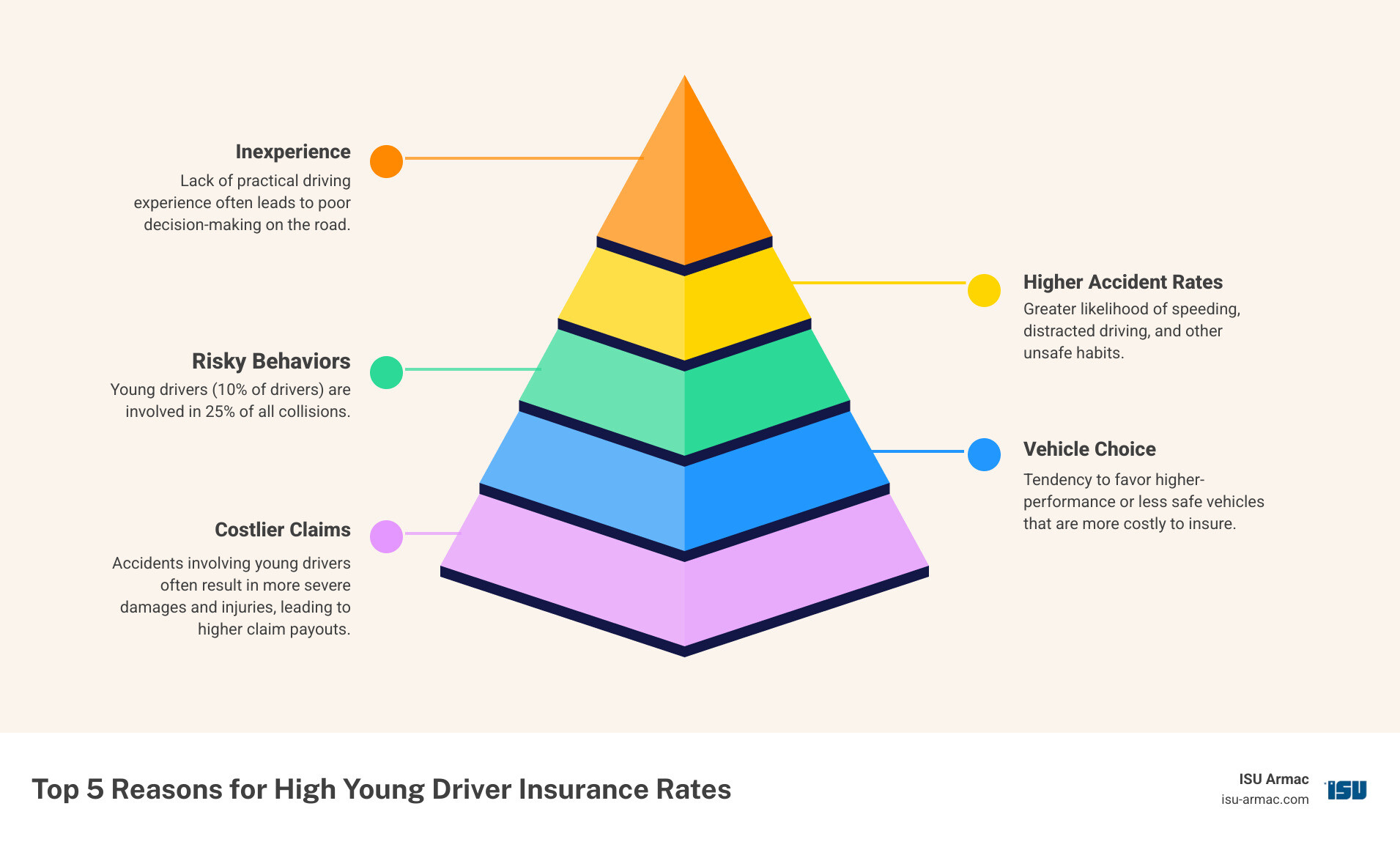
The statistics behind these high costs are sobering. Young drivers account for only 10% of drivers on the road, but are involved in roughly 25% of collisions. This dramatic overrepresentation in accident statistics, a fact supported by data from agencies like the CDC: Teen Drivers and NHTSA teen driving, directly translates to higher premiums, as insurance companies use historical data to assess risk.
Several factors drive these higher costs beyond just age. Insurance companies consider young drivers high-risk due to their inexperience, tendency to engage in riskier driving behaviors, and statistically higher likelihood of filing claims. The type of vehicle chosen, geographic location, and coverage options all play crucial roles in determining final premium costs.
I’m Ryan McEachron, Chief Executive Officer of ISU Insurance Services ARMAC Agency in Victorville, and I’ve helped countless young drivers and their families steer car insurance quotes young driver challenges over my decades in the insurance industry. My experience has shown me that while young driver insurance is expensive, there are proven strategies to significantly reduce these costs while maintaining proper protection.
Basic car insurance quotes young driver glossary:
Key Factors That Determine Your Insurance Premium

When we look at car insurance quotes young driver, it quickly becomes clear that many variables are at play. Insurance companies are master statisticians, and they assess a wide range of factors to determine how much risk you pose as a driver. Understanding these factors is the first step toward finding more affordable rates. These include your driving record, the type of vehicle you drive, and even your personal details.
Your Driving Record and Experience
Your driving history is perhaps the most significant predictor of your future insurance costs. Insurers want to see that you’re a responsible driver, and a clean record speaks volumes.
A clean driving record is your golden ticket to lower premiums. If you have a history free of tickets, accidents, or claims, insurance companies see you as less of a risk. This is particularly crucial for young drivers, as building a clean record from the start can dramatically impact rates once you gain more experience. Conversely, at-fault accidents and traffic violations will almost certainly lead to increased premiums. An accident, even a minor one, can significantly increase your premium, and an unfavorable history can have long-term consequences on your insurance costs. Our goal is always to help you maintain a spotless record.
Your years licensed directly correlate with your experience level. Insurance companies generally consider drivers under 25, or those who passed their test less than a year ago, as inexperienced. The longer you’ve been a licensed driver without incidents, the more favorable your rates will become.
Another powerful tool for young drivers is completing driver training courses. While not always mandatory, a government-approved driver’s training program can prepare you for the road, improve your safety, and, crucially, help reduce your car insurance costs. Many insurers offer discounts ranging from 10% to 25% for completing such courses, as it demonstrates a commitment to safe driving.
The Vehicle You Drive
Believe it or not, the car you choose to drive plays a huge role in your insurance premium. It’s not just about how flashy it looks; it’s about how risky it is to insure.
Car safety ratings are a big consideration. Vehicles with high safety ratings, equipped with advanced safety features, tend to be cheaper to insure because they reduce the risk of injury and severe damage in an accident. For independent safety evaluations, see IIHS ratings. On the other hand, sports cars vs. sedans is a classic example of vehicle choice impacting premiums. Sports cars, with their higher horsepower and perceived higher risk of speeding, typically fall into higher insurance groups and cost significantly more to insure. Choosing a less powerful, more affordable car, like a compact sedan or a small SUV, can significantly reduce your insurance premiums. The lower the insurance group of a car, the cheaper it is to insure.
The vehicle age and associated repair costs also factor in. Older, less valuable cars might allow you to opt for basic mandatory coverage, potentially saving you money, especially if the cost of full coverage outweighs the car’s value. However, some older vehicles might have higher repair costs due to parts scarcity, which could offset some savings.
Finally, installing anti-theft devices can make a difference. If your car is fitted with an alarm, immobilizer, or another validated security device, it may help to reduce your car insurance quotes young driver costs, as it lowers the risk of theft.
Personal and Policy Details
Beyond your driving habits and vehicle, several personal and policy-specific details influence your premiums.
Your age and gender are fundamental factors. As we’ve mentioned, if you are under 25, you are considered a young driver and will pay more than older, more experienced drivers. While some regions have restrictions on using gender as a factor, where permitted, it can influence rates.
Your geographic location is also critical. Living in a densely populated area like Southern California, including our local communities of Victorville, Apple Valley, or Hesperia, can mean higher rates due to increased traffic congestion, higher accident rates, and greater risk of theft or vandalism. Conversely, areas with lower population density and crime rates often see lower premiums.
The impact of your credit score on insurance rates for young drivers is another important consideration. While not all states allow insurers to use credit scores, in those that do, a good credit score can lead to discounts. Some insurers view a higher credit score as an indicator of responsibility, potentially translating to lower premiums. It’s always worth inquiring about potential advantages related to your credit score.
The deductible amount you choose directly affects your premium. A deductible is the amount you pay out-of-pocket before your insurance coverage kicks in. If you increase your voluntary excess (deductible) from, say, $500 to $1,000, your overall premium will decrease. This is because you’re taking on more of the initial risk. However, it’s crucial to choose a deductible you can comfortably afford in case you need to make a claim.
Finally, your coverage limits play a role. While liability coverage is mandatory, opting for higher limits or adding comprehensive and collision coverage will increase your premium. We always recommend balancing cost with adequate protection to ensure you’re fully covered in unexpected situations.
How to Find the Best Car Insurance Quotes for a Young Driver

Navigating car insurance quotes young driver can feel like a quest for the Holy Grail, but we’re here to tell you it’s entirely possible to find affordable options. The secret lies in smart shopping, leveraging discounts, understanding modern policy options like telematics, and knowing whether a standalone policy or being on a parent’s plan is right for you.
Comparing Quotes: The #1 Way to Save
This cannot be stressed enough: comparing quotes from multiple providers is the single most effective way to find affordable car insurance for a young driver. Premiums vary greatly depending on your profile, and what one company considers high-risk, another might view more favorably. We’ve seen how important it is to compare offers, with some smaller companies even offering better quotes.
The benefits of comparing are clear: you uncover the wide range of rate variations across the market. Don’t settle for the first quote you receive. As a young driver, you’re viewed as a higher risk, so insurers price you differently. What might be a competitive rate from one insurer could be significantly undercut by another.
This is where using a broker becomes invaluable. As an independent agency, we have the unique ability to shop multiple carriers on your behalf. We can compare car insurance quotes from various providers, saving you time and effort while ensuring you see the full spectrum of available rates. Our goal is to help you find the best value – the right balance between comprehensive coverage and an affordable price. We check the prices, so you don’t have to!
Top Discounts for Young Drivers
Beyond comparing rates, savvy young drivers can significantly reduce their premiums by taking advantage of various discounts:
- Good Student Discount: If you maintain excellent grades (typically a B average or higher), many insurers offer a discount. This shows responsibility and can lead to savings.
- Driver’s Ed Discount: As mentioned earlier, completing a government-approved driver training course can lead to substantial discounts, often ranging from 10-25% off your premiums.
- Distant Student Discount: If you’re a student living away from home (e.g., at college or university) and only use the family car occasionally when visiting, you might qualify for a discount as an “occasional driver” on your parent’s policy.
- Bundling Policies: One of the easiest ways to save is by bundling your car insurance with other policies, like home insurance or renters insurance, from the same provider. Many insurers offer a multi-line discount if you insure your car and apartment with them.
- Usage-Based Insurance (UBI): Also known as telematics or “black box” insurance, UBI programs track your driving habits (speed, braking, mileage). If you’re a safe driver, you can earn significant discounts – some programs offer up to 10% instantly for signing up and up to 25% off with proven safe driving results. If you’re between 16-24 with little or no driving history, UBI could be your best bet for affordable rates.
- Alumni Discounts: If you’re a college graduate, check if your alma mater has partnerships with insurance companies that offer exclusive rates to alumni.
Your Own Policy vs. Your Parent’s: What’s the Right Choice?
This is one of the most common questions we hear from young drivers and their parents. Should a young driver get their own policy, or be added to a parent’s existing one? The answer depends on several factors, including vehicle ownership, residency, and how much the young driver uses the car.
Generally, if you can, using your parent’s policy is often the path to pay the least amount of money for insurance. If you live at home and your parents are listed as the owners of the car you’re driving, you can usually be added to their policy as a named driver. This can be much more cost-effective than a separate policy.
However, there are important considerations:
| Feature | Individual Policy for Young Driver | Added to Parent’s Policy |
|---|---|---|
| Cost | Significantly higher premiums; you are the primary risk factor. | Generally much more affordable; you benefit from the parent’s driving history and multi-car discounts. |
| Coverage | You choose your own coverage limits, which might be lower to save money. | You typically share the coverage limits of the parent’s policy, which are often higher and more comprehensive. |
| Building History | Immediately starts building your own independent insurance history. | Helps build an insurance history, but a standalone policy can be more impactful for future rates. |
| Responsibility | You are fully responsible for payments and managing the policy. | The parent is the policyholder; an accident on your part will impact their rates and record. |