
Why Understanding Car Insurance Costs Matters Before You Buy
A car insurance cost estimator is an online tool that provides a quick preview of your potential insurance costs before you contact an agent. If you’re looking to estimate your insurance costs, here’s what you need to know:
Quick Answer: How to Use a Car Insurance Cost Estimator
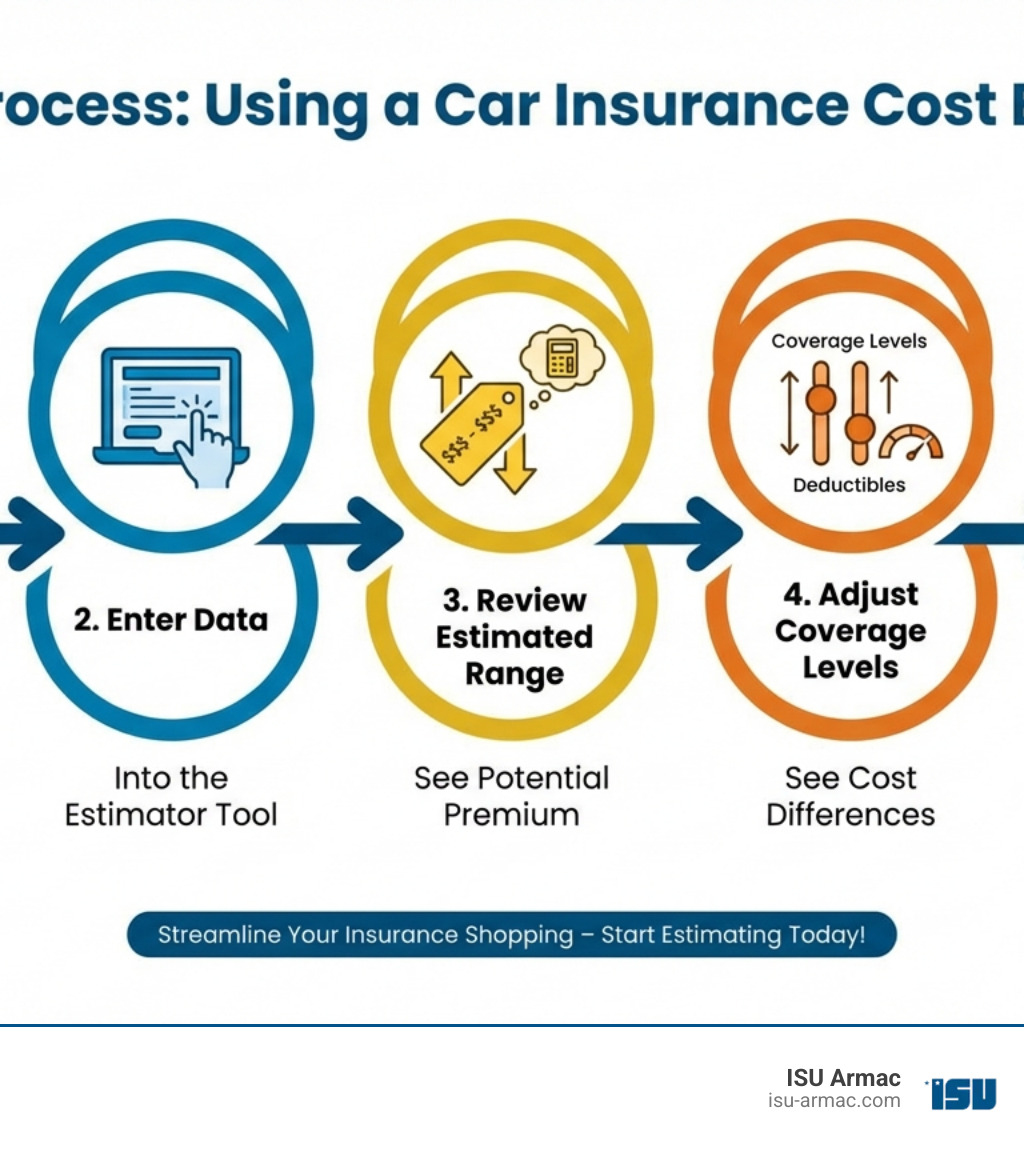
- Enter your ZIP code – Location is a primary factor in your rate.
- Provide vehicle details – Make, model, year, and VIN.
- Share driver information – Age, marital status, and driving history.
- Select coverage levels – Liability limits, deductibles, and optional coverages.
- Compare estimates – Review results from multiple insurers to find the best rate.
Car insurance costs vary widely. The national average for full coverage is $2,301 per year, but a driver in New York might pay nearly $200 more per month than one in Wyoming. Similarly, a 16-year-old can pay over $450 more monthly than a 60-year-old for the same coverage. Estimating your costs beforehand is crucial to avoid overpaying.
Many people pay too much for car insurance because they don’t shop around. An estimator lets you see potential rates in minutes without sharing your contact information with multiple companies. You can test different coverage levels and see how your vehicle choice affects rates.
The catch? An estimate is a ballpark figure, not a final quote. The actual price can change once an insurer pulls your driving record, checks your credit score (in most states), and reviews your full insurance history.
I’m Ryan McEachron, CEO of ISU Insurance Services ARMAC Agency in Victorville. I’ve seen how a car insurance cost estimator helps High Desert residents budget effectively and prevent sticker shock. Let me walk you through how these tools work and how to use them to find your best rate.
What is a Car Insurance Estimator and How Does It Work?
A car insurance cost estimator is your first step to understanding what you’ll pay for coverage. Instead of calling multiple insurance companies, you can get a ballpark figure in minutes online. While not a final price, it’s incredibly useful for budgeting and comparing options.
Here’s how it works: you provide basic information about yourself, your vehicle, and your desired coverage. The estimator’s algorithm compares your profile against large databases of average rates and risk factors. It’s a simplified, faster version of how insurance companies calculate premiums, answering the question, “What do people like me typically pay?”
The value of these tools lies in their no-commitment nature. You can test scenarios like, “What if I bought a sedan instead of a truck?” or “How much would my rate drop if I increased my deductible?” It’s a safe way to explore options before starting the formal quoting process.

How Estimators Calculate Premiums
Estimators use the same core principles as insurers: rating factors and statistical analysis. They begin with broad state-level data and narrow it down to your ZIP code. Living in Victorville versus Hesperia can mean different rates due to unique local patterns of accidents, theft, and traffic.
The estimator then weighs key factors. Your vehicle type is significant; a sports car costs more to insure than a family sedan because it presents more statistical risk. Driver demographics like age and marital status also play a role, as actuarial data shows different accident rates among groups.
Your driving history is also considered, though estimators use self-reported information like “clean record” or “one accident” rather than pulling your official record. This keeps the process quick and anonymous while providing a reasonably accurate picture.
Each estimator’s formula is slightly different, as insurers weigh these factors differently. One may prioritize a vehicle’s safety ratings, while another focuses on a ZIP code’s claim history, explaining why you might see different estimates for the same profile.
The Difference Between an Estimate and a Real Quote
Understanding the gap between an estimate and a real quote is crucial. An estimate is a starting point based on average rates and general information. It’s quick, anonymous, and non-binding. Think of it as window shopping to get a sense of the market.
A real quote is the actual price an insurer will charge. To get one, we need detailed information: your driver’s license number, vehicle VIN, complete driving record, and insurance history. In most states, insurers also check a credit-based insurance score, though California prohibits this practice.
This detailed information allows for a personalized risk assessment. The quote you receive is a binding offer, typically valid for 30 days, assuming the information is accurate. It’s the actual price you’ll pay.
An estimate tells you what houses in a neighborhood generally sell for. A real quote is the specific offer you receive after a full inspection.
| Feature | Car Insurance Estimate | Real Car Insurance Quote |
|---|---|---|
| Purpose | Ballpark figure, budgeting, comparison | Firm offer, purchase decision |
| Accuracy | Approximation, average rates | Precise, binding for a period |
| Information Req. | General (ZIP, age range, vehicle type) | Detailed (DLN, VIN, full history, credit) |
| Binding? | No | Yes |
| Credit Check? | No | Often (where allowed by law) |
| Driving Record? | No, self-reported general history | Yes, official pull |
Key Factors That Influence Your Car Insurance Estimate
Many factors influence your car insurance cost estimator results, and they can vary significantly even within Southern California. For example, while the national average for full coverage is $2,301 a year, California car insurance averages around $2,115 per year. Location is a major driver of these differences.
What Information Does a Car Insurance Cost Estimator Need?
To provide an accurate estimate, a car insurance cost estimator needs several key details. Having this information ready will make the process smoother and the results more reliable:
- Your Driver’s Age: A major factor, as younger and older drivers typically face higher rates.
- Marital Status: Married individuals often receive slightly lower rates.
- Your Vehicle’s Make and Model: The type of car you drive significantly impacts your premium.
- Your Vehicle Identification Number (VIN): This allows the estimator to pull specific details about your car’s features.
- Annual Mileage: How much you drive affects your risk exposure.
- Garaging Address (ZIP Code): Where your vehicle is primarily parked is a critical factor in determining local risk.
- Desired Coverage Levels: You’ll select the type of coverage (e.g., liability, full coverage) and sometimes specific limits and deductibles.
Providing accurate information is crucial, as even small discrepancies can lead to an estimate that’s far from your actual quote.
How Your Profile and Vehicle Affect the Estimate
Your personal profile and the car you drive are two of the biggest levers affecting your car insurance costs. Insurers use these factors to assess the likelihood of you filing a claim.
Age and Experience: This is a huge one. A 16-year-old driver costs an average of over $450 more monthly than a 60-year-old driver for the same coverage because statistics show younger drivers are more likely to be in accidents. Rates generally decrease with age and experience.
Driving Record: A clean driving record with no accidents or tickets will almost always result in lower premiums. Conversely, a history of violations will significantly increase your rates. As time passes and your record improves, your rates can come down.
Credit-Based Insurance Score: In most states, insurers use a credit-based insurance score as a rating factor. However, California, Hawaii, and Massachusetts prohibit insurers from using credit scores when determining car insurance rates. For our clients in Victorville, Apple Valley, Hesperia, and Oak Hills, your credit score will not impact your auto insurance premium.
Vehicle Type: What you drive matters.
- Safety Ratings: Cars with higher safety ratings often qualify for lower premiums.
- Repair Costs: Vehicles with expensive parts or complex technology (like luxury or electric cars) cost more to repair, leading to higher comprehensive and collision premiums. For instance, insuring a Subaru Outback costs an average of $1,427 annually, compared to $2,231 for a Tesla Model 3.
- Theft Rates: Cars that are frequently stolen will have higher comprehensive coverage costs.
- Age of Vehicle: As a vehicle ages and loses value, premiums for comprehensive and collision coverage often decrease.
How to Use a Car Insurance Cost Estimator to Find Cheaper Rates
The average driver often overpays for car insurance by not shopping around. A car insurance cost estimator is a powerful tool to change that. Instead of spending hours on the phone, you can get a snapshot of potential rates in minutes.
Think of an estimator as a research tool that lets you see what different coverage levels might cost before you commit. You can test scenarios—like increasing your deductible or dropping comprehensive coverage on an older vehicle—without any sales pressure.
We encourage our clients in Victorville, Apple Valley, Hesperia, and Oak Hills to use estimators for their annual insurance review. Life changes like paying off a car loan or bundling policies can lead to significant savings, and an estimator helps you spot those opportunities.
Bundling is one of the smartest moves you can make. Combining your auto insurance with a homeowners or renters policy usually earns a substantial discount. If you’re curious about protecting your home while saving on your auto policy, check out our home insurance services to see how bundling could work for you.
The best part of using an estimator is that you remain in control. You gather information to make a smart decision for your budget without unwanted calls or emails.
Getting the Most Accurate Estimate
The key to a reliable estimate is simple: be honest and precise. Fudging numbers on a speeding ticket or your annual mileage will only lead to a misleading estimate and wasted time when you seek a real quote.
- Provide accurate data for everything the estimator asks: your age, exact ZIP code, vehicle details, and driving history.
- Update your information whenever something significant changes, like getting married, moving, or buying a new car.
- Your annual mileage matters. The average driver logs about 12,400 miles. If you drive less, you might qualify for a low-mileage discount.
- Include all household drivers who will use the car. Leaving drivers off will give you a lower estimate but will cause issues when getting an actual policy.
The more precise your inputs, the closer your estimate will be to reality.
Understanding the Limitations of an Estimator
Estimates are not final offers. An estimator provides a ballpark figure based on averages. The real price is determined only after an insurer pulls your driving record, reviews your insurance history, and applies its specific rating formula.
Furthermore, most discounts aren’t included in initial estimates. You might qualify for good student, safe driver, or anti-theft device discounts that can add up to significant savings. This means your real quote could even be lower than the estimate once all available discounts are applied.
Unique circumstances, like owning a classic car or having advanced safety features, are also hard for an estimator to capture. An agent can account for these nuances. Finally, market conditions fluctuate, and rates can change. The data feeding an estimator might not be perfectly current, creating small variances.
An estimator is a fantastic research tool, but it’s not a substitute for getting a real quote from a licensed agent who can find all applicable discounts and provide a firm price.
Determining Your Coverage Needs and When to Use an Estimator
One of the most valuable features of a car insurance cost estimator is its ability to help you determine your coverage needs. It’s not just about price; it’s about getting the right protection.
Every state has minimum insurance requirements, but these often provide very limited protection. For example, California’s minimums are $30,000 for injury to one person, $60,000 for injury to more than one person, and $15,000 for property damage. A serious accident could easily exceed these limits, leaving you personally liable for the rest.
This is where “full coverage” comes in. This term typically refers to a policy that includes liability, comprehensive, collision, and uninsured/underinsured motorist protection. We often recommend liability insurance sufficient to cover your net worth. An estimator can help you balance cost and protection.
How Can a Car Insurance Cost Estimator Help Determine Coverage?
An estimator is a great tool for playing “what if” with your coverage:
- Compare Coverage Costs: Toggle between minimum liability and full coverage to see the price difference. A policy with maximum full coverage costs an average of almost $400 more monthly than minimum coverage, helping you weigh cost against risk.
- Adjust Liability Limits: See how increasing your liability limits (e.g., from $25k/$50k to $100k/$300k) affects your premium. Often, significantly more protection costs only a little more per month.
- Evaluate Collision and Comprehensive: If you own your car outright, an estimator shows how much these coverages add to your premium, helping you decide if they’re worth the cost for an older vehicle.
- Price Optional Coverages: Add options like roadside assistance or rental car reimbursement to see their impact on the estimated cost.
By seeing these cost variations, you can make more informed decisions about the right coverage for you and your family in the High Desert.
How Often Should You Use an Estimator?
We recommend using a car insurance cost estimator regularly as your life evolves.
- Annual Policy Review: Use an estimator annually before your policy renewal. Rates and discounts change, so it’s good to ensure you’re still getting a competitive price.
- Significant Life Events: Check for new estimates when life changes occur:
- You get married or buy a new home (bundling opportunities).
- You purchase a new car.
- You add a teen driver to your policy.
- You move to a new ZIP code, as rates can change even within the High Desert.
Regularly checking with an estimator keeps you informed and empowered to find savings or adjust your coverage as needed.
Frequently Asked Questions about Car Insurance Estimators
Here are answers to some of the most common questions we hear from our clients in Victorville, Apple Valley, Hesperia, and Oak Hills about car insurance cost estimators.
What is the main purpose of a car insurance cost estimator?
The main purpose is to give you a realistic ballpark figure of what you might pay for car insurance. It’s a research tool for budgeting and comparison shopping before you get formal quotes. It allows you to explore how different factors, like vehicle choice or adding a new driver, might impact your premium without any commitment.
Why do estimates vary so much between different calculators?
Estimates vary because each calculator uses its own dataset, algorithm, and weighting system. One tool might pull from a database that heavily weighs recent accident data in your ZIP code, while another might focus more on your vehicle’s safety ratings. These formulas mirror the diverse rating systems of different insurance companies, leading to different results for the same profile.
This variation is why working with an independent agency like ISU Armac is so valuable. We shop multiple carriers, each with their own rating system, to compare real quotes and find you the best actual rate, not just an estimate.
Can I get an accurate estimate without providing personal information?
You can get a general estimate, but its accuracy depends on the level of detail you provide. Using just a ZIP code, age range, and vehicle type will give you a rough figure, which is useful for initial research. However, for an estimate that more closely reflects what you’ll actually pay, you need to be more specific.
Sharing your exact vehicle details (including VIN), a complete driving history, and desired coverage levels will yield a much more reliable estimate. For a truly accurate and binding price, nothing beats a real quote. If you’re concerned about privacy, working with a trusted agency is a great solution. At ISU Armac, we handle your information with care to shop multiple carriers for you, and you can even get an auto insurance quote without personal information through our initial process to explore options comfortably.
Conclusion
A car insurance cost estimator is an invaluable tool for making smarter decisions about your coverage. It demystifies the factors that drive your premium, from your ZIP code in the High Desert to the type of car you drive. It turns a confusing process into something manageable.
However, an estimate is just that—an estimate. It’s a starting point for budgeting and comparison, but it isn’t the final price. The real savings and best protection are found when you move from an estimate to an actual quote, where all your unique circumstances and available discounts are applied.
That’s where our team at ISU Armac comes in. As your local agents in Victorville, Apple Valley, Hesperia, and Oak Hills, we have the expertise to shop multiple carriers on your behalf. We find every discount you qualify for and deliver personalized quotes that match your needs.
A car insurance cost estimator gives you knowledge; we help you turn that knowledge into results.
Ready to turn your estimate into actual savings? Let’s find you the best coverage at the lowest rate.