
Why Understanding California Business Insurance Requirements is Critical for Every Business Owner
California business insurance requirements can seem overwhelming, but getting them right is essential for protecting your business and staying compliant with state law. Whether you’re just starting out or have been in business for years, understanding what coverage you need – and what could happen if you don’t have it – is crucial for your success.
Here are the core California business insurance requirements every business owner needs to know:
- Workers’ Compensation Insurance – Required for ALL businesses with employees (even part-time)
- Commercial Auto Insurance – Mandatory for any business-owned vehicles
- Professional Liability (E&O) – Required for LLCs and many licensed professionals
- Industry-Specific Coverage – Contractors, cannabis businesses, and other industries have special requirements
California is home to over 4.1 million small businesses that employ 7.5 million people – nearly 99.8% of all businesses in the state. With this massive business community comes strict insurance regulations designed to protect workers, customers, and the public.
The consequences of not having proper coverage go far beyond fines. You could face:
- Heavy penalties and stop-work orders
- Personal liability for employee injuries or customer damages
- Inability to get contracts or professional licenses
- Financial ruin from a single lawsuit or accident
I’m Ryan McEachron, CEO of ISU Insurance Services ARMAC Agency, and I’ve helped countless Victorville area businesses steer California business insurance requirements for over two decades. Having served on the Victorville City Council and worked extensively with local business owners, I understand the unique challenges you face in meeting these requirements while keeping costs manageable.
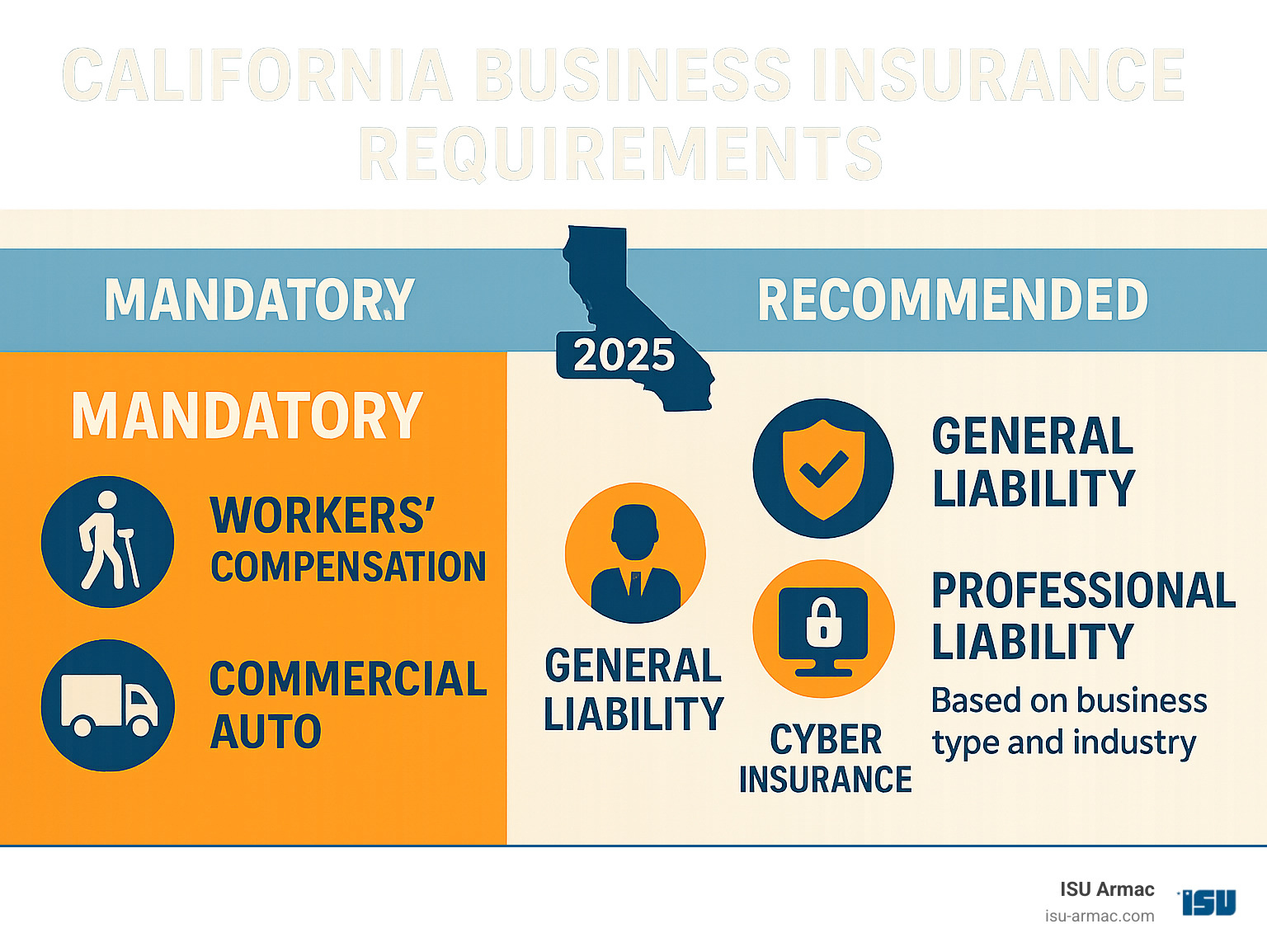
Quick look at California business insurance requirements:
- what is small business insurance
- how to get small business insurance
- liability insurance for a small business
Understanding the Core California Business Insurance Requirements

When you’re running a business in California, certain insurance policies aren’t optional – they’re the law. Think of these California business insurance requirements as the foundation of your business protection plan. Without them, you’re not just taking a financial risk; you’re breaking state law.
The penalties for skipping required coverage can be devastating. We’re talking about hefty fines, stop-work orders that can shut down your operations, and even personal liability that puts your own assets at risk. As someone who’s helped hundreds of Victorville area businesses steer these waters, I’ve seen how the right coverage protects your business assets while keeping you on the right side of the law.
Navigating California Business Insurance Requirements for Employees
Here’s something that surprises many new business owners: the moment you hire your first employee – even if it’s just part-time or seasonal help – you’re legally required to carry Workers’ Compensation insurance. This is one of the most critical California business insurance requirements, and there’s no wiggle room here.
Workers’ Compensation operates on a no-fault system, which means your employees get coverage for medical expenses, lost wages, and disability benefits regardless of who caused the workplace injury. This might sound expensive, but it actually protects you from potentially devastating lawsuits. Without it, you could be personally liable for every penny of an injured employee’s medical bills and lost income.
The average cost runs around $62 per month in California, though your actual premium depends on your industry and safety record. Some contractors – particularly those in roofing, tree service, or HVAC work – need Workers’ Compensation even if they work alone. The state considers these trades so inherently risky that sole proprietors must carry coverage.
Recent changes in California law have also expanded workers’ rights, requiring employers to inform employees about their right to legal counsel for workers’ compensation issues. Staying compliant means keeping up with these updates and ensuring your policy meets all current requirements.
Not having this coverage when required isn’t just a civil matter – it’s a misdemeanor offense that can result in significant fines and legal consequences. For detailed guidance, check out the Workers’ Comp FAQs from the CA Dept. of Industrial Relations.
Decoding California Business Insurance Requirements for Vehicles
If your business owns, leases, or regularly uses vehicles for work purposes, commercial auto insurance becomes another non-negotiable part of your California business insurance requirements. Your personal auto policy won’t cut it here – most personal policies specifically exclude business use, leaving you completely exposed.
Commercial auto insurance covers the big risks: accidents, theft, vandalism, and weather damage involving your business vehicles. California sets minimum liability limits that every business must meet: $15,000 for bodily injury per person, $30,000 for bodily injury per accident, and $5,000 for property damage per accident.
But here’s where it gets tricky – what about when your employees use their own cars for business errands? Or when you rent a vehicle for a business trip? That’s where Hired and Non-Owned Auto (HNOA) coverage becomes essential. Without it, your business could face massive liability if an accident happens during business use of a vehicle you don’t own.
I’ve helped countless businesses in Apple Valley, Victorville, and Hesperia understand these nuances. The key is making sure every possible vehicle scenario is covered, so you’re never caught off guard. You can learn more about the specifics at California’s minimum auto insurance requirements.
Beyond the Mandates: Industry-Specific and Recommended Coverage

While Workers’ Compensation and Commercial Auto insurance form the foundation of California business insurance requirements, the real world of business protection goes much deeper. Your clients, landlords, and industry peers expect more comprehensive coverage – and frankly, smart business owners demand it too.
Think of these additional policies as your business’s safety net. They catch the risks that mandatory coverage doesn’t address, from customer lawsuits to cyber attacks. In my years helping Victorville area businesses, I’ve seen too many owners learn the hard way that “legally compliant” and “properly protected” are two very different things.
General & Professional Liability: Protecting Against Lawsuits
General Liability insurance is like having a good lawyer on retainer – you hope you’ll never need it, but you’ll be grateful it’s there when trouble strikes. While not always legally mandated, most commercial landlords and many clients won’t work with you without it. This coverage protects your business when customers get injured on your property, when your work accidentally damages someone else’s property, or even when you’re accused of libel and slander in your advertising.
The average cost runs about $42 per month in California – a small price for protection against potentially devastating lawsuits. I’ve seen a simple slip-and-fall claim cost a business owner tens of thousands in legal fees alone, even when they weren’t at fault.
Professional Liability insurance, also called Errors & Omissions (E&O), is essential if you provide advice, services, or expertise to clients. This coverage steps in when clients claim your work mistakes or negligence caused them financial harm. At around $71 per month on average, it’s particularly crucial for consultants, accountants, real estate agents, software developers, architects, engineers, lawyers, and healthcare providers.
For LLCs in California, E&O insurance often becomes a legal requirement rather than just a smart choice. The state requires LLCs providing professional services to maintain financial security, typically through an E&O policy, with minimum coverage of $100,000 per licensee over $500,000, up to $5 million maximum.
Specialized Coverage for Modern Risks
Today’s business world brings risks our grandparents never imagined. Cyber Liability insurance has become essential as hackers target small businesses three times more often than large corporations. With California’s strict data breach laws requiring businesses to notify affected residents when security breaches occur, the costs can escalate quickly.
This coverage helps with data breach costs, client notification expenses, credit monitoring services, legal fees, and regulatory fines. When your customer data is compromised, cyber insurance becomes your lifeline.
Commercial Property insurance protects your physical assets from fire, theft, vandalism, and weather damage. It covers your building (if you own it), equipment, inventory, and furniture. For home-based businesses, this is particularly important since your homeowner’s policy likely excludes business property and activities. You can find more info about home insurance for home-based businesses to understand these gaps.
Industry-Specific Mandates: Contractors and Cannabis
Some industries face unique California business insurance requirements that go beyond the standard mandates.
Contractors operate under particularly strict rules. Even sole proprietors in specific trades like roofing, HVAC, and tree service must carry Workers’ Compensation insurance despite having no employees. The state also requires a $25,000 contractor license bond, and most clients demand specific General Liability coverage levels before you can even bid on projects.
The cannabis industry faces its own specialized requirements. Licensed cannabis businesses must maintain general liability insurance with $2 million aggregate limits and $1 million per occurrence limits, plus post a $5,000 surety bond. These requirements reflect both the regulatory complexity and inherent risks in this emerging industry.
Understanding these industry-specific needs isn’t just about compliance – it’s about building a sustainable business that can weather the storms and capitalize on opportunities. Whether you’re swinging hammers in Hesperia or running a tech startup in Apple Valley, having the right coverage mix gives you the confidence to focus on what you do best.
Managing Insurance Costs and Finding the Right Policy

Let’s be honest – meeting California business insurance requirements can feel like a balancing act between protecting your business and protecting your budget. As someone who’s worked with countless small businesses in Apple Valley, Oak Hills, and throughout the High Desert, I understand that every dollar matters. The good news? There are smart strategies to manage your insurance costs without cutting corners on coverage.
Key Factors That Influence Your Insurance Premiums
Your insurance premiums aren’t pulled out of thin air – they’re calculated based on specific risk factors that insurance companies have refined over decades. Understanding these factors helps you make informed decisions about your coverage.
Industry risk plays a huge role in your premiums. A construction company naturally faces different risks than a bookkeeping service, and insurance rates reflect that reality. If you’re in a higher-risk industry, don’t despair – there are still ways to manage costs through proper safety protocols and loss prevention.
The number of employees on your payroll directly impacts your Workers’ Compensation costs. More employees typically mean higher premiums, but it also means your business is growing – which is a good problem to have. What matters is ensuring each employee is properly classified for their actual job duties.
Your business location matters more than you might think. A business in downtown Los Angeles faces different risks than one in rural Victorville. Crime rates, natural disaster exposure, and even local traffic patterns all factor into your premiums. While you can’t change your location, understanding how it affects your rates helps you budget appropriately.
Your claims history tells insurers a lot about your future risk. A clean record with few or no claims can lead to better rates over time. This is why investing in safety training and preventive measures pays dividends beyond just protecting your employees and customers.
Coverage limits and deductibles give you direct control over your premiums. Higher coverage limits mean higher premiums, but they also mean better protection when you need it most. Similarly, choosing a higher deductible can significantly lower your monthly costs – just make sure you can comfortably cover that amount if a claim occurs.
Years of experience in business work in your favor. Established businesses with proven track records often qualify for better rates than brand-new ventures. If you’re just starting out, don’t worry – those better rates will come as you build your business history.
How to Save Money and Compare Quotes
Smart business owners know that managing insurance costs isn’t about finding the cheapest policy – it’s about finding the best value. Here’s how to do it right.
Bundling policies often provides significant savings. A Business Owner’s Policy (BOP) combines General Liability and Commercial Property insurance into one package, typically costing less than buying these coverages separately. It’s designed specifically for small to medium-sized businesses and often includes additional benefits like business interruption coverage.
Choosing higher deductibles can dramatically reduce your premiums. If your business has healthy cash flow and emergency reserves, this strategy makes financial sense. Just remember – your deductible is what you’ll pay out of pocket before insurance kicks in, so choose an amount you can handle without straining your operations.
Risk management programs are investments that pay for themselves. Workplace safety training reduces Workers’ Compensation claims. Security systems lower property insurance costs. Employee background checks can reduce liability exposure. Insurance companies reward businesses that actively work to prevent losses.
Shopping around remains one of the most effective ways to save money on California business insurance requirements. Insurance rates can vary significantly between carriers, even for identical coverage. What makes one business attractive to one insurer might make it less appealing to another – that’s why comparison shopping is so valuable.
Working with an independent agent like ISU Armac gives you access to multiple insurance carriers through one relationship. Instead of calling dozens of companies yourself, we do the legwork for you. We compare quotes, explain coverage differences, and help you understand exactly what you’re buying. Because we’re independent, we work for you, not for any single insurance company. We can also help you verify that any agent you work with is properly licensed through the California Department of Insurance, ensuring you’re working with qualified professionals who understand the nuances of California’s insurance landscape.
Frequently Asked Questions about California Business Insurance
What happens if I don’t have the required business insurance in California?
The consequences of not having proper California business insurance requirements in place can be devastating for your business. I’ve seen too many business owners in the High Desert area learn this lesson the hard way, and it’s never pretty.
Fines and penalties are just the beginning of your troubles. Operating without Workers’ Compensation insurance, for example, is actually a misdemeanor offense in California. The state doesn’t mess around when it comes to protecting workers, and they’ll hit you with substantial fines that can quickly drain your business bank account.
But it gets worse. State authorities can issue stop-work orders that literally shut down your operations until you get compliant. Imagine having to tell your customers you can’t serve them, your employees they can’t work, and your vendors that orders are on hold – all because you didn’t have the right insurance coverage.
Personal liability is perhaps the scariest consequence. Without proper coverage, you’re personally on the hook for damages, medical costs, and legal fees. This means your house, your savings, your retirement accounts – everything you’ve worked for – could be at risk if someone gets hurt or sues your business.
Many business owners don’t realize that contracts and licenses often depend on having adequate insurance. That big client you’ve been courting? They’ll walk away the moment they find you don’t have the required coverage. Professional licenses can be suspended or revoked, effectively putting you out of business.
The ultimate nightmare scenario is financial ruin from a single uninsured incident. One serious workplace injury, one major lawsuit, or one significant property damage claim could force you to close your doors forever. It’s simply not worth gambling with your livelihood.
What is a Business Owner’s Policy (BOP) and is it right for my small business?
A Business Owner’s Policy is like getting a combo meal at your favorite restaurant – you get more coverage for less money than if you ordered everything separately. A BOP bundles together the most essential protections small businesses need: Commercial Property Insurance to protect your physical assets, General Liability Insurance to cover third-party claims, and typically Business Interruption Insurance to help replace lost income if you have to temporarily close due to a covered incident.
This bundled approach is cost-effective and designed specifically for small to medium-sized businesses operating in lower-risk industries. If you run a retail store, restaurant, office, or service business here in Victorville or the surrounding areas, a BOP could be perfect for you.
The beauty of a BOP is its simplicity. Instead of juggling multiple policies with different renewal dates and coverage terms, you have one comprehensive policy that covers your most common risks. It’s particularly appealing for busy business owners who want solid protection without the complexity.
However, BOPs aren’t right for every business. High-risk industries like construction or manufacturing typically need more specialized coverage. That’s where we come in – we’ll assess your specific operations and risks to determine if a BOP provides adequate coverage or if you need a more customized approach.
For More info about Business Owner’s Policies, we’re always happy to walk you through the details and help you understand if this option makes sense for your unique situation.
What resources are available to help me understand my obligations?
You don’t have to steer California business insurance requirements alone – there are plenty of resources available to help you understand exactly what you need. The key is knowing where to look and how to interpret the information for your specific business.
The California Department of Insurance (CDI) is your primary go-to resource. They’re the state’s insurance watchdog, and their website is packed with guides, consumer information, and tools to help you understand your obligations. You can even verify that any agent you’re considering working with is properly licensed.
The Small Business Administration (SBA) offers excellent general guidance for small business owners, including comprehensive information on insurance and risk management strategies. They understand the unique challenges small businesses face and provide practical advice that actually makes sense.
For anything related to Workers’ Compensation, the Department of Industrial Relations (DIR) is your best friend. They oversee all the Workers’ Comp laws in California and provide detailed resources for employers trying to understand their obligations. Their website breaks down complex regulations into digestible information.
The Commercial Insurance Guide from the CDI is particularly valuable – it’s like having a roadmap for understanding commercial insurance in California.
While these resources are incredibly helpful, interpreting how they apply to your specific business can still be challenging. That’s where working with an experienced independent agent like us makes all the difference. We stay current on all the regulations and requirements, and we can translate that complex information into a clear action plan for your business. Whether you’re in Apple Valley, Hesperia, or anywhere in Southern California, we’re here to help you make sense of it all.
Secure Your California Business for a Confident Future

Getting your California business insurance requirements right isn’t just about following the law – it’s about building a solid foundation for your company’s future. When you have the right coverage in place, you can focus on what really matters: growing your business and serving your customers.
We’ve covered a lot of ground together in this guide. You now understand that Workers’ Compensation and Commercial Auto insurance aren’t optional if you have employees or business vehicles. You know that General Liability and Professional Liability coverage can save your business from devastating lawsuits. And you’ve learned that specialized coverage like Cyber Liability and Commercial Property insurance addresses the modern risks every business faces.
The truth is, every business in Southern California faces unique challenges. A tech startup in Apple Valley has different risks than a construction company in Hesperia. A home-based consultant in Oak Hills needs different protection than a retail store in Victorville. That’s why cookie-cutter insurance solutions rarely work.
This is where proactive risk management makes all the difference. When you take the time to understand your specific risks and get proper coverage, you’re not just protecting your assets – you’re investing in your peace of mind. You’re ensuring that one accident, lawsuit, or cyber attack won’t wipe out everything you’ve worked to build.
As independent insurance agents at ISU Armac, we don’t work for the insurance companies – we work for you. This means we can shop multiple carriers to find coverage that fits your budget without cutting corners on protection. We’ve helped hundreds of businesses steer California business insurance requirements, and we understand the unique challenges facing companies throughout the High Desert region.
The cost of proper insurance is always less than the cost of being uninsured when disaster strikes. Don’t wait until it’s too late to find gaps in your coverage or find out you’re not meeting legal requirements.
Get expert help with your commercial insurance needs and let us help you build an insurance program that grows with your business and protects what matters most.