
Why California Earthquakes Are a Real and Present Danger
The Shaky Ground Beneath: Why California is Earthquake Country
California isn’t called “Earthquake Country” for nothing! It sits right on one of our planet’s most active seams, where two gigantic pieces of the Earth’s crust are constantly on the move. To truly grasp why CA earthquakes are such a regular part of life here, we need to dive into the amazing, sometimes a little scary, world of plate tectonics.
Our Earth’s tough outer shell, called the lithosphere, isn’t one solid piece. Think of it more like a cracked eggshell, broken into several enormous plates. These plates are always, ever so slowly, gliding across the softer, molten rock beneath them. California finds itself smack dab in the middle of this slow-motion collision between two of these giants: the Pacific Plate and the North American Plate. While the North American Plate is generally heading southwest, the Pacific Plate is cruising northwest, actually carrying parts of California, like Los Angeles and San Diego, along for the ride! This creates an incredible, constant grind where these plates rub against each other, building up immense pressure.
The main stage for this geological drama is the world-famous San Andreas Fault system. But don’t picture just one straight line! It’s actually a sprawling network of faults stretching over 800 miles across California. The San Andreas itself is primarily a “strike-slip” fault. Imagine two cars scraping sides on a narrow road – that’s how these two sides slide horizontally past each other. This is different from other plate boundaries, like “subduction zones,” where one plate dives right under another. For instance, off the Pacific Northwest coast, the Juan de Fuca plate (a remnant of the ancient Farallon plate) is doing just that.
Beyond the main San Andreas, California is crisscrossed by a whole host of other significant major fault zones, each with the potential to release powerful CA earthquakes.
- Take the Hayward Fault Zone, for example. It snakes right through the busy East Bay area of San Francisco, making it one of California’s most closely watched and potentially dangerous faults. It’s known for “seismic creep,” a slow, continuous movement that can gently shift buildings over time, but it also has a history of major, sudden ruptures. Here’s a sobering thought: as of December 2024, the Hayward Fault is 156 years overdue for a major earthquake, having exceeded its average return period of 130 years. Talk about running on borrowed time!
- Then there’s the San Jacinto Fault Zone in Southern California. This one is often called the “sister” to the San Andreas and is one of the most active faults in the entire state.
- And let’s not forget the particularly sneaky Blind Thrust Faults. Unlike the San Andreas, which is often visible on the surface, these faults are hidden deep underground. They cause the Earth’s crust to compress and buckle, pushing land upwards. The devastating 1994 Northridge earthquake, which caused billions in damages in Los Angeles, was triggered by a previously unknown blind thrust fault, proving that even hidden dangers can pack a massive punch.
Scientists are constantly studying these fault systems to better understand the earthquake probability of future CA earthquakes. Tools like the Uniform California Earthquake Rupture Forecast (UCERF) help us estimate where and when future quakes might occur. For instance, there’s a significant 70% probability that a fault in the San Francisco Bay Area will experience a 6.7 Mw (Moment Magnitude) or greater earthquake before 2030. These probabilities serve as a powerful reminder of our geological reality. For a deeper look into global fault systems, we encourage you to explore resources like this one.
A History of Tremors: California’s Most Impactful Earthquakes
Understanding CA earthquakes isn’t just about rocks and faults; it’s also a fascinating journey through California’s history. How we’ve understood and reacted to the shaking ground has changed a lot over time, often after a really big tremor forced us to learn.
The very first recorded earthquake in California was way back in 1769. Spanish explorers and missionaries from the Portolá expedition noted it in their journals. Can you imagine being among the first Europeans to feel California’s famous shakes? For a long time, these events were often seen as just part of nature, or even acts of a higher power.
As California grew, especially after the Gold Rush, the sheer number and strength of these tremors became impossible to ignore. By the late 1800s and early 1900s, people started to study them scientifically. But it took one truly massive event – the 1906 San Francisco earthquake – to really kickstart serious government research into CA earthquakes. This huge quake led to the creation of places like the Caltech Seismological Laboratory. Here, brilliant minds like Charles Richter and Harry Wood developed important tools, like the Richter scale, to measure earthquakes. Today, we mostly use the Moment Magnitude (Mw) scale, which gives us an even better idea of the total energy released, especially for bigger quakes.
Notable Historical CA Earthquakes
California’s story is marked by powerful CA earthquakes that have literally reshaped the state – its buildings, its laws, and its spirit. Here are some of the most impactful:
- 1906 San Francisco Earthquake (7.9 Mw): This giant hit on April 18, 1906. It’s still one of the biggest natural disasters in U.S. history. While the shaking was awful, it was the fires that followed, fed by broken gas lines and no water, that caused most of the damage and deaths. Estimates vary, but over 3,000 people may have died. This event was a huge wake-up call, pushing the U.S. government to finally take earthquake research seriously.
- 1933 Long Beach Earthquake (6.4 Mw): This quake wasn’t as huge, but it caused a lot of damage, especially to older, brick buildings. Critically, it badly damaged many public schools. This led to a major change in building rules, directly creating the Field Act, which made sure all public schools in California were built to withstand earthquakes.
- 1989 Loma Prieta Earthquake (6.9 Mw): This quake struck during the World Series! It caused big damage across the San Francisco Bay Area, including parts of the Bay Bridge collapsing. Sixty-three people died, and damages were estimated around $6 billion. This event really showed how vulnerable older buildings and areas on soft ground were, leading to more efforts to strengthen existing structures.
- 1994 Northridge Earthquake (6.7 Mw): This devastating Southern California quake happened on January 17, 1994. It was caused by a fault nobody even knew about! While it didn’t last long, the shaking was incredibly intense in a busy area. It severely damaged apartment buildings and parking structures. Fifty-seven people died, over 8,700 were injured, and damages reached an estimated $40 billion, making it one of the costliest natural disasters in U.S. history.
- 2019 Ridgecrest Earthquakes (6.4 Mw and 7.1 Mw doublet): This pair of quakes hit a less populated part of the Mojave Desert. While only one person died, it caused significant damage to roads and buildings. It reminded us that even areas not directly on the famous San Andreas Fault can experience powerful CA earthquakes. Damages were estimated at $5.3 billion.
Lessons Learned and Policy Changes
The story of CA earthquakes is truly one of learning, often the hard way. For a while, people tried to downplay the risks, especially real estate developers who didn’t want to scare off buyers. But major quakes forced a big shift from pretending everything was fine to actually doing something about it.
The 1906 San Francisco earthquake, for instance, directly pushed the U.S. government to acknowledge the problem and start agencies focused on earthquake research. The 1933 Long Beach earthquake, with its impact on schools, directly led to the Field Act. Later, the 1971 San Fernando earthquake, which badly damaged hospitals, resulted in even stricter building standards for important places like fire stations, hospitals, and schools.
Other key laws and policy changes include:
- Alquist-Priolo Earthquake Fault Zoning Act (1972): This law stops people from building homes and other important structures directly on top of active fault lines. It’s about giving faults their space!
- Seismic Hazards Mapping Act (1990): This requires the California Geological Survey to map out areas prone to earthquake hazards like liquefaction (where soil acts like a liquid during shaking) and landslides. Local governments then use these maps for their planning.
- Hospital Facilities Seismic Safety Act (1973): This made sure that all hospitals in California meet very strict earthquake safety standards, because we need our hospitals to stand strong when we need them most.
These actions show how major CA earthquakes have truly shaped modern building codes and scientific study, making California a world leader in preparing for and living with seismic activity.
Building for Resilience: How California Mitigates Risk
Living in California means we’re constantly reminded of the dynamic forces beneath our feet. But instead of just reacting to CA earthquakes, we’ve learned to be proactive. Our state has poured significant effort into making our communities safer and more resilient, focusing on strong building practices, upgrading older structures, improving vital infrastructure, and educating everyone who calls this beautiful state home.
California’s building codes are truly world-class. They’re regularly updated, constantly learning from past quakes and incorporating the latest scientific breakthroughs. This means that homes and buildings constructed more recently are generally much better equipped to handle serious shaking than those built decades ago. It’s like giving our structures a modern, high-tech shield against seismic forces.
Of course, a big part of the challenge lies with the many older buildings that predate these tougher codes. That’s where “retrofitting” comes in. This process strengthens existing structures to make them more earthquake-resistant. A lot of focus has been placed on two key types of vulnerable buildings:
- Unreinforced Masonry (URM) Buildings: Think of old brick or stone buildings. Without proper reinforcement, they can be very dangerous during an earthquake. Many cities now have rules to ensure these buildings are either strengthened or, in some cases, taken down.
- Soft-Story Buildings: These are often apartment buildings with open ground floors, like those with carports or big retail spaces. Because the lower level lacks continuous walls, it can be very weak in a quake, sometimes leading to collapse. You’ll find many communities now requiring these types of buildings to be retrofitted.
Beyond our homes and workplaces, California has also made huge investments in its essential infrastructure. Bridges, overpasses, and critical lifelines like water and gas pipelines have all been reinforced. The goal? To make sure they can withstand strong shaking and stay functional after a major seismic event, keeping our communities connected and supplied.
Public education is another cornerstone of our preparedness efforts. Groups like the Earthquake Country Alliance (ECA) are fantastic examples of how public, private, and grassroots organizations work together. They’re dedicated to helping everyone in earthquake country get ready, offering resources and organizing activities. One of the most impactful initiatives is “The Great California ShakeOut,” an annual statewide earthquake drill. Millions of Californians participate, practicing the vital “Drop, Cover, and Hold On” technique. It’s a simple action that can save lives.

The Role of Science and Technology
Behind California’s impressive mitigation efforts is a powerful network of scientific and technological expertise. We’re fortunate to have some of the brightest minds and most advanced tools dedicated to understanding and preparing for CA earthquakes.
The Advanced National Seismic System (ANSS) is a nationwide network that keeps a constant eye on seismic activity, and California plays a huge part in its operations. The California Geological Survey (CGS) works tirelessly to study earthquakes, helping us make smart decisions about where and how we build our communities to be more earthquake-resistant. And then there’s the Southern California Earthquake Center (SCEC), a true leader in earthquake research, modeling, and outreach, pushing the boundaries of what we know about seismic events.
One of the most exciting advancements is the Earthquake Early Warning (EEW) system, better known as ShakeAlert. While it can’t predict when an earthquake will happen, it’s incredibly clever. It uses a vast network of seismic sensors to detect an earthquake as it starts. Then, it rapidly sends alerts to phones and other devices in areas that will soon experience shaking. This gives people precious seconds—sometimes even a minute—to “Drop, Cover, and Hold On” before the strongest shaking arrives. Those few seconds can make all the difference.
Scientists also use sophisticated models, like the Uniform California Earthquake Rupture Forecast (UCERF), to calculate the probability of earthquakes occurring in certain areas over a period of years. This helps us anticipate where future quakes might strike. These insights, along with the detailed National Seismic Hazard Maps, are absolutely vital. They help inform our building codes and guide land-use planning, ensuring that new construction is located and designed with our seismic realities firmly in mind.
Are You Prepared? A Practical Guide to Earthquake Safety
When the ground starts shaking beneath your feet, you won’t have time to Google “what to do during an earthquake.” That’s why personal preparedness is absolutely crucial for anyone living with CA earthquakes. While California’s building codes and early warning systems are impressive, your safety ultimately depends on the steps you take right now, before disaster strikes.
The Earthquake Country Alliance has developed the “Seven Steps to Earthquake Safety,” and these aren’t just bureaucratic recommendations – they’re life-saving actions that can make the difference between minor inconvenience and major catastrophe. Let’s walk through what really matters.
Securing your space is your first line of defense. That tall bookshelf in your living room? It needs to be bolted to the wall. Your water heater should be strapped down with metal bands – when these tip over, they don’t just break, they can cause gas leaks and flooding. Heavy picture frames, mirrors, and that massive flat-screen TV all need to be properly anchored. Think of it this way: anything that could fall and hurt someone needs to be secured.
Creating a family communication plan might sound boring, but it’s essential. Choose an out-of-state contact person who can coordinate information when local phone lines are jammed. Make sure everyone knows where to meet if you can’t get home. Practice “Drop, Cover, and Hold On” with your kids until it becomes second nature – this simple action protects you from the flying debris that causes most earthquake injuries.
Your emergency supplies should sustain your household for at least three days, though seven days is better. We’re talking about one gallon of water per person per day, non-perishable food, a battery-powered radio, flashlights, first aid supplies, and any necessary medications. Don’t forget a manual can opener – electric ones won’t help when the power’s out.
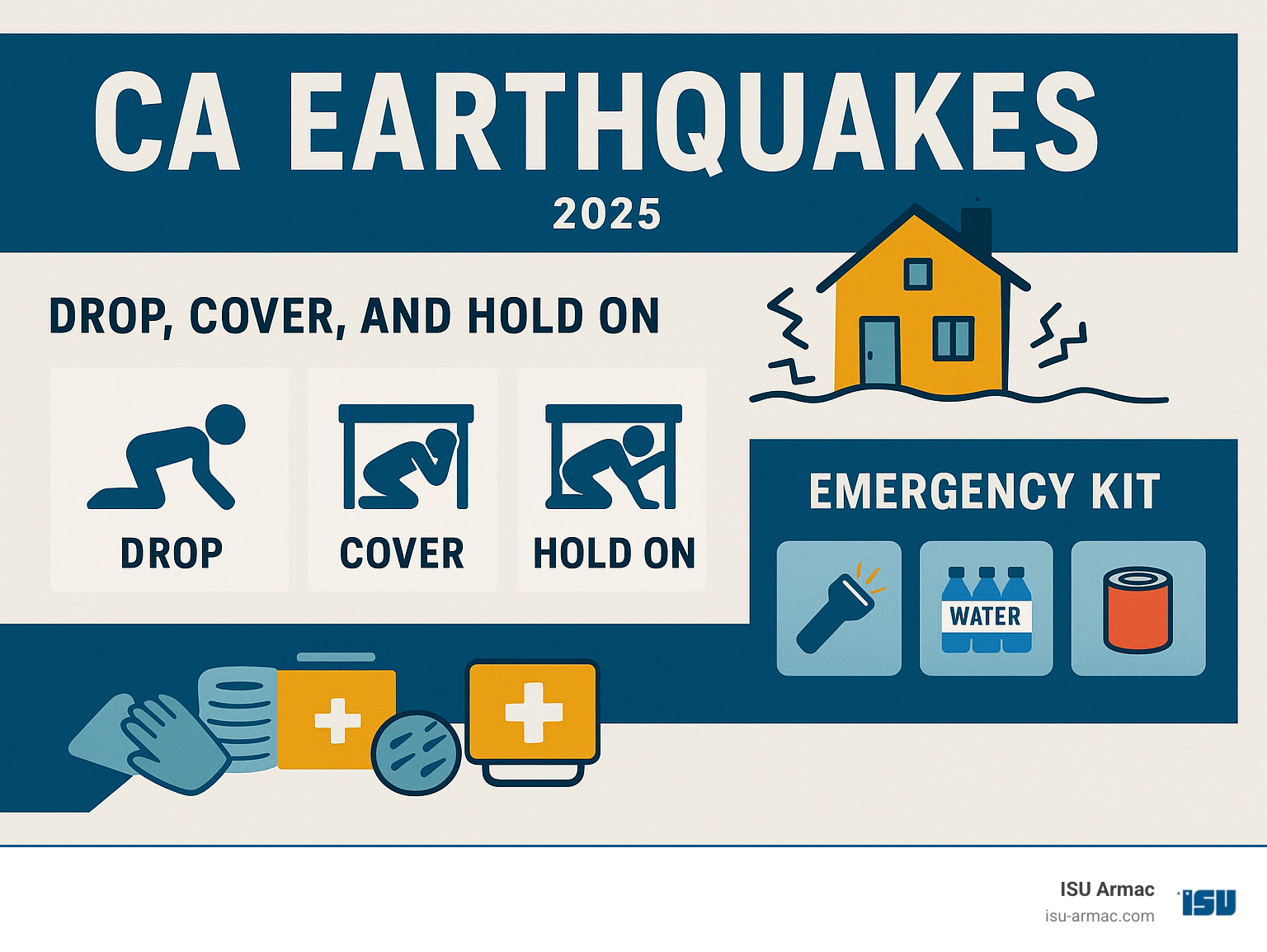
When an earthquake hits, remember: Drop, Cover, and Hold On. If you’re indoors, immediately drop to your hands and knees, take cover under a sturdy desk or table, and hold on to it while protecting your head and neck with your free arm. No sturdy furniture nearby? Crouch against an interior wall and cover your head. If you’re outside, move quickly to an open area away from buildings, power lines, and anything that could topple over.

Financial Preparedness for CA Earthquakes
Here’s where many Californians get a rude awakening: standard homeowners insurance doesn’t cover earthquake damage. That’s right – after a major quake destroys your home, your regular Home Insurance policy won’t pay a penny toward repairs or rebuilding. This isn’t fine print trickery; it’s a clear exclusion that catches thousands of homeowners off guard every time CA earthquakes strike.
The California Earthquake Authority (CEA) provides earthquake insurance policies specifically designed for California residents, but they’re not your only option. The key is understanding your risk level and choosing coverage that makes sense for your situation and budget.
Assessing your risk involves more than just knowing you live in California. Factors like your home’s age, construction type, and proximity to active faults all play a role in determining both your earthquake risk and insurance costs. Older homes, particularly those with unreinforced masonry or soft-story construction, face higher risks and may require retrofitting to qualify for coverage.
As an independent agency, ISU Armac can help you explore options for a separate Earthquake Insurance policy to protect your property and finances. We work with multiple carriers to find coverage that fits your needs and budget, because the last thing you want is to find you’re unprotected after the ground stops shaking.
Staying Informed About Current CA Earthquakes
Knowledge is power, especially when you’re living on some of the world’s most active fault lines. Staying informed about current seismic activity helps you understand the ongoing earthquake patterns in your area and can provide valuable context when the next big one hits.
The USGS Earthquake Hazards Program is your go-to source for real-time earthquake information. Their website shows current activity across California, with detailed maps and data about recent quakes. You can set up notifications for earthquakes in your area and access historical data to understand long-term patterns.
Caltech Seismological Laboratory and UC Berkeley Seismology Lab operate the seismic networks that monitor Southern and Northern California respectively. These institutions provide detailed scientific analysis of CA earthquakes and are often the first to provide expert commentary after significant events.
The “Did You Feel It?” reporting system run by the USGS lets you report your experience during an earthquake. This crowd-sourced data helps scientists understand how shaking intensity varies across different areas, contributing to better earthquake preparedness and building codes.
Don’t forget about tsunami warnings. While less common, major offshore earthquakes can generate tsunamis that threaten California’s coast. The West Coast & Alaska Tsunami Warning Center provides official warnings and evacuation information for coastal areas.
These resources aren’t just for earthquake nerds – they’re practical tools that help you understand the seismic reality of living in California. The more you know about earthquake activity in your area, the better prepared you’ll be when the next significant quake occurs.
Frequently Asked Questions about California Earthquakes
We get a lot of questions about CA earthquakes, and that’s perfectly normal! It’s a complex topic with a lot of moving parts (pun intended!). Let’s clear up some of the most common questions people ask.
What is the difference between magnitude and intensity?
This is a really important distinction when talking about CA earthquakes. Think of it this way:
Magnitude is like the strength of a light bulb. It measures the total energy released at the earthquake’s source, deep underground. It’s a single, fixed number for each earthquake, no matter where you are. For instance, we often hear about the Moment Magnitude scale (Mw), which gives us that core number.
Intensity, on the other hand, is like how bright that light bulb looks from where you’re standing. It describes how much shaking and damage you actually experience at a specific place. This can change a lot! If you’re right next to the earthquake, the intensity will be high. If you’re far away, it might be much lower. Local ground conditions also play a big role. For example, during the 1989 Loma Prieta quake, areas built on soft, unstable ground (like San Francisco’s Marina District) felt much stronger shaking and saw more damage than areas built on solid rock, even though they were both affected by the same earthquake. The Modified Mercalli Intensity (MMI) scale is what scientists use to describe this varying level of shaking.
Can we predict earthquakes?
This is the million-dollar question, and the answer is a clear no. Despite what you might wish for, or what you might hear in movies, scientists cannot predict the exact time, date, and location of a future earthquake. It’s simply not possible with our current technology and understanding.
However, we’re not completely in the dark! Scientists can use advanced forecasting models, like the Uniform California Earthquake Rupture Forecast (UCERF), to figure out the probability of an earthquake happening in a certain area over a period of years. This means they can tell us, for example, that there’s a 70% chance of a major quake in the San Francisco Bay Area before 2030. These probabilities are super important for long-term planning, like building codes and emergency preparedness. But remember, those fun stories about animals “predicting” quakes? They’re just myths!
Does a standard homeowners policy cover earthquake damage?
This is perhaps the most crucial piece of information for any California resident, and it’s where many people get caught off guard. The simple answer is no.
A standard Personal Lines Insurance or homeowners policy in California does not cover damage caused by CA earthquakes. This is a common misconception, and it’s why it’s so important to understand your coverage. If a major quake hits and you only have a standard policy, you could be facing massive repair bills or even the cost of rebuilding your home out of your own pocket.
To protect your property and finances from earthquake damage, you need a separate earthquake insurance policy. This is a specialized type of coverage designed specifically for the unique risks of seismic activity. We at ISU Armac strongly encourage you to talk with a knowledgeable insurance professional. We can help you understand your options and find the right protection for your home and peace of mind.
Conclusion: Securing Your Peace of Mind in Earthquake Country
Living here in California means we get to enjoy incredible beauty, amazing innovation, and a truly unique, dynamic landscape. But let’s be honest, CA earthquakes are an undeniable part of that reality. They’re a constant, gentle (or sometimes not-so-gentle!) reminder that we share our home with some incredibly powerful natural forces.
But this doesn’t have to be a source of constant worry or anxiety. Think of it less as a threat and more as a “quake up call” – a powerful nudge to empower ourselves with knowledge and take proactive steps. Throughout this guide, we’ve journeyed through the historical context, the fascinating geological reasons behind the shaking, and the most impactful events that have shaped our state. We’ve also seen how California has thoughtfully implemented measures to mitigate risks and continuously improve our collective preparedness. And, crucially, we’ve highlighted exactly where you can find current information and, most importantly, how you can prepare yourself and your finances for what lies ahead.
The truth is, the power of knowledge, combined with diligent preparation, is truly immense. Mitigation and building resilience are ongoing efforts, not just for the state as a whole, but for each one of us as individuals. Protecting your family and your hard-earned assets is absolutely paramount. So, we genuinely encourage you to take that next vital step: review your emergency plans, take the time to secure your home, and, critically, ensure your financial preparedness is rock-solid.
Ready to secure your property and truly gain that peace of mind? Explore your options for comprehensive Earthquake Insurance today. As an independent agency proudly serving Apple Valley, Victorville, Hesperia, Oak Hills, and communities throughout Southern California, we at ISU Armac are here to help you find the right coverage. We’ll ensure you’re fully protected from the next big one, so you can focus on enjoying all that California has to offer.