
Why Your Business Can’t Afford to Be Unprepared
Business interruption coverage is insurance that replaces lost income and covers ongoing expenses when your business is forced to close temporarily due to a covered event like a fire, windstorm, or theft. Here’s a quick overview:
- What it covers: Lost revenue, rent, payroll, loan payments, taxes, and relocation costs.
- How it works: Activates when physical damage from a covered peril forces you to suspend operations.
- Not standalone: Must be added to a commercial property insurance policy.
- Period of restoration: Standard coverage is 30 days but can be extended up to 360 days or more.
- Common exclusions: Pandemics, viruses, floods, earthquakes, and undocumented income.
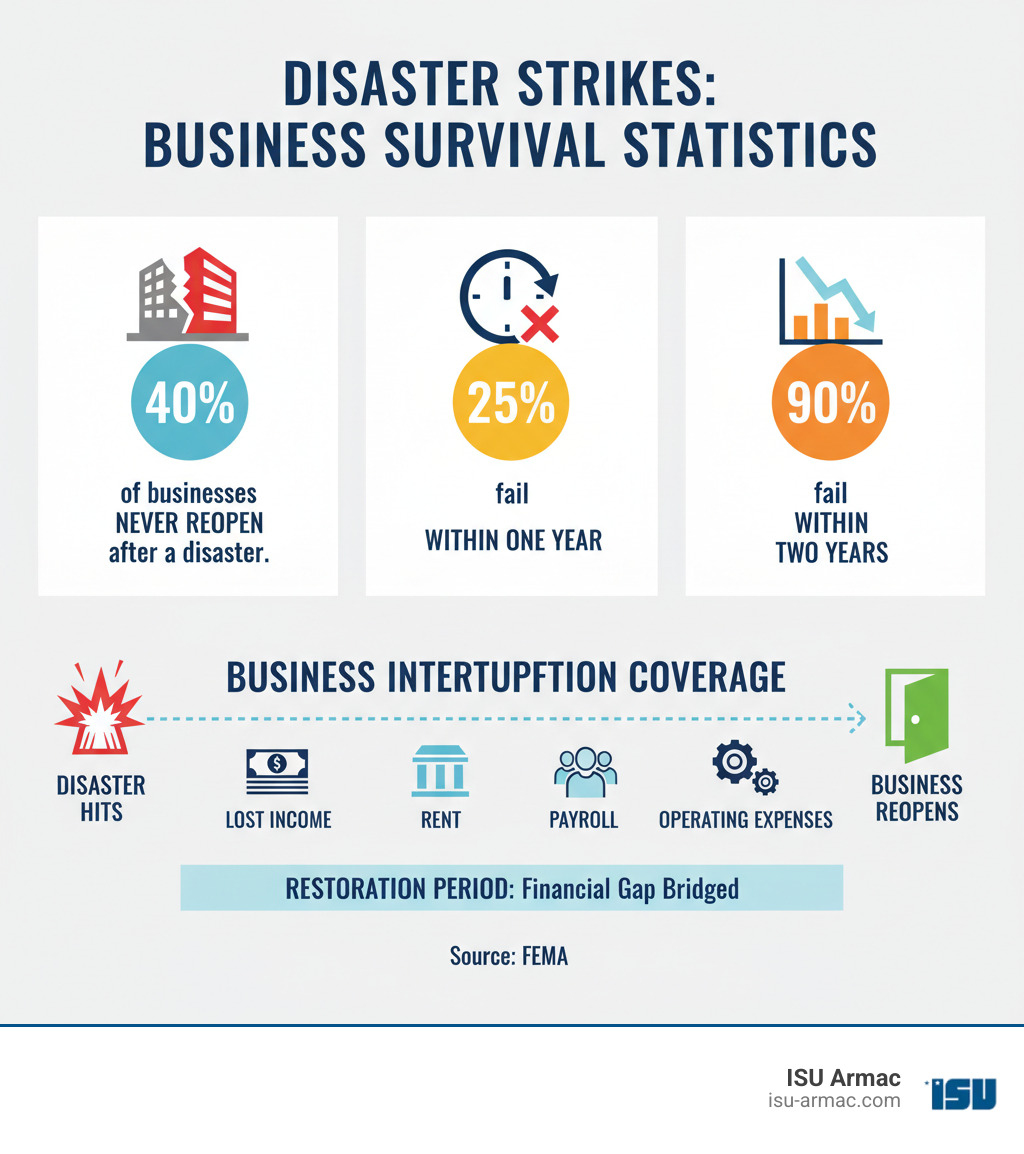
The stakes are high. According to FEMA, 40% of businesses that close following a disaster never open again, and another 25% fail within one year. More than 90% of businesses struck by a disaster fail within two years. These aren’t just numbers—they represent local business owners who thought they were protected until it was too late.
Business interruption coverage bridges the financial gap between disaster and reopening. While property insurance rebuilds your physical space, this coverage keeps money flowing to pay bills, retain employees, and maintain your market presence. Without it, many businesses close permanently, not from the damage itself, but from running out of money while waiting to reopen.
I’m Ryan McEachron, CEO of ISU Insurance Services ARMAC Agency. I’ve seen how this coverage saves businesses in Victorville and the High Desert. Our community faces unique risks, from wildfires to extreme weather, making comprehensive business interruption coverage essential to protecting your livelihood.
What is Business Interruption Insurance and Why Is It Crucial?

Imagine a fire damages your storefront. Your commercial property insurance will handle the rebuild—the walls, equipment, and inventory. But what about the income you’re losing while repairs drag on? How do you pay your staff, your rent, and your loan payments when no money is coming in?
This is where business interruption coverage becomes your financial lifeline. It’s not about fixing buildings; it’s about keeping your business financially alive while those buildings get fixed.
This coverage isn’t a standalone policy. It’s an add-on to your Commercial Property Insurance Guide and activates when a covered peril, like a fire or windstorm, forces you to close.
How Business Interruption Differs from Property Insurance
Property insurance covers direct losses—the physical damage to tangible assets like your building and merchandise. It pays for repairs and replacements.
Business interruption coverage handles indirect losses—the financial ripple effects of that damage. It replaces the income you would have earned and covers operational costs that continue during the shutdown. The two policies work as partners: one rebuilds your business, the other keeps it breathing.
The Critical Role in Post-Disaster Recovery
Many businesses that close after a disaster had property insurance to rebuild. What they lacked was the cash flow to survive months of zero revenue during construction. Business interruption coverage solves this problem by:
- Replacing Lost Income: It provides funds based on your historical financial records, so you can cover costs without draining your savings.
- Covering Operating Expenses: It helps pay for ongoing costs like rent, utilities, loan payments, and taxes.
- Retaining Employees: By covering payroll, it helps you keep your valuable team intact and ready for reopening.
- Maintaining Market Presence: It allows you to keep phone lines active and communicate with customers, showing your community you’re coming back.
This coverage provides invaluable peace of mind, allowing you to focus on recovery instead of worrying about making payroll. It doesn’t just help you survive; it helps you come back stronger.
Understanding Your Business Interruption Coverage Policy
Navigating the details of a business interruption coverage policy is key to ensuring you’re protected. Unlike simple property insurance, this coverage deals with financial projections and calculations. Understanding these components is crucial.

What specific losses does business interruption coverage include?
When a covered disaster forces you to close, business interruption coverage kicks in to cover your financial losses. This includes:
- Lost Net Income: The profit you would have earned, calculated based on your historical financial records.
- Continuing Operating Expenses: Costs that don’t stop when you close, such as rent or mortgage, loan payments, taxes, and employee payroll.
- Relocation Costs: Expenses for moving to and operating from a temporary location while your primary space is repaired.
Extra Expenses vs. Lost Income
While Lost Income coverage replaces the money you would have made, Extra Expense coverage pays for additional costs to get back in business faster. For example, instead of waiting months for repairs and collecting lost income, you could use Extra Expense coverage to rent a temporary space or pay for expedited equipment delivery. This minimizes downtime and often costs the insurer less than paying for a prolonged shutdown, creating a win-win scenario.
The Timeline: Waiting Period and Period of Restoration
Understanding your policy’s timeline is critical.
- Waiting Period: This is a time-based deductible, typically 48 to 72 hours, before coverage begins. It excludes minor, short-term interruptions.
- Period of Restoration: This is the window during which your policy pays for losses. It starts after the waiting period and continues until your property is repaired and you can resume operations, or until the policy’s time limit is reached.
Many standard policies limit this period to just 30 days, which is often not enough time for significant repairs. We almost always recommend an endorsement to extend the Period of Restoration to 360 days or more. An Extended Period of Indemnity endorsement can provide coverage even after you reopen, helping you ramp back up to pre-loss revenue levels.
Gross Profits vs. Gross Rentals Coverage
Businesses earn money differently, and coverage forms reflect this. Choosing the right one is essential.
- Gross Profits Coverage: This is for businesses that sell goods or services (retail, restaurants, manufacturing). It’s based on sales data and operating expenses, aiming to replace net income and cover fixed costs.
- Gross Rentals Coverage: This is for property owners who collect rent. It protects that rental income stream and covers property-specific expenses like the mortgage and taxes.
Using the wrong form can lead to being underinsured. If you own your property and also rent out a portion, you may need a hybrid approach. We can help determine the right structure for your business model.
Key Triggers, Exclusions, and Limitations
Knowing what triggers your business interruption coverage—and what it excludes—is critical. Many business owners were surprised during the COVID-19 pandemic to find their policies didn’t respond as expected. Let’s clarify the boundaries.

Common Triggers for a Claim
For coverage to apply, three conditions must be met:
- Direct Physical Loss or Damage: Your insured property must be physically damaged. A fire, a burst pipe, or a windstorm tearing off your roof are clear examples.
- Caused by a Covered Peril: The cause of the damage must be a peril covered by your underlying property policy, such as fire, theft, or vandalism.
- Suspension of Operations: The damage must force you to suspend or significantly reduce your business operations.
What are the limitations of business interruption coverage?
Understanding your policy’s limitations can prevent disappointment during a claim. Key limitations include:
- Pandemic and Virus Exclusion: Standard policies do not cover losses from viruses or pandemics because they typically don’t cause direct physical damage to property. Government shutdowns for public health crises are generally not covered without this physical damage component.
- Physical Damage Requirement: If your business loses money for reasons other than physical damage (e.g., a drop in customer demand or a reputational crisis), this coverage won’t apply.
- Excluded Perils: If the damage is caused by a peril excluded from your property policy, like a flood or earthquake, the resulting business interruption is also not covered. These require separate policies.
- Undocumented Income: You can only claim income that can be verified through solid financial records. Keeping accurate books is essential.
- Policy Limits and Deductibles: All policies have a maximum payout limit, a waiting period (time deductible), and a defined period of restoration.
Reviewing your specific policy language is crucial. For more details, the Insurance Information Institute and the NAIC offer valuable insights. At ISU Armac, we help you understand exactly what you’re buying to avoid surprises.
Advanced and Contingent Coverage Options
Your business depends on a network of suppliers, customers, and service providers. A disaster striking one of them can disrupt your operations, even if your own property is untouched. Standard business interruption coverage may not be enough in these situations, which is why advanced endorsements are available.

Contingent Business Interruption (CBI)
Contingent Business Interruption (CBI) insurance, or “Dependent Properties” coverage, covers your lost profits when physical damage to someone else’s property disrupts your business. This is crucial if you rely on:
- Key Suppliers: A fire at your main supplier’s factory shuts down your production line.
- Key Customers: A flood at your largest client’s facility halts their orders.
- “Leader” Properties: An anchor store in your shopping center closes, drastically reducing foot traffic.
CBI fills the gap when a disaster happens off-site but still impacts your bottom line. It can often be added to your Business Owners Insurance policy.
Civil Authority Coverage
Civil Authority coverage provides relief when a government order prohibits access to your premises due to damage at a nearby property. For example, if the fire department cordons off your block after an explosion next door, this coverage can help replace lost income. Coverage is typically limited, often to a few weeks, but it can be a vital lifeline during a forced shutdown.
Other Essential Endorsements to Consider
Several other endorsements can strengthen your business interruption coverage:
- Utility Services (Time Element): Covers losses from a disruption of power, water, or communications caused by physical damage to utility property off-premises.
- Ordinance or Law: Covers the increased costs and extended downtime required to rebuild your property to meet current, stricter building codes.
- Extended Period of Indemnity: Continues to pay for lost income after your business reopens, giving you time to ramp back up to pre-disaster revenue levels.
Calculating Your Coverage Needs and Costs
Determining the right amount of business interruption coverage requires a careful analysis of your finances and risks. It’s a balance between adequate protection and a manageable budget.

How to Determine the Right Amount of Coverage
To calculate your needs, you must determine how much money is required to keep your business afloat during a shutdown. A business income worksheet is the best tool for this, but the process involves these key steps:
- Analyze Financial Records: Review at least two years of profit and loss statements and sales records to understand your revenue and expenses.
- Project Future Profits: Account for expected growth, as your coverage should protect future income, not just past performance.
- Identify Continuing Expenses: List all costs that would continue during a shutdown, such as rent, loan payments, and key employee salaries.
- Estimate Your Recovery Time: Realistically estimate how long it would take to rebuild and reopen after a major disaster, considering permits, construction, and restocking. This is why extending your period of restoration beyond the standard 30 days is crucial.
Working with an insurance professional is vital for this process. At ISU Armac, we understand the unique challenges facing businesses in Victorville and the High Desert. You can learn more about our approach to Business Insurance Cost planning on our website.
Factors That Influence the Cost of Your Premium
Several factors determine your premium for business interruption coverage:
- Industry and Risk: A restaurant with open flames has a higher risk profile than an office-based consulting firm.
- Location: Businesses in areas prone to wildfires, earthquakes, or severe weather, like much of Southern California, will have higher premiums.
- Business Size: Larger operations with more revenue and higher payroll expenses will require more coverage, increasing the cost.
- Coverage Limits: Higher limits and longer periods of restoration increase the premium but provide better protection.
- Claims History: A history of frequent claims can increase your rates.
- Protective Features: Fire suppression systems, security alarms, and structural upgrades can lower your premium by reducing risk.
At ISU Armac, we shop multiple carriers to find the best combination of coverage and cost for your Commercial Insurance needs.
Conclusion: Securing Your Business’s Future
You’ve worked hard to build your business. But as we’ve seen, unexpected disasters can derail even the best-laid plans. Business interruption coverage is the financial lifeline that keeps your business solvent when the unthinkable happens.
While property insurance rebuilds your physical space, business interruption coverage keeps your business breathing. It covers payroll, rent, and other ongoing expenses, giving you the financial stability to reopen your doors. The statistics are stark: a high percentage of businesses fail after a disaster because they lack the cash flow to survive the shutdown. This coverage is designed to prevent that.
Here in Victorville and the High Desert, businesses face unique risks from wildfires to extreme weather. Your protection plan should reflect these local challenges. At ISU Armac, we specialize in creating custom solutions. We assess your specific risks and shop multiple carriers to build a comprehensive Commercial Insurance plan that fits your needs and budget.
Don’t wait for a disaster to find gaps in your coverage. Your business is a vital part of our community. Contact us to review your business insurance needs today, and let’s ensure your business has the protection it needs to weather any storm.