
Why Armed Security Businesses Face Unique Insurance Challenges
Armed security business insurance is specialized coverage designed to protect companies that employ armed guards from the unique, high-stakes risks they face daily. Unlike standard business insurance, these policies must account for firearm liability, use of force incidents, and the heightened potential for severe claims.
The armed security industry faces inherent risks that can result in catastrophic financial losses. Recent events involving armed security guards have highlighted how quickly a single incident can threaten a company’s survival. Medical expenses from firearm-related incidents can exceed $1 million, and while the general commercial insurance cost for security companies may seem manageable, the addition of armed operations significantly raises the stakes.
I’m Ryan McEachron, CEO of ISU Insurance Services ARMAC Agency, and I’ve spent years helping Victorville businesses steer complex insurance needs, including specialized armed security business insurance coverage. My experience on the Victorville City Council and with local business organizations has given me deep insight into the unique challenges security companies face in our region.

Why Armed Security Business Insurance is Non-Negotiable
Running an armed security business means operating in high-liability situations where a split-second decision can have million-dollar consequences. Armed security business insurance is not an optional expense; it’s the financial lifeline that ensures your business continuity. Without it, a single lawsuit alleging excessive force, negligence, or false arrest could bankrupt your company, even if the claims are baseless. The legal defense costs alone can be crippling.

Quality insurance provides crucial lawsuit protection, covering legal defense, settlements, and judgments. It also offers employee protection, giving your guards peace of mind to perform their duties effectively. Furthermore, proper coverage builds client trust, as most clients require a certificate of insurance before signing a contract. Going without adequate coverage exposes your business to catastrophic risks. For a detailed look at what can happen, see the 9 Big Risks of Going Without Commercial Liability Insurance.
Essential Coverage Types for Armed Security Firms
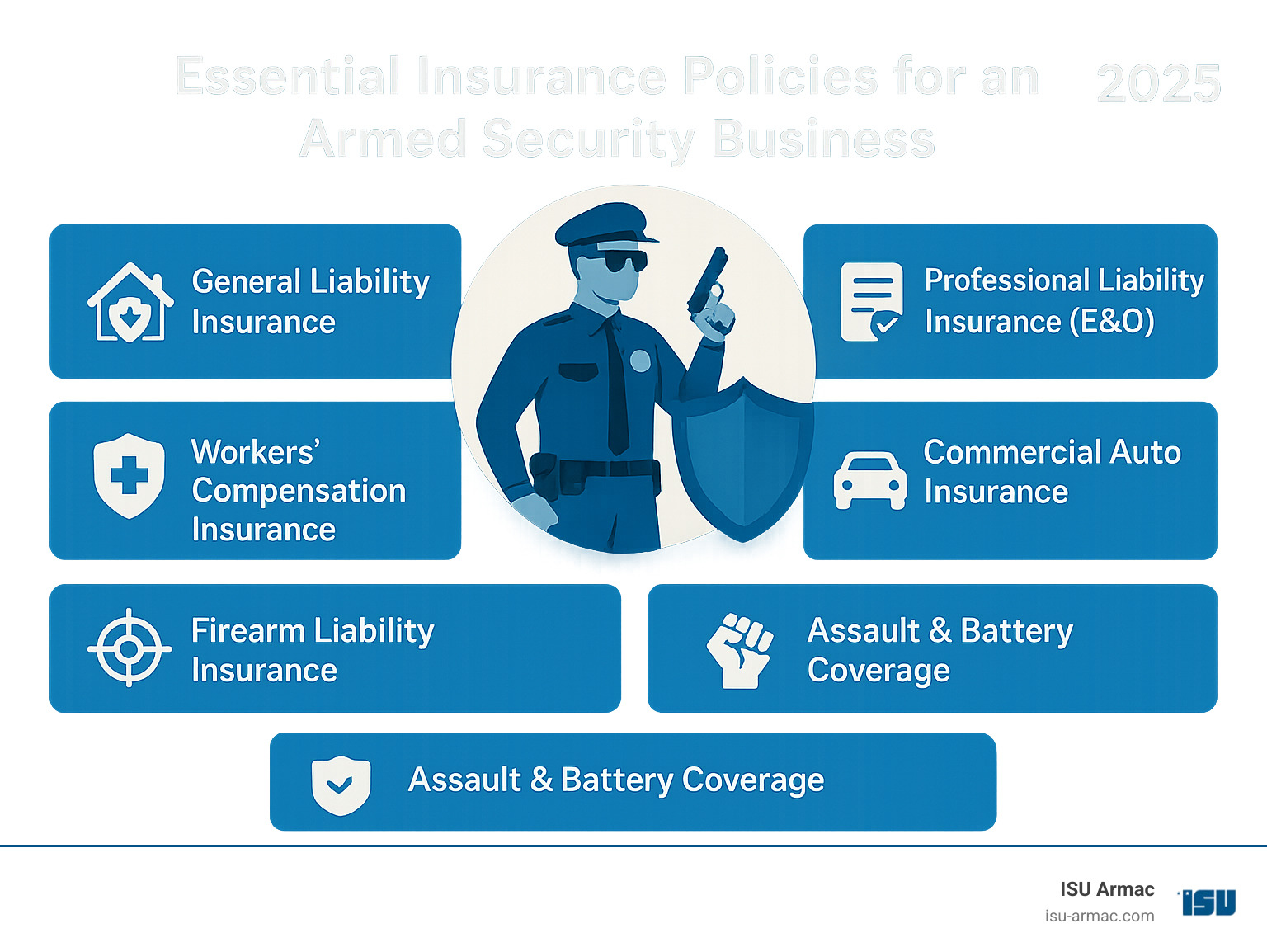
Your operation requires specialized protection. Here are the essential policies:
General Liability Insurance: This is your foundation, covering third-party claims of bodily injury or property damage. For a deeper dive, see our guide on Commercial General Liability Insurance Coverage.
Professional Liability Insurance: Also known as Errors & Omissions (E&O), this protects you if a client claims your firm failed to perform its duties, leading to a financial loss.
Workers’ Compensation Insurance: Legally required in most states for businesses with employees, this covers medical expenses and lost wages for guards injured on the job.
Commercial Auto Insurance: If your business uses vehicles for patrols, this is essential. Personal auto policies do not cover work-related accidents.
Firearm Liability Insurance: This specialized coverage is critical, handling claims arising from the use of a firearm by one of your guards, such as accidental discharge or wrongful injury.
Assault & Battery Coverage: This endorsement fills a common gap in standard policies, providing protection if a guard is accused of using excessive force.
Legal Requirements and Client Mandates
Operating an armed security business involves meeting strict legal and contractual obligations. State laws mandate certain coverages, such as workers’ compensation and commercial auto insurance. Failing to carry required insurance can lead to fines, license suspension, and personal liability for claims. You can learn more about whether Is General Liability Insurance Required by Law?.
Client contracts frequently demand higher coverage limits than state minimums and may require you to list the client as an additional insured on your policy. Your licensing compliance also depends on maintaining proper insurance. A clean compliance record can lead to lower premiums, while violations can make coverage difficult to obtain. Meeting these requirements is not just about avoiding penalties—it’s fundamental to staying in business.
Decoding the Cost of Armed Security Business Insurance
Understanding the cost of armed security business insurance is crucial for managing your budget. Premiums vary significantly based on a personalized risk assessment of your business. Key factors influencing your rates include:
- Services Offered: Executive protection, static posts, and event security each carry different risk levels.
- Payroll Size: More guards and work hours increase your exposure to potential claims.
- Location: Operating in high-crime areas or litigious regions can increase costs.
- Claims History: A clean record demonstrates effective risk management and can lead to lower premiums.
- Coverage Limits: Higher limits provide more protection but come at a higher cost.
For a deeper dive into how these factors are calculated, see our guide on Business Liability Insurance Cost.

Average Premiums for Key Coverages
While every business is unique, here are typical annual premium ranges for essential coverages:
| Insurance Type | Average Annual Premium Range |
|---|---|
| General Liability | $500 – $2,000 |
| Professional Liability | $1,000 – $3,000 |
| Workers’ Compensation | 1-3% of payroll |
| Commercial Auto (per vehicle) | $1,200 – $2,400 |
| Firearm Insurance | < $800 |
| Commercial Property | $500 – $3,000 |
| Business Owner’s Policy (BOP) | $1,000 – $3,000 |
| Cyber Liability | Starting at $1,000 |
| Business Interruption | $750 – $1,500 |
| Armored Car Insurance | Can exceed $3,000 |
These are industry averages; your actual premium will depend on your specific risk factors.
Why Arming Your Guards Increases Insurance Costs
The decision to arm your guards fundamentally changes your risk profile from an insurer’s perspective. Firearms introduce a level of liability that unarmed security does not face, leading to higher costs for several reasons:
- Heightened Risk: The potential for accidental discharge, misuse of force, or severe injury creates scenarios that can result in catastrophic claims.
- Specialized Coverage: You will need specific firearm liability coverage. While premiums for this may be under $800 annually, the cost increases with the number of armed personnel.
- Severe Injuries: Firearm-related injuries are often more severe, leading to higher medical costs and larger claims, which impacts both general liability and workers’ compensation premiums.
- Stricter Underwriting: Insurers scrutinize your training programs, certifications, and regulatory compliance. Gaps can increase premiums or even lead to denial of coverage. Many carriers are reluctant to insure armed operations, which limits market availability and can drive up prices.
Smart Strategies to Lower Your Insurance Premiums
You can take proactive steps to manage your insurance costs. Consider these strategies:
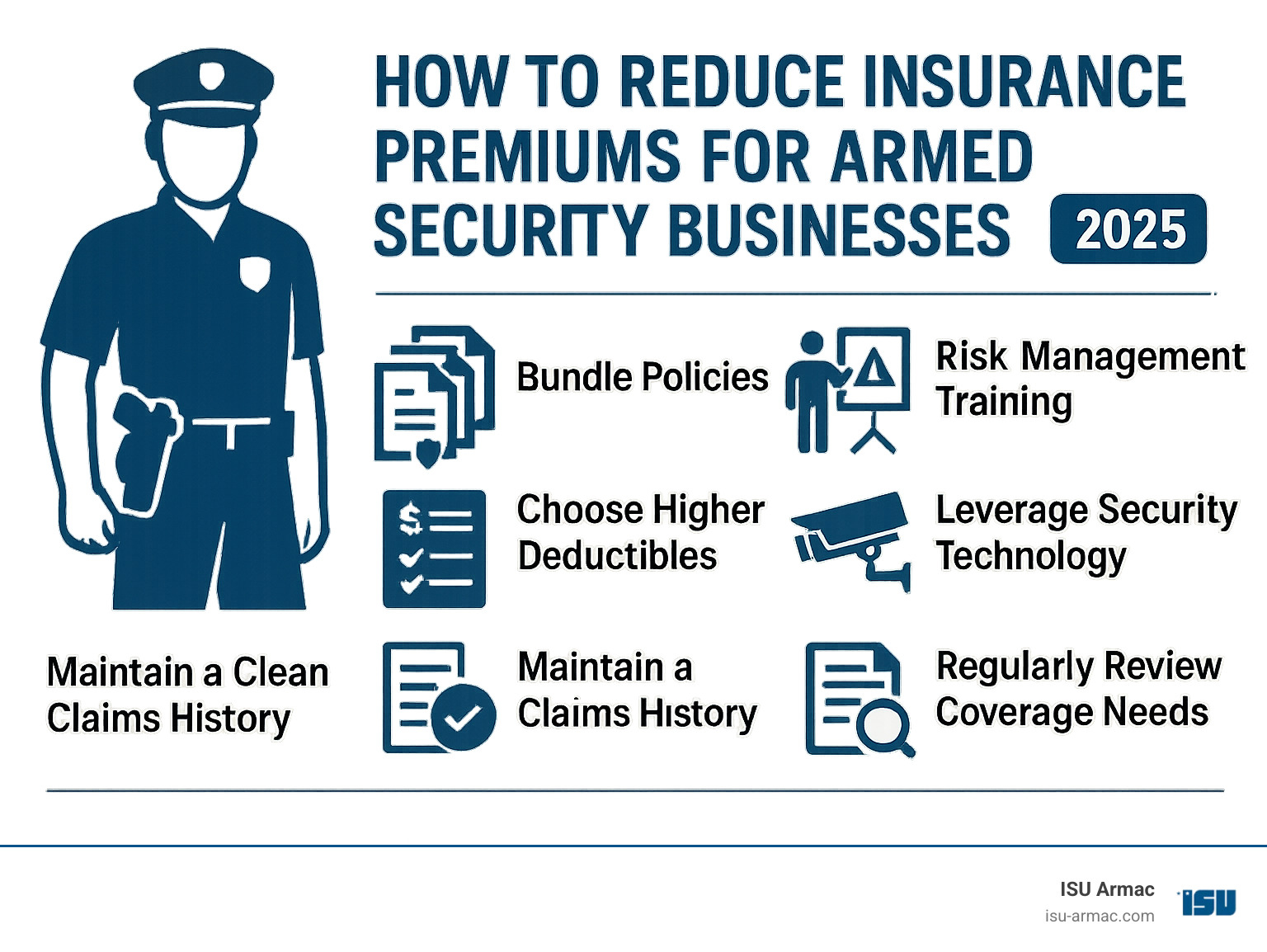
- Bundle Policies: Combine multiple coverages like general liability and commercial auto with one insurer for a discount of 10-25%.
- Invest in Training: Comprehensive risk management and de-escalation training can significantly lower your risk profile.
- Choose Higher Deductibles: Accepting more financial responsibility for smaller claims can lower your premium.
- Leverage Technology: Using body cameras, GPS tracking, and incident reporting tools demonstrates a commitment to risk prevention.
- Maintain a Clean Claims History: A strong safety record is your best tool for securing better rates over the long term.
- Conduct Regular Policy Reviews: Ensure your coverage evolves with your business to avoid paying for unnecessary protection.
For more ideas, check out these 10 Tips for Small Businesses Looking for Commercial Liability Insurance. Taking these steps can help you manage costs without sacrificing essential protection.
How to Find the Right Insurance Partner for Your Security Firm
Choosing an insurance partner is as critical as selecting equipment for your guards. You need a long-term ally who understands the unique challenges of armed security and can advocate for your business. Look for a partner with proven industry expertise, responsive customer support, an efficient claims process, and strong financial stability ratings (such as from AM Best).

Types of Insurance Providers to Consider
Several options exist for securing armed security business insurance:
- Specialty Brokers: Focus exclusively on high-risk industries and have access to specialized markets.
- Niche Providers: Have dedicated units for security companies and understand the industry’s nuances.
- Direct-to-Consumer Carriers: Offer digital platforms for straightforward operations.
- Large National Insurers: Provide comprehensive solutions and robust claims services.
- Independent Insurance Agencies: An agency like ISU Armac shops multiple carriers on your behalf, offering broad coverage options and competitive rates without being tied to a single company.
Vetting a Provider for Your Armed Security Business Insurance
When evaluating potential partners, ask targeted questions:
- Experience: How long have they worked with armed security firms? Can they provide references?
- Claims Handling: What is their process for responding to and resolving claims?
- Risk Management: Do they offer support like safety consultations or training resources?
- Armed Operations Coverage: Crucially, verify they explicitly cover armed personnel, including firearm liability and assault & battery. Understanding What is Not Covered Under Commercial Liability Insurance is key.
- Reviews: Check client testimonials, especially from other security companies.
The Application Process: Getting Your Quote
To get an accurate quote, you’ll need to provide key information. We’ve streamlined our process to make getting a Commercial Insurance Quote as efficient as possible. Be prepared to share:
- Business Operations: Details on the services you provide and your locations.
- Personnel: The number of armed vs. unarmed guards.
- Financials: Annual revenue and payroll information.
- Assets: Vehicle schedules for any patrol services.
- History: Your prior claims history.
Frequently Asked Questions about Armed Security Insurance
Armed security business insurance can be complex. Here are answers to some common questions we receive.
What is the difference between General Liability and Professional Liability insurance?
These two coverages protect against different risks. General Liability covers third-party bodily injury and property damage. For example, if a client slips and falls in your office or a guard accidentally damages a client’s property. Professional Liability (or Errors & Omissions) covers claims that your firm failed to perform its professional duties, such as a guard forgetting to lock a gate, which leads to theft. You can learn more about the professional side at What is Errors & Omissions Liability Insurance?. Both are essential for security companies.
Does a standard business owner’s policy (BOP) cover armed security operations?
Typically, no. A standard Business Owners Policy bundles general liability and property insurance for lower-risk businesses and usually excludes high-risk activities like armed security. The unique risks, such as firearm liability and potential assault and battery claims, require specialized endorsements or standalone policies. A BOP can cover your office property, but it won’t be sufficient to cover your operational liability.
Are my guards’ personal firearms covered under my business policy?
This is a critical distinction. Your business’s firearm liability policy is designed to cover the liability arising from a guard’s use of their firearm on duty—for instance, if an accidental discharge injures someone. However, it typically does not cover the firearm itself as property. If the guard’s personal firearm is damaged or stolen on the job, your business policy likely won’t pay to replace it. Guards may need their own personal property coverage for their equipment. It’s vital to clarify this in your policy. For more context, you can reference information on Firearm Insurance.
Secure Your Business with the Right Partner
Choosing the right armed security business insurance is a critical decision that protects your assets, employees, and future. The stakes are high, and the risks are real, which is why you need a partner who understands the complexities of your industry.
At ISU Armac, we are that trusted partner for businesses throughout Victorville, Apple Valley, Hesperia, and Oak Hills. Our key advantage is our independence. We are not tied to a single insurance company, which allows us to shop multiple carriers to find you the most comprehensive coverage at the most competitive rates. We do the heavy lifting of comparing policies and negotiating terms to ensure every aspect of your operation is covered, from firearm liability to workers’ compensation.
Don’t leave your business’s future to chance. The peace of mind that comes from knowing you are properly protected is invaluable, allowing you to focus on providing exceptional security services to your clients. By working with experienced professionals, you invest in your company’s long-term stability.
Ready to get the protection your business deserves? Let’s discuss your specific needs and find the right solution to safeguard your tomorrow. Explore our comprehensive Commercial Insurance options today and find why so many security businesses trust ISU Armac to have their backs.