
Car insurance costs are climbing, and California drivers are feeling the impact. However, you possess more control over your rates than you may realize. The key is not a secret trick but a series of strategic decisions. The most effective methods for reducing costs involve increasing your deductible, bundling policies with home or renters insurance, and—most importantly—shopping for new quotes at least annually.
Your Guide to Lowering California Car Insurance Costs

Securing affordable car insurance in California can feel like navigating a maze. The good news is that many drivers overpay because they have not reviewed their policy details or explored alternative options. This guide aims to change that.
This document provides practical, actionable advice. The first step toward saving money is understanding the primary factors that influence your premium.
These factors include:
- Your driving record and claims history.
- The make, model, and age of your vehicle.
- Your selected coverage limits and deductibles.
- Potential discounts for which you may be eligible.
The Most Effective Savings Strategies
To begin, it is useful to distinguish between changes that offer immediate premium reductions with minimal effort and those that require more planning but yield substantial long-term savings. This serves as your strategic plan.
The following infographic highlights the strategies that consistently deliver the most significant impact for our clients, helping you prioritize your efforts.
These five strategies represent your fastest path to a lower bill. Implementing just one or two can result in noticeable monthly savings. We will now explore each of these strategies in greater detail, providing actionable advice you can use today.
Master Your Policy with Smarter Coverage Choices
View your car insurance policy not as a fixed bill but as a flexible agreement composed of individual choices you control. Adjusting these choices is the most direct way to reduce your premium. The key is to eliminate coverage you no longer require. One of the first areas to examine is your deductible—the amount you pay out-of-pocket on a claim before your insurance coverage begins. By selecting a higher deductible, you assume more risk, and insurers reward this with a lower rate.
Strategically Raise Your Deductible
This represents a direct trade-off: accepting more risk can lead to significant savings. Industry-wide data indicates that increasing a deductible from $200 to $500 can reduce collision and comprehensive costs by 15% to 30%.
For those with a sufficient emergency fund, raising the deductible to $1,000 could result in savings of 40% or more. For many California drivers, this single adjustment can translate to hundreds of dollars in annual savings. A yearly policy review is an essential tool for identifying such savings opportunities.

Evaluate Your Collision and Comprehensive Coverage
Collision and comprehensive coverages are vital for new vehicles or those with outstanding loans. However, for an older car, these coverages may represent an unnecessary expense.
A useful rule of thumb is to consider dropping this coverage if its annual premium exceeds 10% of your car's market value. For example, paying $500 annually for collision on a 12-year-old sedan valued at $4,000 is not financially prudent. Before purchasing any used vehicle, understanding its complete history, including what a rebuilt title means, is critical for accurately predicting insurance costs.
Find the Right Liability Limits
Liability coverage is a non-negotiable part of your policy, as it protects your financial assets in the event of an at-fault accident. However, this does not mean you must purchase the highest available limit. The objective is to be adequately protected, not over-insured.
Perform a rough calculation of your net worth, including savings, investments, and home equity. Your liability limits should be sufficient to protect these assets. For instance, paying for a million-dollar policy is unnecessary if your net worth is closer to $150,000. Our guide on personal car insurance plans provides more detail on this topic. An annual consultation with an agent can ensure your liability coverage aligns with your current financial situation.
Ask for Every Discount You Deserve
Consider your car insurance premium a starting point, not a final price. Many drivers overpay because they are unaware of the numerous discounts available. Insurers rarely apply these savings automatically; you must proactively request them. Assuming your agent is aware of life changes, such as joining a professional organization or a teen driver achieving honor roll status, is a common mistake.
Dig Deeper Than the Obvious Savings
While good driver discounts are well known, significant savings often come from less common credits related to your profession, affiliations, and vehicle features.
Consider the following possibilities:
- Your Profession: Many insurers offer preferential rates for professions considered lower-risk, such as teachers, engineers, scientists, and nurses.
- Affinity Groups & Memberships: Affiliations with alumni associations, professional groups, or clubs like AAA often provide access to pre-negotiated group rates.
- Vehicle Safety Features: Ensure you receive credit for features like anti-lock brakes, factory-installed anti-theft systems, multiple airbags, and daytime running lights.
These are just a few examples. An engineer with a clean record who belongs to a professional society could realize substantial savings. Specific programs often exist for first responders, which we detail in our guide to car insurance for first responders.
The Power of Bundling Your Policies
One of the largest available discounts is the multi-policy discount, or "bundling." This involves purchasing your auto insurance along with your homeowners, renters, or life insurance from the same company.
Insurers reward this loyalty because it improves operational efficiency and customer retention. In return, they offer significant discounts, often ranging from 10% to 20% off your total insurance bill. Working with an independent agency like ISU Insurance Services is particularly beneficial here, as we can compare options from hundreds of carriers to find the optimal bundle.
As the diagram below shows, your premium is directly shaped by the core decisions you make about your policy.
This illustrates how the fundamental levers—your deductible, coverage choices, and liability limits—work together to determine your final cost.
Make the Annual Discount Review a Habit
Your life circumstances change, and so do your opportunities for discounts. Establishing a habit of conducting an annual policy review with your agent is a sound financial practice. A proactive approach ensures your policy reflects your current situation, maximizing your savings.
How Your Financial Health Impacts Your Premiums
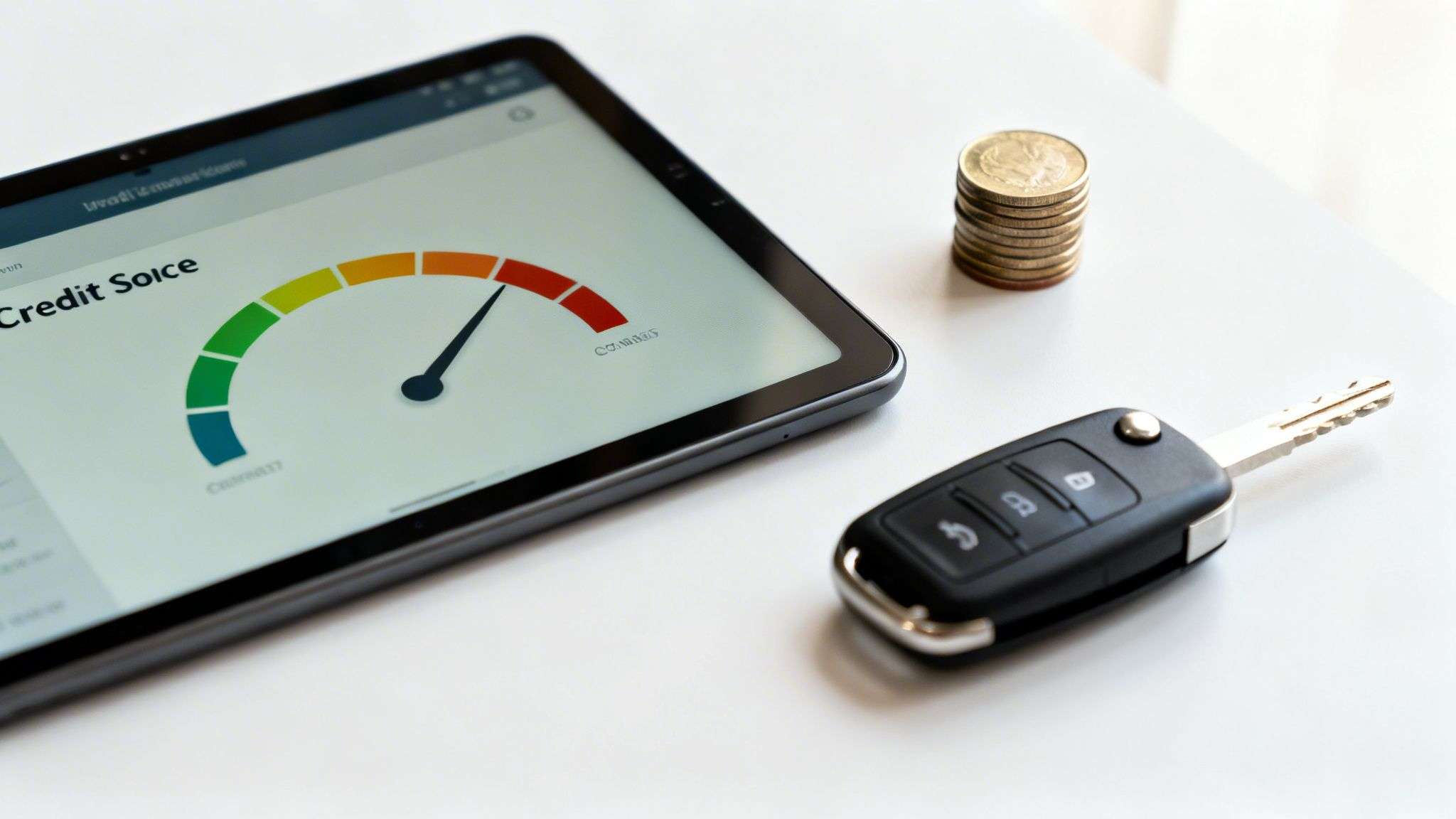
A powerful, often overlooked strategy for lowering car insurance rates is managing your financial habits. In California, your credit history directly influences your auto insurance premiums through a credit-based insurance score, which insurers use to predict the likelihood of a claim.
Although a few states prohibit this practice, it is a standard and significant rating factor in California. Therefore, building a strong credit history can lead to tangible, long-term savings on your auto insurance.
Why Your Credit Score Matters So Much
The premium difference between an individual with poor credit and one with excellent credit can be substantial, often amounting to hundreds or even thousands of dollars annually for identical coverage.
A 2023 study revealed that drivers with excellent credit (800+) paid 49% less for insurance than those with fair credit (580-669). The penalty for poor credit was even more severe, with drivers scoring below 580 paying 115% more than those with top-tier credit. This means a California driver with a poor credit history could pay more than double the premium of a neighbor with excellent credit. You can explore the full study findings on AARP to review the data. Improving your credit is one of the most effective ways to secure cheaper car insurance.
Simple Steps to Improve Your Credit Score
Improving your credit score is a long-term process, but consistent habits can make a significant difference and result in lower premiums.
- Pay every single bill on time. This is the most critical factor in your credit score. Use automatic payments or calendar reminders to avoid missing due dates.
- Keep your credit card balances low. A general guideline is to maintain balances below 30% of your total available credit, as high utilization can negatively impact your score.
- Check your credit reports for free. You are entitled to free copies of your credit reports from the three major bureaus. Review them for errors and dispute any inaccuracies immediately.
Your credit score acts as a financial report card. By demonstrating financial responsibility, you signal to insurers that you are a low-risk client, which they reward with better rates.
The Power of Shopping Around to Find Better Rates
When it comes to your auto policy, loyalty does not always yield financial benefits. The single greatest mistake drivers make is remaining with the same insurance company out of habit, which often results in overpayment. The most powerful tool for reducing your premium is your willingness to shop around and compare quotes.
Insurance companies constantly adjust their rates. The carrier that offered the best deal previously may now be among the most expensive for your circumstances. For this reason, an annual policy review should be a mandatory part of your financial routine.
Key Moments to Trigger a Rate Comparison
While an annual check-up is advisable, certain life events should prompt an immediate rate comparison. These events can alter your risk profile, creating an ideal opportunity to find a better deal.
Consider these events as financial opportunities to request fresh quotes:
- Move to a new address: Rates are tied to ZIP code data, so a move can significantly impact your premium.
- Buy a new car: Every vehicle is rated differently based on factors like repair costs, safety, and theft risk.
- Get married: Married drivers are statistically viewed as lower risk, which often results in lower premiums.
- Add or remove a driver: Adding a teenager to your policy will increase costs, but shopping around can mitigate the impact.
- See a change in your credit score: A significant improvement in your credit history can unlock better rates.
The Advantage of an Independent Agency
With rising repair costs and market volatility in 2026, comparing quotes is more critical than ever. Drivers who shop around consistently save between $200 and $500 annually. A sound practice is to obtain quotes from at least three to five different companies. To ensure a valid comparison, every quote must have identical liability limits, deductibles, and optional coverages.
This process can be tedious and time-consuming, which is why working with an independent insurance agency is so advantageous. An independent agent performs this legwork on your behalf. At ISU Insurance Services, we shop our network of over 300 carriers to find the best rate for your specific needs, maximizing your savings while saving you time. Our guide to personal auto insurance quotes is a great place to learn more about the process.
Your Questions on Lowering Car Insurance Rates Answered
This section addresses common questions from California drivers. The details are crucial when it comes to saving money on car insurance.
How Often Should I Shop For New Car Insurance?
As a general rule, shop for new car insurance rates at least once a year, approximately one month before your policy renews. More importantly, obtain fresh quotes after any major life event, such as moving, buying a new car, getting married, or adding a driver to your policy. These events can significantly alter your risk profile, meaning a different insurer may offer a more competitive rate.
Will Filing a Small Claim Actually Raise My Rate?
It is highly probable. A minor claim can lead to the loss of a claims-free discount and a rate increase upon renewal. Before filing a claim, compare the repair estimate to your deductible and the potential premium increase. If the repair cost is only slightly more than your deductible, paying out-of-pocket is often the more financially sound long-term decision. For example, filing a $750 claim on a $500 deductible may save $250 initially but could result in a $400 premium increase over the next year.
Are Telematics Programs Like Drive Safe And Save Worth It?
For safe drivers, telematics programs can be highly beneficial, offering discounts of up to 30%. These programs track driving habits, such as braking, acceleration, speed, and time of day, via a mobile app or a device plugged into your car. If you consistently drive safely, you stand to save a considerable amount. However, if your driving habits include frequent hard braking or late-night travel, these programs may not be advantageous. Evaluate your habits before enrolling.
How Much Does My Car Choice Affect My Insurance Cost?
The vehicle you drive is a primary determinant of your insurance cost. Insurers evaluate a car's safety record, theft rate, average repair costs, and performance specifications. A family sedan or modest crossover will almost always be cheaper to insure than a high-performance sports car or a luxury SUV with expensive imported parts. It is advisable to get insurance quotes for specific models you are considering before purchasing a vehicle to avoid unexpected costs.
For additional strategies, other guides that explain how to lower car insurance rates can offer supplementary perspectives.
The expert team at ISU Insurance Services can simplify this process for you. We compare rates from over 300 carriers to find the ideal policy that fits your life and budget. Get a personalized quote today at https://isu-armac.com.