
Running a grocery store is a balancing act. You're managing everything from bustling aisles and complex supply chains to the day-to-day needs of your customers and crew. With so much in motion, the right insurance isn't just another business expense—it's one of your most critical operational assets. It’s the safety net that protects you from the kinds of hazards that can, and do, lead to devastating financial losses. This guide is here to walk you through exactly what you need to protect your store's future.
Why Comprehensive Insurance Is Your Store's Safety Net
Think of your store’s insurance policy as being just as vital as your refrigeration units or your security system. Without it, one single event—a customer slipping on a wet floor, a prolonged power outage that spoils your inventory, or a key employee getting injured on the job—could put your entire business at risk. A solid insurance plan is built to absorb these kinds of shocks so you can keep your doors open with confidence.
The industry data backs this up. The global food insurance market hit USD 2,408 million in 2024 and is expected to grow to USD 3,641 million by 2032. With North America making up around 38% of this market, it's clear that strict food safety laws and the high stakes of our industry make proper coverage a non-negotiable.
The High-Stakes Risks Grocers Face
Your store faces a unique mix of risks that you have to be ready for every single day. Getting a handle on these specific weak points is the first step in building a strong defense. Seeing how others have tackled similar issues, like in this grocery store parking garage door case study, can give you a practical sense of how different pieces of your protection plan fit together.
Here are just a few of the biggest threats:
- Customer Injuries: Slips, trips, and falls are hands-down one of the most common—and expensive—claims for grocers. A puddle in the produce aisle or a stray box in a walkway is all it takes to trigger a major liability claim.
- Product Spoilage: When a walk-in freezer fails or a storm knocks out power for hours, you could be looking at thousands of dollars in spoiled meat, dairy, and produce gone in an instant.
- Equipment Breakdown: Your refrigerators, ovens, and HVAC systems are the heart of your operation. When they break down, the cost to repair or replace them is immense, not to mention the business you lose while they're out of commission.
- Supply Chain Failures: Sometimes the problem isn't inside your store. A disruption with a key supplier can leave your shelves empty, leading to lost sales and frustrated customers who might not come back.
A complete insurance strategy isn't just about reacting to disasters; it's about proactively building resilience into your business model. It ensures that when the unexpected happens, you have the financial resources to recover quickly and continue serving your community.
Understanding Core Insurance Policies for Grocers
Running a grocery store means juggling a unique set of risks every single day. To protect your business, you need an insurance portfolio that's as well-stocked as your shelves. Let's break down the three fundamental coverages every grocer needs to build a solid foundation of protection: General Liability, Product Liability, and Spoilage Coverage. Each one tackles a different, but equally critical, threat to your bottom line.
General Liability: The First Line of Defense
General Liability Insurance is the absolute cornerstone of your risk management strategy. It’s designed to handle claims of bodily injury or property damage happening on your premises—think aisles, entryways, and parking lots.
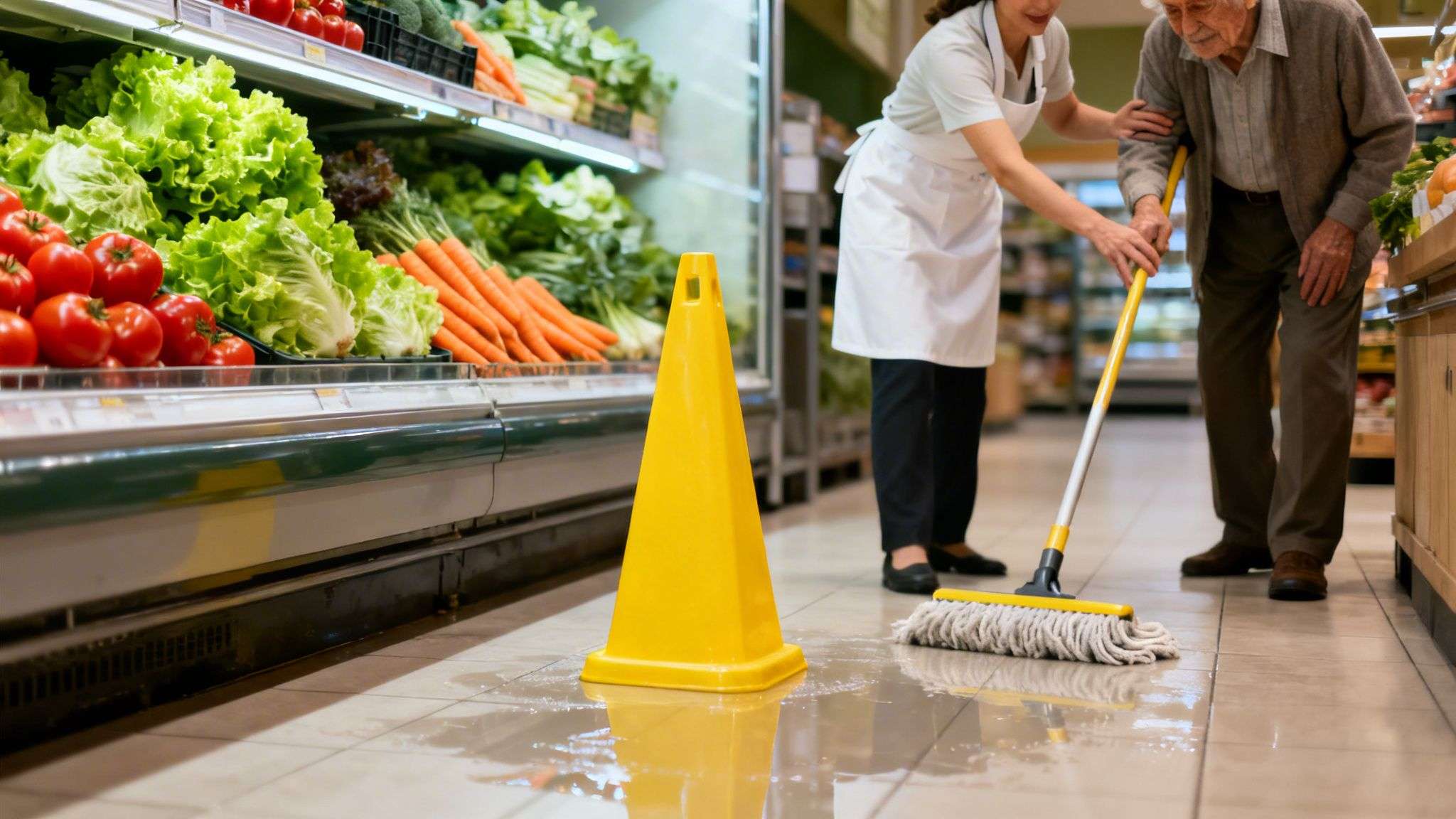
It’s the policy that kicks in when a customer slips on a recently mopped floor or a loose grape in the produce aisle and gets hurt. If they fall and break their wrist, this policy is what covers their medical expenses and your legal defense costs if a lawsuit follows.
Given that slip-and-fall incidents are one of the most common and expensive claims in the grocery world, this coverage isn't just nice to have; it's essential. A single claim can easily run $30,000 or more, a figure that could cripple an uninsured business. For a deeper dive into this crucial coverage, our general liability insurance guide has all the details.
Product Liability: Protecting Against What You Sell
While General Liability covers accidents at your store, what happens when the danger is in the food itself? That's where Product Liability Insurance steps in. This policy is vital for any business that sells consumables, protecting you if a product you sell causes someone to get sick or injured.
For example, your deli sells a popular chicken salad, but a contaminated batch leads to several cases of food poisoning. Product Liability is designed to cover the customers' medical bills, your legal fees, and any resulting settlements.
Product Liability is your financial shield against the inherent risks of selling food. From contaminated produce to an allergic reaction caused by a mislabeled bakery item, this coverage is what stands between your business and a potentially ruinous lawsuit.
Without it, a single foodborne illness outbreak can not only lead to devastating financial loss but also cause irreparable damage to your store's hard-earned reputation.
Essential Insurance Coverage for Grocery Stores at a Glance
| Coverage Type | What It Protects | Common Claim Scenario | Why It's Essential |
|---|---|---|---|
| General Liability | Your business from claims of bodily injury or property damage occurring on your premises. | A customer slips on a wet floor, falls, and sues the store for their medical bills. | Protects against frequent and costly "slip-and-fall" incidents that happen in any public space. |
| Product Liability | Your business from claims that a product you sold caused illness or injury. | Several customers get food poisoning after eating a contaminated deli item. | Crucial for any business selling food, shielding you from lawsuits related to foodborne illness or allergens. |
| Spoilage Coverage | Your perishable inventory from loss due to equipment failure or power outages. | A prolonged power outage causes all refrigerated and frozen goods to spoil. | Reimburses you for thousands of dollars in lost stock, preventing a major financial blow from a single event. |
As you can see, each policy addresses a specific, high-stakes risk. Having all three creates a comprehensive safety net for your store's daily operations.
Spoilage Coverage: Safeguarding Your Inventory
Finally, there’s Spoilage Coverage. Sometimes called Equipment Breakdown or Perishable Goods Coverage, this policy reimburses you for inventory that spoils due to specific, unforeseen events. It’s your financial backup when the very systems you rely on to keep food fresh suddenly fail.
Imagine a major storm knocks out power for an entire afternoon. The temperature in your walk-in coolers and freezers rises, ruining thousands of dollars worth of meat, dairy, produce, and frozen items. Spoilage Coverage would pay to replace that lost stock, turning a potential disaster into a manageable problem.
This coverage is typically triggered by events like:
- Mechanical Breakdown: The compressor on your main refrigeration unit gives out.
- Power Outage: A utility grid failure leaves your store without electricity.
- Refrigerant Contamination: A leak in the system spoils your products and requires a full repair.
Together, these three policies—General Liability, Product Liability, and Spoilage—form a powerful defensive trio. They secure your premises, cover your products, and protect your inventory, ensuring your grocery store is ready to handle its most common and costly risks.
Specialized Coverage Your Grocery Store Needs
Once you have the basics in place, it’s time to look at the specific risks that come with running a modern grocery store. Think of these specialized policies less as "add-ons" and more as essential tools for dealing with very real, very specific threats. They're what turn a good insurance plan into a great one, protecting your business from the kinds of disruptions that can be financially devastating.
Workers Compensation: Your Employee Safety Net
In California, if you have employees, you’re legally required to have Workers' Compensation Insurance. But honestly, even if it weren’t the law, you’d still want it. This policy is the safety net that catches both your employees and your business when someone gets hurt on the job.
Grocery work is physical. Your team is lifting heavy boxes, operating slicers in the deli, and navigating stockrooms, not to mention the constant risk of a slip on a wet floor. It only takes a second for an accident to happen.
Let's say a stocker throws out their back while unloading a truck. Workers' Comp steps in to cover their medical bills and a portion of their lost wages while they recover. This means your employee can focus on getting better without financial stress, and your business is shielded from a potentially crippling lawsuit.
Commercial Auto Insurance for Deliveries and Errands
Does your store use a van for customer deliveries? A car for bank runs? Do you ever send an employee out in their own car to pick up supplies? If you answered yes to any of these, Commercial Auto Insurance is a must-have. A personal auto policy simply won't cover accidents that happen during business activities.
Picture this: your delivery van gets into a fender-bender on its way to a customer. Commercial Auto Insurance is what pays for the repairs, the damage to the other car, and any medical bills. Without it, every one of those costs comes directly out of your business's pocket, turning a simple delivery into a huge financial liability.
Cyber Liability: Your Digital Security Guard
Today, some of the biggest threats to your grocery store are completely invisible. Your point-of-sale terminals, customer loyalty programs, and online ordering systems all handle a goldmine of sensitive data. Cyber Liability Insurance is designed to protect you from the fallout of a data breach or hack.
What happens if a hacker gets into your payment system and steals a batch of customer credit card numbers? The costs can be staggering. A good Cyber Liability policy helps manage the chaos by covering expenses like:
- Customer Notification: The cost of legally informing every affected customer.
- Credit Monitoring: Paying for services to protect your customers' credit.
- Fines and Penalties: Covering steep regulatory fines that often follow a breach.
- Public Relations: Hiring experts to help manage your store’s reputation.
A breach can also shut down your operations, which is why many cyber policies include business interruption coverage to help replace lost income while you get back on your feet.
A strong insurance portfolio is your best defense against the unpredictable. As food safety laws get stricter, the global market for food liability insurance is expected to hit USD 1,300 million by 2032. It's a clear sign that having comprehensive protection is more critical than ever.
Commercial Crime: Protecting Against Theft
As much as you trust your people, the reality is that theft—both internal and external—is a constant risk in retail. Commercial Crime Insurance is built to protect your store's finances from losses caused by dishonest acts.
This isn't just about a shoplifter. It’s for when you discover an employee has been skimming from the cash drawer for months, or when a robbery clears out your registers. The policy helps you recover those stolen funds. It's a crucial layer of security that plugs gaps left by other property policies, giving you a way to recoup losses from crimes like employee theft, forgery, or robbery.
How Are Grocery Store Insurance Costs Calculated?
There's no one-size-fits-all price tag for grocery store insurance. Think of it less like buying a product off the shelf and more like a tailor fitting a suit. Insurers look at the specific, unique details of your store to figure out the exact level of risk they're taking on. That risk assessment is what ultimately determines your premium.
It all starts with the fundamentals of your operation—the "who, what, where, and how big" of your grocery business.
Core Factors That Influence Your Premiums
The first things an underwriter will look at are the physical and financial stats of your store. A sprawling supermarket in a downtown metro area is a completely different animal than a small, family-owned market in a quiet suburb. The risks are different, so the pricing has to be, too.
They’ll zero in on a few key details:
- Store Size and Location: A larger footprint means more area to maintain and more room for accidents. Likewise, a store in an area known for severe weather or high crime rates presents a higher property risk.
- Annual Revenue: More sales usually mean more foot traffic and a higher volume of products moving through your store. This naturally increases the chances of a customer claim, which is reflected in your liability premium.
- Number of Employees: The more people on your payroll, the greater the statistical likelihood of a workplace injury. This is a primary driver for your workers' compensation costs.
- Claims History: If your store has a history of frequent or expensive claims, insurers will see you as a higher risk. A clean record, on the other hand, can work in your favor to keep premiums down.
How Your Product Mix Shapes Your Rates
What you sell is just as critical as your store's size or sales volume. Certain products bring their own special set of risks, and insurers pay close attention to them.
For example, if you have a popular deli counter serving hot foods, your risk of a foodborne illness outbreak is much higher than a store that only sells packaged goods. Selling beer and wine? That introduces liquor liability. A fresh seafood counter brings risks of spoilage and contamination that a simple dry-goods grocer doesn't have.
Finding the right deductible is a bit of a balancing act. If you choose a high deductible, you agree to pay more out-of-pocket if a claim happens, but your annual premium will be lower. A low deductible means you'll pay less when a claim occurs, but your premium will be higher.
The goal is to land on a number that fits your store's cash flow and your comfort level with risk.
This flowchart gives you a good visual of how different policies are designed to cover the varied risks a grocery business faces every day.
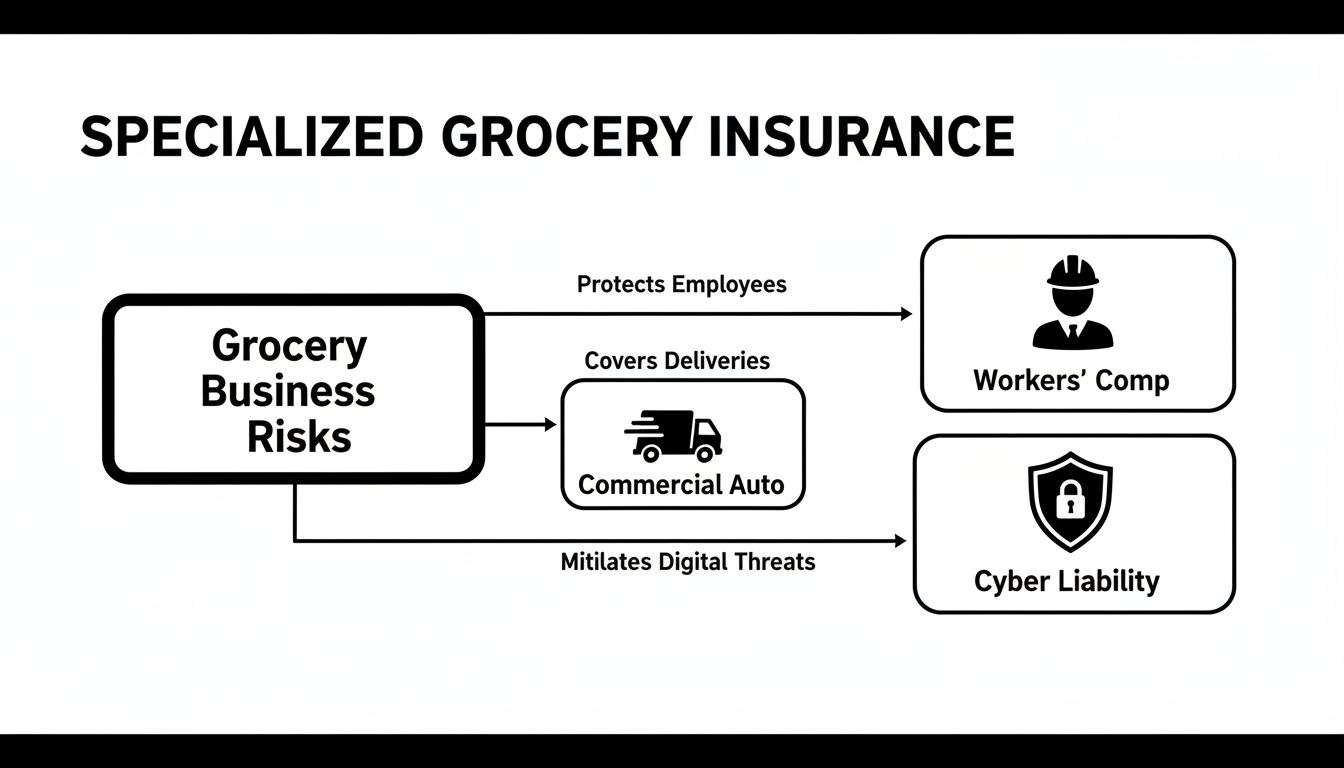
As you can see, you can't just have one policy. Specialized coverages like Workers' Comp, Commercial Auto, and Cyber Liability are essential for handling very specific threats to your operation.
Controlling Costs with Proactive Risk Management
While you can't change your store's location, you absolutely have control over other factors that influence your premiums. By showing an insurer you're serious about managing risk, you can directly lower your costs. Simple, consistent safety protocols—like having a clear "clean-up on aisle four" procedure and doing regular floor checks—can drastically cut down on slip-and-fall claims.
Investing in solid security is another smart move. When an underwriter sees that you have surveillance cameras, a modern fire suppression system, and professional alarms, it tells them you're actively protecting your assets from theft, vandalism, and fire. For anyone looking to get a better handle on this, A Business Owner's Guide to Commercial Alarm Systems is a fantastic resource that explains how these systems don't just deter criminals but also demonstrate responsibility to your insurer.
At the end of the day, your insurance premium tells a story about your business. By actively managing your risks and making informed choices with your agent, you can make sure that story is one of safety and responsibility—getting the right insurance for grocery stores without paying for coverage you don't need.
Why a Business Owners Policy Is a Smart Choice
For most small and mid-sized grocers, juggling multiple insurance policies feels like an unnecessary headache. A Business Owner's Policy (BOP) is designed to fix that. It bundles the most critical coverages into a single, more affordable package. I often tell my clients to think of it as the "combo meal" of insurance—you get the essential protections you need anyway, but at a better price than buying them all separately.
This approach doesn't just save you money; it simplifies your life. Instead of tracking different renewal dates, payments, and policy documents, you have one comprehensive plan. It's a straightforward path to securing solid insurance for grocery stores without the usual administrative clutter.
What Is Included in a Grocery Store BOP?
At its heart, a BOP is built to shield your business from the most frequent and expensive claims. It creates a robust financial safety net by combining three core coverages into one policy.
- General Liability Insurance: This is your front-line defense when someone claims your business caused them bodily injury or damaged their property. It's what kicks in when a customer slips on a freshly mopped floor or an errant shopping cart dings a car in the parking lot.
- Commercial Property Insurance: This policy protects your physical stuff—the building itself (if you own it), all your inventory on the shelves, equipment like registers and deli slicers, and even the sign out front. It provides the money to repair or replace these assets after a fire, theft, or heavy storm.
- Business Interruption Insurance: If a disaster like a fire forces you to shut down temporarily, this is the coverage that keeps you afloat. It helps replace the income you're losing and covers ongoing expenses like rent and payroll, giving you the breathing room you need to get back on your feet.
Customizing Your BOP with Endorsements
While a standard BOP provides a great foundation, it's not a one-size-fits-all solution. You can and should fine-tune it with endorsements, which are add-ons that cover risks specific to your grocery operation. This is how you make a good policy a great one.
For instance, a basic BOP won't cover losses from equipment failure. You would add a Spoilage Coverage endorsement to protect your thousands of dollars in perishable inventory if a walk-in freezer fails or a blackout knocks out your power.
By bundling key coverages, a BOP provides a critical financial backstop. As market conditions evolve, this bundled approach becomes an even smarter strategy for grocers.
Other essential endorsements for a grocery store often include:
- Liquor Liability: A must-have if you sell beer, wine, or spirits.
- Cyber Liability: Protects against data breaches, a growing risk with modern POS systems.
- Hired and Non-Owned Auto: Covers incidents when an employee uses their own car for a delivery or bank run.
Recent industry trends make bundling even more compelling. With the average retail workers' compensation claim costing $41,000 for lost time and insured catastrophe losses recently topping $105 billion in a single year, a combined policy is a financially sound decision. To see how these pieces fit together, take a look at our detailed guide on what a Business Owner's Policy includes. This packaged approach ensures your protection is both efficient and robust.
Finding the Right Insurance Partner for Your Store
Choosing the right insurance for your grocery store isn't just about buying a policy; it's about finding a true partner. You'll face a key decision right away: go directly to a single insurance company or work with an independent agent? This choice can make a huge difference in the coverage you get and what you pay for it.

Why an Independent Agent Is Your Advocate
Here's the best way to think about it. An agent working for a direct carrier has one boss: the insurance company. Their job is to sell that company’s products. An independent agent, on the other hand, works for you. Their loyalty is to your grocery store, not a specific insurer.
And that’s a bigger deal than you might think. An independent agent becomes your advocate, shopping the entire market to find the perfect fit for your store’s specific risks. You’re not stuck with one company’s menu of options; you get access to a whole world of them.
For instance, a partner like ISU Insurance Services works with over 300 different insurance carriers. That means they can put multiple quotes and policy options on the table, finding you the most competitive price for the protection you actually need.
An independent agent is more than a salesperson—they're a risk advisor. They dig into your operations, from the deli counter to the delivery van, to build an insurance plan that fits like a glove.
Preparing for Your Insurance Conversation
To get the most out of your meeting with an agent, a little prep work goes a long way. When you have your key information ready to go, the agent can more accurately and quickly find the best options for your store. This infographic shows you exactly what to pull together beforehand.
Following this checklist helps ensure your conversation is productive. Handing over details like annual revenue, employee numbers, and any past claims history gives an agent the clear picture they need to find the right policies.
It’s just as important to come with your own set of questions. Ask about different deductible options, what the claims process looks like, and if there are discounts for having safety measures in place. When you partner with an expert, you're not just buying insurance—you're building a smart defense for your business's future.
Frequently Asked Questions About Grocery Store Insurance
When you're running a grocery store, insurance questions come up all the time. Let's tackle a few of the most common ones we hear from owners just like you.
Is Insurance Legally Required For A Grocery Store In California?
Yes, but it's a two-part answer. In California, the one insurance policy you absolutely must have by law is Workers' Compensation, and that applies the moment you hire your first employee.
While General Liability isn't a state mandate, it's virtually impossible to operate without it. Think about it: almost any commercial landlord will demand you show proof of coverage before they’ll even hand you the keys. More importantly, going without it is like walking a financial tightrope with no net. One serious slip-and-fall claim could wipe out an unprotected business overnight, making solid insurance for grocery stores a non-negotiable part of staying in business.
My Grocery Store Is Small. Do I Really Need All These Policies?
The risks don't shrink just because your store's footprint does. A customer injury, a cooler failure that spoils thousands of dollars in meat and dairy, or a data breach can hit a small grocer just as hard as a large supermarket—in fact, it's often harder for a smaller business to recover.
The cost to defend your business in court or replace an entire walk-in cooler's worth of inventory is substantial, no matter your square footage.
A Business Owner's Policy (BOP) is a fantastic starting point for smaller grocery and corner stores. It smartly bundles your General Liability and Commercial Property insurance together, giving you foundational protection at a much better price than buying them separately.
This is the most common and cost-effective way to cover your biggest exposures without overcomplicating things.
How Can I Lower My Insurance Premiums Without Sacrificing Coverage?
This is the million-dollar question, and the good news is you have more control than you might think. Insurers reward proactive owners who actively manage their risk.
You can make your store a much more attractive risk—and earn lower premiums—by taking a few key steps:
- Establish a clear safety program: This includes regular staff training on cleanup protocols and proper food handling.
- Invest in security: Modern security cameras, alarms, and fire suppression systems are huge pluses.
- Keep things tidy: Documented procedures for keeping aisles clear of clutter and spills can directly impact your rates.
Another powerful move? Don't go it alone. Working with an independent insurance agent gives you a massive advantage, as they can shop your policy to hundreds of different insurance companies to find the best fit. Bundling your essential policies into a BOP is also one of the easiest ways to get an instant discount.
Finding that sweet spot between comprehensive protection and a manageable cost is what it's all about. The expert advisors at ISU Insurance Services work with over 300 carriers to build a policy that protects your store, your employees, and your bottom line. Get a personalized quote today.