
Why Bundling Insurance is a Smart Move for Your Business
Small business insurance packages offer a convenient and cost-effective way to protect your business from unexpected risks. These bundled policies combine multiple types of coverage into a single package, typically including general liability, commercial property, and business income protection.
Key Benefits of Small Business Insurance Packages:
- Cost savings – Bundling can save you 10-25% compared to buying separate policies
- Simplified management – One policy, one bill, one renewal date
- Comprehensive protection – Covers property damage, liability claims, and business interruption
- Reduced coverage gaps – Ensures you don’t miss critical protections
The most common type is a Business Owner’s Policy (BOP), which costs an average of $141 per month according to industry data. This compares favorably to buying separate general liability ($42/month), professional liability ($61/month), and other coverages individually.
Running a business means facing constant risks – from slip-and-fall accidents to equipment breakdowns to cyber attacks. As one industry expert notes: “Accidents, natural disasters, and lawsuits could run you out of business.” That’s why 93% of small businesses that experience cyber incidents report severe impacts to their operations.
I’m Ryan McEachron, CEO of ISU Insurance Services ARMAC Agency in Victorville, with over 25 years of experience helping business owners steer small business insurance packages and find the right protection for their unique needs. My background serving on the Victorville City Council and various business organizations gives me deep insight into the challenges local entrepreneurs face when securing appropriate coverage.
Small business insurance packages helpful reading:
- association health plans for small business
- can a small business pay for individual health insurance
- shop small business health options program
Decoding the Most Common Small Business Insurance Packages: The BOP
Picture this: you’re at your favorite restaurant, and instead of ordering appetizer, main course, and dessert separately, you choose the prix fixe menu. You get everything you need in one convenient package, often at a better price. That’s exactly what a Business Owner’s Policy (BOP) does for your business insurance needs.
The BOP is the most popular choice among small business insurance packages because it bundles your essential coverages into one streamlined policy. Rather than juggling multiple insurance policies from different companies with different renewal dates and payment schedules, you get comprehensive protection that’s both convenient and cost-effective.

What makes a BOP particularly appealing is how it simplifies your life as a business owner. Instead of researching different types of coverage, comparing multiple policies, and managing various insurance relationships, you can focus on what you do best – running your business. We often recommend exploring a Business Owners Policy as the foundation for most small businesses because it addresses the core risks that keep entrepreneurs awake at night.
What’s Typically Inside a Business Owner’s Policy?
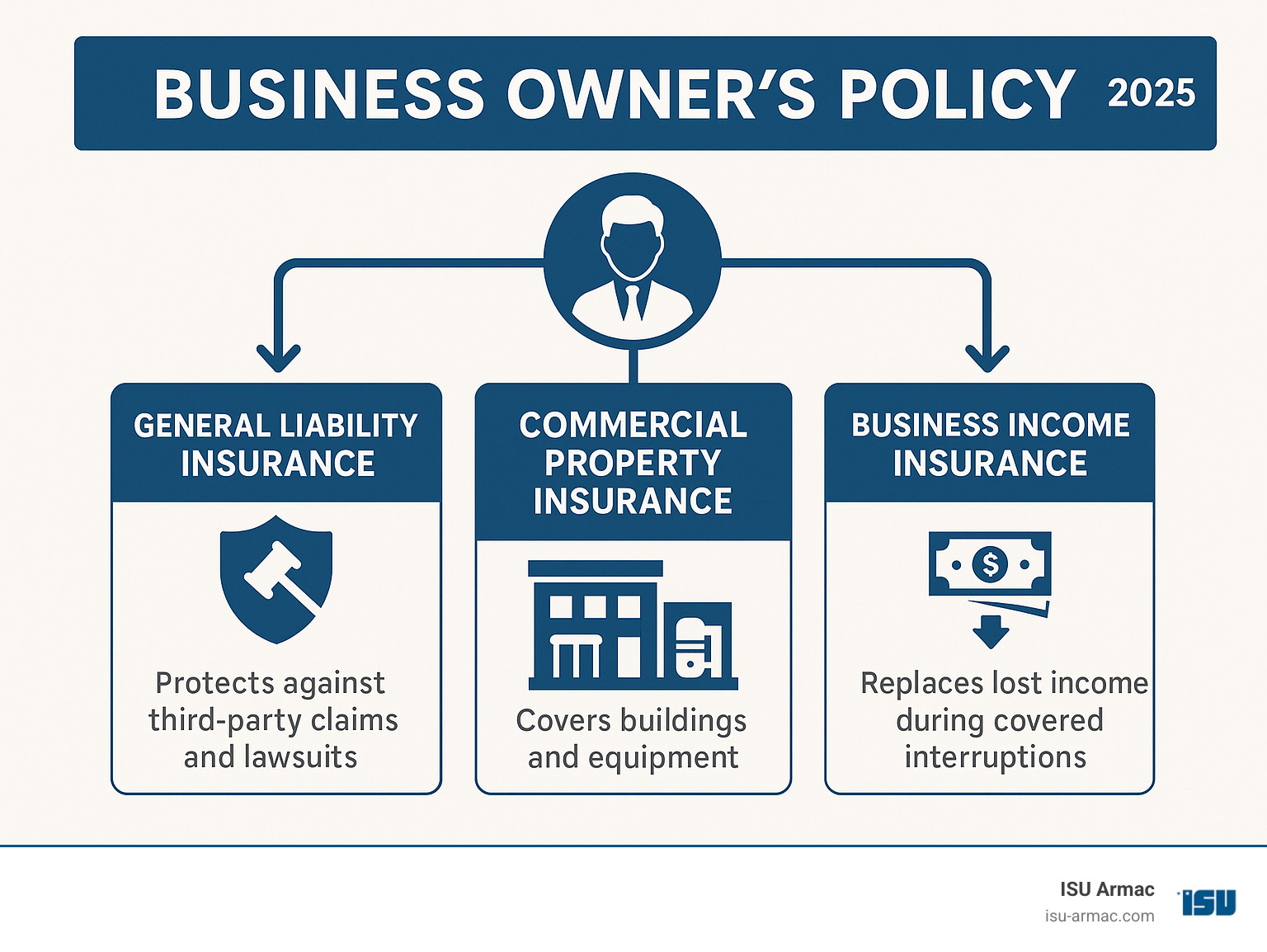
Every BOP includes three fundamental types of protection that work together like a safety net for your business. Think of them as the three pillars holding up your financial security.
General liability insurance serves as your shield against third-party claims. When a customer slips on your freshly mopped floor, or you accidentally damage a client’s property while providing services, this coverage steps in to handle medical expenses, legal fees, and potential settlements. It even protects you from claims involving advertising mistakes or copyright issues. Most commercial landlords require this coverage before they’ll lease space to you. You can dive deeper into General Liability Insurance Coverage to understand all the ways it protects your business.
Commercial property insurance acts as the guardian of your physical assets. Your office equipment, inventory, furniture, and even the building itself (if you own it) are protected against covered perils like fire, theft, vandalism, and certain weather events. Imagine walking into your retail store after a break-in to find your cash register gone and merchandise scattered everywhere. Commercial property insurance helps you replace what was stolen and repair the damage, getting you back in business faster.
Business income insurance might be the most overlooked yet crucial component. When a covered loss forces you to temporarily close your doors, your bills don’t take a vacation. Rent, payroll, loan payments, and utilities keep coming whether you’re open or not. This coverage replaces your lost revenue and covers continuing expenses while you rebuild or repair, ensuring your business survives the interruption.
Who is a BOP Designed For?
A Business Owner’s Policy works best for small to medium-sized businesses operating in relatively low-risk industries. The sweet spot typically includes companies with fewer than 50 employees and less than $5 million in annual sales, though these numbers can vary between insurance companies.
Your business is likely a great candidate for a BOP if you have a physical location where you conduct business, whether you own or rent the space. You probably have business assets like equipment, inventory, or furniture that would be expensive to replace. And if customers, clients, or the general public visit your premises or interact with your business in any way, the liability protection becomes essential.
Retail stores from clothing boutiques to hardware shops are classic BOP candidates. Restaurants and cafes benefit from the comprehensive coverage that protects their kitchen equipment, dining areas, and customer interactions. Professional offices like marketing agencies, real estate firms, or consulting practices find BOPs perfect for their needs. Service providers such as hair salons, florists, or dry cleaning businesses also fit well within BOP parameters.
The common thread among all these businesses is their physical presence and interaction with third parties – two factors that create both property and liability risks.
Key Benefits of Bundling into Small Business Insurance Packages
The magic of small business insurance packages lies in how they transform insurance from a necessary headache into a strategic advantage. The benefits go far beyond simple convenience.
Cost savings represent the most immediate and tangible benefit. Insurance companies reward customers who purchase multiple coverages by offering substantial bundling discounts. These discounts typically range from 5% when you combine two or more products from the same provider, up to 10% when you bundle a BOP with workers’ compensation insurance. Some carriers even offer up to 12% savings on commercial auto insurance when bundled with other policies. Over the course of a year, these savings can amount to hundreds or even thousands of dollars that you can reinvest in growing your business.
Simplified policy management might save you even more money in terms of time and stress. Instead of tracking three separate policies with different renewal dates, payment schedules, and insurance companies, you deal with one comprehensive policy. One annual renewal meeting, one payment to remember, one insurance company relationship to maintain. This streamlined approach reduces administrative burden and virtually eliminates the chance of accidentally letting coverage lapse because you forgot about one of multiple renewal dates.
Broader protection with reduced coverage gaps provides peace of mind that’s hard to put a price on. When you purchase individual policies from different companies, you risk creating gaps where certain situations might not be fully covered. A BOP is specifically designed to provide comprehensive protection against the most common risks small businesses face, with coverage types that complement each other seamlessly. This integrated approach means you’re less likely to find an expensive coverage gap at the worst possible moment – right when you need to file a claim.
Beyond the BOP: Essential Coverages to Add to Your Package
While a Business Owner’s Policy provides excellent foundational protection, it’s like having a good pair of running shoes – perfect for jogging, but you’ll need different gear for rock climbing. Every business faces unique risks that require customization beyond the standard BOP coverage.
Think of your BOP as the main course, and these additional coverages as the sides that complete your meal. We work with our clients to identify their industry-specific risks and build truly custom protection that fits like a glove.

The reality is that standard BOPs have some important gaps. They typically won’t cover employee injuries, business vehicle accidents, professional mistakes, or cyber attacks. Depending on your business model, these gaps could leave you seriously exposed.
Workers’ Compensation Insurance
Here’s something that catches many new business owners off guard: if you have employees, Workers Compensation Insurance isn’t optional – it’s the law in almost every state.
This coverage steps in when an employee gets injured or becomes ill due to their job. It handles medical expenses, covers lost wages during recovery, and provides rehabilitation support. Without it, you could be personally responsible for these costs, which can quickly spiral into the tens of thousands of dollars.
Beyond the state law requirements, workers’ compensation protects your business from potentially devastating lawsuits. When an employee accepts workers’ comp benefits, they typically can’t sue you for additional damages. It’s a win-win that keeps everyone protected.
Commercial Auto Insurance
If you or your employees drive for business – even occasionally – your personal auto insurance probably won’t cover accidents that happen during work activities. This includes everything from business vehicles like delivery trucks to employee driving their personal cars to client meetings.
Commercial Auto Insurance provides both liability protection (when you cause damage to others) and physical damage coverage (for your own vehicles). Whether you’re a contractor hauling equipment or a consultant visiting clients, this coverage protects your business from auto-related financial disasters.
The coverage extends beyond just the vehicle itself. If an employee causes a serious accident while running a business errand, the lawsuit could target your company’s assets. Commercial auto insurance provides that crucial buffer.
Professional Liability (Errors & Omissions)
For service-based businesses, your expertise is your product. But what happens when that expertise leads to an unexpected outcome for your client? Professional Liability insurance, also called Errors & Omissions (E&O), protects against negligence claims related to professional mistakes or undelivered services.
This coverage is essential for consultants, accountants, marketing agencies, and other professionals who provide advice or specialized services. Even if you do everything right, a client might blame you for their financial losses. Liability Insurance for a Small Business in the form of E&O covers legal defense costs and potential settlements.
Professional liability claims can be particularly expensive because they often involve significant financial losses. A single mistake could result in a lawsuit worth more than your entire annual revenue.
Cyber Liability Insurance
Every business is a technology business to some degree. Whether you store customer credit card information, maintain employee records, or simply use email, you’re handling sensitive data that cybercriminals want to steal.
Cyber Liability Insurance protects against data breaches and cyberattacks, covering everything from customer data protection costs to recovery expenses after an incident. This includes forensic investigations, customer notifications, credit monitoring services, and legal fees.
The statistics are sobering: 93% of small and medium enterprises that experience cyber incidents report severe impact to their business operations. Many small businesses never fully recover from a major data breach, making cyber liability coverage increasingly essential for comprehensive small business insurance packages.
Understanding the Cost of a Business Insurance Package
Let’s talk numbers – because I know that’s what’s really on your mind! When business owners ask me about small business insurance packages, the first question is almost always about cost. And honestly, that makes perfect sense. You’re running a business, watching every dollar, and you need to know what you’re getting into.
The truth is, there’s no magic number that applies to everyone. Insurance costs are as unique as your business itself. Think about it – a small accounting firm in downtown Victorville faces completely different risks than a construction company working across the High Desert. That’s why pricing varies so much.

But I can give you a realistic picture of what to expect and help you understand what drives those costs. For detailed information specific to your situation, I’d recommend checking out our guide on How Much Does Insurance Cost for a Small Business?.
Key Factors That Influence Your Premium
When insurance companies calculate your premium, they’re essentially playing detective – trying to figure out how risky your business is to insure. Here’s what they’re looking at:
Industry risk is probably the biggest factor. A restaurant with hot grills and wet floors naturally has more potential for accidents than a home-based consulting business. It’s not personal – it’s just math based on years of claims data.
Your business location matters more than you might think. Here in Southern California, we deal with earthquake risks and wildfire concerns that a business in Ohio doesn’t face. Higher crime areas also mean higher premiums, especially for property coverage.
The number of employees you have directly impacts your costs, particularly for workers’ compensation. More people on the job means more potential for workplace injuries, which insurers factor into their calculations.
Coverage limits and deductible amounts give you some control over your costs. Think of it like a seesaw – higher limits mean better protection but higher premiums. Higher deductibles mean lower monthly costs but more out-of-pocket expense if something happens.
Your claims history tells a story about your business. A clean record suggests good risk management, while frequent claims might signal higher future costs. Annual revenue also plays a role – bigger businesses often have more assets at risk and higher liability exposure.
Average Costs and Potential Savings
While every business is different, here are some real numbers to help you budget. Based on industry data, here’s what businesses typically pay monthly for standalone policies:
| Policy Type | Average Monthly Cost |
|---|---|
| General Liability | ~$42 |
| Professional Liability | ~$61 |
| Workers’ Compensation | ~$45 |
Now here’s where small business insurance packages really shine. A Business Owner’s Policy that bundles general liability, commercial property, and business income coverage averages about $141 per month. When you do the math, you’re getting three essential coverages for less than what two standalone policies would cost!
The savings get even better when you bundle additional coverages. Some insurers offer up to 10% discounts when you add workers’ compensation to your BOP. Others provide up to 12% savings on commercial auto when bundled with other policies. Even a 5% discount for buying two or more products adds up over time.
These aren’t just marketing gimmicks – they represent real money back in your pocket that you can reinvest in growing your business.
How to Obtain and Customize Your Policy
Getting the right small business insurance packages for your company doesn’t have to feel overwhelming, especially when you have the right guidance. Think of it as building a custom safety net for your business – one that fits your specific needs and budget perfectly. The process typically involves taking a close look at your unique risks, comparing quotes from multiple carriers, and then reviewing your coverage regularly to make sure it grows with your business. For a comprehensive walkthrough of this process, explore How to Get Small Business Insurance.
The beauty of working with an independent agency like ours is that we handle much of the heavy lifting for you. We don’t work for just one insurance company – we work for you, shopping multiple carriers to find the best combination of coverage and price.
Assessing Your Business’s Unique Risks
Before diving into policy options, you need to understand what you’re actually protecting. This isn’t about creating fear – it’s about being smart and prepared. Every business faces different risks, and understanding yours is the foundation of building effective small business insurance packages.
Start by identifying potential liabilities in your daily operations. Do customers visit your location where they could slip and fall? Do you store sensitive customer data that hackers might target? Do you provide professional advice that clients rely on for major decisions? These scenarios help determine whether you need general liability, cyber liability, or professional liability coverage.
Next, focus on property valuation. Walk through your business and honestly assess what it would cost to replace your building, equipment, inventory, and furniture if they were destroyed tomorrow. Many business owners underestimate these values, which can leave them scrambling to rebuild after a loss.
Don’t forget about employee risks if you have a team. Consider the nature of their work environment and daily tasks. An office worker faces different risks than someone operating machinery or working at heights. This assessment directly impacts your workers’ compensation needs and costs.
Finally, review any contractual requirements you might have. Your commercial lease, client contracts, or business loans often specify minimum insurance coverage you must maintain. Missing these requirements could put you in breach of contract, so it’s crucial to understand them upfront.
For additional insights into this process, check out our 10 Tips for Small Businesses Looking for Commercial Liability Insurance.
How to Customize Small Business Insurance Packages for Your Needs
Once you understand your risks, the real magic happens – customizing your coverage to fit like a perfectly custom suit. This is where small business insurance packages move beyond cookie-cutter solutions to become truly personalized protection.
Endorsements and policy riders are your secret weapons for addressing specific risks that standard policies might miss. Think of them as add-ons that expand your coverage. A restaurant might add food spoilage coverage for when the freezer breaks down, while a contractor might include coverage for tools stolen from job sites. These small additions can save you thousands when the unexpected happens.
Adjusting coverage limits is about finding that sweet spot between adequate protection and manageable premiums. Based on your risk assessment, you might choose higher limits for areas where you face greater exposure and standard limits elsewhere. It’s a strategic balancing act that requires understanding both your risks and your budget.
Choosing the right deductibles can significantly impact your monthly costs. A higher deductible means lower premiums, but you’ll pay more out-of-pocket if you need to file a claim. We help you find a deductible that aligns with your business’s cash flow and comfort level with risk.
This is where working with an independent agent makes all the difference. As ISU Armac, based in Victorville with locations in Apple Valley, Hesperia, and Oak Hills, we serve all of Southern California with a unique approach. We don’t represent just one insurance company – we represent you. This means we can shop multiple carriers, compare their offerings, and negotiate on your behalf to find the best coverage at the most competitive rates.
We take pride in choosing reputable providers for our clients. We partner with financially stable insurance companies known for excellent claims service and ethical business practices. You can even view a list of the World’s Most Ethical Companies to understand the standards we look for in our carrier partners.
Your business isn’t static, and neither should your insurance be. We recommend an annual policy review or whenever you experience significant changes like purchasing new equipment, expanding services, or hiring additional employees. This ensures your small business insurance packages continue to provide the right protection as your business evolves and grows.
Conclusion: Secure Your Business’s Future Today
Choosing the right small business insurance packages doesn’t have to be overwhelming. Think of it as building a safety net that lets you sleep better at night, knowing your hard work and dreams are protected from life’s curveballs.
We’ve walked through how a Business Owner’s Policy creates that essential foundation – bundling general liability, commercial property, and business income coverage into one streamlined package. It’s like having a Swiss Army knife for your most common business risks. Then we explored how adding specialized coverages like workers’ compensation, commercial auto, professional liability, and cyber insurance creates a comprehensive shield custom specifically to your business.
The math alone makes bundling attractive. You’re looking at potential savings of 10-12% compared to buying separate policies, plus the sanity-saving benefit of managing just one policy with one bill and one renewal date. No more juggling multiple insurance companies or worrying about coverage gaps that could leave you exposed.
But here’s what really matters: small business insurance packages give you the confidence to take calculated risks and grow your business. When you know you’re protected against the unexpected – whether it’s a customer injury, a cyber attack, or equipment damage – you can focus your energy on what you do best instead of worrying about what might go wrong.
As we’ve helped countless businesses across Victorville, Apple Valley, Hesperia, and Oak Hills, we’ve seen how the right insurance transforms anxious business owners into confident entrepreneurs. Protecting your assets is a critical step in building a resilient and successful enterprise.
The best time to secure your coverage is before you need it. Every day without proper insurance is a day you’re gambling with everything you’ve worked to build. We’re here to make the process simple, shopping multiple carriers to find you the best protection at the most competitive rates.
Ready to move forward? Check out our comprehensive guide on Business Insurance for Small Businesses or explore your small business insurance options today. With the right small business insurance packages in place, you’re not just protecting what you have – you’re investing in the future you’re building.