
Why Understanding Personal Vehicle Business Use Saves You Money
Personal vehicle business use is a major tax-saving opportunity for self-employed individuals, business owners, and gig workers. If you drive your car for work—to meet clients, pick up supplies, or make deliveries—you can deduct those expenses from your taxable income.
Quick Answer: How to Deduct Personal Vehicle Business Use
- Track Business Miles: Use a log or app to record all work-related driving.
- Choose a Method: At tax time, select either the Standard Mileage Rate (70 cents per mile for 2025) or the Actual Expense method.
- Calculate & Deduct: Apply your chosen method to determine your deduction and report it on your tax return (e.g., Schedule C).
- Keep Records: Retain all mileage logs and receipts for at least five years in case of an audit.
The difference between these methods can mean thousands of dollars in tax savings. The standard mileage rate is simpler, while the actual expense method often benefits those with expensive vehicles or high operating costs.
I’m Ryan McEachron, CEO of ISU Insurance Services ARMAC Agency in Victorville. For over 25 years, I’ve helped local entrepreneurs steer the intersection of personal vehicle business use and proper insurance. Many clients find their personal auto policy doesn’t cover business activities—a costly gap we’ll explore in this guide.
Who Can Deduct Car Expenses and What Qualifies as Business Use?
If you’re self-employed, an independent contractor, or a gig economy worker, you can deduct expenses for your personal vehicle business use. This includes freelancers, consultants, rideshare drivers, and small business owners across Southern California. However, due to recent tax law changes, most W-2 employees can no longer claim these deductions.
Defining Business vs. Personal Mileage
Understanding what the IRS considers business mileage is the key to maximizing your deduction. Getting this right is critical.
What counts as business mileage:
- Driving to meet with clients or customers.
- Traveling between different offices or work sites.
- Driving to a temporary work location.
- Running business-related errands, like picking up supplies.
What does NOT count:
- Commuting: Your drive from home to your regular place of business is never deductible. The IRS views this as a personal expense.
- Personal Errands: Stopping at the grocery store on the way home from a client meeting is a personal trip.
If you use one vehicle for both business and personal trips, you must calculate your business-use percentage. This is why meticulous record-keeping is essential.
Employees vs. Self-Employed Individuals
Your ability to deduct vehicle expenses hinges on your employment status. The Tax Cuts and Jobs Act (TCJA) of 2018 suspended the deduction for unreimbursed employee business expenses through 2025.
- Self-Employed/Business Owners: You can deduct vehicle expenses on Schedule C of your tax return, reducing both your income and self-employment taxes.
- W-2 Employees: You generally cannot deduct work-related driving costs, even if your employer doesn’t reimburse you. Your best option is to seek reimbursement from your company.
A few narrow exceptions exist for employees: Armed Forces reservists, qualified performing artists, and certain government officials can still deduct unreimbursed travel expenses using Form 2106. For everyone else who is self-employed, tracking business miles is one of the smartest financial moves you can make.
Maximizing Deductions for Your Personal Vehicle Business Use
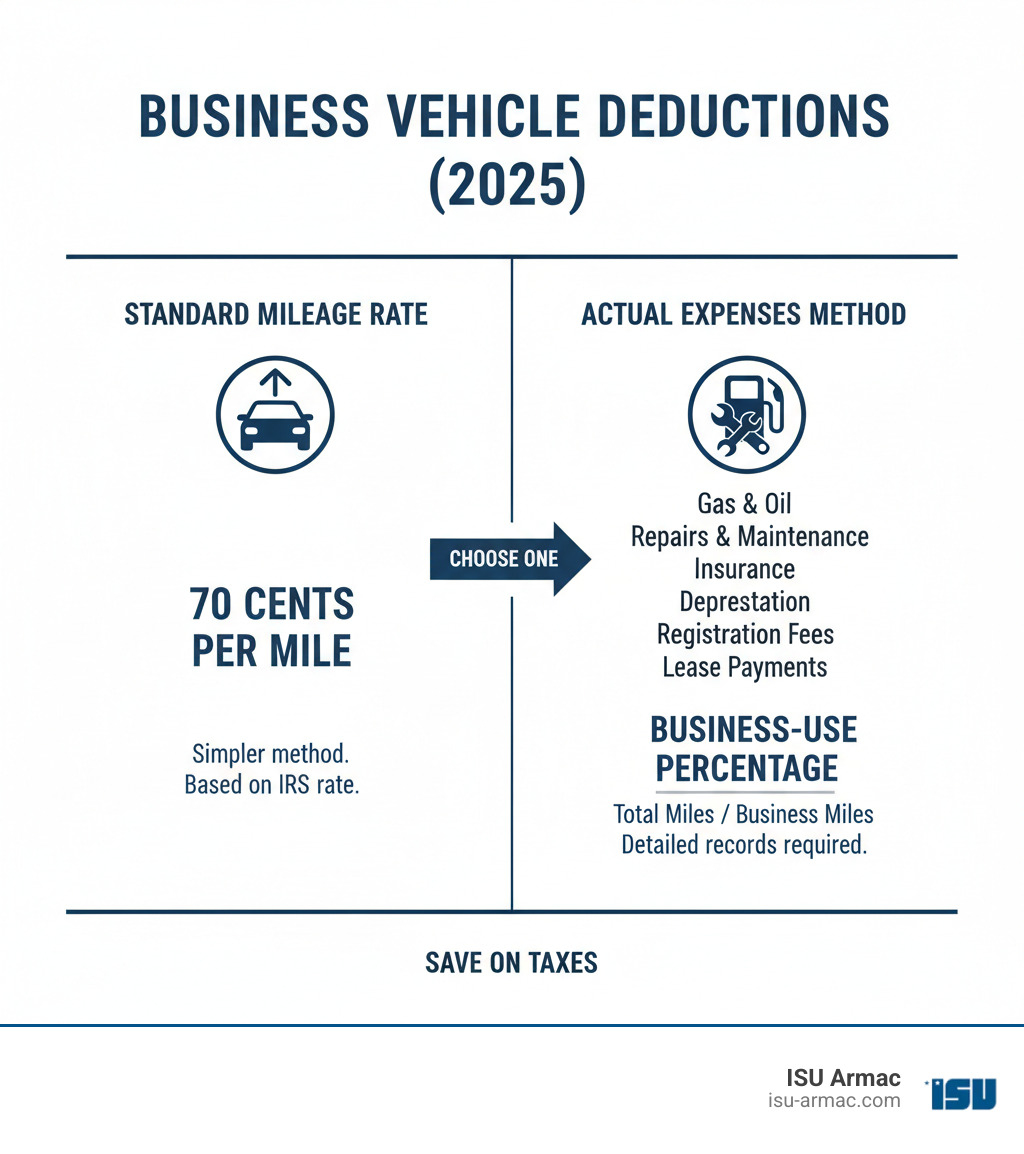
Once you know you’re eligible, you must choose how to calculate your deduction. The IRS offers two methods: the standard mileage rate and the actual expense method. You can calculate your deduction both ways and choose the one that yields a greater tax saving.

Method 1: The Standard Mileage Rate
The standard mileage rate is the simplest option. The IRS sets a rate per business mile that covers most operating costs. For 2024, the rate is 67 cents per mile, and it increases to 70 cents per mile for 2025.
To calculate, simply multiply your business miles by the current rate. For example, 10,000 business miles in 2024 would result in a $6,700 deduction. This rate includes depreciation, fuel, oil, maintenance, tires, insurance, and registration. You can still separately deduct business-related parking fees, tolls, and interest on your car loan.
This method has limitations. You cannot use it if you operate five or more vehicles or if you’ve previously claimed certain types of depreciation on the vehicle. If you lease a vehicle and choose this method, you must use it for the entire lease term. You can find the current standard mileage rate on the IRS website.
Method 2: The Actual Expense Method
The actual expense method requires more detailed record-keeping but can offer a larger deduction, especially for expensive vehicles or those with high operating costs. With this method, you deduct the actual costs of using your car for business.
These costs include gas, oil, repairs, tires, insurance, registration, depreciation (for owned cars), and lease payments. You can also deduct business-related tolls and parking.
To calculate your deduction, first determine your business-use percentage (business miles / total miles driven). Then, multiply your total vehicle expenses by this percentage. For example, if your car was used 67% for business and your total annual expenses were $8,000, your deduction would be $5,360. Ensuring you have proper Commercial Auto Insurance is a key part of managing these costs.
Comparing Standard Mileage vs. Actual Expenses
- Standard Mileage: Best for simplicity, economical cars, and those who want minimal record-keeping. You only need to log your miles.
- Actual Expenses: Better for expensive cars, vehicles with high repair or fuel costs, and those willing to track every receipt.
Crucial Rule: If you own your vehicle, you can switch from the standard method to the actual expense method in a later year. However, if you start with the actual expense method, you must stick with it for the life of that car. For leased vehicles, your first-year choice is binding for the entire lease period.
Advanced Deductions: Depreciation, Section 179, and Vehicle Type
Beyond the basic methods, advanced strategies like depreciation and Section 179 can open up significant tax savings, especially if you’ve purchased a vehicle for your business.
Understanding Depreciation and Luxury Car Limits
When you buy a vehicle for personal vehicle business use, the IRS allows you to recover its cost over time through depreciation. However, there are annual limits on how much you can claim for passenger automobiles (vehicles under 6,000 pounds).
For a vehicle placed in service in 2024 and used 100% for business, the maximum first-year depreciation is $12,400, plus an additional $8,000 in bonus depreciation, for a potential total of $20,400. This bonus depreciation is being phased out; it was 80% in 2023 and dropped to 60% for 2024, making the timing of your purchase important.
Using Section 179 and the Heavy Vehicle Exception
The Section 179 deduction allows you to expense a large portion of a vehicle’s cost in the year you place it in service, rather than depreciating it over several years. The vehicle must be used more than 50% for business.
This is where it gets interesting for business owners considering a larger vehicle. The “luxury car” limits do not apply to SUVs, pickups, or vans with a Gross Vehicle Weight Rating over 6,000 pounds. For these heavy vehicles, you could potentially deduct up to $30,500 in the first year (for 2024) using a combination of Section 179 and bonus depreciation. This “heavy SUV” strategy is a popular and powerful tax-saving tool, stemming from recent tax legislation like the Tax Cuts and Jobs Act. You can learn more about these ongoing tax changes in this One Big Beautiful Bill article.
Deductions for Leased vs. Owned Vehicles
Whether you buy or lease also impacts your tax deductions.
- Owning: If you use the actual expense method, you can claim depreciation (including Section 179/bonus) and deduct the interest on your car loan. If you use the standard mileage rate, you can still deduct loan interest separately.
- Leasing: You deduct the business-use portion of your actual lease payments. However, if you choose the standard mileage rate, you’re locked into that method for the entire lease. Additionally, for high-value leased vehicles (over $62,000 for 2024 leases), you must add a small “income inclusion” amount back to your income, as detailed in IRS publications like IRS Revenue Procedure 2024-13.
The How-To: Record-Keeping and Insurance Requirements
Choosing a deduction method is half the battle. To protect your deductions from IRS scrutiny and your business from liability, you need excellent records and the right insurance.

How to Keep Impeccable Records
The IRS requires proof. Your mileage log is the foundation of your vehicle deduction. For every business trip, you must record:
- The date
- Your destination
- The business purpose of the trip
- Your starting and ending odometer readings
The easiest way to do this is with a GPS-enabled smartphone app (like MileIQ or Everlance) that automatically tracks your drives. A simple pen-and-paper logbook or a spreadsheet also works if you’re consistent. If you use the actual expense method, you must also save every receipt for gas, repairs, insurance, and other vehicle costs. The IRS requires you to keep these records for at least three years, but we recommend five to seven years for safety.
Insurance Requirements for Personal Vehicle Business Use
This is a critical point many business owners miss: your Personal Auto Insurance policy likely does not cover you when you’re driving for work. Most policies have business use exclusions, meaning if you have an accident while on a business trip, your claim could be denied, leaving you personally liable for all costs.
This gap affects contractors hauling tools, consultants driving to client offices, and gig workers making deliveries. These activities typically require more than a personal policy. Rideshare and delivery drivers, in particular, face unique challenges, as their personal policies almost never provide coverage while they are working.
You absolutely need commercial auto insurance if your vehicle is titled in your business’s name, you transport goods or people for a fee, or employees drive your vehicle. Even if you’re just a sole proprietor using your sedan for frequent business travel, you may need a commercial policy or a special endorsement.
As an independent agency in Victorville, ISU Armac can shop multiple carriers to find the right Commercial Auto Insurance for your specific needs. Don’t let an insurance gap undermine your business. Let’s ensure you’re properly protected for your personal vehicle business use.
Frequently Asked Questions about Vehicle Deductions
Over 25 years of serving business owners in the High Desert, I’ve answered countless questions about vehicle deductions. Here are some of the most common.
Can I write off my monthly car payments?
No, you cannot deduct the principal portion of your car loan payments. However, you can deduct the interest you pay on the loan if you use the actual expense method. If you lease a vehicle, the business-use portion of your entire lease payment is deductible.
What is the easiest way to track my business miles?
The best method is the one you’ll use consistently. For most people, the easiest and most accurate way is a GPS-enabled mileage tracking app on your smartphone (e.g., MileIQ, Everlance). These apps automatically log your trips and generate IRS-compliant reports. A traditional pen-and-paper logbook is also perfectly acceptable if you’re diligent about recording every business trip.
Do commuting miles from my home to my office count for business?
No. The IRS is very clear that your daily drive from home to your primary place of business is a personal commute and is never deductible. However, travel from that primary workplace to other job sites or to meet clients is deductible. The main exception is if you have a qualifying home office that is your principal place of business. In that case, driving from your home office to a client’s location can be considered deductible business travel.
Conclusion
If there’s one thing I hope you take away from this guide, it’s that personal vehicle business use deductions aren’t just for large corporations with company car fleets. They’re for you—the self-employed professional, the independent contractor, the gig worker, and the small business owner driving the roads of Victorville, Apple Valley, Hesperia, and beyond. These deductions represent real money back in your pocket, and with the 2025 standard mileage rate at 70 cents per mile, those savings add up quickly.
The path to maximizing these deductions starts with understanding your eligibility and choosing the right method for your situation. Whether you opt for the simplicity of the standard mileage rate or the potentially higher savings of the actual expense method, both routes can lead to substantial tax savings. For those with heavier vehicles or significant business use, advanced strategies like Section 179 and bonus depreciation can turn a vehicle purchase into a powerful tax-planning tool.
But here’s the reality: none of these deductions matter if you can’t back them up. The IRS requires detailed, consistent records, and a mileage log is your best friend come tax time. Start tracking today, not next January when you’re scrambling to reconstruct a year’s worth of trips. Whether you prefer a simple notebook in your glove compartment or a GPS-enabled app on your phone, find a system that works for you and stick with it.
And while we’re talking about protection, let’s circle back to something equally important—your insurance coverage. I’ve seen too many business owners find, at the worst possible moment, that their personal auto policy won’t cover them when they’re driving for business. The peace of mind that comes from having the right coverage is worth every penny, especially when you’re building something you care about.
At ISU Armac, we understand that insurance isn’t one-size-fits-all. That’s why we shop multiple carriers to find coverage that fits your specific needs and budget. Whether you need a simple business use endorsement on your personal policy or full Commercial Auto Insurance for your fleet, we’re here to help you make sense of it all. After 25 years serving Southern California businesses, we’ve learned that the best insurance is the kind that’s there when you need it—and that starts with having an honest conversation about how you actually use your vehicle.
So keep those records, choose your deduction method wisely, and make sure you’re properly covered. Your business deserves both the tax savings and the protection that come from doing things right. Drive safe out there, and here’s to your continued success on the road ahead.