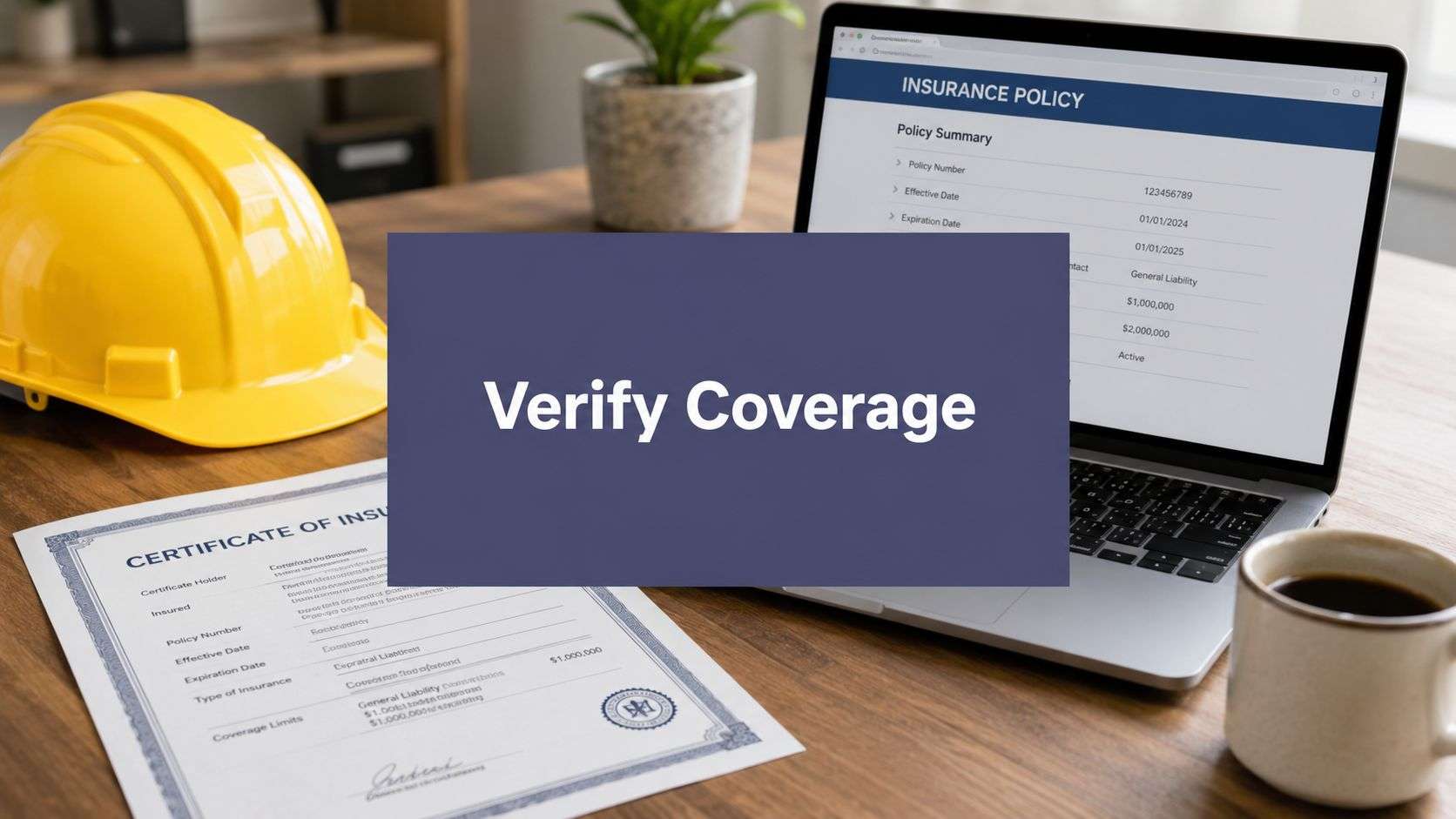
You're about to send a crew to a job, or sign off on a subcontractor, and somebody asks for proof of workers' compensation. If the certificate is old, the policy details don't line up, or the insurer can't be confirmed, the whole job slows down. In California, that's not office clutter, it's the difference between a clean start and a stop-order headache.
For employers in Victorville and across California, workers compensation insurance verification is a working habit, not a one-time file check. It protects the business from hiring someone who looks insured but isn't, from getting caught with the wrong policy on a project, and from discovering too late that a certificate in the folder doesn't match the coverage in force. It also keeps contractor onboarding, audit prep, and job-site mobilization moving without guesswork.
Table of Contents
- Why California Employers Need to Verify Workers Compensation
- Documents to Request Before You Trust a Policy
- Reading the Policy Declarations and Decoding the Details
- California Verification Tools and Where to Confirm Coverage
- California Enforcement and the Cost of Skipping Verification
- Red Flags and Common Verification Pitfalls
- Building a Verification Routine and Getting Covered Right
Why California Employers Need to Verify Workers Compensation
A Victorville contractor can have the right crew lined up, the tools loaded, and the schedule ready, then lose the morning because the general contractor wants proof before anyone steps on site. That's normal now. A COI printed last month doesn't settle the question, because the issue is whether the policy is active, matched to the work, and issued by a carrier that can stand behind it in California.
That's why verification matters. California's coverage checks aren't just about compliance paperwork, they're about avoiding the moment when an injured worker, a site supervisor, or a licensing reviewer asks for proof the business can't produce. The practical problem is simple, a certificate can look fine while the policy is expired, misclassified, or not tied to the correct employer name.
Practical rule: if the work hasn't started yet, the certificate hasn't been verified yet.
I tell employers to treat verification like clocking time on a jobsite. If the crew logs arrival, a supervisor knows who's present, and the record is accurate. The same logic applies to insurance documentation, and tools like shift scheduling clock in are useful because they make attendance and job start times easier to align with coverage dates.
For California businesses that want a local place to start, the basics are laid out in this workers' compensation overview. The reason to care is plain, one missed check can turn into a dispute, a delay, or a stop-order mess that nobody wanted.
Documents to Request Before You Trust a Policy
The first document most employers ask for is a certificate, usually an ACORD 25 Certificate of Liability Insurance. That's fine as a starting point, but in California a certificate by itself doesn't prove much. A responsible review asks for the supporting paperwork too, because the certificate often leaves out the details that decide whether the policy really fits the job.
Ask for the policy declarations page, the workers' compensation policy number, the carrier name, the NAIC number, and the producer's contact information. Those items let you go back to the source and confirm the coverage directly instead of relying on a screenshot or a forwarded PDF. For subcontractors, that direct check matters when the job is already scheduled and nobody wants a surprise.
For employees or workers with history that could affect onboarding, ask for the relevant claim history or loss-run documentation when it's appropriate. For owner-operators and 1099s, require a signed independent contractor verification that addresses the actual working relationship, not just the label on the invoice. A certificate doesn't decide worker status, the facts do.
A current certificate should show the producer's name and contact, carrier name, policy number, effective dates, limits, classification codes, and a description of operations. If one of those pieces is missing, the review isn't finished.
Use the details to spot recycled or altered paperwork. If the employer name is wrong, the dates don't align, the operations description is too vague, or the classification code feels copied from another trade, pause and confirm the file directly. For a plain-English breakdown of what should be in the packet, the guide on workers' compensation insurance certificates is a useful reference point for California employers.
Reading the Policy Declarations and Decoding the Details
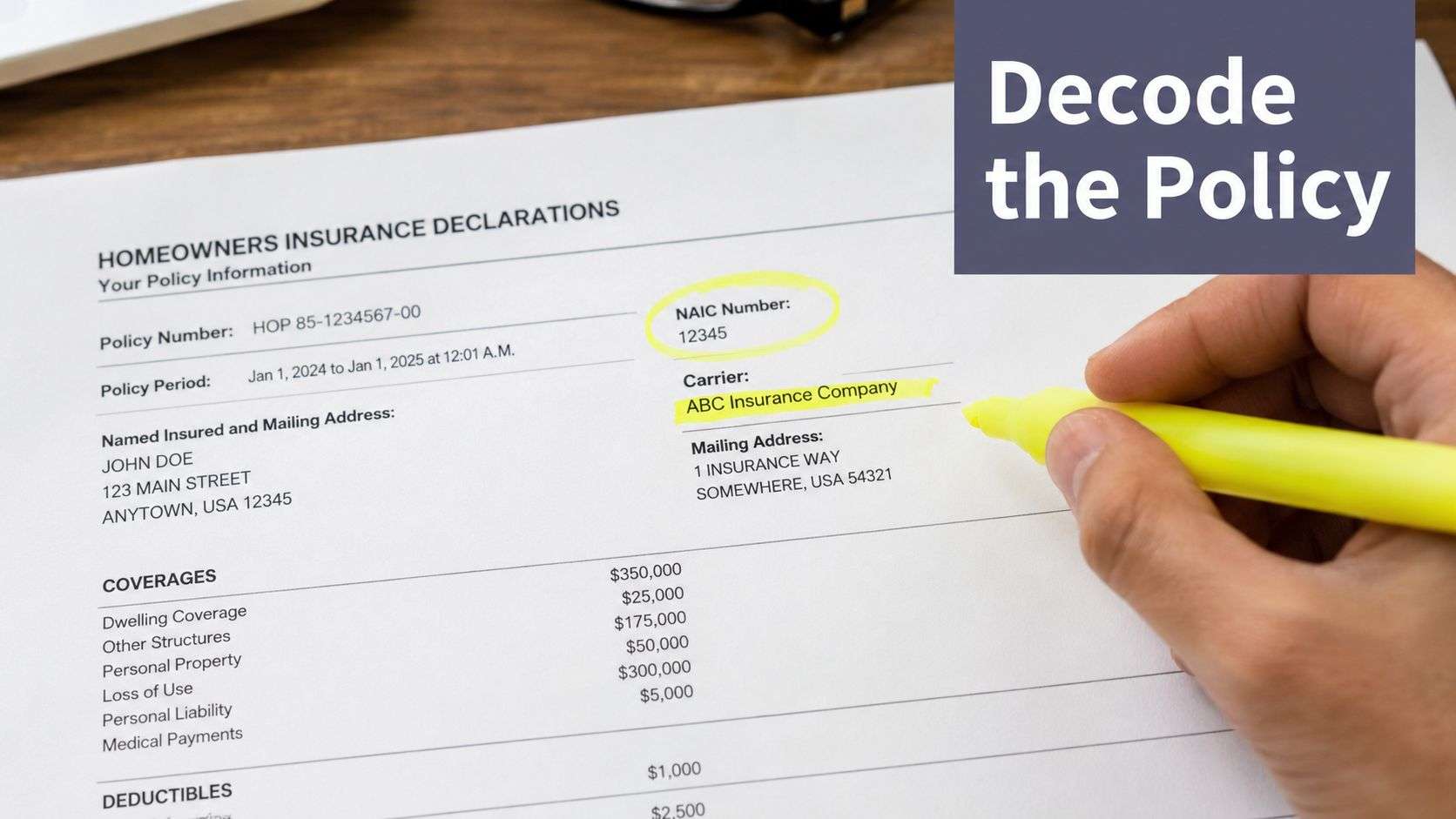
The declarations page tells you more than the certificate does, if you read it line by line. Start with the carrier name and confirm it matches the insurer you expect. Then check the policy period, because the key test is whether the coverage window covers the days work will be performed, not just the date the certificate was printed.
The next checkpoint is the classification code. A roofing crew classified like office staff is a problem waiting for a policy audit, and it can also create trouble when a claim is filed. Payroll estimates matter for the same reason, because the carrier is pricing the risk based on the work the business says it performs, not what it wishes it performed.
Here's the practical habit that saves time:
- Match the employer name: Make sure the legal name on the declarations page matches the business entity on the contract.
- Check the work dates: Confirm the job dates fall inside the policy period, not just near it.
- Review the class codes: Compare the listed codes with the actual scope of work, especially for field labor.
- Look for endorsements: Read for exclusions, cancellation language, and any condition that trims coverage mid-project.
If anything looks off, call the broker or carrier using the number printed on the declarations page, not the number typed on the certificate. That one habit cuts through a lot of recycled paperwork. A certificate is a summary, the declarations page is where the story starts.
For a broader explanation of how the policy works behind the scenes, this guide to workers' compensation insurance gives the right context before you rely on a document that could be stale or incomplete.
California Verification Tools and Where to Confirm Coverage
California gives employers several ways to cross-check a policy, and each tool answers a different question. The WCIRB coverage verification search is useful when you want to confirm whether a policy was written and is active with an admitted carrier. The CSLB public lookup helps confirm contractor licensing status and bond posting, but it doesn't prove workers' compensation coverage by itself.
The DIR Workers' Compensation Coverage Search is the next layer when you need a state-maintained policy record. It's especially helpful when a contractor says coverage exists but the paper trail is thin. If the online result still leaves doubt, I tell employers to call the carrier directly and keep a screenshot with a timestamp.
| California Workers Comp Verification Tools Compared | |||
|---|---|---|---|
| Tool | What It Confirms | What It Does Not Confirm | Best Use |
| WCIRB coverage search | Policy activity with an admitted carrier | Policy limits, exclusions, and work-specific classification details | Fast confirmation before a job starts |
| CSLB lookup | Contractor license status and bond posting | Workers' compensation coverage | Checking whether a contractor is properly licensed |
| DIR coverage search | State-maintained coverage record | Full policy language and endorsements | Cross-checking a contractor's insurance claim |
| Carrier direct confirmation | Whether the policy is actually in force | Public license status | Final confirmation when a file looks uncertain |
The safe sequence is simple. Check the state tools first, then verify with the carrier if anything doesn't line up. Record the date, the source, and the result, because screenshots without timestamps turn into arguments later.
For employers who need a licensed local agency to help assemble the right paperwork and verify what's on file, ISU Insurance Services in Victorville can handle workers' compensation placement and documentation review for California businesses.
California Enforcement and the Cost of Skipping Verification
A missing workers' compensation file can turn into a stop order fast. California can shut work down when coverage is not in place, and the employer can be assessed $100 per employee employed when the stop order is issued and served under the state's stop-order rule (California stop-order regulation). That kind of penalty turns a missing certificate into a jobsite problem before lunch.
The state also looks at prior uninsured periods. Under Labor Code section 3722, if an employer has been uninsured for more than a week in the prior calendar year, the director can issue a penalty assessment order for the greater of twice the unpaid premium for the uninsured period or $1,500 per employee during that period (Labor Code section 3722). That is why verification should happen before a contractor starts work, not after a renewal notice shows up.
Contractors face another layer of exposure. California also requires proof of coverage in the licensing context, so a missing certificate can turn into a license problem and then a business problem. If the business cannot prove coverage, the state can act on that gap.
Plain truth: a current certificate in the file can save a project, but only if it is real, current, and tied to the correct employer.
That is the cost of skipping verification. It is lost time, damaged trust, and a much more expensive recovery path than checking the policy before work begins.
For employers who want a licensed local agency to help assemble the right paperwork and verify what is on file, ISU Insurance Services in Victorville can handle workers' compensation placement and documentation review for California businesses.
Red Flags and Common Verification Pitfalls
A clean-looking certificate can still be a trap. The first document most employers ask for is a certificate, but in California a certificate alone does not establish coverage. If the paper does not match the policy, the employer name is wrong, or the dates are stale, the file is weak from the start.
Watch for misaligned employer names, coverage dates that have already passed, and vague operations descriptions that do not match the job. A policy can also look fine at first glance while a cancellation clause or endorsement changes the exposure. The contractor may say coverage exists, but the file still will not hold up when someone asks for proof.
A few red flags deserve immediate follow-up:
- Recycled PDFs: Old certificates often get reused after the policy changes.
- Screenshots instead of PDFs: Screenshots are easy to crop and harder to verify.
- Missing producer contact details: If you cannot call the source, you cannot confirm the file.
- No certificate holder named: If your business is not identified, the protection may not be set up the way you expect.
- Mismatch between the work and the class code: That usually means the file was not reviewed with the actual job in mind.

The safest move is to verify the policy directly. If the contractor resists that step, that tells you enough. A certificate does not determine worker status, the actual working relationship does. A business that is serious about the job should be just as serious about the paperwork behind it.
Building a Verification Routine and Getting Covered Right
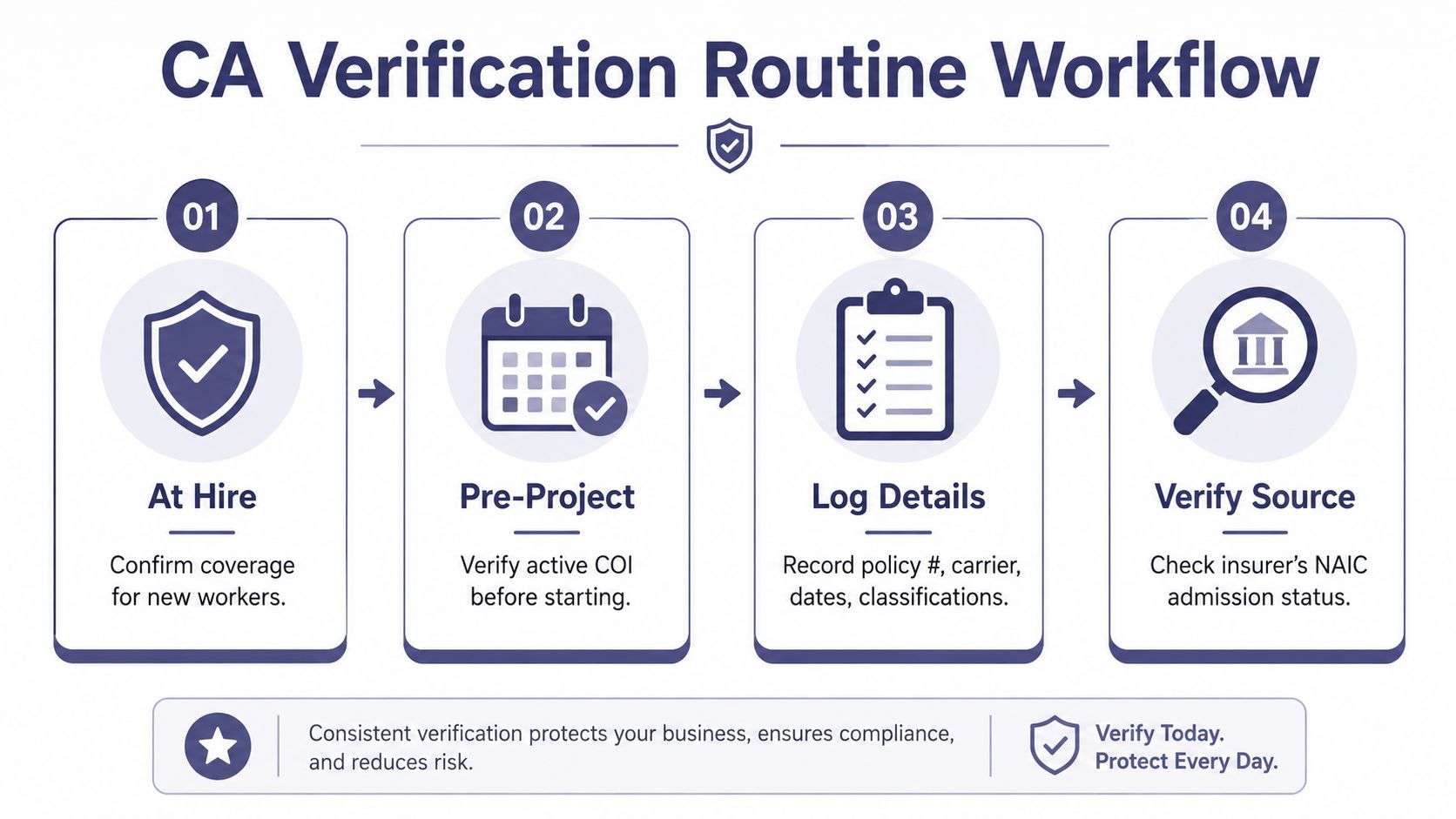
The routine that works is boring, which is exactly why it works. Check coverage at hire, check it again before the project starts, and log the policy number, carrier, dates, classification codes, and the source used to confirm it. If the file came from the state search, the carrier, or the broker, record that too.
Then set calendar reminders before expiration and ask for updated declarations before the policy rolls off. If there's a lapse, document the follow-up immediately instead of waiting until the next audit or claim. That habit keeps gaps from hiding in the file.
A good onboarding checklist should also include the contractor's license status, the workers' comp certificate, and a written agreement that requires prompt notice of any coverage change. Keep all of it in the same file, because scattered records are hard to defend. A neat audit trail is worth more than a thick folder full of undated attachments.
If your business needs to bind coverage, clean up a stop-order issue, or replace a weak file with a real one, a California-licensed agency like ISU Insurance Services can help you get the policy issued, confirm the documents, and file what you need so the work can move forward.
If you want a straight answer on a certificate, a policy, or a contractor file that doesn't quite add up, visit ISU Insurance Services and talk with a California agency that handles workers' comp the way employers use it. They can help you verify coverage, line up the paperwork, and get a California business back to work with less guessing and fewer surprises.