You can stand in a Victorville kitchen with three quotes on the table and still not know which one protects your home. One premium looks low, another looks expensive, and neither tells you much until you line up the same dwelling limit, the same deductible, and the same exclusions.
That's where most first-time buyers get stuck. Home Insurance in Victorville CA is less about hunting for the cheapest number and more about understanding why two apparently similar homes can land in very different price bands, especially in the High Desert where roof age, construction details, wildfire exposure, and coverage gaps all matter.
Table of Contents
- Why Victorville Homeowners Need a Local Lens on Insurance
- The Building Blocks of a Homeowners Policy
- What Drives the Price of a Victorville Homeowners Policy
- The Coverage Gaps Most Victorville Policies Leave Behind
- How to Compare Victorville Home Insurance Quotes the Right Way
- Discounts and Smart Ways to Lower Your Premium
- Frequently Asked Questions About Victorville Home Insurance
- Your Next Step With ISU Insurance Services
Why Victorville Homeowners Need a Local Lens on Insurance
A Victorville homeowner can open a renewal notice at the kitchen table and wonder why the premium seems to come out of nowhere. Local pricing follows the home itself, not just California averages, because Victorville has a strong owner-occupied housing base, and those homes are the core customers for home insurance in the city.
That local lens matters because statewide figures can mislead. California homeowners spent about $1,200 per year on average in 2023, and one California benchmark places a policy with $300,000 in dwelling coverage at roughly $1,641 per year. Those numbers help with orientation, but they do not tell you what your house will cost to insure (High Desert home insurance in Victorville).
Why a local comparison beats a statewide average
Victorville homes do not all age the same way, and they do not all sit under the same underwriting lens. A newer home with updated systems can look very different to an insurer than an older property with original components. That means one quote may reflect the condition of your actual house, while another may be based on a broad assumption that misses important details.
A local independent agency helps by comparing options across carriers instead of forcing the conversation into one brand's pricing model.
Practical rule: if the quote does not match your actual house, the price does not mean much.
ISU Insurance Services is built for that kind of local comparison. As a community-rooted independent agency in Victorville, it can help homeowners compare coverage options rather than settle for the first premium that looks acceptable. The right starting point is not, “What is the average?” It is, “What does this specific home need, and what does each policy include?”
The Building Blocks of a Homeowners Policy
A homeowners policy makes more sense once you stop treating it like one block of coverage. It is a bundle of six core protections, often called Coverages A through F. Each part answers a different question, such as what gets rebuilt, what gets replaced, where you can stay during repairs, and who is protected if someone gets hurt on your property.
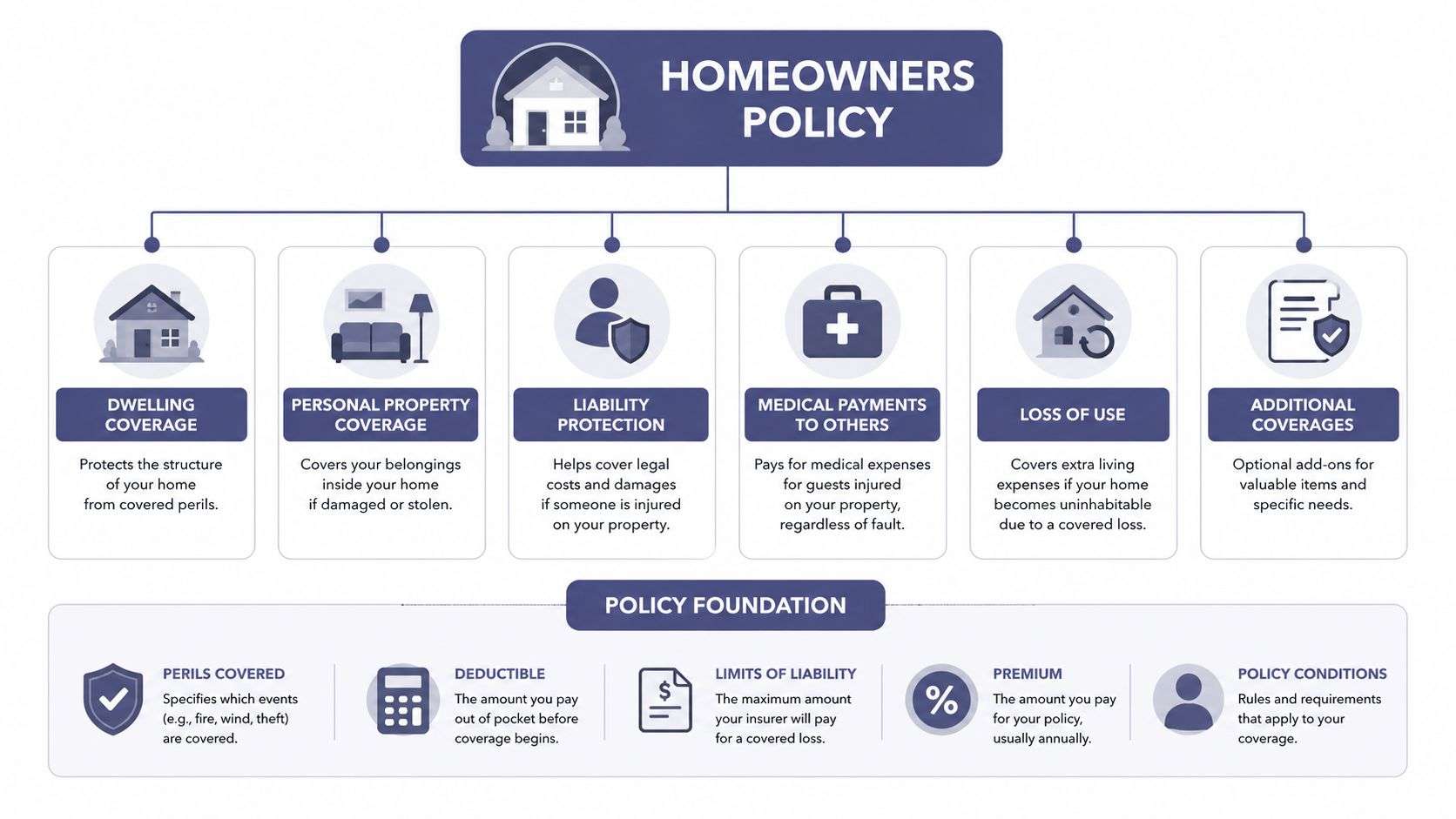
Coverage A, dwelling, pays to repair or rebuild the main structure after a covered loss, so it should be tied to replacement cost, not market value. Coverage B protects other structures, such as a detached garage or fence. Coverage C handles personal property, which is the stuff inside the house, furniture, clothes, appliances, and similar belongings.
What the remaining coverages cover
Coverage D, loss of use, pays certain extra living costs if a covered claim makes the home temporarily unlivable. Coverage E, personal liability, helps if someone is injured and you are legally responsible. Coverage F, medical payments to others, is usually smaller and is meant for minor injuries that happen on the property.
A Victorville repair claim makes the split easier to see. If a kitchen fire damages cabinets, wiring, and drywall, the dwelling limit is the part that matters for the structure itself. If smoke ruins a couch and a mattress, that loss falls under personal property. If the family has to stay elsewhere while repairs are finished, loss of use keeps those temporary expenses from landing entirely on the homeowner.
A policy quote also depends on the home itself. The price changes with the age of the house, the deductible, and the amount of dwelling coverage, which is why a quick estimate can miss the mark if it is based on incomplete details. A homeowner who wants a rough starting point can use an online homeowners insurance cost calculator before asking for full quotes.
Replacement cost pays to rebuild with materials of similar kind and quality.
Actual cash value pays after subtracting depreciation, which can leave a homeowner filling a much larger gap.
What Drives the Price of a Victorville Homeowners Policy
Victorville premiums shift because each home brings a different risk profile to the quote. California's homeowners profile framework ties pricing to the mix of deductible, age of home, and coverage amount (homeowners profile). The same policy form can still land at very different price points once the home's age, rebuild cost, and deductible change.
A first-time homeowner often expects one simple answer, but insurers do not price houses that way. A house with an older roof, dated plumbing, or a lower deductible can cost more to insure, while a newer home with higher out-of-pocket protection may cost less. Coverage amount also matters because the insurer is taking on a larger rebuild obligation as the dwelling limit rises.
The main underwriting levers
The deductible works like the amount you agree to handle yourself before the insurer pays. A higher deductible usually lowers the premium, but only if the homeowner can comfortably cover that amount after a loss. Age matters too. Older homes often bring more concern around roofs, plumbing, and electrical systems, so the quote can rise even when the house appears similar from the street. Coverage amount changes the bill as well, because a larger dwelling limit means a larger promise to rebuild if the structure is damaged.
That pattern is why Victorville quotes can spread out so much from one home to the next. Two houses may look close in size and layout, yet one may have updates that make it easier to insure while the other may carry older components that raise the price. Local construction costs and finish levels also matter when the replacement cost is calculated, since the insurer is not pricing the house as it stands today, but what it would take to rebuild it after a covered loss.
Before you request quotes, verify the roof age, square footage, and whether the home has updated plumbing or electrical. Those details can change both eligibility and price.
Why two similar houses can get different quotes
In Victorville, small property differences often create the biggest price gaps. Roof age and roof material matter, construction type matters, and so do prior claims and whether the home has been updated. A house with newer systems and a cleaner claims history may look easier to insure than a similar house that has never been modernized.
The gap can also widen when the quote is missing accurate property details. If the dwelling limit is too low, the policy may leave a homeowner short after a loss. If it is too high, the premium can rise for coverage the house may not need. The easiest way to organize those questions is to start with a rough estimate, then test how the answer changes as you adjust limits, deductibles, and property details with a Victorville homeowners insurance cost calculator. The final number still depends on the property-specific quote.
The Coverage Gaps Most Victorville Policies Leave Behind
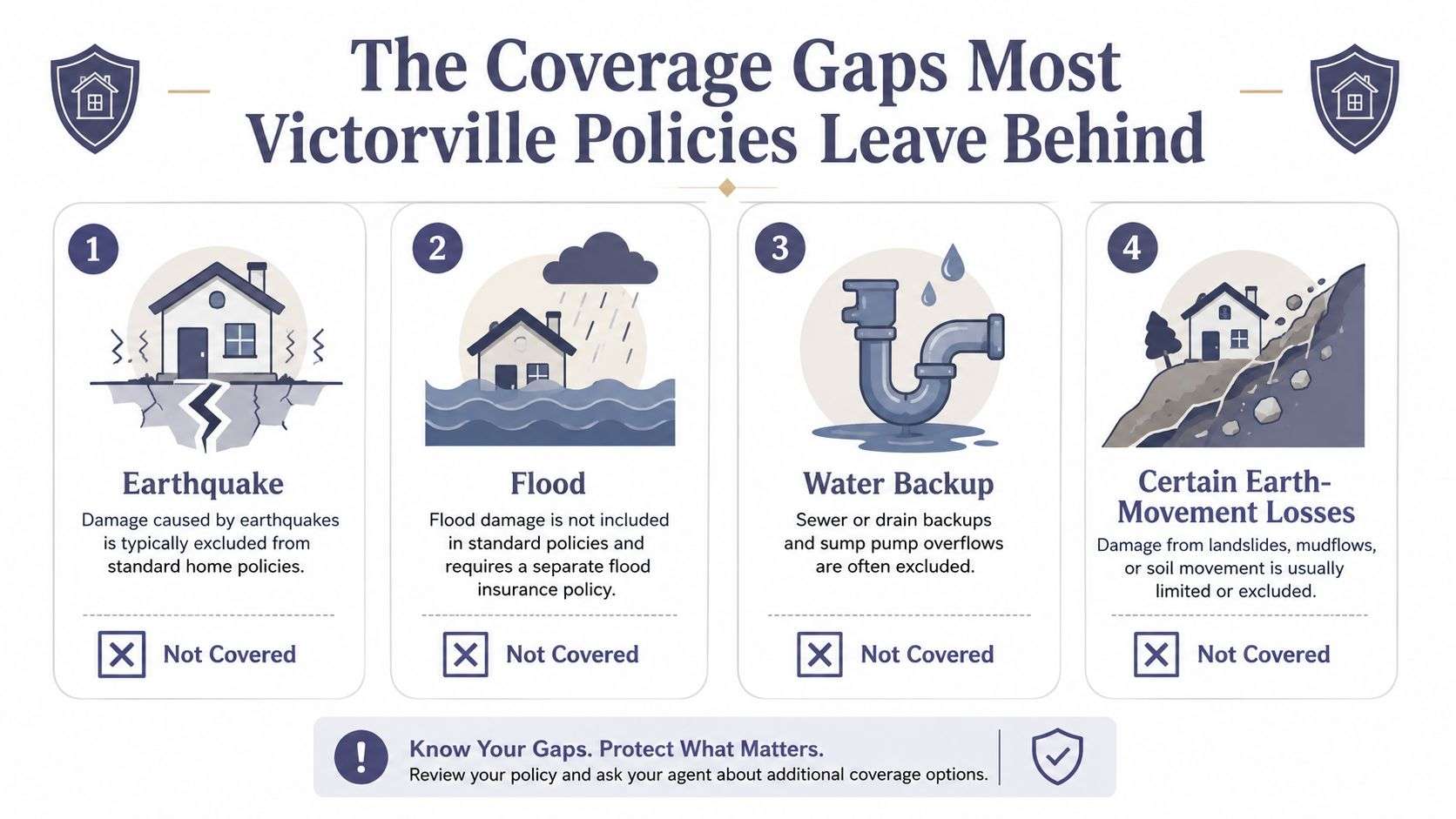
The biggest mistake is assuming a standard homeowners policy covers every major loss that matters in inland Southern California. It doesn't. Earthquake, flood, water-backup, and some earth-movement losses are generally excluded or tightly limited, and that gap gets overlooked too often in High Desert conversations (homeowners insurance in Victorville).
Base policy versus endorsement
A base policy handles many sudden and accidental losses, but it won't automatically fix everything that can damage a house in Victorville. If shaking cracks a foundation, you're into earthquake territory. If water rises from outside the home, that's a flood issue. If a drain backs up and sends water into the house, you may need an endorsement or separate coverage to help pay for the damage.
That's also where homeowners get confused about what “water damage” means. Water from a burst pipe may be handled differently than water from outside the home or from a backed-up line. The distinction matters because the wrong assumption can leave a claim partially uncovered.
What to discuss before you buy
A separate earthquake policy can make sense for some homes, especially when a mortgage, savings cushion, and the home's structure all point in different directions. Flood coverage is separate for a reason, and the same goes for water-backup protection. If a sewer or drain backup would be hard to absorb out of pocket, that endorsement deserves a real conversation.
Equipment breakdown coverage is another item many homeowners overlook because it sounds technical. In plain language, it can help with sudden mechanical or electrical failures in home systems that aren't handled well by the base policy. Victorville homeowners don't need to buy every endorsement blindly, but they do need to know which gaps are still sitting in the policy.
For a deeper look at flood-specific protection, this guide on what flood insurance coverage is is a useful companion piece when you're sorting out what the base policy leaves behind.
How to Compare Victorville Home Insurance Quotes the Right Way
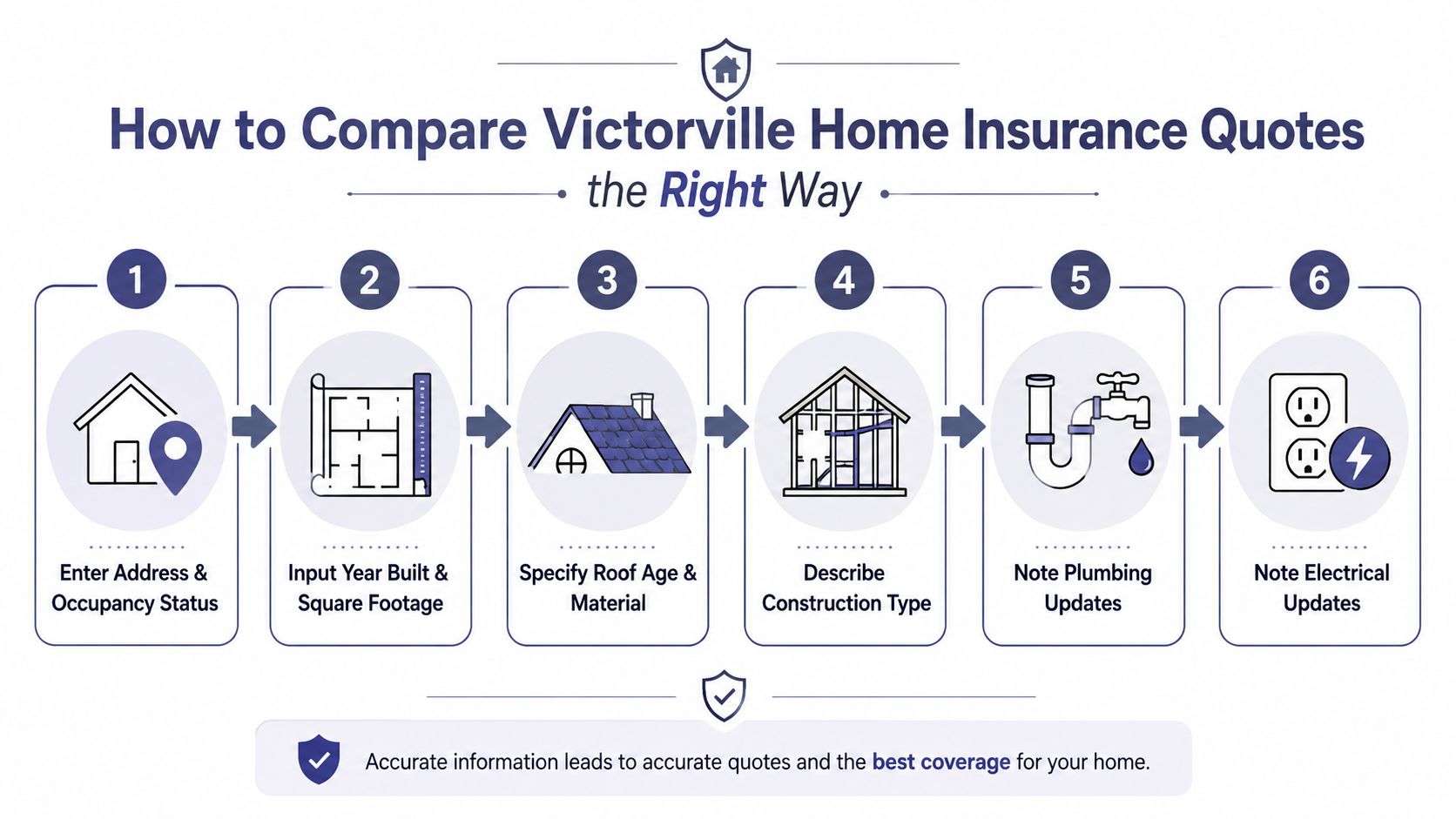
A quote is only useful if the insurer is pricing the same home the same way. That starts with the property facts. ISU Armac's guidance says quote accuracy depends on details such as address and occupancy, year built, square footage, roof age and material, construction type, and updates to plumbing, electrical, HVAC, or windows; insurers may also ask for claims history and documentation like photos or renovation receipts (home owner insurance in Victorville).
The comparison checklist that keeps quotes honest
Start with the parts of the policy that define the protection. Compare dwelling limit, personal property, loss of use, liability, deductible, and the exclusions sitting in the fine print. Two quotes can look close on premium and still be miles apart on what happens after a loss.
Gather your documents once, then use them for every quote request.
- Current policy page or mortgage requirements: Bring the existing limits and any lender conditions so the comparison stays aligned.
- Home facts: Write down the year built, square footage, roof age, roof material, and construction type.
- Update history: Note any plumbing, electrical, HVAC, or window upgrades.
- Claims history: Be ready to explain prior losses clearly and accurately.
- Photos or receipts: Keep renovation records handy if you've made meaningful improvements.
A clean workflow helps the result
One practical way to handle this is to answer the property questions first, then compare the same coverage structure across every quote. If one offer uses a lower dwelling limit or hides a larger deductible behind a lower premium, it isn't a better deal. It's just a different policy.
For homeowners who want a broader set of inputs in one conversation, ISU Insurance Services is one option for a local comparison because it can line up the dwelling limit, personal property, loss of use, liability, and underwriting assumptions in the same review. That makes the quote conversation more accurate and a lot less confusing.
Discounts and Smart Ways to Lower Your Premium
The cheapest premium isn't always the smartest result, but there are still real levers that can help lower the bill. In Victorville, the biggest savings usually come from choices that change risk or change how much the insurer has to assume it may pay after a loss. ISU Armac's first-time-buyer guidance says local pricing may start around $800 per year for basic coverage and rise to $1,500+ per year for broader protection, with the final premium shaped by rebuild cost, coverage limits, deductible, and risk factors such as property condition and exclusions (first-time buyers guidance).

The savings levers worth asking about first
- Bundle where it fits: If a homeowner can place multiple policies together, the quote conversation may open up more favorable pricing than a standalone policy.
- Choose a higher deductible carefully: This often has a direct effect because you're taking on more of the small-loss risk yourself.
- Improve the home's risk profile: Security systems, updated systems, and a solid roof can all help the property look more manageable to underwrite.
- Ask about payment options: Some policies reward paying in full rather than stretching payments over time.
Not every discount applies to every house. Some depend on the home's condition, and some depend on how the insurer underwrites the property. That's why a Victorville homeowner should ask which savings are automatic, which are conditional, and which require documentation.
A broader lesson applies here too. A lower premium that comes with a thinner dwelling limit or a sharper exclusion set may be a poor value if the home suffers a major loss. Use discounts to improve value, not to shrink protection.
For readers who like pairing home planning with buying strategy, this guide to buying smart houses with confidence is a helpful side read on making the house choice and the insurance choice work together.
Frequently Asked Questions About Victorville Home Insurance
Is homeowners insurance required in California
No, California law does not require homeowners insurance, but lenders commonly require it when there's a mortgage involved (California Department of Insurance guide). If you own a home free and clear, the state doesn't force you to buy it, though going without coverage still leaves you exposed to a major loss.
What should I do after I file a claim
Start with photos, videos, and a prompt report to your insurer. Keep every repair receipt and document anything related to temporary living expenses if the home can't be occupied. The sooner the file is organized, the less time you spend reconstructing what happened later.
What if my policy is non-renewed
Don't wait until the last week to react. If a policy is being non-renewed, ask for the reason in writing, then review the home's roof, claims history, and any open underwriting concerns before you submit new applications. In a High Desert market, timing matters because the home's condition and the carrier's risk appetite can change the outcome quickly.
How often should I revisit my coverage limit
Any time the rebuild picture changes, the policy should be checked again. A renovation, a system upgrade, or a meaningful change in replacement cost can leave an old limit behind the actual cost to rebuild. That's one reason Victorville homeowners should review the policy before renewal instead of only after a loss.
Do renters and landlord policies work the same way
No. Renters insurance protects the tenant's belongings and certain liability exposures, while a landlord policy focuses on the building and the owner's interest in it. The structure of the coverage is different even though both use the same basic idea of property, liability, and loss-related protection.
Your Next Step With ISU Insurance Services
Before you call, gather the property details, your current declarations page, any claim history, and your coverage goals. ISU Armac says the most important comparison points are dwelling limit, personal property, loss of use, liability, and the underwriting assumptions tied to age, roof, and construction (home insurance quotes in Victorville).
If you want a local conversation that's built around your actual house, not a generic average, a Victorville independent agency can walk the policy inputs with you and compare options across carriers. You can also start with the local home insurance agent page if you'd rather review the basics first.
If you're ready to compare Victorville home insurance with someone who works through the details instead of guessing at them, visit ISU Insurance Services and gather your home facts before you reach out. A quick local review can help you see whether your current limits, deductibles, and exclusions fit the house you own today.