
Why Every Business Owner Needs a Business Auto Insurance Quote
Getting a business auto insurance quote is the first step to protecting your company vehicles and your financial future. Here’s what you need to know right away:
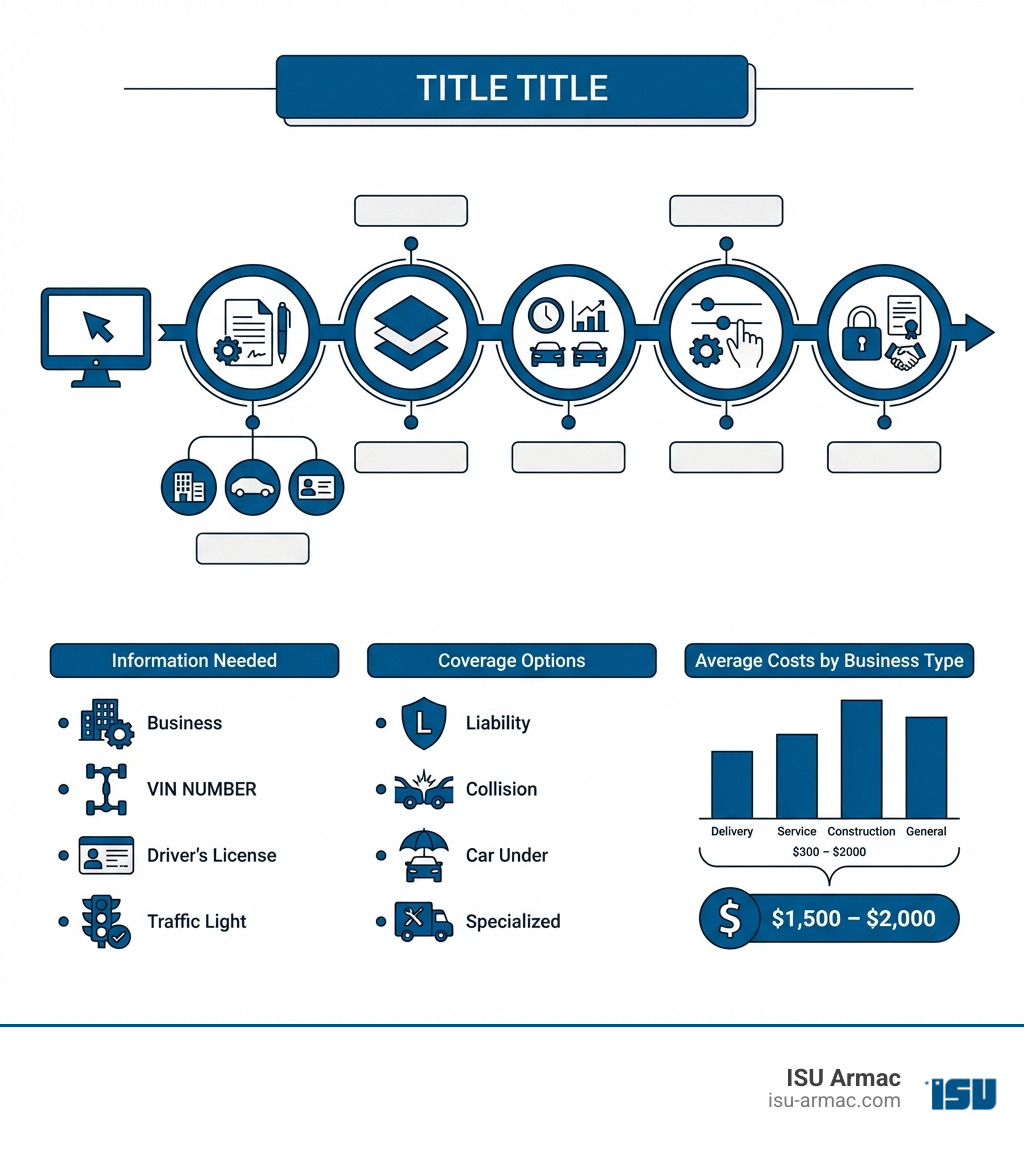
Quick Answer: How to Get a Business Auto Insurance Quote
- Gather your information – Business details, vehicle VINs, driver license numbers, and driving history.
- Choose your coverages – Liability (mandatory), plus optional collision, comprehensive, and specialized coverage.
- Compare quotes online – Get quotes in as little as 8 minutes from multiple carriers.
- Customize your policy – Adjust limits and deductibles to balance protection and cost.
- Secure your rate – Purchase coverage and obtain your Certificate of Insurance.
What You’ll Pay: Commercial auto insurance typically costs $212-$282 per month per vehicle, depending on your business type, vehicles, location, and driving records.
If you use any vehicle for business—a pickup truck hauling equipment, a van making deliveries, or even your personal car for client visits—you need commercial auto insurance. Personal auto policies don’t cover business use, and a single denied claim could cost you thousands out of pocket.
The good news is that getting a business auto insurance quote online is faster and easier than ever. You can compare rates from multiple carriers, customize your coverage, and secure protection for your business vehicles in under 10 minutes.
As Ryan McEachron, CEO of ISU Insurance Services ARMAC Agency in Victorville, I’ve helped hundreds of local business owners steer the complexities of securing the right business auto insurance quote. With over 25 years of experience, I understand the specific challenges facing businesses in the High Desert and Southern California.
The Commercial Auto Insurance Imperative: What It Is and Who Needs It
If your business uses vehicles in Southern California—whether for deliveries in Apple Valley, hauling tools in Victorville, or client meetings in Hesperia—they are vital assets that need protection. Commercial auto insurance is that protection, a crucial safety net against financial loss from accidents, theft, or vandalism.
At its core, commercial auto insurance is designed for vehicles used in business operations. It’s distinct from personal auto insurance because business vehicles face greater risks, often being on the road more frequently and for longer distances. Without it, your business could face devastating out-of-pocket costs for repairs, medical bills, and legal fees. In California, it’s also a legal requirement to carry liability coverage for business vehicles.
Who needs this coverage? If your business owns, leases, or uses vehicles to transport goods, tools, or people, you need a commercial policy. This includes:
- Contractors and Tradespeople: Plumbers, electricians, and landscapers using trucks or vans.
- Delivery Services: Restaurants, florists, or couriers in communities like Oak Hills and Victorville.
- Food Trucks and Mobile Businesses: Any business that operates on wheels.
- Sales and Service Professionals: Real estate agents, IT consultants, or mobile groomers who drive for work.
Coverage extends to a wide range of vehicles, from cars and pickup trucks to dump trucks, delivery vans, and trailers. Essentially, if a vehicle helps generate income, it likely requires commercial auto insurance. You can learn more in our guide to Commercial Vehicle Insurance. For a quick overview, this video explains how it works: Play video explaining commercial auto insurance.
Personal vs. Commercial Auto: Understanding the Key Differences
Many business owners in Victorville and Apple Valley mistakenly believe their personal auto policy covers business use. This is a costly error. Personal and commercial policies are designed for different risks. The most critical distinction is that a personal policy explicitly excludes business-related activities. If you have an accident while working, your claim could be denied, leaving your business liable for all costs.
Commercial policies are built for these higher risks, offering higher liability limits and covering employees. They often cover personal use of a business vehicle, too. Here’s a breakdown of the differences:
| Feature | Personal Auto Insurance | Commercial Auto Insurance |
|---|---|---|
| Primary Use | Personal transport, commuting | Business operations, service calls, transport of goods/people |
| Coverage Limits | Typically lower | Generally much higher to cover business liability |
| Liability | Covers the individual’s responsibility | Covers the business’s legal responsibility, including employees |
| Covered Uses | Excludes driving for profit | Covers business activities and often personal use of the vehicle |
| Cost | Lower premiums | Higher premiums due to increased risk |
| Vehicle Type | Standard cars, SUVs, minivans | Cars, trucks, vans, and specialized vehicles (e.g., dump trucks) |
| Drivers | Named household members | Named employees and other permitted operators |
Given these differences, have the right policy. For more insights, explore our guide on whether you might need both commercial and personal auto insurance.
Decoding Your Policy: Coverages, Claims, and Common Scenarios
IPTC Metadata: Title=”Insurance Policy Coverage Section”, Description=”A close-up of an insurance policy document with a magnifying glass focusing on the coverage section, illustrating the importance of understanding policy details.”
Understanding your business auto insurance quote is vital to safeguarding your business. A robust policy combines mandatory coverages required by law with optional protections custom to your needs. Knowing what does commercial auto insurance cover helps shield you from the financial fallout of an accident.
Mandatory and Optional Coverages You Need to Know
In California, a standard commercial auto policy includes several key coverages:
- Liability Coverage: This is essential. It covers costs if you or an employee are at fault in an accident that causes bodily injury or property damage to others. California mandates minimum liability limits, but we often recommend higher amounts for adequate protection.
- Medical Payments (MedPay): Pays for medical expenses for you and your passengers after an accident, regardless of fault.
- Uninsured/Underinsured Motorist (UM/UIM): Protects you if you’re in an accident with a driver who has insufficient or no insurance.
Beyond these, consider optional coverages for more complete protection:
- Collision Coverage: Pays to repair or replace your vehicle after a collision.
- Comprehensive Coverage: Covers non-collision damage from events like theft, vandalism, fire, or falling objects.
- Hired & Non-Owned Auto Coverage: Extends liability protection when you or your employees use rented vehicles or personal cars for business.
- Inland Marine for Tools and Equipment: Your auto policy covers the vehicle, but not the loose tools inside. If a contractor’s tools are stolen from a truck in Hesperia, this coverage protects that valuable property.
Common Claims and How to File Them
Accidents happen. Knowing the claims process can save time and stress. Common claims include employee at-fault accidents, vehicle theft or vandalism in areas like Victorville, or third-party injuries.
If an incident occurs, follow these steps for a smooth claims process:
- Ensure Safety: Check for injuries and call 911 if needed.
- Gather Information: Collect names, contact info, insurance details, and license plate numbers from all parties. Note any witnesses.
- Document the Scene: Take photos of vehicle damage and the surrounding area.
- Notify Your Insurer: Contact your insurance provider as soon as possible to report the incident.
- Provide Documentation: Be ready to share the police report, photos, and other requested documents to expedite your claim.
Understanding how does commercial auto insurance work during a claim is key. Our team at ISU Armac guides our Southern California clients through every step.
Cracking the Code on Costs and Savings
IPTC Metadata: Title=”Calculating Commercial Auto Insurance Costs”, Description=”A calculator placed beside keys for a commercial truck, symbolizing the process of determining insurance premiums and potential savings for business vehicles.”
The cost of a business auto insurance quote is a primary concern for most business owners, with premiums varying based on risk. Understanding the factors that influence your rate is the first step toward finding affordable, effective coverage.
What Factors Influence Your Commercial Auto Insurance Premiums?
Insurers assess risk to set premiums. Key factors include:
- Vehicle Type and Value: Expensive or specialized vehicles like dump trucks cost more to insure than standard sedans.
- Driving Records: The driving history of all operators is critical. A clean record helps keep costs down, while accidents or violations will increase premiums.
- Business Location: Operating in densely populated or higher-crime areas like parts of Victorville and Apple Valley can lead to higher rates.
- Industry Risk: A construction company faces higher risks and premiums than an office-based business with occasional car use.
- Coverage Limits and Deductibles: Higher coverage limits increase premiums, while higher deductibles can lower them.
- Claims History: A history of frequent or costly claims will result in higher premiums.
For a detailed breakdown, see our guide on the Cost of Commercial Auto Insurance. Local factors also play a role, which you can learn about in our Car Insurance Victorville CA guide.
How Businesses Can Save Money on Insurance
Reducing your premiums is possible without sacrificing coverage. Here are some smart strategies for our Southern California clients:
- Bundle Policies: Combine your commercial auto with general liability or other business policies for a multi-policy discount, often up to 15%.
- Focus on Driver Safety: Implement a driver safety program and hire employees with clean driving records. A good safety record can lead to lower rates at renewal.
- Choose Appropriate Limits and Deductibles: Work with an agent to find the right balance. A higher deductible can lower your premium, but ensure you can afford the out-of-pocket cost.
- Pay Premiums in Full: Paying your annual premium upfront often comes with a discount.
- Choose Vehicles Wisely: Opt for reliable, less expensive vehicles when possible, as they are cheaper to insure. Anti-theft devices can also lead to discounts.
- Use Multi-Vehicle Discounts: Insuring a fleet of vehicles with one carrier can open up discounts of 5% to 15%.
We help clients find out who has the cheapest commercial auto insurance for their needs by comparing options from multiple carriers.
How to Get the Best Business Auto Insurance Quote Online
IPTC Metadata: Title=”Comparing Business Auto Insurance Quotes Online”, Description=”A person uses a laptop to compare business auto insurance quotes, highlighting the convenience and efficiency of online quote tools.”
Getting a business auto insurance quote online is the preferred method for many busy entrepreneurs in Southern California. It’s an efficient and transparent way to find the right coverage.
Information Needed to Get a Business Auto Insurance Quote
To get an accurate quote quickly, gather the following information beforehand:
- Business Information: Legal business name, address (including the primary ZIP code like Victorville 92392 or Apple Valley 92307), FEIN or SSN, industry, and claims history.
- Vehicle Information: For each vehicle, you’ll need the year, make, model, VIN, primary use, estimated annual mileage, and details on any special equipment.
- Driver Information: For all drivers, provide their full name, date of birth, driver’s license number, and driving history for the past 3-5 years.
- Desired Coverage: Have an idea of the liability limits and deductibles you prefer.
Having this information ready will allow you to complete the online process in minutes.
The Benefits of Comparing Your Business Auto Insurance Quote
Comparing multiple business auto insurance quote options is the best way to secure optimal coverage at a competitive price.
- Find the Best Rate: Different carriers price risk differently. Comparing quotes helps you find the lowest premium for the coverage you need.
- Customize Coverage: Seeing a range of options allows you to tailor your policy, adjusting limits and deductibles to fit your budget and risk tolerance.
- Understand Market Prices: Side-by-side quotes give you a clear picture of market rates for your business type in Southern California, empowering you to make an informed choice.
- Convenience and Speed: Online tools allow you to shop for quotes from your office or home in Victorville, often delivering results in minutes.
We believe in empowering our clients with choices. That’s why we encourage you to Get a Quote through our streamlined process, where we help you compare options from various carriers to find the perfect fit.
Frequently Asked Questions about Commercial Auto Insurance
We hear a lot of questions from business owners in Southern California about commercial auto insurance. Here are some of the most common ones we encounter:
Does commercial auto insurance cover personal use of a business vehicle?
Yes, this is one of the key distinctions and benefits of a commercial auto policy. Unlike a personal auto policy which explicitly excludes business use, a commercial policy typically covers the vehicle for both business and personal use. So, if you use your work van for weekend errands or to take the kids to soccer practice, you’re generally still covered. This flexibility is a significant advantage for many small business owners who rely on a single vehicle for both work and personal life.
What happens if I use my personal car for business without the right insurance?
This is a critical point that many business owners overlook, often assuming their personal policy will suffice. If you use your personal vehicle for business purposes—such as making deliveries, transporting tools, or regularly visiting clients—without the appropriate commercial coverage or endorsement, you’re taking a significant risk. If you get into an accident during business use, your personal insurer could deny the claim entirely. This would leave you personally responsible for all damages, medical expenses, and legal fees. Furthermore, your personal policy could even be canceled, potentially making it harder and more expensive to get insurance in the future. It’s simply not worth the gamble; always ensure your vehicle’s use aligns with your insurance policy.
Are my tools and equipment covered by commercial auto insurance?
This is a common question, especially for contractors, landscapers, and mobile service providers in places like Hesperia and Oak Hills. The short answer is: it depends. Your commercial auto insurance policy will cover the vehicle itself and any permanently attached equipment, such as a ladder rack, a built-in toolbox, or a snowplow. However, loose tools, equipment, inventory, or products being transported within the vehicle are generally not covered by the auto policy. For these valuable items, you’ll need a separate type of coverage, often called inland marine insurance or tools and equipment coverage, which can typically be added to your general liability policy. This ensures that if your tools are stolen from your truck or damaged in transit, you’re financially protected.
Conclusion: Drive Your Business Forward with the Right Protection
Navigating business auto insurance quote might seem complex, but it’s a straightforward process that offers invaluable peace of mind. We’ve covered what commercial auto insurance is, why it’s essential, how it differs from personal policies, and the key factors that influence your premiums.
Protecting your business vehicles is about safeguarding your financial stability. A single denied claim due to inadequate coverage could be devastating for a small business.
The power to find the best coverage at the most competitive rates is at your fingertips. By understanding what’s needed for a quote and comparing your options, you can make an informed decision that serves your business.
At ISU Armac, we are your partners in protection, deeply rooted in the Southern California communities of Victorville, Apple Valley, Hesperia, and Oak Hills. Our unique selling proposition is our ability to shop multiple carriers, ensuring we find the best coverage at the lowest rates for your specific needs. We tailor solutions to protect what you’ve worked so hard to build.
Don’t leave your business vulnerable. Take the next step to secure your assets and ensure your wheels of fortune keep turning.
Get your comprehensive commercial insurance quote today
Top 5 Tips for Saving on Your Business Auto Insurance Quote
- Bundle Your Policies: Combine auto with general liability for a multi-policy discount.
- Prioritize Driver Safety: Maintain clean driving records and implement a safety program.
- Optimize Your Deductible: Choose a higher deductible to lower your premium, ensuring you can cover the cost.
- Insure Your Whole Fleet: Get a multi-vehicle discount by insuring all your business vehicles with one carrier.
- Pay Your Premium Annually: Paying in full upfront can often earn you a discount.