
Why Understanding Commercial General Liability Coverage Exclusions Can Save Your Business
Commercial general liability coverage exclusions are specific situations and risks your CGL policy will not cover. While a CGL policy offers broad protection against third-party claims for bodily injury and property damage, its limitations can leave your business exposed if you don’t understand them.
According to industry data, 90% of small business owners aren’t confident they’re adequately insured. This gap often stems from misunderstanding what their CGL policy actually covers versus what it excludes. These exclusions exist to prevent the policy from acting as a warranty and to carve out risks that require specialized insurance, such as professional services or pollution.
As Ryan McEachron, CEO of ISU Insurance Services ARMAC Agency in Victorville, I’ve seen how devastating an unexpected claim denial can be. My work with the local business community has shown me that understanding commercial general liability coverage exclusions is critical to avoiding costly coverage gaps.
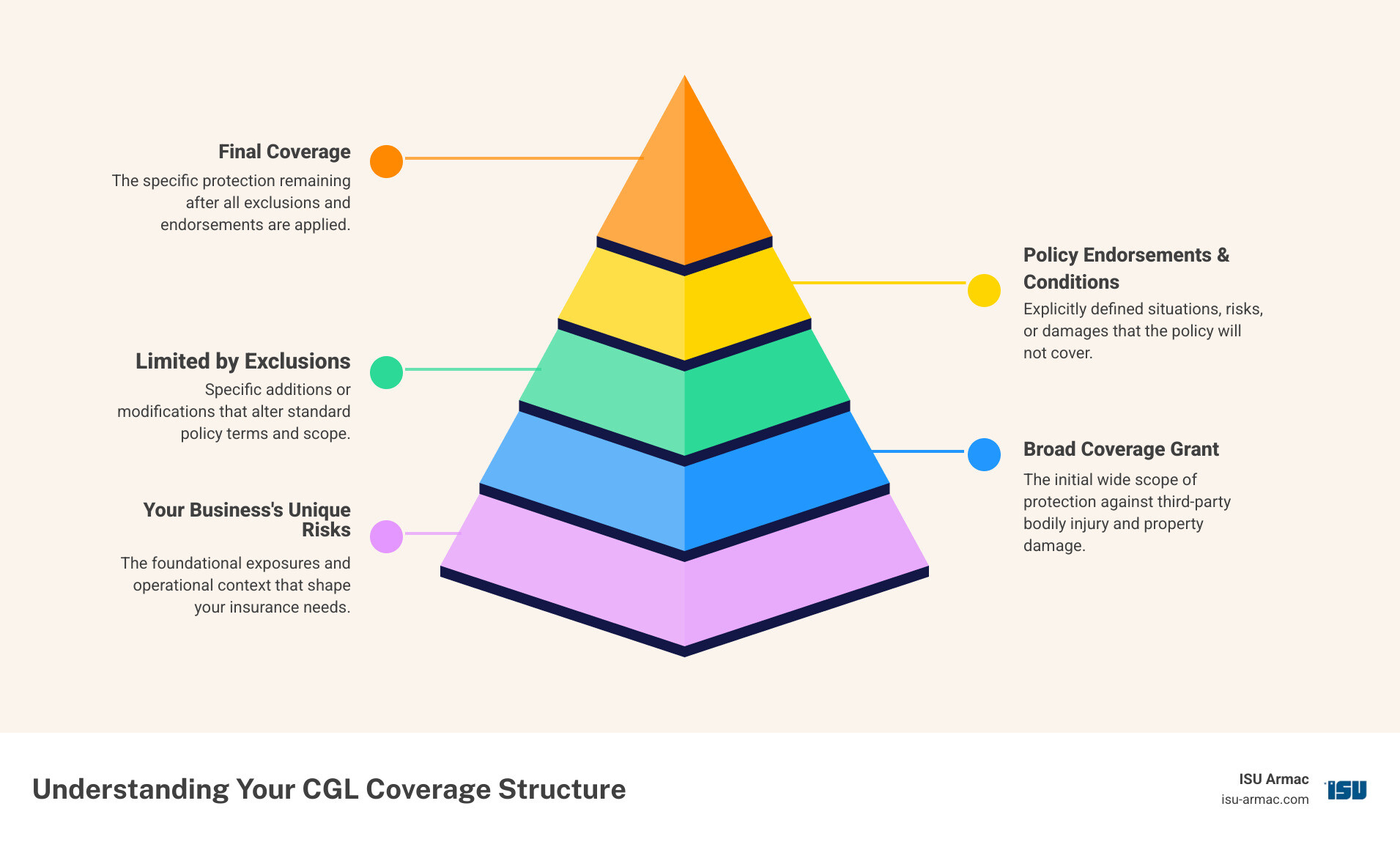
Key concepts within CGL include premises and operations liability, completed operations liability, and personal injury advertising injury.
Understanding the Foundation: What is CGL and Why Do Exclusions Exist?
A Commercial General Liability (CGL) policy is a cornerstone of business insurance, protecting you from the financial fallout of third-party claims. These are claims from outside parties (customers, vendors, etc.) alleging bodily injury, property damage, or personal and advertising injury related to your business. A CGL policy helps cover the high costs associated with legal defense, settlements, and judgments.
If CGL is so broad, why do exclusions exist? They aren’t meant to be deceptive. Exclusions serve to:
- Define the policy’s scope: They carve out risks that require specialized insurance (like professional services or cyber liability).
- Prevent misuse: A CGL policy is not a warranty for your work or a performance bond.
- Exclude uninsurable risks: Catastrophic or intentional acts are typically not covered.
- Manage moral hazard: Insurance shouldn’t reward deliberate harm.
Understanding these reasons clarifies that CGL policies are designed for a specific set of accidental risks.
What a CGL Policy Typically Covers
A standard CGL policy provides several key protections:
- Bodily Injury: Covers physical harm to a third party, like a customer slipping and falling in your Victorville store.
- Property Damage: Covers damage to a third party’s tangible property, such as your employee accidentally damaging a client’s fence in Oak Hills.
- Personal and Advertising Injury: Protects against non-physical injuries like libel, slander, or copyright infringement in your marketing.
- Premises and Operations: Covers injuries or damage occurring on your premises or from your ongoing operations.
- Products-Completed Operations Hazard: Protects against injury or damage that occurs after your product is sold or your work is finished.
For more details, explore our guide on General Liability Insurance Coverage.
Why It’s Crucial for Businesses to Understand Exclusions
Ignoring commercial general liability coverage exclusions is a major risk. For businesses in Apple Valley, Hesperia, and across Southern California, understanding these limits is vital to:
- Avoid Coverage Gaps: Knowing what isn’t covered allows you to find other solutions, like endorsements or specialized policies.
- Prevent Financial Loss: An unexpected claim denial can be devastating, forcing you to pay legal costs and settlements out-of-pocket.
- Make Informed Decisions: Understanding exclusions helps you ask the right questions and tailor your insurance portfolio to your actual risks.
Misunderstanding your policy can lead to some of the 9 Big Risks of Going Without Commercial Liability Insurance. Our goal is to empower you with this knowledge.
A Deep Dive into Common Commercial General liability Coverage Exclusions

Let’s examine some of the most common commercial general liability coverage exclusions to clarify the boundaries of your CGL protection. For a general overview, you can also review our page on General liability insurance exclusions.
Expected or Intended Injury and Contractual Liability
- Expected or Intended Injury: A CGL policy won’t cover bodily injury or property damage that is “expected or intended” by the insured. Insurance is for accidents, not deliberate harm. An exception may apply for the use of “reasonable force to protect persons or property.”
- Contractual Liability: Your policy generally won’t cover liability you voluntarily assume in a contract. However, an important exception exists for liability assumed in “insured contracts,” which can include lease agreements, elevator maintenance agreements, and certain indemnification agreements. It’s vital to review contracts with your broker. Learn more about Business Liability Insurance.
The Pollution Exclusion: A Significant Limitation
The “absolute pollution exclusion” is one of the most significant commercial general liability coverage exclusions. It removes coverage for bodily injury or property damage arising from the discharge or release of “pollutants.” This term is defined broadly to include nearly any irritant or contaminant. For businesses in Southern California involved in construction, manufacturing, or auto services, this means a standard CGL policy will not cover cleanup costs or liability claims from a pollution event. This is a prime example of a risk requiring specialized coverage, as detailed in our guide on what is not covered under commercial liability insurance?.
Professional Services and Your Work: Key Exclusions

- Professional Services: A CGL policy excludes claims arising from providing or failing to provide professional services. This applies to any business offering specialized advice or skills, such as consultants, architects, or IT professionals. These risks are covered by Professional Liability insurance, also known as Errors and Omissions Insurance.
- Damage to Your Product or Work: Your CGL policy will not pay to repair or replace your own faulty product or defective work. It is designed to cover the damage your work causes to other property, not to act as a warranty for your own work. For general contractors, a “subcontractor exception” may restore some coverage for work done by a sub.
Exclusions for Aircraft, Auto, and Watercraft
A CGL policy excludes liability arising from the ownership, maintenance, or use of aircraft, autos, and most watercraft. These risks require their own separate policies, such as Commercial Auto Insurance for company vehicles in Apple Valley or a specialized aircraft liability policy. While “mobile equipment” (like a forklift) may have some coverage, the rules are complex and should be reviewed with your broker.
Property-Related Exclusions
- Damage to Your Property: CGL covers third-party property damage, not damage to property you own, rent, or occupy. That’s the job of a Commercial Property Insurance policy.
- Care, Custody, or Control: This common exclusion removes coverage for damage to personal property that is in your possession. If you are an auto mechanic in Hesperia and damage a customer’s car, your CGL policy won’t cover the damage to the car itself. This risk often requires a specialized policy like Bailee’s coverage. You can learn more from this external resource on The “Care, Custody and Control” CGL Exclusion.
- Impaired Property: This complex exclusion applies when your faulty product or work renders another party’s property unusable without physically damaging it. The CGL policy won’t cover this loss of use if the issue can be fixed by repairing or replacing your product/work.
Bridging the Gaps: How to Cover What Your CGL Policy Excludes
Understanding commercial general liability coverage exclusions allows you to identify vulnerabilities and secure the right protection. For most excluded risks, specific insurance solutions are available. Gaps can be bridged through policy endorsements (riders) or, more commonly, by purchasing separate, standalone policies. Exploring your Commercial Insurance options is the best way to build a comprehensive protection plan.
CGL vs. Other Essential Business Insurance Policies
A CGL policy is broad, but it’s not a one-size-fits-all solution. Common exclusions point to the need for other specialized policies. Here’s a quick comparison:
| Policy Type | What it Covers | What it Excludes (that CGL also excludes) |
|---|---|---|
| Commercial General Liability (CGL) | Third-party bodily injury, property damage, personal & advertising injury. | Employee injuries, professional errors, cyberattacks, auto accidents. |
| Workers’ Compensation | Employee medical expenses and lost wages for work-related injuries. | Third-party injuries, damage to others’ property. |
| Professional Liability (E&O) | Claims from professional errors, omissions, or negligence. | Bodily injury/property damage (unless from a professional error). |
| Cyber Liability | Data breaches, cyberattacks, and resulting business interruption. | Physical bodily injury or property damage. |
| Commercial Auto | Bodily injury and property damage caused by business vehicles. | Non-vehicle accidents, professional errors. |
| Commercial Property | Damage to your business’s physical assets (building, equipment). | Third-party liabilities, professional errors. |
How to Obtain Coverage for Excluded Risks
To protect your Southern California business, you must proactively address CGL exclusions. Here are the policies that cover common gaps:
- Pollution Liability: Covers cleanup costs and claims from pollution incidents.
- Cyber Liability: Covers costs related to data breaches and cyberattacks.
- Professional Liability (E&O): Protects against claims of negligence for service-based businesses in Oak Hills and beyond.
- Employment Practices Liability (EPLI): Covers claims of discrimination, wrongful termination, and harassment.
- Commercial Auto: Covers liability from accidents involving business vehicles.
- Commercial Property: Protects your own buildings, equipment, and inventory.
Understanding the Insurance Needed for Small Business is a dynamic process that evolves with your company.
Making Your Policy Work for You: Limits, Brokers, and Best Practices
Understanding your policy’s structure is key to managing risk. This includes limits, deductibles, and the role of your broker.
How Limits, Deductibles, and Exclusions Interact
Your CGL policy has financial caps, including a Per Occurrence Limit (max payout for one incident) and a General Aggregate Limit (total max payout for the policy period). You also have a deductible, which is the amount you pay out-of-pocket on a covered claim before insurance pays.
The most important rule is that exclusions come first. If a claim falls under a commercial general liability coverage exclusion, your policy limits and deductible are irrelevant. There is no coverage, and you are responsible for the entire loss. For example, if a pollution claim is excluded, your $1 million policy limit provides no protection. This is why understanding exclusions is more critical than just knowing your limits. For more on the financial aspects, visit our page on Commercial General Liability Insurance Cost.
A key benefit of a CGL policy is the insurer’s “duty to defend,” where they provide legal defense for a covered claim, often paying costs in addition to your policy limits. In the event of a claim, you must notify your insurer promptly and cooperate with their investigation.
The Role of an Insurance Broker
Navigating CGL exclusions is complex. An experienced broker at ISU Armac is your advocate. We help by:
- Identifying Gaps: We analyze your business operations in Victorville or Apple Valley to find where exclusions leave you vulnerable.
- Accessing Carriers: We shop multiple insurers to find the best coverage and most favorable terms for your specific needs.
- Explaining Policy Language: We translate insurance jargon so you understand what is and isn’t covered.
- Advocating During Claims: We assist you through the claims process to ensure fair handling.
Our goal is to empower you with knowledge. Check out our 10 Tips for Small Businesses Looking for Commercial Liability Insurance to get started.
Frequently Asked Questions about CGL Exclusions
Here are answers to common questions we hear from Southern California business owners about commercial general liability coverage exclusions.
Does a CGL policy cover injuries to my own employees?
No. A CGL policy explicitly excludes injuries to your employees that happen on the job. This risk is covered by a separate, mandatory Workers’ Compensation policy, which provides medical benefits and wage replacement for injured employees. CGL only covers third-party injuries.
My product was faulty and I had to recall it. Is the cost of the recall covered?
No. CGL policies contain a “Recall of Products, Work or Impaired Property” exclusion. This means the policy will not cover costs associated with recalling, inspecting, or replacing your own defective product. These are considered business risks, not third-party liability.
Are “Acts of God” like floods or earthquakes excluded from CGL?
Yes, CGL policies exclude catastrophic events like floods, earthquakes, and wars. Damage from these events requires separate policies (e.g., Flood or Earthquake Insurance). However, if your negligence during such an event leads to a third-party injury (for example, a customer is injured due to your poorly maintained property during a storm), the liability portion of the claim might still be covered by your CGL policy.
Secure Your Business by Understanding Your Coverage
Navigating commercial general liability coverage exclusions is essential for any responsible business owner in Southern California. We’ve seen that exclusions for risks like pollution, professional services, and employee injuries are not minor details—they are critical boundaries that define your financial protection.
The key takeaway is that your CGL policy is a powerful shield, but it has gaps. Understanding these exclusions allows you to identify vulnerabilities and make informed decisions about the specialized insurance needed to fill them.
At ISU Armac, we help businesses in Apple Valley, Victorville, and Hesperia decipher the fine print and build a comprehensive insurance program. Don’t let an exclusion leave your business exposed.
Reach out to us today to review your policies and discuss your unique risks. Get a Commercial General Liability Insurance quote custom to your business needs.